The Draughtsman’s Contract — Peter Greenaway

The Resurrectionist (Book Acquired, 6.04.2013)

20130607-155808.jpg

20130607-155816.jpg

Matthew Guinn’s The Resurrectionist showed up in the mail a few days ago. Haven’t really had time to get into it, but the premise seems promising, and Guinn’s Southern lit bona fides also intrigue me.

Publisher W.W. Norton’s blurb:

A young doctor wrestles with the legacy of a slave “resurrectionist” owned by his South Carolina medical school.

“Dog days and the fresh bodies are arriving once again.” So begins the fall term at South Carolina Medical College, where Dr. Jacob Thacker is on probation for Xanax abuse. His interim career—working public relations for the dean—takes an unnerving detour into the past when the bones of African American slaves, over a century old, are unearthed on campus. Out of the college’s dark past, these bones threaten to rise and condemn the present.

In the middle of the nineteenth century, Dr. Frederick Augustus Johnston, one of the school’s founders, had purchased a slave for his unusual knife skills. This slave, Nemo (“no man”) would become an unacknowledged member of the surgical faculty by day—and by night, a “resurrectionist,” responsible for procuring bodies for medical study. An unforgettable character, by turns apparently insouciant, tormented, and brilliant, and seen by some as almost supernatural, Nemo will seize his self-respect in ways no reader can anticipate.

With exceptional storytelling pacing and skill, Matthew Guinn weaves together past and present to relate a Southern Gothic tale of shocking crimes and exquisite revenge, a riveting and satisfying moral parable of the South.


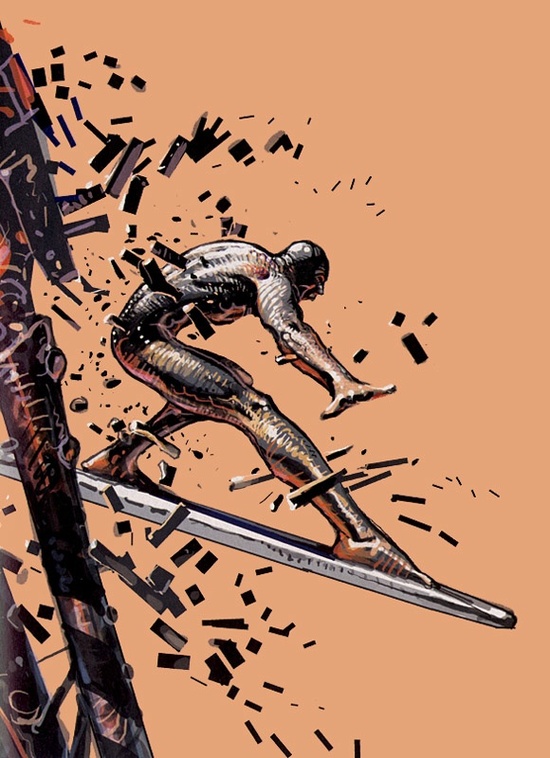
Silver Surfer — Moebius

surfer

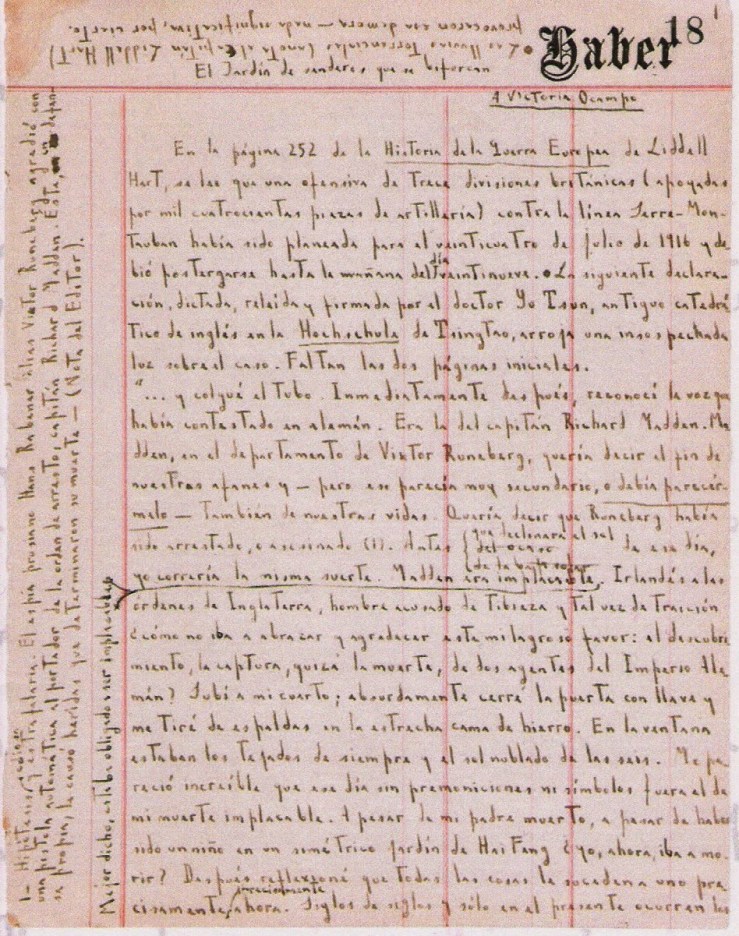
Handwritten Manuscript Page for Jorge Luis Borges’s “The Garden of Forking Paths”

borges manuscript

(Via).

List with No Name #29

  1. V., mostly on a beach in Ko Lanta.
  2. The Road, in the maternity ward after my daughter was born.
  3. Infinite Jest, late at night after I first moved to Tokyo. And then lugging it onto the train.
  4. Un Bel Morir, in the emergency room all night, my mother’s fever so high.
  5. As I Lay Dying, another hospital.
  6. 2666. On a plane leaving San Francisco. And then compulsively every night for a month.
  7. Angels, on a Florida beach.
  8. Cat’s Cradle, on a houseboat, on a river.
  9. The Once and Future King, in the back of a rented car that was zooming across the South Island of NZ, my parents repeatedly imploring me to just look up please.
  10.  Ulysses, on the old gold velour couch I sometimes still miss, on my roommate’s Ritalin, comprehending next to nothing. And then a decade later, with real joy.

Read an Excerpt from Adam Novy’s Work in Progress, The Gore and the Splatter

Hobart has published an excerpt of Adam Novy’s work in progress, The Gore and Splatter. I was a big fan of Adam’s last novel, The Avian Gospels, a dystopian take on terror and gypsies and birds. When I interviewed Adam a few years ago, he told me he was “writing a novel about the life and times of Medusa. It’s called The Gore and the Splatter. Ryan Chang got a bit more info about the novel in his interview with Adam, posted yesterday at Electric Literature:

I’m working on a novel about Perseus and Medusa before they get discovered. The early days of Perseus and Medusa. It takes place partially in mythic Greece and partially the suburb I grew up in. The characters are in the middle of mythic history. One thing about mythology I’ve always been really interested is what the characters know about their place and time in history. There’s this idea that the world is new and folks are creating meaning as they go along. Do they know they’re creating meaning? And what would it be like to be a teenager under those circumstances? Or a parent raising those teenagers, what would it be like?

I’m looking forward to this one. Until then we have the excerpt. Here is an excerpt of the excerpt:

Pentheus’s bedroom: hardly large enough to fit his mattress, a modest trunk of clothes, a wooden torso on a stick that wore his armor while he slept, and an altar to Athena. The floorplanks creaked, the roof leaked water, porous walls keened in wind. He’d let his mother and his nephews have the bedrooms with the windows. The den was also small, and too close to the kitchen for these rooms to be considered separate entities, and this house, such as it was, sat unevenly on pylons of old concrete, for the ground was a decline of dirt and sand on a rambling scrappy hillside, where any rugged vegetables that flourished in the desperate little gardens were scavengered immediately by rabbits.

The bungalow wasn’t quite dysfunctional, merely ugly, small, grotty, and way beyond the prospect of improvement. Still, the sneaky sisters Casey and Arden enjoyed their lives in an unfairly lavish home, and the house where the miraculous atrocity had happened, with the river and the tree, was nigh short of a mansion, if an ugly, nouveau, tasteless one. Perhaps whoever’d lived there had been killed for being vulgar. Pentheus had been working in a lumber yard adjacent to The Turnbull Farm—a huge, efficient version of the farm where Casey and Arden lived—when Mister Reddy heard that he was tall and took him on as his assistant. Your feet are very big, he’d said, you’ll leave a large carbon footprint. Pentheus thought he’d caught his golden opportunity, but all he got to do was walk beside the boss in heavy armor, sweat until he felt that he would rot, follow incoherent orders and let teenage girls humiliate him. And the pay was just as crappy as the lumber yard. Agave, his own mother, was a maid for Mister Turnbull. She was sixty-eight years old, but still she cooked, scrubbed the floor, washed stains from the clothes of messy children whose privilege didn’t exactly translate into manners. Pentheus and Agave paid their rent to Mister Reddy, who was Mister Turnbull’s partner, though Mister Reddy and Mister Turnbull also paid their salaries. Pentheus and his mother were little more than conduits for money as it looped its way inexorably back to whence it came. Jayden, Pentheus’s nephew, had said they were a kind of large intestine, where food was turned to shit and got excreted without their being able to enjoy it. Pentheus sometimes wished the boy was less articulate.

Birthday — Dorothea Tanning

10-Birthday_4

“The Seven Vagabonds” — Nathaniel Hawthorne

“The Seven Vagabonds” — Nathaniel Hawthorne

Rambling on foot in the spring of my life and the summer of the year, I came one afternoon to a point which gave me the choice of three directions. Straight before me the main road extended its dusty length to Boston; on the left a branch went toward the sea, and would have lengthened my journey a trifle of twenty or thirty miles, while by the right-hand path I might have gone over hills and lakes to Canada, visiting in my way the celebrated town of Stamford. On a level spot of grass at the foot of the guide-post appeared an object which, though locomotive on a different principle, reminded me of Gulliver’s portable mansion among the Brobdignags. It was a huge covered wagon—or, more properly, a small house on wheels—with a door on one side and a window shaded by green blinds on the other. Two horses munching provender out of the baskets which muzzled them were fastened near the vehicle. A delectable sound of music proceeded from the interior, and I immediately conjectured that this was some itinerant show halting at the confluence of the roads to intercept such idle travellers as myself. A shower had long been climbing up the western sky, and now hung so blackly over my onward path that it was a point of wisdom to seek shelter here.

“Halloo! Who stands guard here? Is the doorkeeper asleep?” cried I, approaching a ladder of two or three steps which was let down from the wagon.

The music ceased at my summons, and there appeared at the door, not the sort of figure that I had mentally assigned to the wandering showman, but a most respectable old personage whom I was sorry to have addressed in so free a style. He wore a snuff-colored coat and small-clothes, with white top-boots, and exhibited the mild dignity of aspect and manner which may often be noticed in aged schoolmasters, and sometimes in deacons, selectmen or other potentates of that kind. A small piece of silver was my passport within his premises, where I found only one other person, hereafter to be described.

“This is a dull day for business,” said the old gentleman as he ushered me in; “but I merely tarry here to refresh the cattle, being bound for the camp-meeting at Stamford.” Continue reading ““The Seven Vagabonds” — Nathaniel Hawthorne”

Hotel Room — Edward Hopper