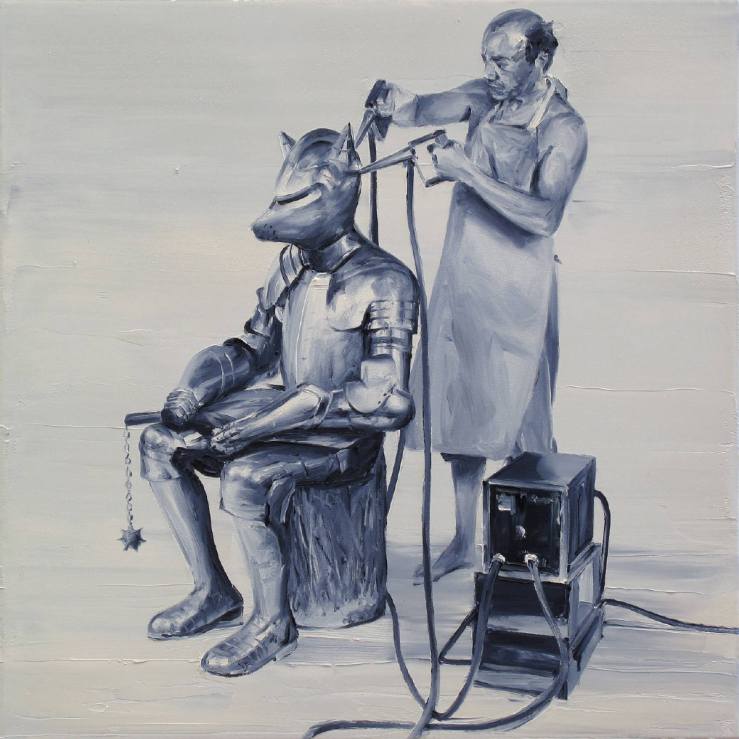
Franken — Paco Pomet

Paco_Pomet_Franken_2011_1939_412

(More/via)

List with No Name #27

  1. Mulholland Dr.
  2. Blue Velvet
  3. Inland Empire 
  4. Eraserhead
  5. The Elephant Man
  6. The Straight Story 
  7. Dune
  8. Twin Peaks: Fire Walk with Me 
  9. Wild at Heart
  10. Lost Highway 
 

See Record Player, A Documentary About Christian Marclay


Oven — Corneliu Baba

“Fenimore Cooper’s Literary Offenses” — Mark Twain

“Fenimore Cooper’s Literary Offenses” by Mark Twain


“The Pathfinder” and “The Deerslayer” stand at the head of Cooper’s novels as artistic creations. There are others of his works which contain parts as perfect as are to be found in these, and scenes even more thrilling. Not one can be compared with either of them as a finished whole. The defects in both of these tales are comparatively slight. They were pure works of art. 
–Professor Lounsbury


The five tales reveal an extraordinary fullness of invention. … One of the very greatest characters in fiction, Natty Bumppo… The craft of the woodsman, the tricks of the trapper, all the delicate art of the forest were familiar to Cooper from his youth up.
–Professor Matthews


Cooper is the greatest artist in the domain of romantic fiction in America.
–Wilkie Collins


It seems to me that it was far from right for the Professor of English Literature at Yale, the Professor of English Literature in Columbia, and Wilkie Collins to deliver opinions on Cooper’s literature without having read some of it. It would have been much more decorous to keep silent and let persons talk who have read Cooper.

Cooper’s art has some defects. In one place in “Deerslayer,” and in the restricted space of two-thirds of a page, Cooper has scored 114 offenses against literary art out of a possible 115. It breaks the record.

There are nineteen rules governing literary art in domain of romantic fiction — some say twenty-two. In “Deerslayer,” Cooper violated eighteen of them. These eighteen require:

1. That a tale shall accomplish something and arrive somewhere. But the “Deerslayer” tale accomplishes nothing and arrives in air.

2. They require that the episodes in a tale shall be necessary parts of the tale, and shall help to develop it. But as the “Deerslayer” tale is not a tale, and accomplishes nothing and arrives nowhere, the episodes have no rightful place in the work, since there was nothing for them to develop.

3. They require that the personages in a tale shall be alive, except in the case of corpses, and that always the reader shall be able to tell the corpses from the others. But this detail has often been overlooked in the “Deerslayer” tale.

4. They require that the personages in a tale, both dead and alive, shall exhibit a sufficient excuse for being there. But this detail also has been overlooked in the “Deerslayer” tale.

5. The require that when the personages of a tale deal in conversation, the talk shall sound like human talk, and be talk such as human beings would be likely to talk in the given circumstances, and have a discoverable meaning, also a discoverable purpose, and a show of relevancy, and remain in the neighborhood of the subject at hand, and be interesting to the reader, and help out the tale, and stop when the people cannot think of anything more to say. But this requirement has been ignored from the beginning of the “Deerslayer” tale to the end of it.

6. They require that when the author describes the character of a personage in the tale, the conduct and conversation of that personage shall justify said description. But this law gets little or no attention in the “Deerslayer” tale, as Natty Bumppo’s case will amply prove.

7. They require that when a personage talks like an illustrated, gilt-edged, tree-calf, hand-tooled, seven- dollar Friendship’s Offering in the beginning of a paragraph, he shall not talk like a negro minstrel in the end of it. But this rule is flung down and danced upon in the “Deerslayer” tale.

8. They require that crass stupidities shall not be played upon the reader as “the craft of the woodsman, the delicate art of the forest,” by either the author or the people in the tale. But this rule is persistently violated in the “Deerslayer” tale.

9. They require that the personages of a tale shall confine themselves to possibilities and let miracles alone; or, if they venture a miracle, the author must so plausibly set it forth as to make it look possible and reasonable. But these rules are not respected in the “Deerslayer” tale.

10. They require that the author shall make the reader feel a deep interest in the personages of his tale and in their fate; and that he shall make the reader love the good people in the tale and hate the bad ones. But the reader of the “Deerslayer” tale dislikes the good people in it, is indifferent to the others, and wishes they would all get drowned together.

11. They require that the characters in a tale shall be so clearly defined that the reader can tell beforehand what each will do in a given emergency. But in the “Deerslayer” tale, this rule is vacated.

In addition to these large rules, there are some little ones. These require that the author shall:

12. Say what he is proposing to say, not merely come near it.

13. Use the right word, not its second cousin.

14. Eschew surplusage.

15. Not omit necessary details.

16. Avoid slovenliness of form.

17. Use good grammar.

18. Employ a simple and straightforward style.

Even these seven are coldly and persistently violated in the “Deerslayer” tale.

Cooper’s gift in the way of invention was not a rich endowment; but such as it was he liked to work it, he was pleased with the effects, and indeed he did some quite sweet things with it. In his little box of stage-properties he kept six or eight cunning devices, tricks, artifices for his savages and woodsmen to deceive and circumvent each other with, and he was never so happy as when he was working these innocent things and seeing them go. A favorite one was to make a moccasined person tread in the tracks of a moccasined enemy, and thus hide his own trail. Cooper wore out barrels and barrels of moccasins in working that trick. Another stage-property that he pulled out of his box pretty frequently was the broken twig. He prized his broken twig above all the rest of his effects, and worked it the hardest. It is a restful chapter in any book of his when somebody doesn’t step on a dry twig and alarm all the reds and whites for two hundred yards around. Every time a Cooper person is in peril, and absolute silence is worth four dollars a minute, he is sure to step on a dry twig. There may be a hundred other handier things to step on, but that wouldn’t satisfy Cooper. Cooper requires him to turn out and find a dry twig; and if he can’t do it, go and borrow one. In fact, the Leatherstocking Series ought to have been called the Broken Twig Series. Continue reading ““Fenimore Cooper’s Literary Offenses” — Mark Twain”

Married Life — Roger de La Fresnaye

Animal Disputans (Sigizmund Krzhizhanovsky)

From Sigizmund Krzhizhanovsky’s short story “The Bookmark”:

‘I remember I tossed all night, my elbows bumping against the hard theme that layers our entire life. My pen, as soon as I dipped it in ink, wrote Animal Disputans. That was the title. Next came…Perhaps this doesn’t interest you?’

‘Please go on.’

‘I took the title and the first verses of my song, if you will, from an old and long-forgotten book by the Danish humorist Holberg. This book—Nicolai Klimmi Her subterraneum, I believe it’s called—describes the fantastic adventures of a traveler who winds up, I can’t remember how, inside the Earth. The traveler is astonished to find that inside the planet, as inside a hermetically sealed vessel, lives a race with its own hermetically sealed State system, way of life, culture, everything that is customary in such cases. Over time the life of these undergroundlings—once rife with wars and conflict, cut off, hidden away beneath miles of crust—sorted itself out and settled into a harmonious routine. The problems of the hermetically sealed were all solved, everything ironed out and agreed upon. But in memory of those long-ago wars, Nicolai Klimmi tells us—no, please listen, it’s rather touching—the land’s noblest and richest magnates raised animal disputans. There isn’t anything to argue about in an isolated country where everything has been determined and predetermined in saecula saculorum but these disputants were trained for the purpose, fed a special diet that irritated the liver and sublingual nerve, then pitted against one another and forced to argue till they were hoarse and foaming at the mouth—to unanimous laughter and merry halloos from the lovers of old traditions…

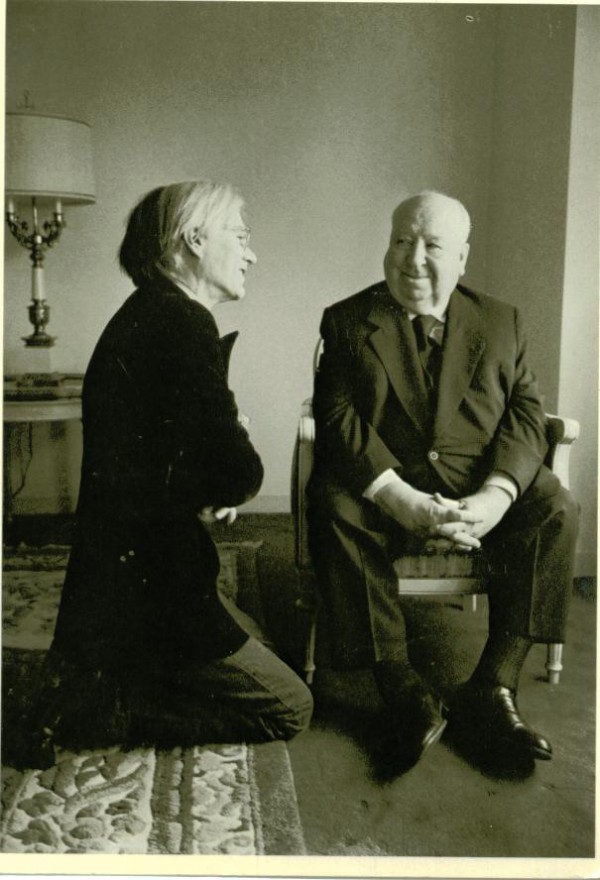
Warhol and Hitchcock

Warhol-Hitchcock-600x880

Andy interviews Alfred.

Merde — Leos Carax (Short Film with English Subtitles)

(Here is my take on Carax’s film Holy Motors, of which Merde is perhaps a preamble).

“Saturday Afternoon” — Erskine Caldwell

“Saturday Afternoon” by Erskine Caldwell

Tom Denny shoved the hunk of meat out of his way and stretched out on the meat block. He wanted to lie on his back and rest. The meat block was the only comfortable place in the butcher shop where a man could stretch out and Tom just had to rest every once in a while. He could prop his foot on the edge of the block, swing the other leg across his knee and be fairly comfortable with a hunk of rump steak under his head. The meat was nice and cool just after it came from the icehouse. Tom did that. He wanted to rest himself a while and he had to be comfortable on the meat block. He kicked off his shoes so he could wiggle his toes. Tom’s butcher shop did not have a very pleasant smell. Strangers who went in to buy Tom’s meat for the first time were always asking him what it was that had died between the walls. The smell got worse and worse year after year.

Tom bit off a chew of tobacco and made himself comfortable on the meat block.

There was a swarm of flies buzzing around the place; those lazy, stinging, fat and greasy flies that lived in Tom’s butcher shop. A screen door at the front kept out some of them that tried to get inside, but if they were used to coming in and filling up on the fresh blood on the meat block they knew how to fly around to the back door where there had never been a screen.

Everybody ate Tom’s meat, and liked it. There was no other butcher shop in town. You walked in and said, “Hello, Tom. How’s everything today?” “Everything’s slick as a whistle with me, but my old woman’s got the chills and fever again.” Then after Tom had finished telling how it felt to have chills and fever, you said, “I want a pound of pork chops, Tom.” And Tom said, “By gosh, I’ll git it for you right away.” While you stood around waiting for the chops Tom turned the hunk of beef over two or three times businesslike and hacked off a pound of pork for you. If you wanted veal it was all the same to Tom. He slammed the hunk of beef around several times making a great to-do, and got the veal for you. He pleased everybody. Ask Tom for any kind of meat you could name, and Tom had it right there on the meat block waiting to be cut off and weighed. Continue reading ““Saturday Afternoon” — Erskine Caldwell”

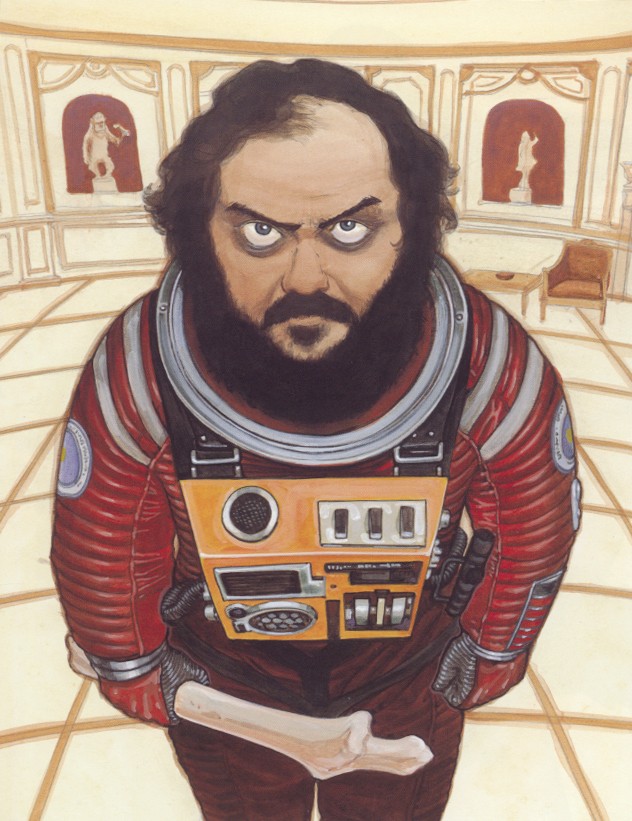
Portrait of Stanley Kubrick — Katsuhiro Otomo

kubrick

June — Childe Hassam

“Of Projectors” — Daniel Defoe

“Of Projectors” by Daniel Defoe

Man is the worst of all God’s creatures to shift for himself; no other animal is ever starved to death; nature without has provided them both food and clothes, and nature within has placed an instinct that never fails to direct them to proper means for a supply; but man must either work or starve, slave or die. He has indeed reason given him to direct him, and few who follow the dictates of that reason come to such unhappy exigences; but when by the errors of a man’s youth he has reduced himself to such a degree of distress as to be absolutely without three things—money, friends, and health— he dies in a ditch, or in some worse place, a hospital.

Ten thousand ways there are to bring a man to this, and but very few to bring him out again.

Death is the universal deliverer, and therefore some who want courage to bear what they see before them, hang themselves for fear; for certainly self-destruction is the effect of cowardice in the highest extreme.

Others break the bounds of laws to satisfy that general law of nature, and turn open thieves, house-breakers, highwaymen, clippers, coiners, &c., till they run the length of the gallows, and get a deliverance the nearest way at St. Tyburn.

Others, being masters of more cunning than their neighbours, turn their thoughts to private methods of trick and cheat, a modern way of thieving every jot as criminal, and in some degree worse than the other, by which honest men are gulled with fair pretences to part from their money, and then left to take their course with the author, who skulks behind the curtain of a protection, or in the Mint or Friars, and bids defiance as well to honesty as the law.

Others, yet urged by the same necessity, turn their thoughts to honest invention, founded upon the platform of ingenuity and integrity.

These two last sorts are those we call projectors; and as there was always more geese than swans, the number of the latter are very inconsiderable in comparison of the former; and as the greater number denominates the less, the just contempt we have of the former sort bespatters the other, who, like cuckolds, bear the reproach of other people’s crimes.

A mere projector, then, is a contemptible thing, driven by his own desperate fortune to such a strait that he must be delivered by a miracle, or starve; and when he has beat his brains for some such miracle in vain, he finds no remedy but to paint up some bauble or other, as players make puppets talk big, to show like a strange thing, and then cry it up for a new invention, gets a patent for it, divides it into shares, and they must be sold. Ways and means are not wanting to swell the new whim to a vast magnitude; thousands and hundreds of thousands are the least of his discourse, and sometimes millions, till the ambition of some honest coxcomb is wheedled to part with his money for it, and then (nascitur ridiculus mus) the adventurer is left to carry on the project, and the projector laughs at him. The diver shall walk at the bottom of the Thames, the saltpetre maker shall build Tom T-d’s pond into houses, the engineers build models and windmills to draw water, till funds are raised to carry it on by men who have more money than brains, and then good-night patent and invention; the projector has done his business and is gone.

But the honest projector is he who, having by fair and plain principles of sense, honesty, and ingenuity brought any contrivance to a suitable perfection, makes out what he pretends to, picks nobody’s pocket, puts his project in execution, and contents himself with the real produce as the profit of his invention.

A Scholar Seated at a Table with Books — Rembrandt