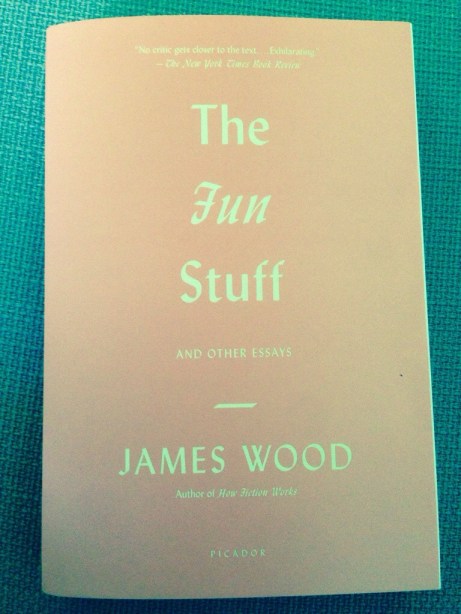
I hate that I love to hate reading James Wood—and when I love what he writes I hate that I love it. His take on Blood Meridian absolutely infuriated me, but a stray line from an essay he wrote on Virginia Woolf has informed pretty much every real review I’ve tried to write since I read it. Anyone who reads deeply and earnestly and cares about literary criticism is likely to find themselves shouting at Wood, and then maybe agreeing with him—with reserved qualifications, and then shouting again. (There is an entire blog devoted to pointing out the failures of Wood’s often deeply conservative aesthetic criticism, by the way).
The Fun Stuff, collecting many of Wood’s pieces from The New Yorker (but also elsewhere), is less pretentious than How Fiction Works, Wood’s last book, a polemic hiding behind the guise of literary criticism that faulted pretty much any prose stylist who deviated from a certain mode of 19th-century free indirect style.
I’ve already read a number of the pieces collected in The Fun Stuff, which is finally out in the U.S. in trade paperback thanks to Picador. You might have read them too. His essays championing Lydia Davis and László Krasznahorkai are fine fun stuff, as is his take on the late W.G. Sebald (first published as an introduction to Austerlitz). His appreciative review of Cormac McCarthy’s The Road though is in many ways a retake on his review of Blood Meridian—Wood can only view McCarthy’s existential questions through the lens of theodicy.
James Wood is maybe most fun—or most infuriating—when he’s at his harshest. The case file here is his pointed take-down “Paul Auster’s Shallowness.” Here, Wood goes through an Auster plot “checklist”:
A protagonist, nearly always male, often a writer or an intellectual, lives monkishly, coddling a loss—a deceased or divorced wife, dead children, a missing brother. Violent accidents perforate the narratives, both as a means of insisting on the contingency of existence and as a means of keeping the reader reading—a woman drawn and quartered in a German concentration camp, a man beheaded in Iraq, a woman severely beaten by a man with whom she is about to have sex, a boy kept in a darkened room for nine years and periodically beaten, a woman accidentally shot in the eye, and so on. The narratives conduct themselves like realistic stories, except for a slight lack of conviction and a general B-movie atmosphere. People say things like “You’re one tough cookie, kid,” or “My pussy’s not for sale,” or “It’s an old story, pal. You let your dick do your thinking for you, and that’s what happens.” A visiting text—Chateaubriand, Rousseau, Hawthorne, Poe, Beckett—is elegantly slid into the host book. There are doubles, alter egos, doppelgängers, and appearances by a character named Paul Auster. At the end of the story, the hints that have been scattered like mouse droppings lead us to the postmodern hole in the book where the rodent got in: the revelation that some or all of what we have been reading has probably been imagined by the protagonist. Hey, Roger Phaedo invented Charlie Dark! It was all in his head.
I’m not a particular fan of Paul Auster, but I imagine those who deeply enjoy his work could feel personally insulted by Wood’s take-down. We get close to the books and authors we love. I think what manifests most in Wood’s criticism here—and elsewhere—is the weariness of someone who once deeply loved literature but who is now perhaps oppressed by it—who has become too aware of its mechanics, its forms, its stale formulations and bad parlor tricks.
Wood telegraphs far more passion and generosity in the collection’s title essay, which is about Keith Moon, the legendary drummer of The Who. He compares Moon’s rhythmic chops to D.H. Lawrence’s sentences:
For me, this playing is like an ideal sentence of prose, a sentence I have always wanted to write and never quite had the confidence to: a long, passionate onrush, formally controlled and joyously messy, propulsive but digressively self-interrupted, attired but disheveled, careful and lawless, right and wrong. (You can encounter such sentences in Lawrence’s prose, in Bellow’s, sometimes in David Foster Wallace’s.) Such a sentence would be a breaking out, an escape. And drumming has always represented for me that dream of escape, when the body forgets itself, surrenders its awful self-consciousness.
I like how personal he gets here. This essay opens the collection, and the one that closes it, “Packing My Father-In-Law’s Library” also communicates personally with the reader. Unconstrained by the pretense of a book review, Wood waxes on families and libraries and the meaning of life. When he writes of his father-in-law, whose books he’s sorting through, that “The books somehow made him smaller, not larger,” it’s hard not to hear a strong undertone of autobiography in the note.
Wood’s lyric essays are an unusual standout here (unusual in the sense that if someone had strung together the words James Wood’s lyric essays, I’d probably roll my eyes). They reveal a love of reading that goes missing in his attacks and his quibbling pieces. The serious literary critic is not, of course, beholden to being merely a cheerleader for literature (or worse, a cheerleader for publishing)—but I do think that the serious literary critic should offer something beyond condemnation or unenthusiastic grumbling. The risk the professional critic runs is to see the machinations of art too plainly, to become jaded to the point that experiencing the sublime is no longer possible (Tobias Wolff’s fantastic story “Bullet in the Brain” deals handily with this theme). Wood guides us here to several writers who disrupt, estrange, and resynthesize the tired tropes of literary fiction—and it’s in that strangeness where we can find the real fun stuff.





 Biblioklept