Sad News — Albert von Keller

Camp Forestia — Peter Doig

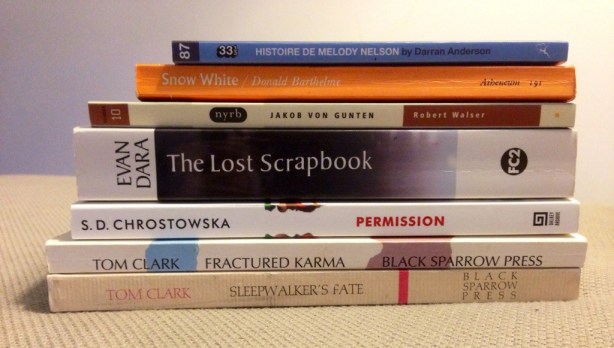
Books I’ve been reading these past few weeks

20131115-165229.jpg

I am reading too many books.

I am hoping to write about a few of these before the month is over, starting with Chrostowska’s Permission (my review is long overdue).

I’m about fifty pages shy of finishing Evan Dara’s The Lost Scrapbook; the book has been a revelation, one of those “How-the-hell-didn’t-I-know-about-this-already-?” deals. I’ll lazily compare it to Gaddis’s J R and DFW’s Infinite Jest.

I fell into rereading Snow White after working through several dozen of Barthelme’s short stories again. He’s probably the best.

Also the best is Tom Clark, whose poetry also falls into that “How-the-hell-didn’t-I-know-about-this-already-?” spectrum.

Quick thought on the beginning of Walser’s Jakob von Gunten: Seems part of a little mini-genre that includes Barthelme’s “Me and Miss Mandible” and Gombrowicz’s Ferdydurke.

Sorry for the lazy blogging. I will try to do better.


“I looked like this horrible Elizabethan courtier” | William Vollmann, Cross-Dresser

14zVOLLMAN4-articleLarge

Mr. Vollmann is 54, heterosexual and married with a daughter in high school. He began cross-dressing seriously about five years ago. Sometimes he transforms himself into a woman as part of a strange vision quest, aided by drugs or alcohol, to mind-meld with a female character in a book he’s writing. Other times it’s just because he likes the “smooth and slippery” feel of women’s lingerie.

From another profile on William T. Vollmann, this time in The New York Times. The profile centers around Vollmann’s latest book, The Book of Dolores.

You may recall Vollmann’s previous adventures in cross-dressing.


The Rose (III) — Cy Twombly

Cy-Twombly_-1928

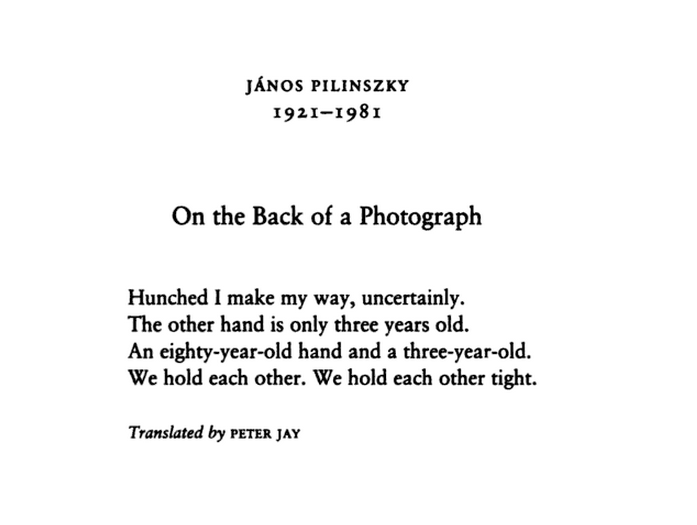
“On the Back of a Photograph” — János Pilinszky

photograph

Antropoides — Frantisek Kupka

“An article on fire, on smoke” and Other Ideas from Nathaniel Hawthorne’s Note-Books

  1. An article on fire, on smoke. Diseases of the mind and soul,–even more common than bodily diseases.
  2. Tarleton, of the Revolution, is said to have been one of the two handsomest men in Europe,–the Prince of Wales, afterwards George IV., being the other. Some authorities, however, have represented him as ungainly in person and rough in manners. Tarleton was originally bred for the law, but quitted law for the army early in life. He was son to a mayor of Liverpool, born in 1754, of ancient family. He wrote his own memoirs after returning from America. Afterwards in Parliament. Never afterwards distinguished in arms. Created baronet in 1818, and died childless in 1833. Thought he was not sufficiently honored among more modern heroes. Lost part of his right hand in battle of Guilford Court House. A man of pleasure in England.
  3. It would be a good idea for a painter to paint a picture of a great actor, representing him in several different characters of one scene,–Iago and Othello, for instance.
  4. A description of a young lady who had formerly been insane, and now felt the approach of a new fit of madness. She had been out to ride, had exerted herself much, and had been very vivacious. On her return, she sat down in a thoughtful and despondent attitude, looking very sad, but one of the loveliest objects that ever were seen. The family spoke to her, but she made no answer, nor took the least notice; but still sat like a statue in her chair,–a statue of melancholy and beauty. At last they led her away to her chamber.
  5. Observation. The effect of morning sunshine on the wet grass, on sloping and swelling land, between the spectator and the sun at some distance, as across a lawn. It diffused a dim brilliancy over the whole surface of the field. The mists, slow-rising farther off, part resting on the earth, the remainder of the column already ascending so high that you doubt whether to call it a fog or a cloud.

Notations from Nathaniel Hawthorne’s American Note-Books.


Woman Reading in a Garden — Henri Matisse

“There is a river of girls and women in our streets” (Donald Barthelme)

THERE is a river of girls and women in our streets. There are so many that the cars are forced to use the sidewalks. The women walk in the street proper, the part where, in other cities, trucks and bicycles are found. They stand in windows too unbuckling their shirts, so that we will not be displeased. I admire them for that. We have voted again and again, and I think they like that, that we vote so much. We voted to try the river in the next town. They have a girl-river there they don’t use much. We slipped into the felucca carrying our baggage in long canvas tubes tied, in the middle, with straps. The girls groaned under the additional weight. Then Hubert pushed off and Bill began to beat time for the rowers. We wondered if Snow White would be happy, alone there. But if she wasn’t, we couldn’t do anything about it. Men try to please their mistresses when they, men, are not busy in the countinghouse, or drinking healths, or having the blade of a new dagger chased with gold. In the village we walked around the well where the girls were dipping their trousers. The zippers were rusting. “Ha ha,” the girls said, “we could tear this down in a minute, this well.” It is difficult to defeat that notion, the one the village girls hold, that the boy who trembles by the wall, against the stones, will be Pope someday. He is not even hungry; his family is not even poor.

From Donald Barthelme’s novel Snow White.


Hercules Killing the Molionides — Albrecht Durer

A Quarry — Albrecht Durer

“Alone” — Edgar Allan Poe

Capture

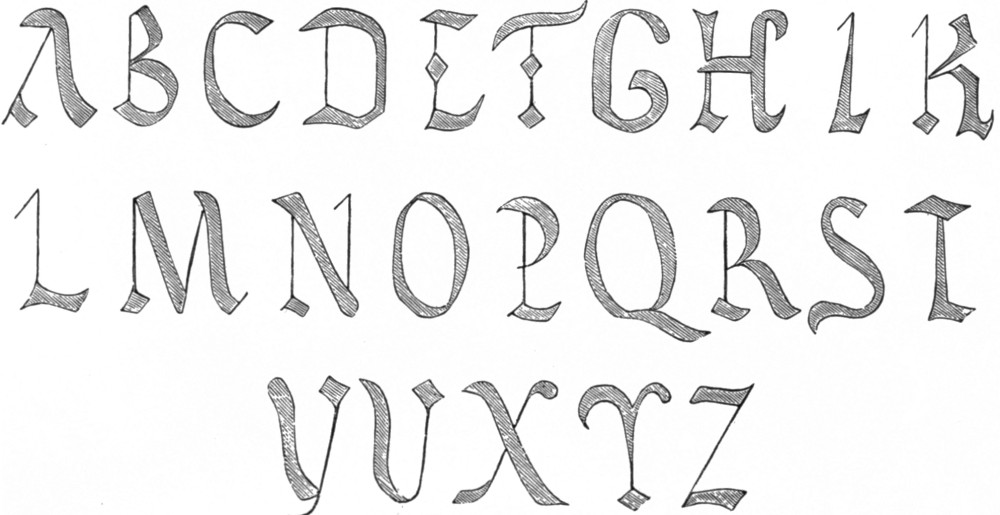
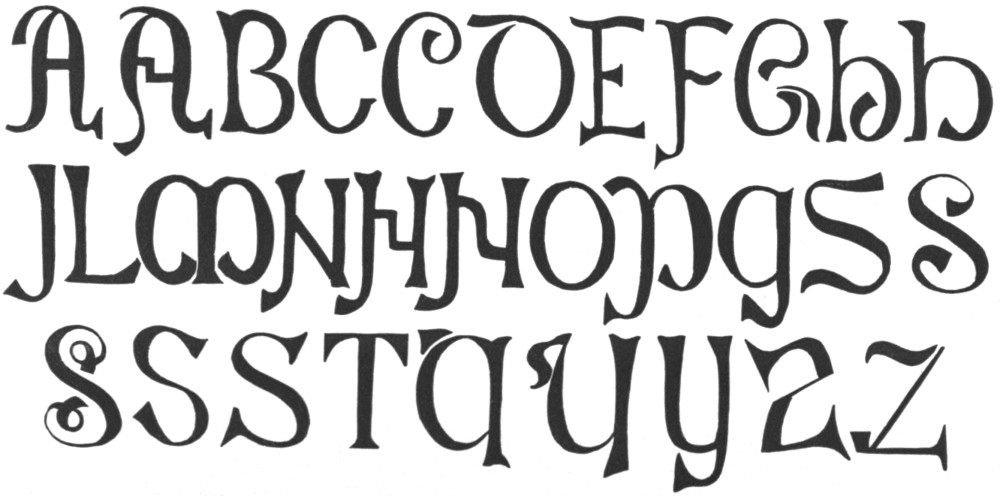
Ornamental Alphabets

8th Century. Vatican

8th Century. British Museum.

8th and 9th Centuries. Anglo-Saxon.

9th Century. From an Anglo-Saxon MS. Battel Abbey.

Continue reading “Ornamental Alphabets”

The Fall of Phaeton — Michelangelo

Young Woman Reading from a Sheet of Paper — Hendrick Terbrugghen

Nightmare — Nicolai Abildgaard