“A Birthday”– Christina Rossetti

birthday

Fairy and Griffon — Gustave Moreau

Three Books That Fit in My Jacket Pocket

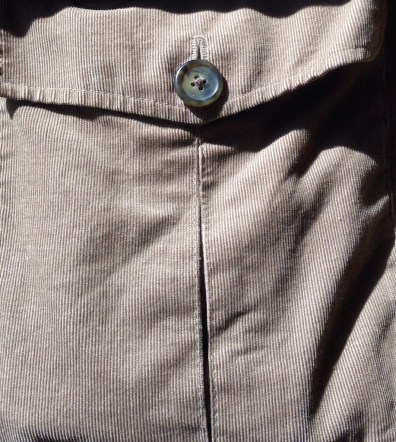
This is the front right pocket of the casual corduroy blazer I usually wear.

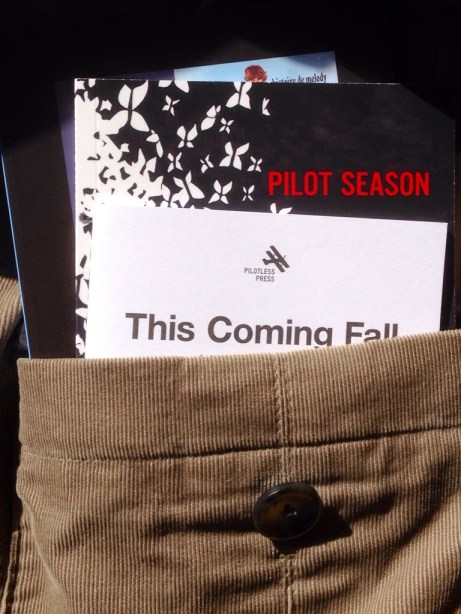
In this picture, it is loaded with three books.

20131216-120737.jpg

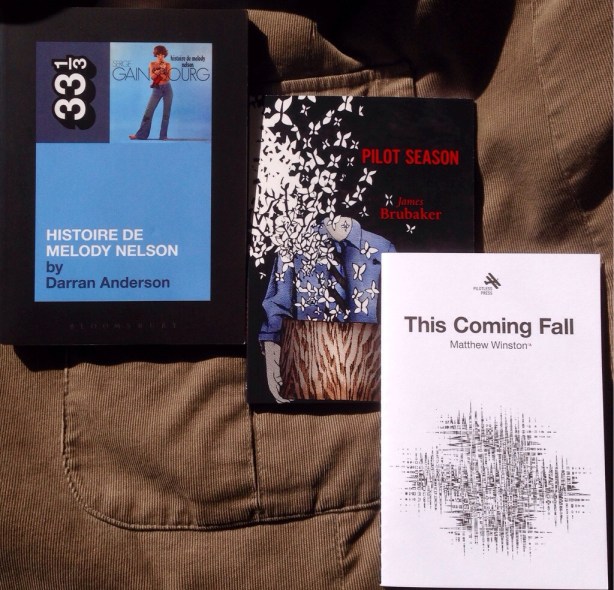
Those books:

Darran Anderson’s Histoire de Melody Nelson

James Brubaker’s Pilot Season

Matthew Winston’s This Coming Fall

20131216-120744.jpg

Perfect for parties you don’t want to be at, family get togethers, end of year faculty meetings, and any other event that you might need to secretly ameliorate with a furtive read.

20131216-120750.jpg

Shadow and Reflection — Nicolae Maniu

Read My Interview with S.D. Chrostowska at 3:AM Magazine

I interviewed S.D. Chrostowska for 3:AM Magazine. I reviewed Chrostowska’s novel Permission here.

3:AM also features a new piece of short fiction from Chrostowska, “How to Avoid the Cardinal Sins /A Nominalistic Pamphlet/“.

From the interview:


3:AM: How did Permission begin? Did it begin as a novel? As something else?

S D Chrostowska: It began with the first message, and ended with the last. It was principally a literary effort subordinated to communication. To me this remains a crucial difference, itsdifferentia specifica. The origin of the now-book Permission was in an illegitimate literary dimension outside the frame of book authorship. You have to understand that, though I had chosen my reader, this reader could not know what if anything would become of the writing that came their way. Naturally I wonder whether and how it changes things for readers today, who approach them as a bound book, to know that the letters, just as they are, were once for real.

3:AM: Why write the letters under a pseudonym? How did you arrive at “Fearn Wren”?

SDC: For the sake of ambiguity. Knowing too much, or for that matter anything, about the artist-producer prejudices us about their work. The prejudice is not just personal or social but also simply contextual. It is all but unavoidable in visual and performing artworks requiring direct human contact, where other people are involved from the start rather than just on the receiving end. Sitting for a portrait or mounting a play depends on direct interaction. But we have already chosen the photographer based on their reputation. And we know something about the director before we get involved in their production or, if we happen to be directors, select actors based on their training or past work.

But writing, usually done at some distance from readers, can minimize our reader’s prejudices—at least until the finished work is judged, and the reviews and exposés come out. One way it can do this is by appearing anonymously or pseudonymously. Such publishing has a long history. As, one should add, does letter-writing under a pseudonym. Permission’s first reader would have had no context to go on.

Being read as an unknown author, not part of the literary scene, mimics that condition somewhat. But almost everyone nowadays can be googled, which is to say traced. I imagine that many people who would pick up a book like mine would be curious in this way.

I’m not sure how I settled on this particular pen-name. I do like ferns and wrens, their behaviors and the myths around them.

Bonus:

So, my signature interview question — “Have you ever stolen a book?” — had to be cut because it was just kind of confusing on 3:AM, but I couldn’t not ask it, so:

3:AM: Have you ever stolen a book?

SDC: Of course. 


Morning, Going to Work — Vincent van Gogh

“A Visit to Walt Whitman”

“A Visit to Walt Whitman”

From James Huneker’s Ivory Apes and Peacocks

My edition of Walt Whitman’s Leaves of Grass is dated 1867, the third, if I am not mistaken, the first appearing in 1855. Inside is pasted a card upon which is written in large, clumsy letters: “Walt Whitman, Camden, New Jersey, July, 1877.” I value this autograph, because Walt gave it to me; rather I paid him for it, the proceeds, two dollars (I think that was the amount), going to some asylum in Camden. In addition, the “good grey poet” was kind enough to add a woodcut of himself as he appeared in the 1855 volume, “hankering, gross, mystical, nude,” and another of his old mother, with her shrewd, kindly face. Walt is in his shirt-sleeves, a hand on his hip, the other in his pocket, his neck bare, the pose that of a nonchalant workman—though in actual practice he was always opposed to work of any sort; on his head is a slouch-hat, and you recall his line: “I wear my hat as I please, indoors or out.” The picture is characteristic, even to the sensual mouth and Bowery-boy pose. You almost hear him say: “I find no sweeter fat than sticks to my own bones.” Altogether a different man from the later bard, the heroic apparition of Broadway, Pennsylvania Avenue, and Chestnut Street. I had convalesced from a severe attack of Edgar Allan Poe only to fall desperately ill with Whitmania. Youth is ever in revolt, age alone brings resignation. My favourite reading was Shelley, my composer among composers, Wagner. Chopin came later. This was in 1876, when the Bayreuth apotheosis made Wagner’s name familiar to us, especially in Philadelphia, where his empty, sonorous Centennial March was first played by Theodore Thomas at the Exposition. The reading of a magazine article by Moncure D. Conway caused me to buy a copy, at an extravagant price for my purse, of The Leaves of Grass, and so uncritical was I that I wrote a parallel between Wagner and Whitman; between the most consciously artistic of men and the wildest among improvisators. But then it seemed to me that both had thrown off the “shackles of convention.” (What prison-like similes we are given to in the heady, generous impulses of green adolescence.) I was a boy, and seeing Walt on Market Street, as he came from the Camden Ferry, I resolved to visit him. It was some time after the Fourth of July, 1877, and I soon found his little house on Mickle Street. A policeman at the ferry-house directed me. I confess I was scared after I had given the bell one of those pulls that we tremblingly essay at a dentist’s door. To my amazement the old man soon stood before me, and cordially bade me enter. Continue reading ““A Visit to Walt Whitman””

The Temptation of St. Anthony — January Wellens de Cock