Impressive View of the Go River –Ikeno Taiga

Ash Wednesday — Carl Spitzweg

Portrait of Maffeo Barberini — Caravaggio

The Hands — Edvard Munch

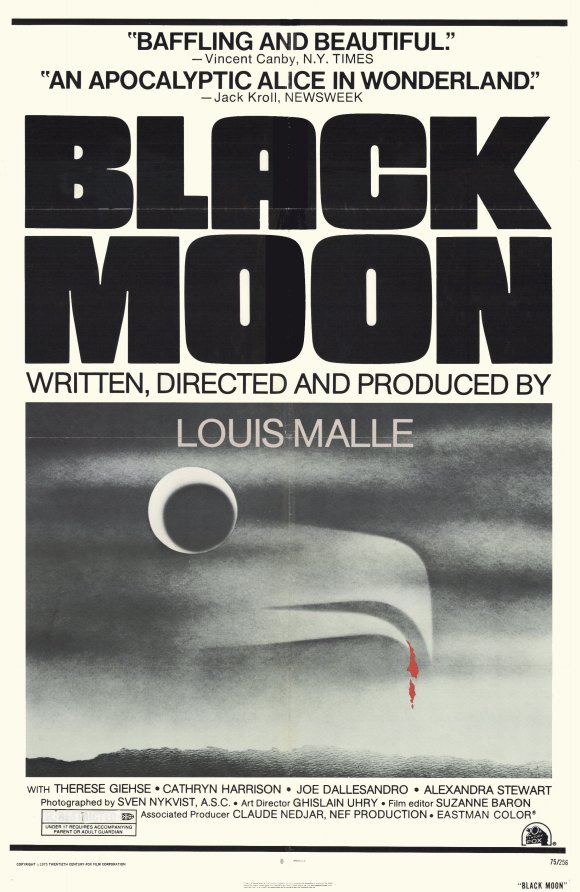
Black Moon — Louis Malle (Full Film)

Pôster

Black Moon may well deserve the title of Louis Malle’s film maudit. The release in September 1975 of what he called his “mythological fairy tale taking place in the near future” disconcerted many, especially as people had expected him to follow up on his previous work, the groundbreaking German-occupation drama Lacombe, Lucien (1974). As a result, the film was his least successful at the box office, and despite receiving two Césars in 1976, it remained until recently one of his most difficult to see.

Black Moon opens as quasi science fiction—there seems to be some kind of nuclear war going on, with soldiers wearing gas masks—but immediately evolves into an elaborate surrealist fantasy. In a deserted countryside, a fair young woman (Cathryn Harrison) fleeing the armed conflict stumbles upon a series of animals, ranging from the rural—a badger, pigs, sheep, snakes, and a horse—to a mythical unicorn. Narrowly escaping being shot, she ends up in a beautiful mansion that is itself overrun by animals, those she has seen outside now joined by a tame rat and an eagle, among others. The human inhabitants of the house are an androgynous and incestuous brother and sister couple, possibly twins (played by Alexandra Stewart and Joe Dallesandro), who, like the heroine, are both called Lily, and their bedridden elderly mother (Thérèse Giehse, who had played the grandmother in Lacombe, Lucien and whom Malle credited with indirectly generating Black Moon by suggesting that he make a film without dialogue; he dedicated the film to her, as she died before it was released). Although Black Moon was produced in an English and a French version—and Malle stated that he preferred the English one—language is reduced to a few grunts, a minute amount of intelligible dialogue, and animal noises. The film is instead replete with surrealist images, such as a talking piglet in a child’s high chair, decapitated animals, feral naked children driving pigs or sheep, and both the female twin and the heroine at one point breast-feeding the old woman.

From Ginette Vincendeau’s essay “Black Moon: Louis in Wonderland.

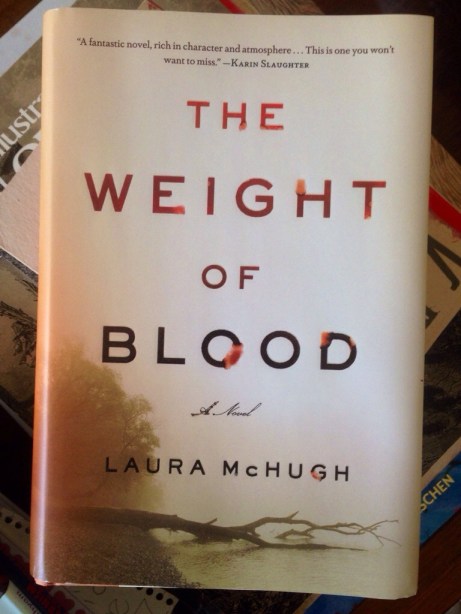
The Weight of Blood (Book Acquired, 2.24.2014)

20140303-140605.jpg

Laura McHugh’s novel The Weight of Blood is new in trade hardback next week from Random House. Their blurb:

The town of Henbane sits deep in the Ozark Mountains. Folks there still whisper about Lucy Dane’s mother, a bewitching stranger who appeared long enough to marry Carl Dane and then vanished when Lucy was just a child. Now on the brink of adulthood, Lucy experiences another loss when her friend Cheri disappears and is then found murdered, her body placed on display for all to see. Lucy’s family has deep roots in the Ozarks, part of a community that is fiercely protective of its own. Yet despite her close ties to the land, and despite her family’s influence, Lucy—darkly beautiful as her mother was—is always thought of by those around her as her mother’s daughter. When Cheri disappears, Lucy is haunted by the two lost girls—the mother she never knew and the friend she couldn’t save—and sets out with the help of a local boy, Daniel, to uncover the mystery behind Cheri’s death.

What Lucy discovers is a secret that pervades the secluded Missouri hills, and beyond that horrific revelation is a more personal one concerning what happened to her mother more than a decade earlier.

The Weight of Blood is an urgent look at the dark side of a bucolic landscape beyond the arm of the law, where a person can easily disappear without a trace. Laura McHugh proves herself a masterly storyteller who has created a harsh and tangled terrain as alive and unforgettable as the characters who inhabit it. Her mesmerizing debut is a compelling exploration of the meaning of family: the sacrifices we make, the secrets we keep, and the lengths to which we will go to protect the ones we love.

The Pancake Baker — Adriaen Brouwer

RIP Robert Ashley

ashleybysavio2

RIP Robert Ashley, 1930-2014

“A Carnival Jangle” — Alice Dunbar

“A Carnival Jangle”

by

Alice Dunbar

There is a merry jangle of bells in the air, an all-pervading sense of jester’s noise, and the flaunting vividness of royal colours. The streets swarm with humanity,—humanity in all shapes, manners, forms, laughing, pushing, jostling, crowding, a mass of men and women and children, as varied and assorted in their several individual peculiarities as ever a crowd that gathered in one locality since the days of Babel.

It is Carnival in New Orleans; a brilliant Tuesday in February, when the very air gives forth an ozone intensely exhilarating, making one long to cut capers. The buildings are a blazing mass of royal purple and golden yellow, national flags, bunting, and decorations that laugh in the glint of the Midas sun. The streets are a crush of jesters and maskers, Jim Crows and clowns, ballet girls and Mephistos, Indians and monkeys; of wild and sudden flashes of music, of glittering pageants and comic ones, of befeathered and belled horses; a dream of colour and melody and fantasy gone wild in an effervescent bubble of beauty that shifts and changes and passes kaleidoscope-like before the bewildered eye.

A bevy of bright-eyed girls and boys of that uncertain age that hovers between childhood and maturity, were moving down Canal Street when there was a sudden jostle with another crowd meeting them. For a minute there was a deafening clamour of shouts and laughter, cracking of the whips, which all maskers carry, a jingle and clatter of carnival bells, and the masked and unmasked extricated themselves and moved from each other’s paths. But in the confusion a tall Prince of Darkness had whispered to one of the girls in the unmasked crowd: “You’d better come with us, Flo; you’re wasting time in that tame gang. Slip off, they’ll never miss you; we’ll get you a rig, and show you what life is.”

And so it happened, when a half-hour passed, and the bright-eyed bevy missed Flo and couldn’t find her, wisely giving up the search at last, she, the quietest and most bashful of the lot, was being initiated into the mysteries of “what life is.”

Down Bourbon Street and on Toulouse and St. Peter Streets there are quaint little old-world places where one may be disguised effectually for a tiny consideration. Thither, guided by the shapely Mephisto and guarded by the team of jockeys and ballet girls, tripped Flo. Into one of the lowest-ceiled, dingiest, and most ancient-looking of these shops they stepped.

“A disguise for the demoiselle,” announced Mephisto to the woman who met them. She was small and wizened and old, with yellow, flabby jaws, a neck like the throat of an alligator, and straight, white hair that stood from her head uncannily stiff.

“But the demoiselle wishes to appear a boy, un petit garcon?” she inquired, gazing eagerly at Flo’s long, slender frame. Her voice was old and thin, like the high quavering of an imperfect tuning-fork, and her eyes were sharp as talons in their grasping glance.

“Mademoiselle does not wish such a costume,” gruffly responded Mephisto.

“Ma foi, there is no other,” said the ancient, shrugging her shoulders. “But one is left now; mademoiselle would make a fine troubadour.”

“Flo,” said Mephisto, “it’s a dare-devil scheme, try it; no one will ever know it but us, and we’ll die before we tell. Besides, we must; it’s late, and you couldn’t find your crowd.”

And that was why you might have seen a Mephisto and a slender troubadour of lovely form, with mandolin flung across his shoulder, followed by a bevy of jockeys and ballet girls, laughing and singing as they swept down Rampart Street.

When the flash and glare and brilliancy of Canal Street have palled upon the tired eye, when it is yet too soon to go home to such a prosaic thing as dinner, and one still wishes for novelty, then it is wise to go into the lower districts. There is fantasy and fancy and grotesqueness run wild in the costuming and the behaviour of the maskers. Such dances and whoops and leaps as these hideous Indians and devils do indulge in; such wild curvetings and long walks! In the open squares, where whole groups do congregate, it is wonderfully amusing. Then, too, there is a ball in every available hall, a delirious ball, where one may dance all day for ten cents; dance and grow mad for joy, and never know who were your companions, and be yourself unknown. And in the exhilaration of the day, one walks miles and miles, and dances and skips, and the fatigue is never felt.

In Washington Square, away down where Royal Street empties its stream of children great and small into the broad channel of Elysian Fields Avenue, there was a perfect Indian pow-wow. With a little imagination one might have willed away the vision of the surrounding houses, and fancied one’s self again in the forest, where the natives were holding a sacred riot. The square was filled with spectators, masked and un-masked. It was amusing to watch these mimic Red-men, they seemed so fierce and earnest.

Suddenly one chief touched another on the elbow. “See that Mephisto and troubadour over there?” he whispered huskily.

“Yes; who are they?”

“I don’t know the devil,” responded the other, quietly, “but I’d know that other form anywhere. It’s Leon, see? I know those white hands like a woman’s and that restless head. Ha!”

“But there may be a mistake.”

“No. I’d know that one anywhere; I feel it is he. I’ll pay him now. Ah, sweetheart, you’ve waited long, but you shall feast now!” He was caressing something long and lithe and glittering beneath his blanket.

In a masked dance it is easy to give a death-blow between the shoulders. Two crowds meet and laugh and shout and mingle almost inextricably, and if a shriek of pain should arise, it is not noticed in the din, and when they part, if one should stagger and fall bleeding to the ground, can any one tell who has given the blow? There is nothing but an unknown stiletto on the ground, the crowd has dispersed, and masks tell no tales anyway. There is murder, but by whom? for what? Quien sabe?

And that is how it happened on Carnival night, in the last mad moments of Rex’s reign, a broken-hearted mother sat gazing wide-eyed and mute at a horrible something that lay across the bed. Outside the long sweet march music of many bands floated in as if in mockery, and the flash of rockets and Bengal lights illumined the dead, white face of the girl troubadour.

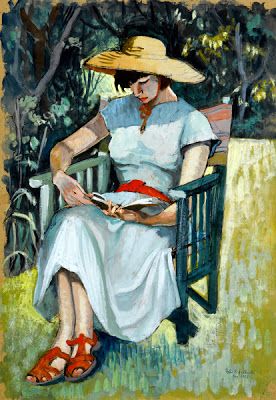
The Artist’s Wife Reading — Fyffe Christie

15e4ee3675c7fb1ea51457d4963e1cc3

Excavation at Night — George Bellows

“Kafka himself is known to have distrusted all utopianism” (Sebald)

trippkafka

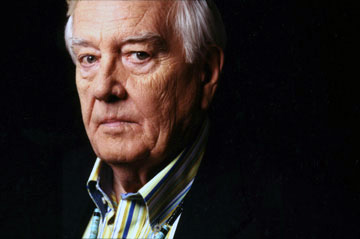
Kafka himself is known to have distrusted all utopianism. Not long before his death he said that he had been exiled from Canaan for forty years, and even the community which he sometimes longed for was basically suspect to him; he wanted only to dissolve away by himself, as the water runs into the sea. Few people ever seem to have been as much alone as Kafka appears in the last pictures of him, to which we may add one extrapolated from them, so to speak, and painted by Jan Peter Tripp. It shows Kafka as he might have looked had he lived eleven or twelve years longer. That would have been in 1935. The Reich party rally would have been held, just as Riefenstahl’s film shows it. The race laws would have come into force, and Kafka, if he had had his photograph taken again, would have looked at us as he does from Tripp’s ghostly picture—from beyond the grave.

From W.G. Sebald’s essay “Kafka Goes to the Movies,” collected in Campo Santo.

The Battle of Alexander at Issus — Albrecht Altdorfer

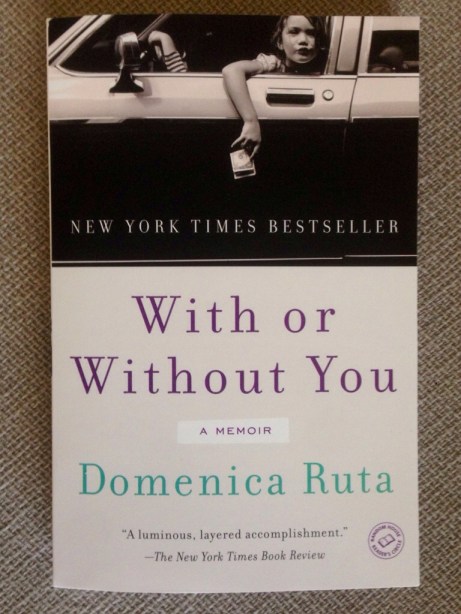
With or Without You (Book Acquired, 2.24.2014)

20140303-140548.jpg

Domenica Ruta’s memoir With or Without You is new in trade paperback next week from Random House. Their blurb:

Domenica Ruta grew up in a working-class, unforgiving town north of Boston, in a trash-filled house on a dead-end road surrounded by a river and a salt marsh. Her mother, Kathi, a notorious local figure, was a drug addict and sometimes dealer whose life swung between welfare and riches, and whose highbrow taste was at odds with her hardscrabble life. And yet she managed, despite the chaos she created, to instill in her daughter a love of stories. Kathi frequently kept Domenica home from school to watch such classics as theGodfather movies and everything by Martin Scorsese and Woody Allen, telling her, “This is more important. I promise. You’ll thank me later.” And despite the fact that there was not a book to be found in her household, Domenica developed a love of reading, which helped her believe that she could transcend this life of undying grudges, self-inflicted misfortune, and the crooked moral code that Kathi and her cohorts lived by.
 
With or Without You is the story of Domenica Ruta’s unconventional coming of age—a darkly hilarious chronicle of a misfit ’90s youth and the necessary and painful act of breaking away, and of overcoming her own addictions and demons in the process. In a brilliant stylistic feat, Ruta has written a powerful, inspiring, compulsively readable, and finally redemptive story about loving and leaving.

An Old Man Holding a Pipe and Tankard — Gabriel Metsu

“Monday or Tuesday” — Virginia Woolf

“Monday or Tuesday”

by

Virginia Woolf

Lazy and indifferent, shaking space easily from his wings, knowing his way, the heron passes over the church beneath the sky. White and distant, absorbed in itself, endlessly the sky covers and uncovers, moves and remains. A lake? Blot the shores of it out! A mountain? Oh, perfect-the sun gold on its slopes. Down that falls. Ferns then, or white feathers, for ever and ever-

Desiring truth, awaiting it, laboriously distilling a few words, for ever desiring-(a cry starts to the left, another to the right. Wheels strike divergently. Omnibuses conglomerate in conflict)-for ever desiring-(the clock asseverates with twelve distinct strokes that it is midday; light sheds gold scales; children swarm)-for ever desiring truth. Red is the dome; coins hang on the trees; smoke trails from the chimneys; bark, shout, cry “Iron for sale”-and truth?

Radiating to a point men’s feet and women’s feet, black or gold-encrusted-(This foggy weather-Sugar? No, thank you-The commonwealth of the future)-the firelight darting and making the room red, save for the black figures and their bright eyes, while outside a van discharges, Miss Thingummy drinks tea at her desk, and plate-glass preserves fur coats-

Flaunted, leaf-light, drifting at corners, blown across the wheels, silver-splashed, home or not home, gathered, scattered, squandered in separate scales, swept up, down, torn, sunk, assembled-and truth?

Now to recollect by the fireside on the white square of marble. From ivory depths words rising shed their blackness, blossom and penetrate. Fallen the book; in the flame, in the smoke, in the momentary sparks-or now voyaging, the marble square pendant, minarets beneath and the Indian seas, while space rushes blue and stars glint-truth? content with closeness?

Lazy and indifferent the heron returns; the sky veils her stars; then bares them.

Dig — Sadie Wendell Mitchell

readinglady