
She fell into a pit that autumn. And she reached out for me. I didn’t understand what was happening. But it was so claustrophobic that I turned away from her, tried to maintain a distance, which she tried to close.
I went to Venice, wrote in a flat my publishing house had at its disposal, Linda was supposed to follow and stay for just under a week, then I would work for a few more days and return. She was so black, she was so heavy, kept saying I didn’t love her, I didn’t really love her, I didn’t want her, I didn’t really want her, this wasn’t working, it would never work, I didn’t want it to, I didn’t want her.
“But I do!” I said as we walked in the autumn chill in Murano with eyes hidden behind sunglasses. However, when she said I didn’t really love her, I didn’t really want to be with her, I wanted to be alone all the time, on my own, it became a little truer.
Where did her despair come from?
Had I brought it with me?
Was I cold?
Did I only think of myself?
I no longer knew what it would be like when my working day was over and I went to her place. Would she be happy, would it be a nice evening? Would she be angry about something, if for example we no longer made love every night, and so I didn’t love her as much as before? Would we sit in bed watching TV? Go for a walk to Långholmen? And once there, would I be devoured by her demands to have all of me, making me keep her at a distance and have thoughts shooting to and for in my brain that this had to come to an end, it wasn’t working, thus rendering any conversation or attempts to get closer impossible, which of course she noticed and took as proof of her main thesis, that I didn’t want her?
Continue reading “An Excerpt From Karl Ove Knausgaard’s My Struggle II: A Man in Love”
Month: March 2014
Garbage — Max Ginsburg

“All I have left in the end is my present pathetic existence” (Thomas Bernhard)
But what am I really like? Once more I was caught up in speculations about myself. I don’t know why, but suddenly I recalled that twenty-five years ago, when I was just over twenty, I’d been a member of the Socialist Party. What a joke! I wasn’t a member for long. As with everything else, I resigned my membership after a few months. And to think that I once wanted to become a monk! That I once thought of becoming a Catholic priest! And that I once donated eight hundred thousand schillings for the starving in Africa! To think that that’s all true! At the time it all seemed logical and natural enough. But now I’ve completely changed. To think that I once believed I would marry! And have children! I even thought at one time of going into the army, of becoming a general or a field-marshal like one of my ancestors! Absurd. There’s nothing I wouldn’t once have given everything for, I told myself. But all these speculations added up, if not to nothing, then to ludicrously little. Poverty, wealth, the church, the army, parties, welfare institutions — all ludicrous. All I have left in the end is my present pathetic existence, which no longer has very much to offer. But that’s how it should be. No doctrine holds water any longer; everything that is said and preached is destined to become ludicrous. It doesn’t even call for my scorn any longer. It doesn’t call for anything, anything at all. When we really know the world, we see that it is just a world full of errors. But we are reluctant to part from it, because in spite of everything we’ve remained fairly naive and childlike, I thought. What a good thing that I had my eye-pressure measured. Thirty-eight! We mustn’t pretend to ourselves. We may keel over at any moment.
From Thomas Bernhard’s novel Concrete.
Landscape — Qi Zhijia

“Oscar Wilde” — Dorothy Parker
Milton When a Boy Instructed by His Mother — Henry Fuseli

Blue Night — Edward Hopper

PLEASE HELP WHAT HORROR IS THIS

Seriously:
What horror is this?
Via frequent commenter Will C., a nightmare image (he linked it, and rightly so, to some other horror).
“Asylum Product” — Charles Reznikoff
True Detective, Bolaño’s 2666, Werewolves, Etc.

1. A couple of years ago I wrote a pretty long essay about rereading Roberto Bolaño’s novel 2666, a dark, compelling, violent, mysterious book that I’ve reread in full three times now, a book that I frequently return to, a book that seems to leer from the shelf too often, Hey, you’re not done with me, you know that, right?
2. Anyway, this long essay about rereading 2666 was also about another book: Sabine Baring-Gould’s 1865 folklore-horror hybrid, The Book of Were-Wolves (download it here). I argued that
What Bolaño and Baring-Gould do in these books is explore madness and violence and the ways that our world tries to (or fails to) contain madness and violence.
—and suggested that
Bolaño’s werewolves are, in line with Baring-Gould’s, people fated to madness and violence, but also relatively normal people. These werewolves contain within them a dreadful capacity for violence.
3. (What I want to say is that any speculation I might offer about the forthcoming conclusion of season one of True Detective I have already offered, at some length, in an essay (about two other texts) which I composed a few years before True Detective aired).
4. Well so and anyway: “After You’ve Gone,” the penultimate episode of True Detective.
In some ways the most straightforward episode to date, even disappointingly so, a bit of a police procedural, serving mostly to realign Cohle and Hart, demonstrating that despite their fight and their differences, they are also very similar. But you already know that, you know what happened in the episode, right? The obsession then is for an answer: Where does this all go? Who did the crimes? Who is The King in Yellow? How does it end?
5. I now lazily link to an article that rounds up some of the conjecture — the “theories” — about how the show will end. You’ve read some of these, right?
6. This kind of conjecture is fun, or maybe “fun” isn’t the right word—maybe what I want to say instead is:
True Detective compels many of its viewers to obsessively hunt down clues in each frame. There’s a thickness to the show’s repetition of key images and phrases—spirals, stars, sets of five figures, antlers, crowns, crosses that dissolve into targets, etc.—a seeming preciseness that invites us to impose our own order, our own narrative.
(This is the kind of conjecture that Hart repeatedly warns Cohle not to indulge in).
7. I’m reminded here of Juan Antonio Masoliver Ródenas’s prologue to Roberto Bolaño’s unfinished novel Woes of the True Policeman:
What matters is the active participation of the reader, concurrent with the act of writing. Bolaño makes this very clear in his explanation of the title: “The policeman is the reader, who tries in vain to decipher this wretched novel.” And in the body of the book itself there is an insistence on this conception of the novel as a life: we exist—we write, we read—so long as we’re alive, and the only conclusion is death.
True Detective, like True Policeman—and, like Bolaño’s masterpiece 2666—all invite the active participation of the reader. But also the woe.
8. There is no supernatural solution to the mysteries of True Detective. From the outset, True Detective has posited (the illusion of) human consciousness as a part of nature that seeks to define itself against nature: the real.
In True Detective, the supernatural is the product of terror and fantasy. It is imaginary. (And of course therefore no less real than the natural, the real, thanks to human consciousness).
9. From the beginning of Baring-Gould’s The Book of Were-Wolves:
It will then be seen that under the veil of mythology lies a solid reality, that a floating superstition holds in solution a positive truth.
This I shall show to be an innate craving for blood implanted in certain natures, restrained under ordinary circumstances, but breaking forth occasionally, accompanied with hallucination, leading in most cases to cannibalism. I shall then give instances of persons thus afflicted, who were believed by others, and who believed themselves, to be transformed into beasts, and who, in the paroxysms of their madness, committed numerous murders, and devoured their victims.
The emphasis is mine.
10. In the sixth episode of True Detective, Cohle says to Hart: “You, these people, this place … you’ll eat your fucking young as long as you have something to salute.” The indictment is broad, dark, and perhaps paranoid, but it serves to highlight the series’s keen attenuation to infanticide, to the infinite loss and dramatic mourning that underpins begetting.
11. Cohle has lost his daughter, and her death at such a young age, he says, spared him “the sin of fatherhood.”
Hart has essentially lost his daughters, ruined his life, ruined his (illusion of the) status as a family man. The thing that mattered—his family—was “right under his nose” the whole time.
On the job, both Cohle and Hart—separately—witness the awful deaths of infants; in both cases, the men snap, disconnect, quit.
12. (At this time, the reader is invited to sift through his or her own recollections of True Detective (if he or she so desires) and set aside examples of infanticidal violence).
13. Many fans of the show have speculated that Martin Hart is the King in Yellow, a notion fueled by the show’s stores of symbolic images, as well as Hart’s own actions.
The theory is intriguing, but I seriously doubt that Hart will be revealed as a perpetrator in the crimes of the Tuttle case. However, he is capable of slipping into werewolf mode: Threatening his lover Lisa’s new beau with horrific violence and then declaring, “I’m not a psycho–I wouldn’t have done those things” (the past perfect tense there is so strange); slipping on gloves to assault the boys who had consensual sex with his daughter Audrey; etc. etc. etc.
Hart’s actions are the strange double bind of the patriarchal lawman who sets to rule with sanctioned order—and, specifically, to rule and control the sexualized female body, which is oh-so-important to begetting. Does he serve and protect? Does he terrorize and menace? Both and at the same time.
But I’d argue that Hart is illusioned, that his identity is constituted in maintaining an illusion, an illusion that Cohle is too keenly aware of (“…you’ll eat your fucking young as long as you have something to salute”).
14. There’s a heap of corpses at the core of Bolaño’s 2666—women who are raped, murdered, discarded. Bolaño sends various detectives—many of them good detectives, true policeman—to find the killers, but there’s no satisfying answer: Just plenty of killers, plenty of werewolves. As the novel reaches its (non)end, we await the promise of a Giant (The Tall Man), a Big Answer. But the answer is inadequate, incomplete.
15. The capacity to transform into a killer, a werewolf is always there. Just put on some gloves. Just slip on a mask.
Or maybe take your mask off.
“All art constantly aspires towards the condition of music”
“The King of Jazz” — Donald Barthelme
“The King of Jazz”
by
Donald Barthelme
Well, I’m the king of jazz now, thought Hokie Mokie to himself as he oiled the slide on his trombone. Hasn’t been a ‘bone man been king of jazz for many years. But now that Spicy MacLammermoor, the old king, is dead, I guess I’m it. Maybe I better play a few notes out of this window here, to reassure myself.
“Wow!” said somebody standing on the sidewalk. “Did you hear that?”
“I did,” said his companion.
“Can you distinguish our great homemade American jazz performers, each from the other?”
“Used to could.”
“Then who was that playing?”
“Sounds like Hokie Mokie to me. Those few but perfectly selected notes have the real epiphanic glow.”
“The what?”
“The real epiphanic glow, such as is obtained only by artists of the caliber of Hokie Mokie, who’s from Pass Christian, Mississippi. He’s the king of jazz, now that Spicy MacLammermoor is gone.”
Hokie Mokie put his trombone in its case and went to a gig. At the gig everyone fell back before him, bowing.
“Hi Bucky! Hit Zoot! Hi Freddie! Hi George! Hi Thad! Hi Roy! Hi Dexter! Hi Jo! Hi Willie! Hi Greens!”
“What we gonna play, Hokie? You the king of jazz now, you gotta decide.”
“How ’bout ‘Smoke’?”
“Wow!” everybody said. “Did you hear that? Hokie Mokie can just knock a fella out, just the way he pronounces a word. What an intonation on that boy! God Almighty!” Continue reading ““The King of Jazz” — Donald Barthelme”
St. Augustine Reading — Marco Zoppo

Night Hauling — Andrew Wyeth

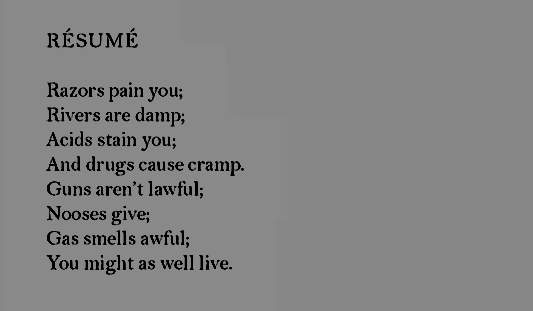
“Résumé” — Dorothy Parker
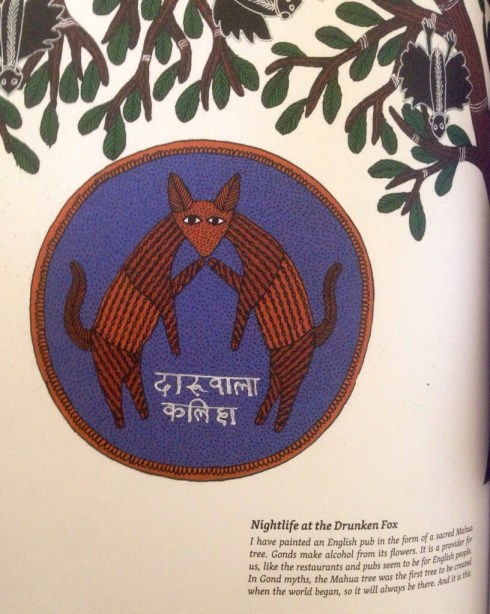
The London Jungle Book (Book Acquired, 2.28.2014)

Bhajju Shyam’s The London Jungle Book arrived a few days ago: Beautiful stuff. Full review to come, but blurb for now:
Hailed as a book that reverses the anthropological gaze, ‘The London Jungle Book’ is the personal story of Indian tribal artist Bhajju Shyam’s first encounter with a western city. Revised & fully updated to mark the 10th anniversary of that momentous journey, Bhajju’s rich art and poignant reflections are as relevant today as they ever were.
 Biblioklept