The Romantic Tough School of Writing | Doris Lessing’s The Golden Notebook

Toward the end of Doris Lessing’s The Golden Notebook, protagonist Anna Wulf inserts this wonderful parody of a certain kind of midcentury writing (Henry Miller seems like the most obvious target here, although I use the term “target” loosely). The piece ends with Wulf’s “own” voice returning, declaring “If I’ve gone back to pastiche, then it’s time to stop.” And then the notebook stops.

* 19 The Romantic Tough School of Writing

The fellows were out Saturday-nighting true-hearted, the wild-hearted Saturday-night gang of true friends, Buddy, Dave and Mike. Snowing. Snow-cold. The cold of cities in the daddy of cities, New York. But true to us. Buddy, the ape-shouldered, stood apart and stared. He scratched his crotch. Buddy the dreamer, pitch-black-eyed, sombrely staring, he would often masturbate in front of us, unconscious, pure, a curious purity. And now he stood with the snow crumb white on his sad bent shoulders. Dave tackled him low, Dave and Buddy sprawled together in the innocent snow, Buddy winded. Dave drove his fist into Buddy’s belly, oh true love of true friends, mensch playing together under the cold cliffs of Manhattan on a true Saturday night. Buddy passed out cold. ‘I love this son-of-a-bitch,’ Dave said, while Buddy sprawled, lost to us and to the sadness of the city. I, Mike, Mike-the-lone-walker, stood apart, the burden of knowing on me, eighteen-years-old and lonely, watching my true buddies, Dave and Buddy. Buddy came to. Saliva flecked his near-dead lips and flew off into the saliva-white snowbank.

He sat up, gasping, saw Dave there, arms around his kneecaps, staring at him, love in his Bronx-sad eyes. Left side of hairy fist to chin, he hit and Dave now fell flat out, out in the death-cold snow. Laughing Buddy, Buddy sat laughing, waiting in his turn. Man, what a maniac. ‘Whatta you going to do, Buddy?’ I said, Mike the lone-walker but loving his true friends. ‘Ha ha ha, d’you see the expression on his face?’ he said and rolled breathless, holding his crotch. ‘Didja see that?’ Dave gasped, life coming to him, rolled, groaned, sat up. Dave and Buddy fought then, true-fought, laughing with joy, till, laughing, fell apart in the snow. I, Mike, winged-with-words Mike, stood sorrowing with joy. ‘Hey I love this bastard,’ gasped Dave, throwing a punch to Buddy’s midriff and Buddy, forearm stopping it, said: ‘Jeez, I love him.’ But I heard the sweet music of heels on the frost-cold pavement, and I said: ‘Hey, fellas.’ We stood waiting. She came, Rosie, from her dark tenement bedroom, on her sweet-tapping heels. ‘Hey, fellas,’ says Rosie, sweet-smiling. We stood watching. Sad now, watching the proud-fleshed Rosie, swivelling on her true sex down the pavement, twitching her round-ball butt, which jerked a message of hope to our hearts. Then Buddy, our buddy Buddy, moved apart, hesitant, sad-eyed, to our sad eyes: ‘I love her, fellas.’ Two friends were left then. Two-fisted Dave and winged-with words Mike. We stood then, watching our friend Buddy, fated with life, nod and move on after Rosie, his pure heart beating to the tune of her sweet heels. The wings of mystic time beat down on us then, white with snowflakes, time that would whirl us all after our Rosies to death and the frame-house funeral. Tragic and beautiful to see our Buddy move on out into the immemorial dance of fated snow-flakes, the dry rime rhyming on his collar. And the love that went out from us to him then was fantastic, true-volumned, sad-faced and innocent of the purposes of time, but true and in fact serious. We loved him as we turned, two friends left, our adolescent top coats flapping around our pure legs. On then, Dave and I, I-Mike, sad, because the intimation-bird of tragedy had touched our pearly souls, he-Dave and I-Mike, on then, goofy with life. Dave scratched his crotch, slow, owl-scratching pure Dave. ‘Jeez, Mike,’ he said, ‘you’ll write it someday, for us all.’ He stammered, inarticulate, not-winged-with-words, ‘You’ll write it, hey feller? And how our souls were ruined here on the snow-white Manhattan pavement, the capitalist-money-mammon hound-of-hell hot on our heels?’ ‘Gee, Dave, I love you,’ I said then, my boy’s soul twisted with love. I hit him then, square to the jaw-bone, stammering with love-for-the-world, love-for-my-friends, for the Daves and the Mikes and the Buddies. Down he went and I then, Mike, then, cradled him, baby, I-love-you, friendship in the jungle city, friendship of young youth. Pure. And the winds of time were blowing, snow-fated, on our loving pure shoulders.

If I’ve gone back to pastiche, then it’s time to stop.

[The yellow notebook ended here with a double black line.]

Resurrexit — Anselm Kiefer

resurrexit

“A Famous Dancer” — Thomas Bernhard

20140721-162338-59018084.jpg

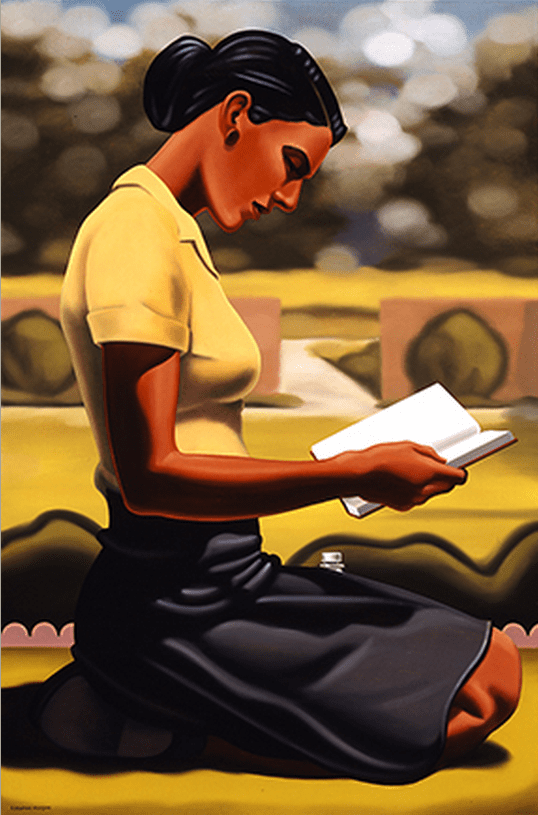
Lucidity — Kenton Nelson

Capture

The Temptation of St. Anthony (Detail) — Hieronymus Bosch

“A Short Novel” | Doris Lessing’s The Golden Notebook

*11 A SHORT NOVEL

Two people together, in any kind of relationship—mother, son; father, daughter; lovers; it doesn’t matter. One of them acutely neurotic. The neurotic hands on his or her state to the other, who takes it over, leaving the sick one well, the well one sick.

From Doris Lessing’s novel The Golden Notebook.

The Beginning of Life — Frantisek Kupka

Bad books are intellectual poison (Schopenhauer)

It is in literature as in life: wherever you turn, you stumble at once upon the incorrigible mob of humanity, swarming in all directions, crowding and soiling everything, like flies in summer. Hence the number, which no man can count, of bad books, those rank weeds of literature, which draw nourishment from the corn and choke it. The time, money and attention of the public, which rightfully belong to good books and their noble aims, they take for themselves: they are written for the mere purpose of making money or procuring places. So they are not only useless; they do positive mischief. Nine-tenths of the whole of our present literature has no other aim than to get a few shillings out of the pockets of the public; and to this end author, publisher and reviewer are in league.

Let me mention a crafty and wicked trick, albeit a profitable and successful one, practised by littérateurs, hack writers, and voluminous authors. In complete disregard of good taste and the true culture of the period, they have succeeded in getting the whole of the world of fashion into leading strings, so that they are all trained to read in time, and all the same thing, viz., the newest books; and that for the purpose of getting food for conversation in the circles in which they move. This is the aim served by bad novels, produced by writers who were once celebrated, as Spindler, Bulwer Lytton, Eugene Sue. What can be more miserable than the lot of a reading public like this, always bound to peruse the latest works of extremely commonplace persons who write for money only, and who are therefore never few in number? and for this advantage they are content to know by name only the works of the few superior minds of all ages and all countries. Literary newspapers, too, are a singularly cunning device for robbing the reading public of the time which, if culture is to be attained, should be devoted to the genuine productions of literature, instead of being occupied by the daily bungling commonplace persons.

Hence, in regard to reading, it is a very important thing to be able to refrain. Skill in doing so consists in not taking into one’s hands any book merely because at the time it happens to be extensively read; such as political or religious pamphlets, novels, poetry, and the like, which make a noise, and may even attain to several editions in the first and last year of their existence. Consider, rather, that the man who writes for fools is always sure of a large audience; be careful to limit your time for reading, and devote it exclusively to the works of those great minds of all times and countries, who o’ertop the rest of humanity, those whom the voice of fame points to as such. These alone really educate and instruct. You can never read bad literature too little, nor good literature too much. Bad books are intellectual poison; they destroy the mind. Because people always read what is new instead of the best of all ages, writers remain in the narrow circle of the ideas which happen to prevail in their time; and so the period sinks deeper and deeper into its own mire

From “On Books and Reading” by Arthur Schopenhauer.

Pitcher, Lemons and Book — Paul Wonner

“To Whoever Is Reading Me” — Jorge Luis Borges

IMG_3142

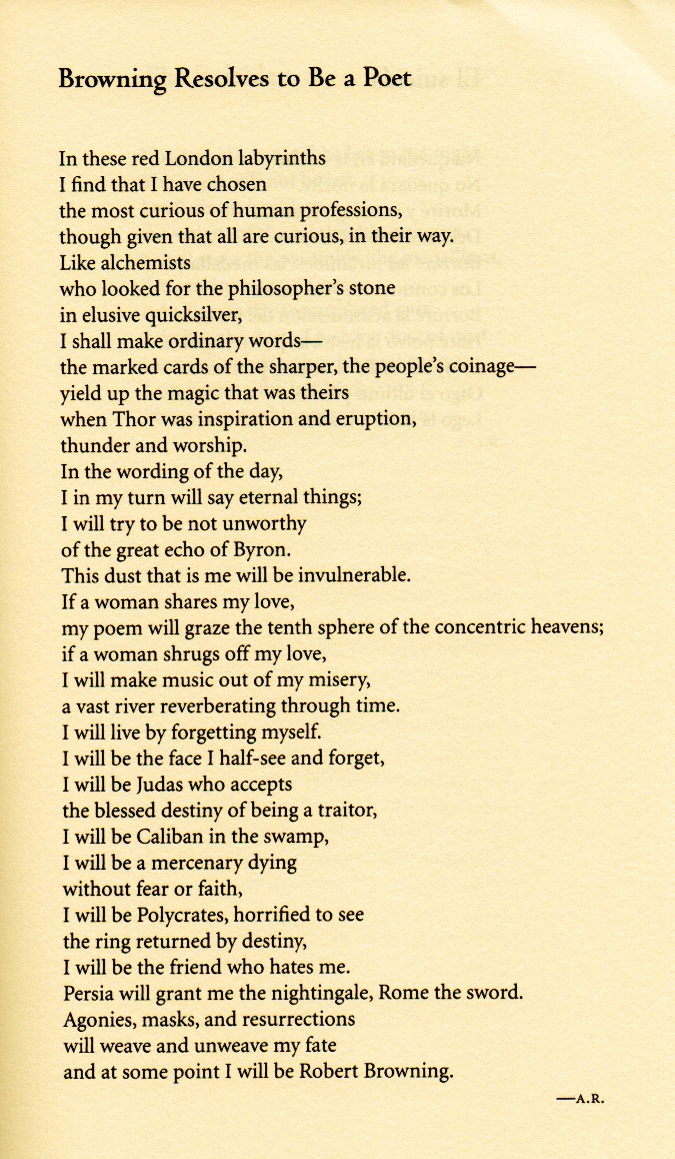
“Browning Resolves to Be a Poet” — Jorge Luis Borges

IMG_3144.JPG

Veronica’s Veil — Oskar Kokoschka

“All art constantly aspires towards the condition of music”

“The Ethnographer” — Jorge Luis Borges

“The Ethnographer”
by
Jorge Luis Borges

I was told about the case in Texas, but it had happened in another state. It has a single protagonist (though in every story there are thousands of protagonists, visible and invisible, alive and dead). The man’s name, I believe, was Fred Murdock. He was tall, as Americans are; his hair was neither blond nor dark, his features were sharp, and he spoke very little. There was nothing singular about him, not even that feigned singularity that young men affect. He was naturally respectful, and he distrusted neither books nor the men and women who write them. He was at that age when a man doesn’t yet know who he is, and so is ready to throw himself into whatever chance puts in his way — Persian mysticism or the unknown origins of Hungarian, the hazards of war or algebra, Puritanism or orgy. At the university, an adviser had interested him in Amerindian languages. Certain esoteric rites still survived in certain tribes out West; one of his professors, an older man, suggested that he go live on a reservation, observe the rites, and discover the secret revealed by the medicine men to the initiates. When he came back, he would have his dissertation, and the university authorities would see that it was published. Murdock leaped at the suggestion. One of his ancestors had died in the frontier wars; that bygone conflict of his race was now a link. He must have foreseen the difficulties that lay ahead for him; he would have to convince the red men to accept him as one of their own. He set out upon the long adventure. He lived for more than two years on the prairie, sometimes sheltered by adobe walls and sometimes in the open. He rose before dawn, went to bed at sundown, and came to dream in a language that was not that of his fathers. He conditioned his palate to harsh flavors, he covered himself with strange clothing, he forgot his friends and the city, he came to think in a fashion that the logic of his mind rejected. During the first few months of his new education he secretly took notes; later, he tore the notes up — perhaps to avoid drawing suspicion upon himself, perhaps because he no longer needed them. After a period of time (determined upon in advance by certain practices, both spiritual and physical), the priest instructed Murdock to start remembering his dreams, and to recount them to him at daybreak each morning. The young man found that on nights of the full moon he dreamed of buffalo. He reported these recurrent dreams to his teacher; the teacher at last revealed to him the tribe’s secret doctrine. One morning, without saying a word to anyone, Murdock left.

In the city, he was homesick for those first evenings on the prairie when, long ago, he had been homesick for the city. He made his way to his professor’s office and told him that he knew the secret, but had resolved not to reveal it.

“Are you bound by your oath?” the professor asked.

“That’s not the reason,” Murdock replied. “I learned something out there that I can’t express.”

“The English language may not be able to communicate it,” the professor suggested.

“That’s not it, sir. Now that I possess the secret, I could tell it in a hundred different and even contradictory ways. I don’t know how to tell you this, but the secret is beautiful, and science, our science, seems mere frivolity to me now.”

After a pause he added: “And anyway, the secret is not as important as the paths that led me to it. Each person has to walk those paths himself.”

The professor spoke coldly: “I will inform the committee of your decision. Are you planning to live among the Indians?”

“No,” Murdock answered. “I may not even go back to the prairie. What the men of the prairie taught me is good anywhere and for any circumstances.”

That was the essence of their conversation.

Fred married, divorced, and is now one of the librarians at Yale.

(Translation by Andrew Hurley).

The Japanese Book — William Merritt Chase

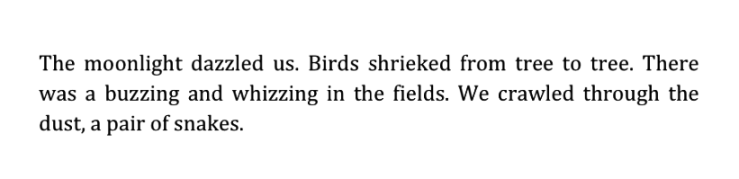
Dazzled (Kafka)

IMG_0101

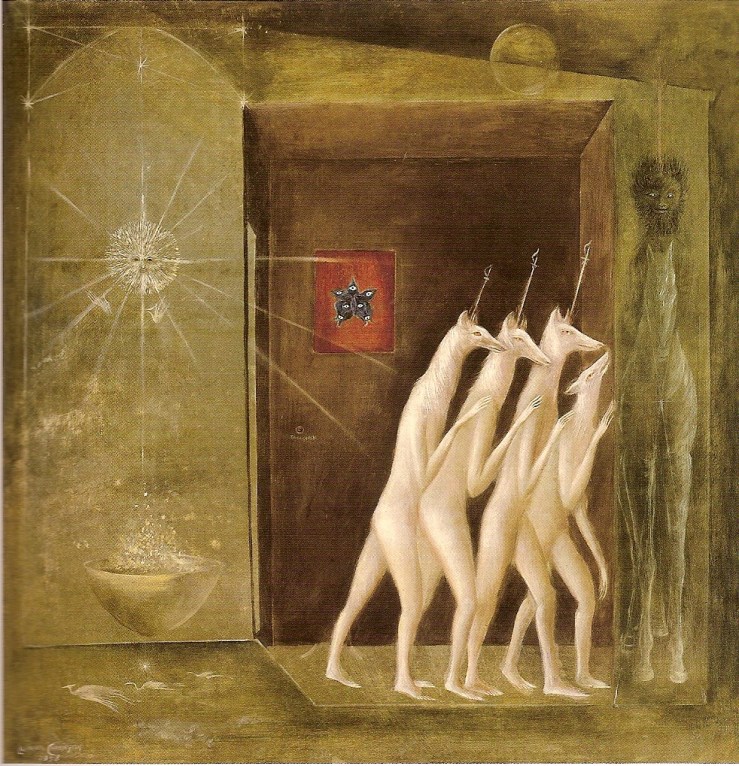
The 4706th Floor — Leonora Carrington

The 4706th Floor