Anti-paranoia (Gravity’s Rainbow)

Rain drips, soaking into the floor, and Slothrop perceives that he is losing his mind. If there is something comforting—religious, if you want—about paranoia, there is still also anti-paranoia, where nothing is connected to anything, a condition not many of us can bear for long. Well right now Slothrop feels himself sliding onto the anti-paranoid part of his cycle, feels the whole city around him going back roofless, vulnerable, uncentered as he is, and only pasteboard images now of the Listening Enemy left between him and the wet sky.

Either They have put him here for a reason, or he’s just here. He isn’t sure that he wouldn’t, actually, rather have that reason…

From Thomas Pynchon’s novel Gravity’s Rainbow. The “pasteboard images” line recalls a favorite passage of Moby-Dick.

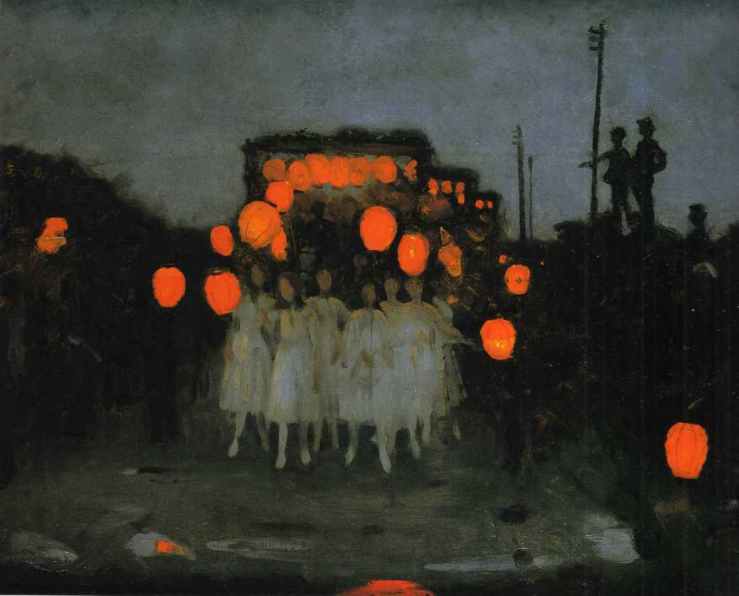
The Lantern Parade — Thomas Cooper Gotch

thomascoopergotchthelanternparade1

1000 Years of Popular Music — Richard Thompson (Film)

Read an excerpt of Alejandro Jodorowsky’s psychomagical memoir at BOMB Magazine

BOMB has published an excerpt from filmmaker Alejandro Jodorowsky’s new memoir Where the Bird Sings Best. An excerpt of the excerpt:

In those good old days, Salvador Arcavi, the first of a long series of Salvadors—traditionally all his descendants had the same name—though respectful of the Holy Book, decided he was not to going to be a prisoner to its letters. Following the prophecy Jacob made to his son (“Your hand will be on the neck of your enemy. Your father’s sons will bow down to you. Judah is a young lion.”), he became a lion tamer. His way to draw nearer to God was to study those beasts and to live an itinerant life, giving performances in which his union with his animals surpassed the limits of reality and reached the miraculous. The lions jumped through flaming hoops, balanced on the tight rope, danced on their hind legs, climbed up on one another to form a pyramid, spelled out the name of a spectator by choosing wooden letters, and, the greatest test, accepted within their jaws without hurting it the head of the tamer, then dragged him through the sawdust to draw a six-pointed star.

My ancestor had a simple method for making the beasts love him: he never forced them to do anything, and he made their training into a game. Whenever they wanted to eat, he fed them, and if they decided not to eat, he did not insist. If they wanted to sleep, he let them, and if they were rutting, he let them fornicate without distraction. He adopted the rhythm of the animals with care and tenderness. He let his hair grow into a mane, he ate raw meat, and he slept naked in the cage embracing his lions.

The Green Stocking — Egon Schiele

Even more beautiful emotions (Kafka’s diary entry, 27 March 1912)

27. March. Monday, on the street. The boy who with several others, threw a large ball at a servant girl walking defencelessly in front of them; just as the ball was flying at the girls’ behind I grabbed him by the throat, choked him in a fury, thrust him aside, and swore. Then walked on and didn’t even look at the girl. One quite forgets one’s earthly existence because one is so entirely full of fury is permitted to believe that, given the opportunity, one would in the same way fill oneself with even more beautiful emotions.

Franz Kafka’s diary entry, 27 March 1912. Translation by Joseph Kresh.