The Voice ( Summer Night) — Edvard Munch

What books does William T. Vollmann find himself returning to again and again?

William T. Vollmann is the interviewee in the New York Times feature “By the Book” this week. It’s a fun read (he chooses Sappho to write his life story, which cracked me up). From the piece:

What books do you find yourself returning to again and again?

I often reread certain parts of my Oxford Revised Standard Bible, which I recommend for the maps and footnotes. The parables of Jesus are haunting in the fashion of certain Zen koans. And the story of Jacob, Leah and Rachel, and the way it leads to young Joseph’s conceit and fall, is of gripping psychological interest. When she was very young I used to tell my daughter about the coat of many colors, and she would say: “But, why, Daddy? Why did they throw Joseph underground?” — “Because they were jealous.” — “Why were they jealous?” — “Because his father loved him more than the others.” She and I would follow the story backward and forward; its elegance was so perfect that my little child could understand it.

Georg Christoph Lichtenberg always inspires me to try to be myself. Here is one of his powerful aphorisms: “I believe that man is in the last resort so free a being that his right to be whatever he believes himself to be cannot be contested.”

I love that fountainhead of Norse myth and saga, the Elder Edda. It is, after all, part of my ethnocultural heritage. Its glorification of ruthless and often pointless cruelty troubles me, and I refuse to identify with that. But I can enjoy the delicate eeriness of other ghost stories without reveling in gruesome murders and wailing horrors, so why can’t I drink in the strangeness of Skirnir’s ride down to Hel on his quest to win the giant maiden? Moreover, the Norse ethos privileges steadfast endurance in the face of pain, bravery in the face of inevitable doom, and loyalty. These qualities would well become all of us mortals, and may grow more relevant once climate change really kicks in.

Summer — Pieter Bruegel

Freedom and the Self: Essays on the Philosophy of David Foster Wallace (Book acquired 7.21.2015)

IMG_7813

Freedom and the Self: Essays on the Philosophy of David Foster Wallace is new from Columbia University Press. Their blurb:

The book Fate, Time, and Language: An Essay on Free Will, published in 2010 by Columbia University Press, presented David Foster Wallace’s challenge to Richard Taylor’s argument for fatalism. In this anthology, notable philosophers engage directly with that work and assess Wallace’s reply to Taylor as well as other aspects of Wallace’s thought.

With an introduction by Steven M. Cahn and Maureen Eckert, this collection includes essays by William Hasker (Huntington University), Gila Sher (University of California, San Diego), Marcello Oreste Fiocco (University of California, Irvine), Daniel R. Kelly (Purdue University), Nathan Ballantyne (Fordham University), Justin Tosi (University of Arizona), and Maureen Eckert. These thinkers explore Wallace’s philosophical and literary work, illustrating remarkable ways in which his philosophical views influenced and were influenced by themes developed in his other writings, both fictional and nonfictional. Together with Fate, Time, and Language, this critical set unlocks key components of Wallace’s work and its traces in modern literature and thought.

Read Herman Melville’s story “The Fiddler”

“The Fiddler”

by

Herman Melville


So my poem is damned, and immortal fame is not for me! I am nobody forever and ever. Intolerable fate!

Snatching my hat, I dashed down the criticism, and rushed out into Broadway, where enthusiastic throngs were crowding to a circus in a side-street near by, very recently started, and famous for a capital clown.

Presently my old friend Standard rather boisterously accosted me.

“Well met, Helmstone, my boy! Ah! what’s the matter? Haven’t been committing murder? Ain’t flying justice? You look wild!”

“You have seen it then?” said I, of course referring to the criticism.

“Oh yes; I was there at the morning performance. Great clown, I assure you. But here comes Hautboy. Hautboy—Helmstone.”

Without having time or inclination to resent so mortifying a mistake, I was instantly soothed as I gazed on the face of the new acquaintance so unceremoniously introduced. His person was short and full, with a juvenile, animated cast to it. His complexion rurally ruddy; his eye sincere, cheery, and gray. His hair alone betrayed that he was not an overgrown boy. From his hair I set him down as forty or more.

“Come, Standard,” he gleefully cried to my friend, “are you not going to the circus? The clown is inimitable, they say. Come; Mr. Helmstone, too—come both; and circus over, we’ll take a nice stew and punch at Taylor’s.”

The sterling content, good humor, and extraordinary ruddy, sincere expression of this most singular new acquaintance acted upon me like magic. It seemed mere loyalty to human nature to accept an invitation from so unmistakably kind and honest a heart.

During the circus performance I kept my eye more on Hautboy than on the celebrated clown. Hautboy was the sight for me. Such genuine enjoyment as his struck me to the soul with a sense of the reality of the thing called happiness. The jokes of the clown he seemed to roll under his tongue as ripe magnum bonums. Now the foot, now the hand, was employed to attest his grateful applause. At any hit more than ordinary, he turned upon Standard and me to see if his rare pleasure was shared. In a man of forty I saw a boy of twelve; and this too without the slightest abatement of my respect. Because all was so honest and natural, every expression and attitude so graceful with genuine good-nature, that the marvelous juvenility of Hautboy assumed a sort of divine and immortal air, like that of some forever youthful god of Greece. Continue reading “Read Herman Melville’s story “The Fiddler””

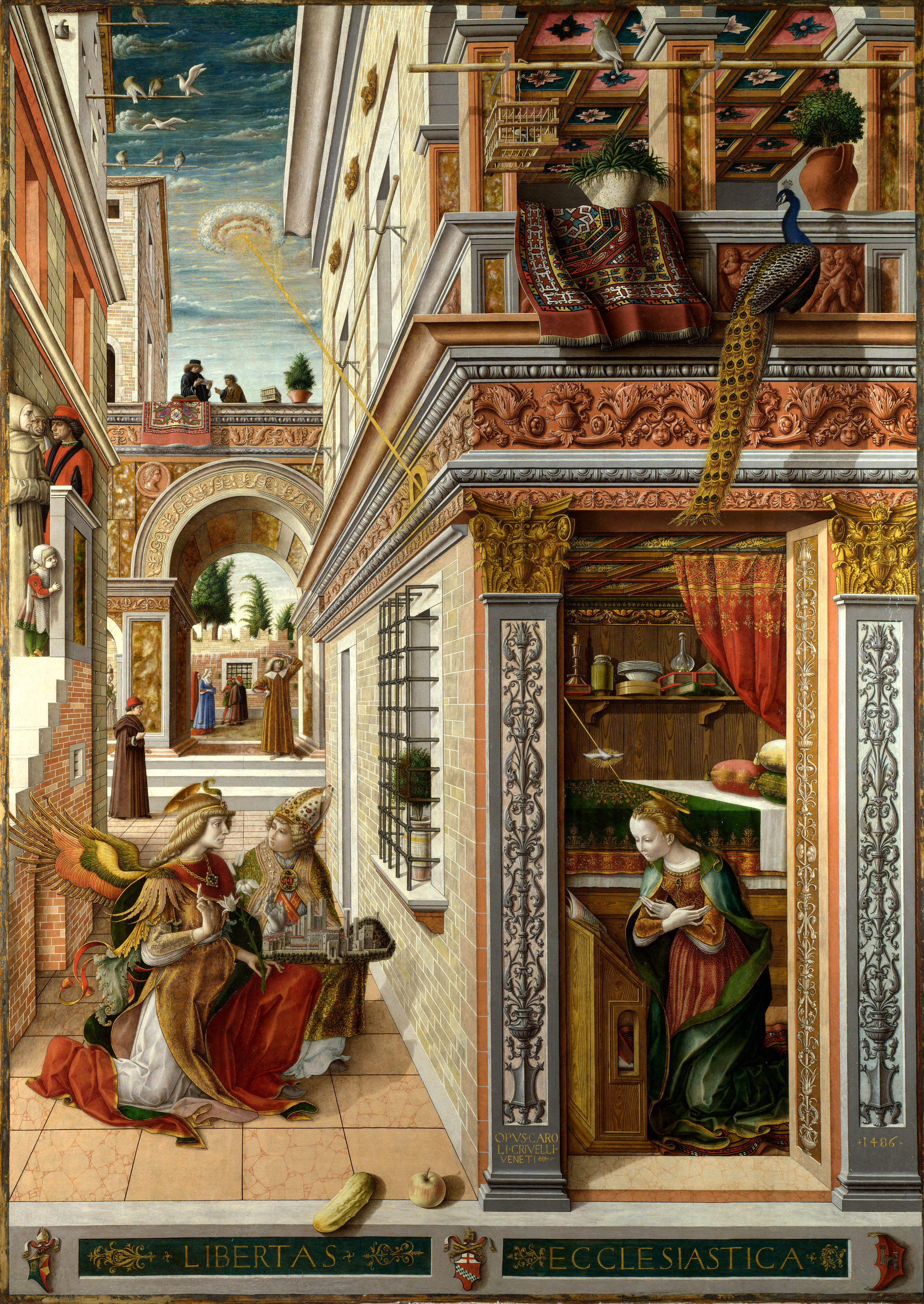
Detail from Crivelli’s Annunciation

Screenshot 2015-07-20 at 9.30.41 AM