Nude Reader Reclining — Felice Casorati

tumblr_n6sq23lmJo1qb4lg8o1_1280

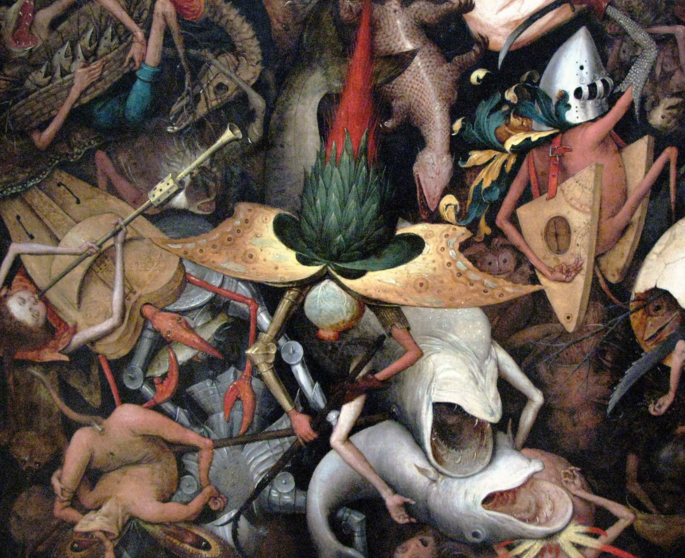
The Fall of the Rebel Angels (Detail) — Pieter Bruegel the Elder

Screenshot 2015-10-17 at 5.28.11 PM

No supernaturalism, only the occult continuation of infinite nature

Daydream, which is to thought as the nebula is to the star, borders on sleep, and is concerned with it as its frontier. An atmosphere inhabited by living transparencies: there’s a beginning of the unknown. But beyond it the Possible opens out, immense. Other beings, other facts, are there. No supernaturalism, only the occult continuation of infinite nature … Sleep is in contact with the Possible, which we also call the improbable. The world of the night is a world. Night, as night, is a universe … The dark things of the unknown world become neighbors of man, whether by true communication or by a visionary enlargement of the distances of the abyss … and the sleeper, not quite seeing, not quite unconscious, glimpses the strange animalities, weird vegetations, terrible or radiant pallors, ghosts, masks, figures, hydras, confusions, moonless moonlights, obscure unmakings of miracle, growths and vanishings within a murky depth, shapes floating in shadow, the whole mystery which we call Dreaming, and which is nothing other than the approach of an invisible reality. The dream is the aquarium of Night.

— VICTOR HUGO, LES TRAVAILLEURS DE LA MER

The Hugo citation comes from Ursula K. Le Guin’s 1971 novel The Lathe of Heaven—Le Guin uses it as a preface to the seventh chapter. It’s beautiful on its own; it also functions as a kind of poetic summary of The Lathe of Heaven.

Beggar with Mandolin — Tamara de Lempicka

Laurie Anderson​ picks DVDs from the Criterion Collection closet

Don DeLillo: The Word, the Image, the Gun (Documentary)

The Ray — Jean-Baptiste-Simeon Chardin

The Fall of the Rebel Angels (Detail) — Pieter Bruegel the Elder

Screenshot 2015-10-17 at 5.26.18 PM

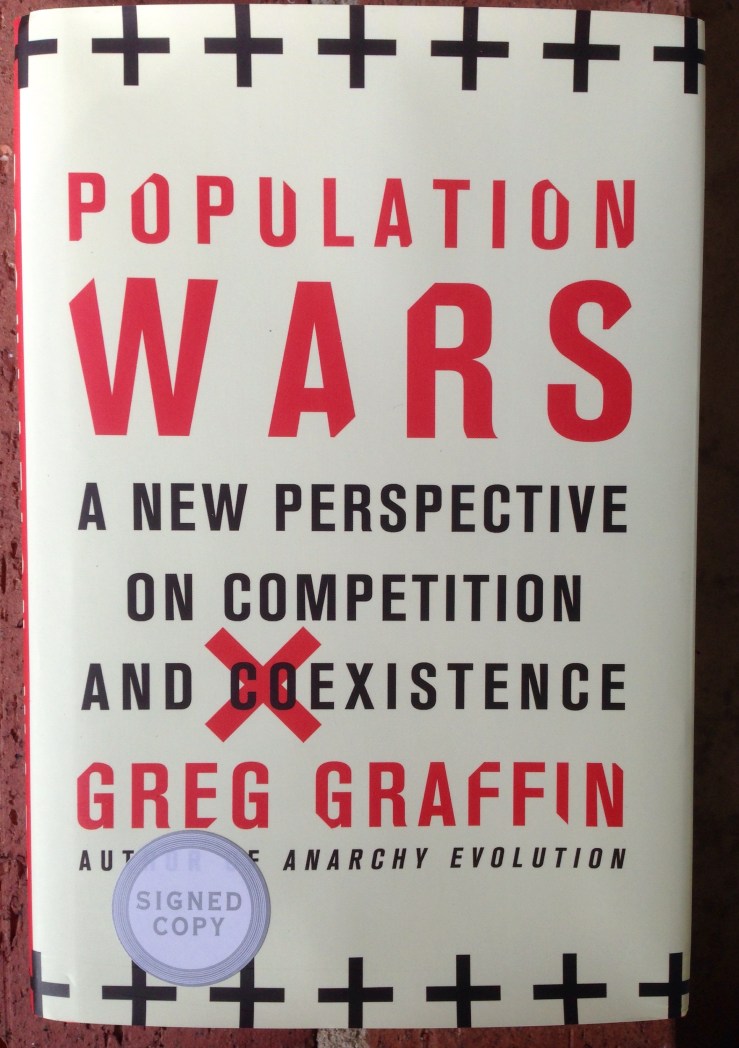
Greg Graffin’s Population Wars (Book acquired some time in September, 2015)

IMG_8539

Greg Graffin is probably best known for his work as the leader of Bad Religion, a band he formed when he was 15. Graffin is also an academic and author. His latest book, Population Wars, makes a compelling argument for coexistence. It’s an accessible and persuasive read, rooted in biology and hope. (And of the three books I’ve read by indie rockers of yore this year, it’s easily the best). Publisher Thomas Dunne’s blurb:

From the very beginning, life on Earth has been defined by war. Today those first wars continue to be fought around and inside us, influencing our individual behavior and that of civilization as a whole. War between populations—whether between different species or between rival groups of humans—is seen as an inevitable part of the evolutionary process. The popular concept of survival of the fittest explains and often excuses these actions.

In Population Wars, Greg Graffin points to where the mainstream view of evolutionary theory has led us astray. That misunderstanding has allowed us to justify wars on every level, whether against bacterial colonies or human societies, even when other, less violent solutions may be available. Through tales of mass extinctions, developing immune systems, human warfare, the American industrial heartland, and our degrading modern environment, Graffin demonstrates how an oversimplified idea of war, with its victorious winners and vanquished losers, prevents us from responding to the real problems we face. Along the way, Graffin reveals a paradox: When we challenge conventional definitions of war, we are left with a new problem—how to define ourselves.

Population Wars is a paradigm-shifting book about why humans behave the way they do and the ancient history that explains that behavior. In reading it, you’ll see why we need to rethink the reasons for war, not only the human military kind but also Darwin’s “war of nature,” and find hope for a less violent future for mankind.

IMG_8540

“All art constantly aspires towards something or other”

Dissection of a Landscape — Jaroslav Serpan

Three ideas from Nathaniel Hawthorne’s Note-Books

It seems a greater pity that an accomplished worker with the hand should perish prematurely, than a person of great intellect; because intellectual arts may be cultivated in the next world, but not physical ones.

To trace out the influence of a frightful and disgraceful crime in debasing and destroying a character naturally high and noble, the guilty person being alone conscious of the crime.

A man, virtuous in his general conduct, but committing habitually some monstrous crime,–as murder,–and doing this without the sense of guilt, but with a peaceful conscience,–habit, probably, reconciling him to it; but something (for instance, discovery) occurs to make him sensible of his enormity. His horror then.

From Nathaniel Hawthorne’s Passages from the American Note-Books.

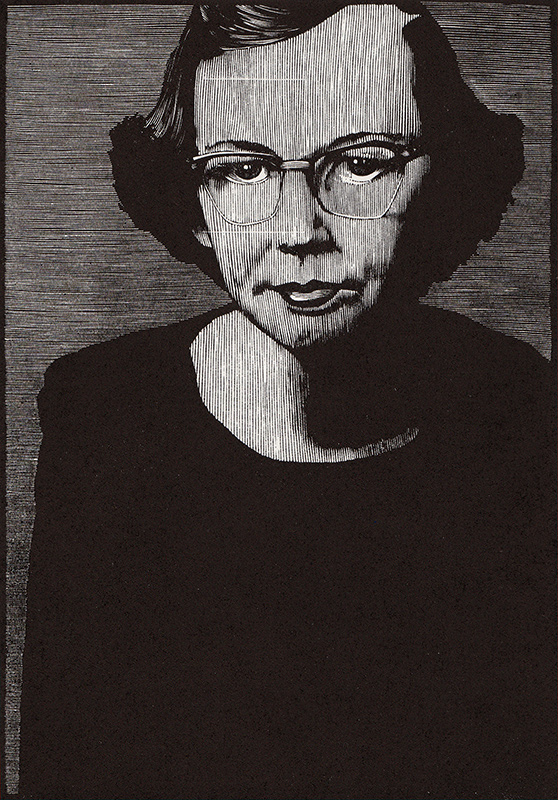
Portrait of Flannery O’Connor — Barry Moser

Florence-O-Connor-7_75x5_25

The Fall of the Rebel Angels (Detail) — Pieter Bruegel the Elder

Screenshot 2015-10-17 at 5.24.36 PM

Orpheus V — Albín Brunovský

orpheus

Totally insane world (Ursula K. Le Guin)

“I am cracking,” he said. “You must see that. You’re a psychiatrist. Don’t you see that I’m going to pieces? Aliens from outer space attacking Earth! Look: if you ask me to dream again, what will you get? Maybe a totally insane world, the product of an insane mind. Monsters, ghosts, witches, dragons, transformations—all the stuff we carry around in us, all the horrors of childhood, the night fears, the nightmares. How can you keep all that from getting loose? I can’t stop it. I’m not in control!”

“Don’t worry about control! Freedom is what you’re working toward,” Haber said gustily. “Freedom! Your unconscious mind is not a sink of horror and depravity. That’s a Victorian notion, and a terrifically destructive one. It crippled most of the best minds of the nineteenth century, and hamstrung psychology all through the first half of the twentieth. Don’t be afraid of your unconscious mind! It’s not a black pit of nightmares. Nothing of the kind! It is the wellspring of health, imagination, creativity. What we call ‘evil’ is produced by civilization, its constraints and repressions, deforming the spontaneous, free self-expression of the personality. The aim of psychotherapy is precisely this, to remove those groundless fears and nightmares, to bring up what’s unconscious into the light of rational consciousness, examine it objectively, and find that there is nothing to fear.”

“But there is,” Orr said very softly.

From Ursula K. Le Guin’s 1971 novel The Lathe of Heaven.


The Fall of the Rebel Angels (Detail) — Pieter Bruegel the Elder

Screenshot 2015-10-17 at 5.21.53 PM