“Gorse Is Not People,” a short story by Janet Frame

“Gorse Is Not People”

by

Janet Frame


Do you remember your twenty-first birthday? The party, the cake, and cutting a slice of it to put under your pillow that night, to make you dream of your future beloved; the giant key; the singing:

I’m twenty-one today!

Twenty-one today!

I’ve got the key of the door!

Never been twenty-one before!

Trivial, obvious words. Yet when the party was over and you lay in bed remembering the glinting key and the shamrock taste of the small glass of wine, and perhaps the taste of a sneaked last kiss in the dark, then the song seemed not trivial or obvious but a poetic statement of a temporal wonder. You had, as they say, attained your majority. You could vote in the elections; you could leave home against your parents’ wishes; you could marry in defiance of all opposition. You had crossed a legal border into a free country, and you now walked equipped with a giant tinsel key, a cardboard key covered with threepenny spangles.

Or perhaps your twenty-first birthday did not happen that way. Perhaps there was no party, no cake, no wine, and no kiss? I would like to tell you about Naida’s twenty-first birthday.

Naida was a dwarf, which is not really a rare thing. I suppose in our lifetime we see many dwarves—first, perhaps, at the circus, where they are advertised as the tiniest people in the world and we pay to watch them moving about in their almost walnut-shell or matchbox beds. Sometimes we pass them in the street and stare hard for a moment, then pretend we haven’t seen them, until they have passed us and we look back, saying, “It must be strange, how strange it must be, such tiny folk, and us out of reach, like tall trees!” Continue reading ““Gorse Is Not People,” a short story by Janet Frame”

Solitaire — Felix Vallotton

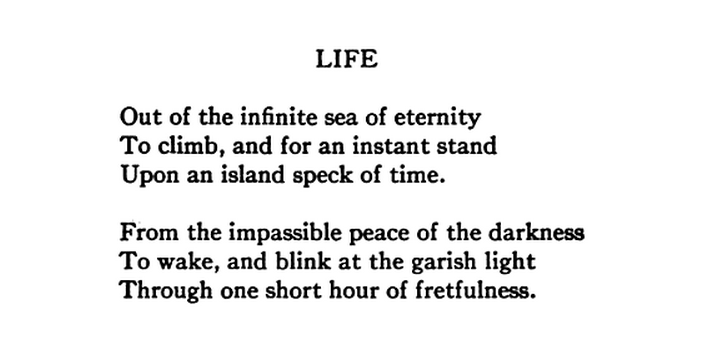
“Life” — James Weldon Johnson

Screenshot 2015-05-29 at 5.48.43 PM

Portrait of a Gentleman in His Study — Lorenzo Lotto

“A Geometric” — Sam Prekop

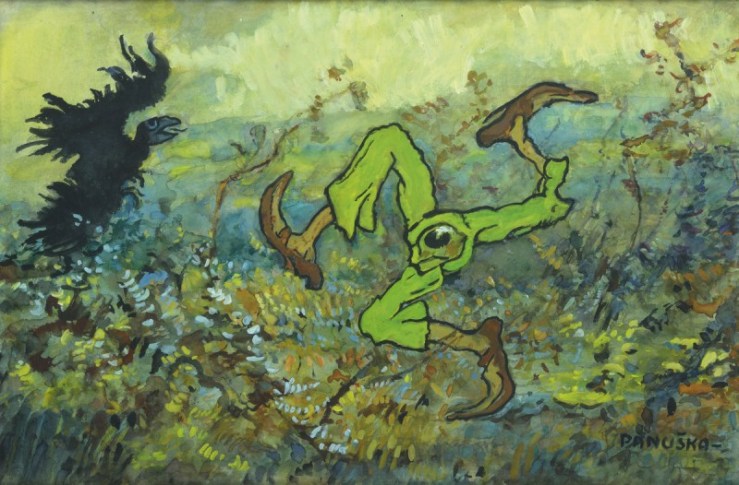
Triskelion — Jaroslav Panuška

jaroslav-panuska-triskelion-1908-1910-2014-04-15-800x526

“The devil suffered from ennui” | Read Maxim Gorky’s short tale “The Devil”

“The Devil”

by

Maxim Gorky

English translation by Leo Wiener


Life is a burden in the Fall,—the sad season of decay and death!

The grey days, the weeping, sunless sky, the dark nights, the growling, whining wind, the heavy, black autumn shadows—all that drives clouds of gloomy thoughts over the human soul, and fills it with a mysterious fear of life where nothing is permanent, all is in an eternal flux; things are born, decay, die … why? … for what purpose?…

Sometimes the strength fails us to battle against the tenebrous thoughts that enfold the soul late in the autumn, therefore those who want to assuage their bitterness ought to meet them half way. This is the only way by which they will escape from the chaos of despair and doubt, and will enter on the terra firma of self-confidence.

But it is a laborious path, it leads through thorny brambles that lacerate the living heart, and on that path the devil always lies in ambush. It is that best of all the devils, with whom the great Goethe has made us acquainted….

My story is about that devil.


The devil suffered from ennui.

He is too wise to ridicule everything.

He knows that there are phenomena of life which the devil himself is not able to rail at; for example, he has never applied the sharp scalpel of his irony to the majestic fact of his existence. To tell the truth, our favourite devil is more bold than clever, and if we were to look more closely at him, we might discover that, like ourselves, he wastes most of his time on trifles. But we had better leave that alone; we are not children that break their best toys in order to discover what is in them. Continue reading ““The devil suffered from ennui” | Read Maxim Gorky’s short tale “The Devil””

Heaven and Earth Magic

Nightmare trip Seinfeld (“The Handicap Spot” S04E22)

“Cut-up from THE GREAT GATSBY and some other sources” — William S. Burroughs

Money — Frantisek Kupka

A U.S. of modern A. where the State is not a team or a code, but a sort of sloppy intersection of desires and fears (Infinite Jest)

…but who can imagine this training serving its purpose in an experialist and waste-exporting nation that’s forgotten privation and hardship and the discipline which hardship teaches by requiring? A U.S. of modern A. where the State is not a team or a code, but a sort of sloppy intersection of desires and fears, where the only public consensus a boy must surrender to is the acknowledged primacy of straight-line pursuing this flat and short-sighted idea of personal happiness: ‘The happy pleasure of the person alone, yes?’

From: David Foster Wallace’s novel Infinite Jest.

Woman with Cat — Hans Baldung

Mary Ellen Mark on photographing Frederico Fellini