Categories are bad news (Barry Hannah)

 WT: Do you read magazines?

BH: If someone would rave about a story in the New Yorker, I’ll read it. But you get a lot of that Woody Allen–New Yorker–Hamptons fiction. My [students] have to send off to the little magazines. I get the sense that only grad students read those.

WT: Writer’s writers?

BH: I don’t like that term, because I wouldn’t buy somebody’s album on a dare if they called him a musician’s musician. I don’t write to be a writer’s writer. I don’t want to be like the little-magazine writer. I don’t want to be that.

Categories are bad news. Being Southern will just kill you sometimes. It’s not always a graceful adjective. Sometimes it means, don’t bother because it’s gonna be [sings a lick from dueling banjos]. It’s gonna be: porch, banjo, Negroes. There’s a canned dream of the South that a lot of people get into, and I’ve resisted that stuff my entire so-called career. Ready-made Southernism just disgusts me, just makes me nauseated. I mean, you can’t see a movie without hearing that goddamned slide guitar. Shit, I’m just so tired of it.


From Barry Hannah’s interview with Wells Tower in The Believer.

“Holy Thursday” (Experience) — William Blake

“Holy Thursday” (Innocence) — William Blake

Metamorphosis — Agostino Arrivabene

resize

One Possible Sequence for Reading Thomas Pynchon’s Novels, Presented Without Remarks

Mason & Dixon

Against the Day

Gravity’s Rainbow

V.

The Crying of Lot 49

Inherent Vice

Vineland

Bleeding Edge

Study Sheet with Fools, Faun, Phoenix and Deer Hunting — Albrecht Durer

Watch The Lives of Brian, A Documentary About Flann O’Brien

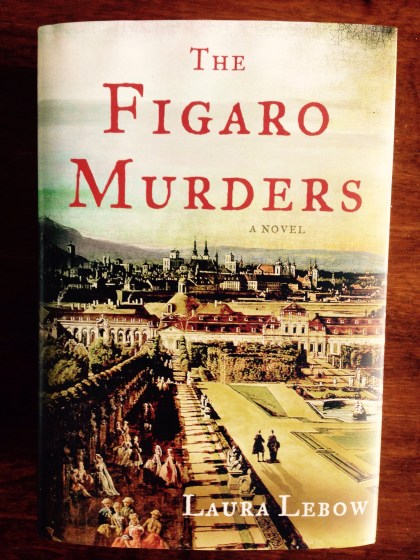
The Figaro Murders (Book acquired some time in February, 2015)

IMG_5571

Laura Lebow’s mystery The Figaro Murders is new in hardback from Macmillan’s Minotaur imprint. Their blurb:

In 1786 Vienna, Lorenzo Da Ponte is the court librettist for the Italian Theatre during the height of the enlightened reign of Emperor Joseph II. This exalted position doesn’t mean he’s particularly well paid, or even out of reach of the endless intrigues of the opera world. In fact, far from it.

One morning, Da Ponte stops off at his barber, only to find the man being taken away to debtor’s prison. Da Ponte impetuously agrees to carry a message to his barber’s fiancée and try to help her set him free, even though he’s facing pressures of his own. He’s got one week to finish the libretto for The Marriage of Figaro for Mozart before the opera is premiered for the Emperor himself.
Da Ponte visits the house where the barber’s fiancée works–the home of a nobleman, high in the Vienna’s diplomatic circles–and then returns to his own apartments, only to be dragged from his rooms in the middle of the night. It seems the young protégé of the diplomat was killed right about the time Da Ponte was visiting, and he happens to be their main suspect. Now he’s given a choice–go undercover into the household and uncover the murderer, or be hanged for the crime himself.
Brilliantly recreating the cultural world of late 18th century Vienna, the epicenter of the Enlightenment, Lebow brings to life some of the most famous figures of music, theatre, and politics.

“Our April Letter” — F. Scott Fitzgerald

This is April again. Roller skates rain slowly down the street
Your voice far away on the phone
Once I would have jumped like a clown through a hoop—
but
“Then the area of infection has increased? …oh …What can I expect after all—I’ve had worse shocks.
Anyhow, I know and that’s something.” (Like hell it is, but it’s what you say to an X-ray doctor.)
Then the past whispering faint now on another phone:
“Is there any change?”
“Little or no change”
“I see”
The roller skates rain down the streets,
The black cars shine between the leaves,
Your voice far away:
“I am going with my daughter to the country. My husband left today. . . No he knows nothing.”
“Good”.
I have asked a lot of my emotions—one hundred and twenty stories, The price was high, right up with Kipling, because there was one little drop of something not blood, not a tear, not my seed, but me more intimately than these, in every story, it was the extra I had. Now it has gone and I am just like you now.
Once the phial was full—here is the bottle it came in.
Hold on there’s a drop left there. . . No, it was just the way the light fell
But your voice on the telephone. If I hadn’t abused words so what you said might have meant something.
But one hundred and twenty stories
April evening spreads over everything, the purple blur left by a child who has used the whole paint-box.

“Our April Letter” is from F. Scott Fitzgerald’s Notebooks.


A Lady with a Cat — Giovanni Boldini

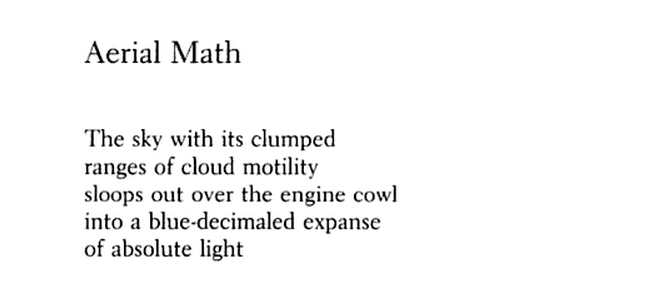
“Aerial Math” — Tom Clark

Screenshot 2015-03-31 at 4.03.24 PM

A universal sense of guilt or an attitude of universal accusation (Italo Calvino)

…if it is impossible today for anyone to feel innocent, if in whatever we do or say we can discover a hidden motive – that of a white man,or a male, or the possessor of a certain income, or a member of a given economic system, or a suffer from a certain neurosis – this should not induce in us either a universal sense of guilt or an attitude of universal accusation.

When we become aware of our disease or of our hidden motives, we have already begun to get the better of them. What matters is the way in which we accept our motives and live through the ensuing crisis. This is the only chance we have of becoming different from the way we are – that is, the only way of starting to invent a new way of being.

From Italo Calvino’s essay “Right and Wrong Uses of Political Uses of Literature.” The essay was delivered as a lecture–in English–in 1976. (Translation credit for the volume the essay is collected in, The Uses of Literature, goes to Patrick Creagh).

The Eternal Evidence — Rene Magritte

Geoff Dyer’s Another Great Day at Sea (Book acquired, 3.26.2015)

IMG_5682

Another Great Day at Sea, Geoff Dyer’s account of life (okay, two weeks of life) on board a U.S. aircraft carrier, is new in trade paperback next week from Random House. Their blurb:

As a child Geoff Dyer spent long hours making and blotchily painting model fighter planes. So as an adult, naturally he jumped at the chance to spend a week onboard the aircraft carrier the USS George H.W. Bush. Part deft travelogue, part unerring social observation, and part finely honed comedy, Another Great Day at Sea is the inimitable Dyer’s account of his time spent wandering the ship’s maze of walkways, hatches, and stairs, and talking with the crew—from the Captain to the ship’s dentists. A lanky Englishman in a deeply American world, Dyer brilliantly records daily life aboard this floating fortress, revealing it to be a prism for understanding a society where discipline and conformity become forms of self-expression. At the same time we are reminded why Dyer is celebrated as one of the most original voices in contemporary literature.

Read an excerpt here.

Always eat grapes downwards (Samuel Butler)

Always eat grapes downwards—that is, always eat the best grape first; in this way there will be none better left on the bunch, and each grape will seem good down to the last.  If you eat the other way, you will not have a good grape in the lot.  Besides, you will be tempting Providence to kill you before you come to the best.  This is why autumn seems better than spring: in the autumn we are eating our days downwards, in the spring each day still seems “Very bad.”  People should live on this principle more than they do, but they do live on it a good deal; from the age of, say, fifty we eat our days downwards.

In New Zealand for a long time I had to do the washing-up after each meal.  I used to do the knives first, for it might please God to take me before I came to the forks, and then what a sell it would have been to have done the forks rather than the knives!

From Samuel Butler’s Note-Books

Landscape with Couple Walking and Crescent Moon — Vincent van Gogh

Brief internal feminist critique (perhaps) of Gravity’s Rainbow

tnagr

From page 507 of Thomas Pynchon’s novel Gravity’s Rainbow.