Speaking of dancers (Kafka)

The necessity of speaking of dancers with exclamation marks. Because in that way one imitates their motion, because one remains in the rhythm and the thought does not then interfere with the enjoyment, because then the action always comes at the end of the sentence and prolongs its effect better.

From Franz Kafka’s diary entry, 16 March 1912.

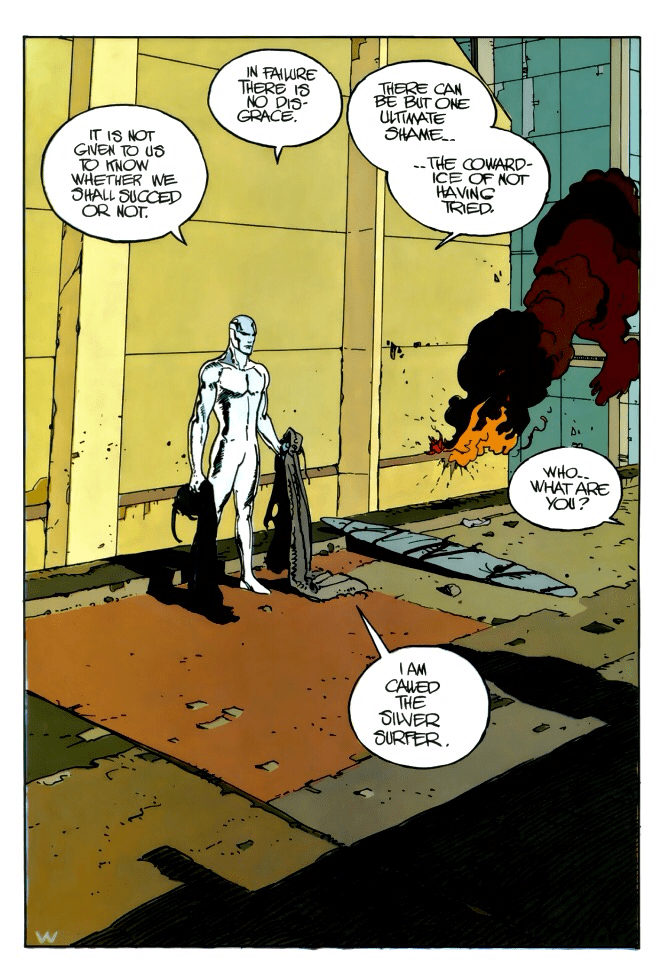
Silver Surfer — Moebius 


“Marriage à la Mode” — Katherine Mansfield

“Marriage à la Mode”

by

Katherine Mansfield

On his way to the station William remembered with a fresh pang of disappointment that he was taking nothing down to the kiddies. Poor little chaps! It was hard lines on them. Their first words always were as they ran to greet him, “What have you got for me, daddy?” and he had nothing. He would have to buy them some sweets at the station. But that was what he had done for the past four Saturdays; their faces had fallen last time when they saw the same old boxes produced again.

And Paddy had said, “I had red ribbing on mine bee-fore!”

And Johnny had said, “It’s always pink on mine. I hate pink.”

But what was William to do? The affair wasn’t so easily settled. In the old days, of course, he would have taken a taxi off to a decent toyshop and chosen them something in five minutes. But nowadays they had Russian toys, French toys, Serbian toys—toys from God knows where. It was over a year since Isabel had scrapped the old donkeys and engines and so on because they were so “dreadfully sentimental” and “so appallingly bad for the babies’ sense of form.”

“It’s so important,” the new Isabel had explained, “that they should like the right things from the very beginning. It saves so much time later on. Really, if the poor pets have to spend their infant years staring at these horrors, one can imagine them growing up and asking to be taken to the Royal Academy.” Continue reading ““Marriage à la Mode” — Katherine Mansfield”

Robert Seydel’s ‘Songs of S.’

Siglio_Maybe-S_Seydel-8

S., locked in a room, is singing. He is surrounded by dust and books about the South Pole, animals, “Paleolithic Masters,” and poetry. He lives around the corner from Emily Dickinson, another shut-in, who visits S. “in form of a bee.” And he sings and sings; in fact, he writes, “songs / dominating / everything / now –,” ending the line with hisfamous neighbor’s signature dash.

I was lucky enough to study with Robert Seydel at Hampshire College from 2008 – 2011, when he died suddenly of a heart attack. ‘Songs of S.’ is a book of Robert’s poetry and drawings that was recently published by Siglio Press and Ugly Duckling Presse. You can read the rest of my brief review over at The Improbable.

Beware

beware

The Bus — Paul Kirchner

fcTGdSL

The Illuminated Man — Duane Michals

Duane Michals, The Illuminated Man, 1968. © Duane Michals, Court

Ides of March — Cy Twombly

“The Gentle Boy” — Nathaniel Hawthorne

“The Gentle Boy”

by

Nathaniel Hawthorne

In the course of the year 1656 several of the people called Quakers—led, as they professed, by the inward movement of the spirit—made their appearance in New England. Their reputation as holders of mystic and pernicious principles having spread before them, the Puritans early endeavored to banish and to prevent the further intrusion of the rising sect. But the measures by which it was intended to purge the land of heresy, though more than sufficiently vigorous, were entirely unsuccessful. The Quakers, esteeming persecution as a divine call to the post of danger, laid claim to a holy courage unknown to the Puritans themselves, who had shunned the cross by providing for the peaceable exercise of their religion in a distant wilderness. Though it was the singular fact that every nation of the earth rejected the wandering enthusiasts who practised peace toward all men, the place of greatest uneasiness and peril, and therefore in their eyes the most eligible, was the province of Massachusetts Bay.

The fines, imprisonments and stripes liberally distributed by our pious forefathers, the popular antipathy, so strong that it endured nearly a hundred years after actual persecution had ceased, were attractions as powerful for the Quakers as peace, honor and reward would have been for the worldly-minded. Every European vessel brought new cargoes of the sect, eager to testify against the oppression which they hoped to share; and when shipmasters were restrained by heavy fines from affording them passage, they made long and circuitous journeys through the Indian country, and appeared in the province as if conveyed by a supernatural power. Their enthusiasm, heightened almost to madness by the treatment which they received, produced actions contrary to the rules of decency as well as of rational religion, and presented a singular contrast to the calm and staid deportment of their sectarian successors of the present day. The command of the Spirit, inaudible except to the soul and not to be controverted on grounds of human wisdom, was made a plea for most indecorous exhibitions which, abstractedly considered, well deserved the moderate chastisement of the rod. These extravagances, and the persecution which was at once their cause and consequence, continued to increase, till in the year 1659 the government of Massachusetts Bay indulged two members of the Quaker sect with the crown of martyrdom.

An indelible stain of blood is upon the hands of all who consented to this act, but a large share of the awful responsibility must rest upon the person then at the head of the government. He was a man of narrow mind and imperfect education, and his uncompromising bigotry was made hot and mischievous by violent and hasty passions; he exerted his influence indecorously and unjustifiably to compass the death of the enthusiasts, and his whole conduct in respect to them was marked by brutal cruelty. The Quakers, whose revengeful feelings were not less deep because they were inactive, remembered this man and his associates in after-times. The historian of the sect affirms that by the wrath of Heaven a blight fell upon the land in the vicinity of the “bloody town” of Boston, so that no wheat would grow there; and he takes his stand, as it were, among the graves of the ancient persecutors, and triumphantly recounts the judgments that overtook them in old age or at the parting-hour. He tells us that they died suddenly and violently and in madness, but nothing can exceed the bitter mockery with which he records the loathsome disease and “death by rottenness” of the fierce and cruel governor. Continue reading ““The Gentle Boy” — Nathaniel Hawthorne”

A drinking game called Prince (Gravity’s Rainbow)

One day Slothrop gets a chance to check this out. Seems Dodson-Truck is a chess fanatic. Down in the bar one afternoon he gets around to asking Slothrop if he plays.
“Nope,” lying, “not even checkers.”
“Damn. I’ve hardly had time till now for a good game.”
“I do know a game,” has something of Tantivy been sheltering inside all this time? “a drinking game, it’s called Prince, maybe the English even invented it, cause you have those princes, right? and we don’t, not that that’s wrong understand, but everybody takes a number, a-and you start off the Prince of Wales has lost his tails, no offense now, the numbers going clockwise around the table, and number two has found them, clockwise from that Prince, or whatever number he wants to call out actually, he, that’s the Prince, six or anything, see, you pick a Prince first, he starts it off, then that number two, or whoever that Prince called, sez, but first he goes, the Prince does, Wales, tails, two sir, after saying that about how that Prince of Wales has lost his tails, and number two answers, not I, sir—”
“Yes yes but—” giving Slothrop a most odd look, “I mean I’m not quite sure I really see, you know, the point to it all. How does one win?”
“Ha! How does one win, indeed. “One doesn’t win,” easing into it, thinking of Tantivy, one small impromptu counter-conspiracy here, “one loses. One by one. Whoever’s left is the winner.”
“It sounds rather negative.”
“Garçon.”


From Thomas Pynchon’s novel Gravity’s Rainbow.

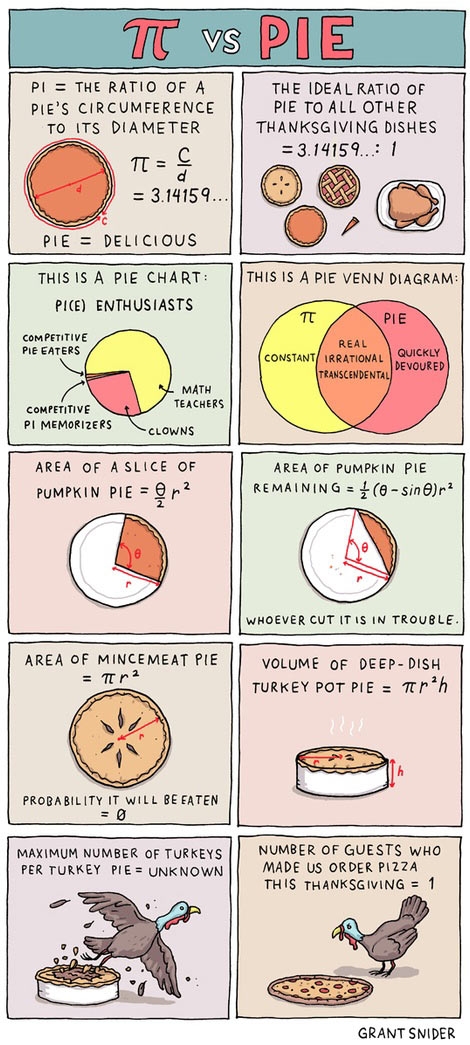
Pi vs. Pie — Grant Snider

4120130019170

An Excerpt From An Excerpt of Han Kang’s The Vegetarian

I crammed my feet into my recently purchased shoes, which were too narrow and pinched uncomfortably, threw open the front door and ran out. I checked whether the lift was going to go all the way up to the top floor, and then dashed down three flights of stairs. Only once I’d managed to jump on the underground train as it was just about to leave did I have time to take in my appearance, reflected in the dark carriage window. I ran my fingers through my hair, did up my tie, and attempted to smooth out the creases in my shirt. My wife’s unnaturally serene face, her incongruously firm voice, surfaced in my mind.

I had a dream—she’d said that twice now. Beyond the window, in the dark tunnel, her face flitted by—her face, but unfamiliar, as though I was seeing it for the first time. However, as I had thirty minutes in which to concoct an excuse for my client that would justify my lateness, as well as putting together a draft proposal for today’s meeting, there was no time for mulling over the strange behavior of my even-stranger wife.

Having said that, I told myself that somehow or other I had to leave the office early today (never mind that in the several months since I’d switched to my new position there hadn’t been a single day where I’d got off before midnight), and steeled myself for a confrontation.

Dark woods. No people. The sharp-pointed leaves on the trees, my torn feet. This place, almost remembered, but I’m lost now. Frightened. Cold. Across the frozen ravine, a red barn-like building. Straw matting flapping limp across the door. Roll it up and I’m inside, it’s inside. A

long bamboo stick strung with great blood-red gashes of meat, blood still dripping down. Try to push past but the meat, there’s no end to the meat, and no exit. Blood in my mouth, blood-soaked clothes sucked onto my skin.

Somehow a way out. Running, running through the valley, then suddenly the woods open out. Trees thick with leaves, springtime’s green light. Families picnicking, little children running about, and that smell, that delicious smell. Almost painfully vivid. The babbling stream, people spreading out rush mats to sit on, snacking on kimbap. Barbecuing meat, the sounds of singing and happy laughter.

But the fear. My clothes still wet with blood. Hide, hide behind the trees. Crouch down, don’t let anybody see. My bloody hands. My bloody mouth. In that barn, what had I done? Pushed that red raw mass into my mouth, felt it squish against my gums, the roof of my mouth, slick with crimson blood.

Chewing on something that felt so real, but couldn’t have been, it couldn’t. My face, the look in my eyes . . . my face, undoubtedly, but never seen before. Or no, not mine, but so familiar . . . nothing makes sense. Familiar and yet not . . . that vivid, strange, horribly uncannyfeeling.

(via.)

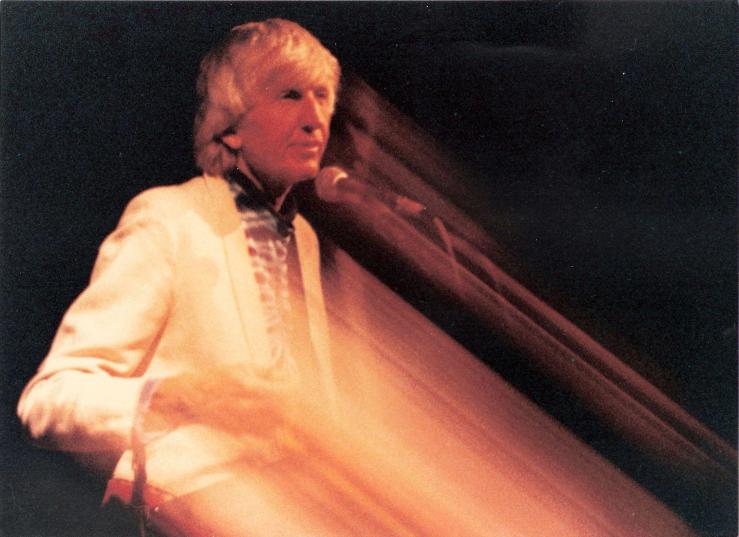
RIP Daevid Allen

Daevid_Allen_12_Selves_Kodak_photo

RIP Daevid Allen, 1938-2015


Man and Woman — Edvard Munch