Read George Saunders’s “Home,” a short story for Veterans Day

“You the one who threw down Mr. Klees?” the sheriff said.

“He’s just back from the war,” Ma said.

“Thank you for your service,” the sheriff said. “Might I ask you to refrain from throwing people down in the future?”

“He also threw me down,” Harris said.

“My thing is I don’t want to go around arresting veterans,” the sheriff said. “I myself am a veteran. So if you help me, by not throwing anyone else down, I’ll help you. By not arresting you. Deal?”

“He was also going to burn the house down,” Ma said.

“I wouldn’t recommend burning anything down,” the sheriff said.

“He ain’t himself,” Ma said. “I mean, look at him.”

The sheriff had never seen me before, but it was like admitting he had no basis for assessing how I looked would have been a professional embarrassment.

“He does look tired,” the sheriff said.

Read all of “Home” by George Saunders at The New YorkerCollected in Tenth of December.

Girl with Really Big Foot in Her Garden — Davor Gromilovic 

Girl with Really Big Foot in Her Garden, 2019 by Davor Gromilovic (b. 1985)

What draws me to this landscape/dreamscape again and again is probably very much like what attracts a gamer to his game world | David Ohle

JA Tyler: Since Motorman was first published by Knopf in 1972, you’ve written two more novels and two novellas based on the world of the character Moldenke, and this year, we’ll see another two: The Blast in July and The Old Reactor in late 2014. Why are you so drawn to this landscape—this future ruin of flood and famine and oppression?

David Ohle: What draws me to this landscape/dreamscape again and again is probably very much like what attracts a gamer to his game world. It’s a gnarly place where anything can happen, but you’re in control of what does. Getting there for me as a writer and reporting about it is accomplished with a simple formula: take current trends and add time. The more time I add, the more ruin I see. But it isn’t total ruin in my novels. Transportation is available in one form or another. There’s food, drugs, and beverages around, however crappy they may be. People don’t starve. And they get high on williwhack, stonepicks, and maximine to ease oppression in general, whether religious (Reverend Hooker in Pisstown Chaos) or governmental (President Michael Ratt in The Age of Sinatra). Once I venture to these landscapes, I become a documentarian, recording what I see. My narrative style is camera-eye, almost entirely visual. I “see” what goes on in these bleak places and times, and I like being there just long enough to write it down.

From a 2014 Bomb interview with Motorman novelist David Ohle.

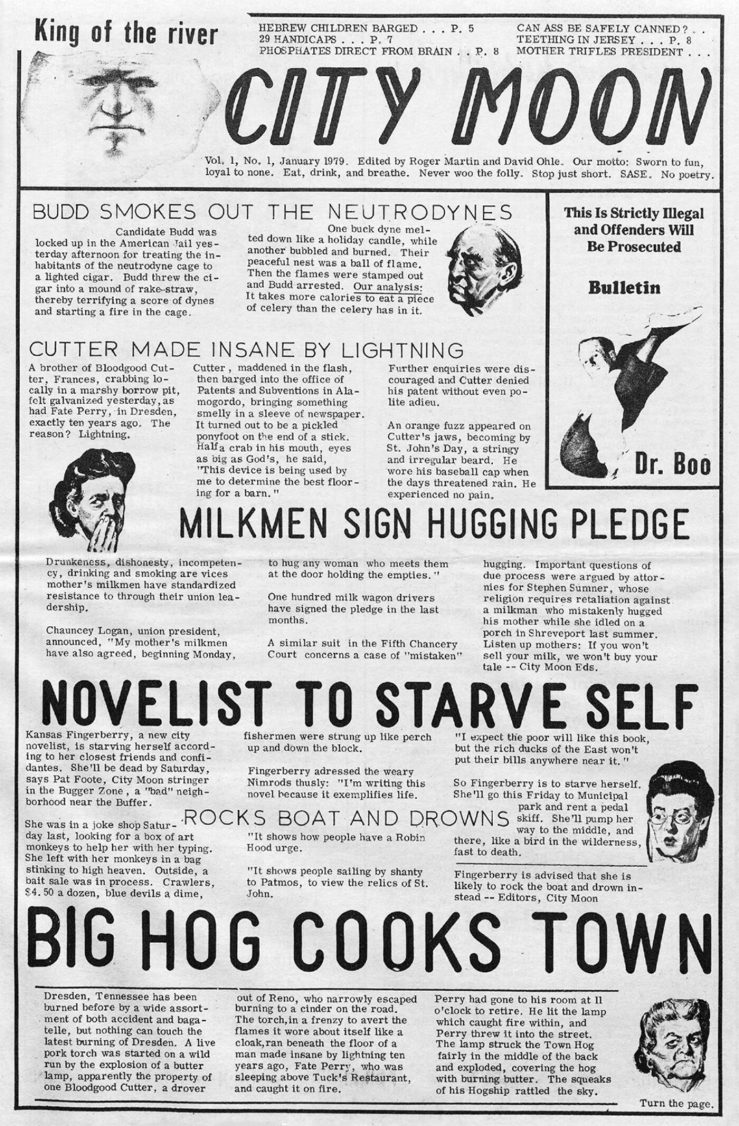
The interview includes a number of scans of The City Moon, a dadaesque “newspaper” Ohle made with his friend Roger Martin:

The City Moon was a satirical print “newspaper” that a friend, Roger Martin, and I produced back in the early-to-mid ’70s. Other friends became involved from time to time, too. It was mainly a cut-and-paste operation. We had a vast collection of old—and sometimes new—newspapers and magazines from which we mined headlines and stories that we “processed” into better and more interesting stories and headlines. This mix of current and old news gave the paper a steampunk aspect. The University of Kansas libraries at the time were tossing out collections of newspapers dating back to the turn of the century, papers like The New York Herald, which still featured articles about horse and motorcar collisions, The Rock City Daily Rocket, and many foreign papers as well. The library tossed them after they were microfilmed. We harvested them from a dumpster behind the library. We also invented stories and characters, many of which found their way into my later fiction in different form. Not long ago, the University of Kansas’s Spencer Research Library undertook to digitize all eighteen issues of the Moon and was generous enough to allow them to be put online where anyone can view them.

Blossom — Erik Thor Sandberg

Blossom, 2018 by Erik Thor Sandberg (b. 1975)

A Joy Beast — Cecil Collins

A Joy Beast, 1962 by Cecil Collins (1908–1989)

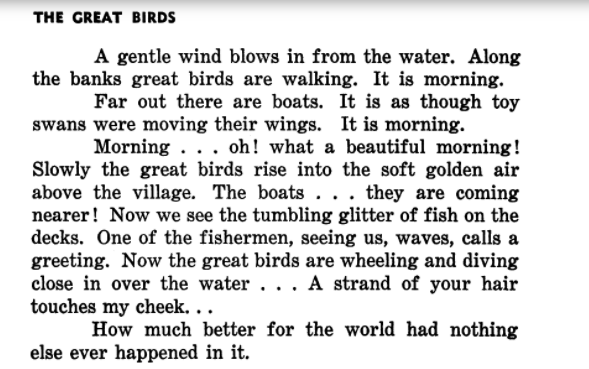
“The Great Birds” — Kenneth Patchen

Spasmodic Affection — Walton Ford

Spasmodic Affection, 2019 by Walton Ford (b. 1960)

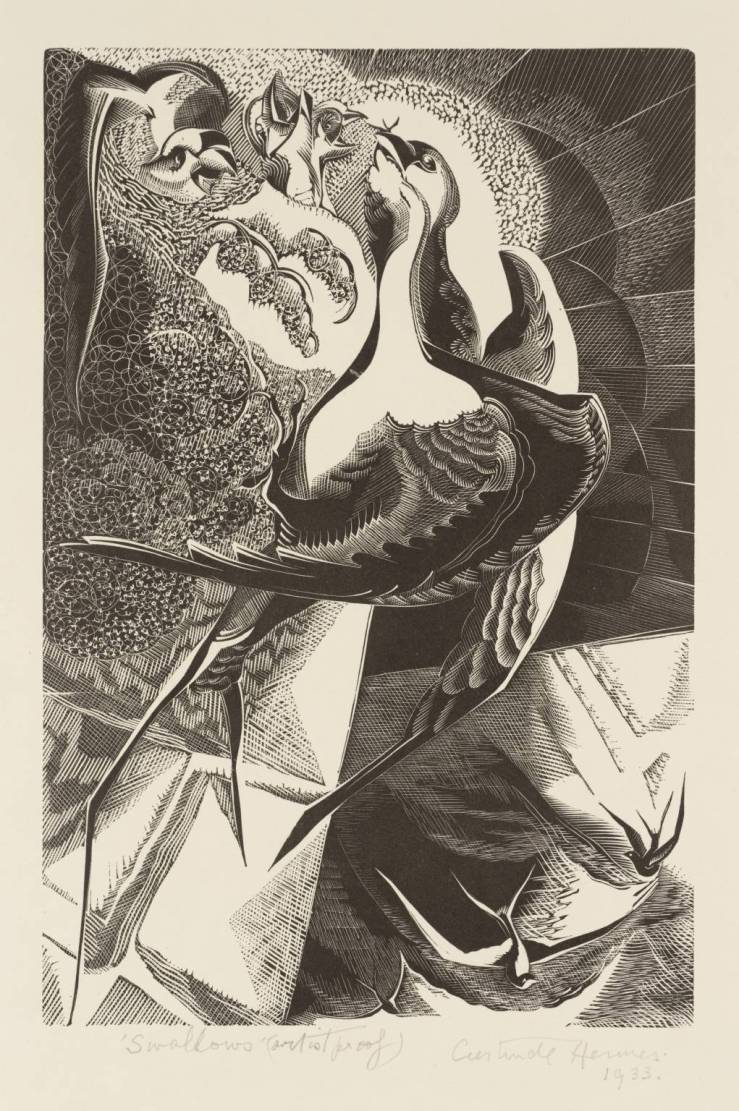
Swallows — Gertrude Hermes

Swallows, 1933 by Gertrude Hermes (1901-1983)

“Situation Reaction,” a questionnaire from David Ohle’s dystopian cult novel Motorman

There is a wisdom that is woe; but there is a woe that is madness | Moby-Dick

Look not too long in the face of the fire, O man! Never dream with thy hand on the helm! Turn not thy back to the compass; accept the first hint of the hitching tiller; believe not the artificial fire, when its redness makes all things look ghastly. To-morrow, in the natural sun, the skies will be bright; those who glared like devils in the forking flames, the morn will show in far other, at least gentler, relief; the glorious, golden, glad sun, the only true lamp—all others but liars!

Nevertheless the sun hides not Virginia’s Dismal Swamp, nor Rome’s accursed Campagna, nor wide Sahara, nor all the millions of miles of deserts and of griefs beneath the moon. The sun hides not the ocean, which is the dark side of this earth, and which is two thirds of this earth. So, therefore, that mortal man who hath more of joy than sorrow in him, that mortal man cannot be true—not true, or undeveloped. With books the same. The truest of all men was the Man of Sorrows, and the truest of all books is Solomon’s, and Ecclesiastes is the fine hammered steel of woe. “All is vanity.” ALL. This wilful world hath not got hold of unchristian Solomon’s wisdom yet. But he who dodges hospitals and jails, and walks fast crossing graveyards, and would rather talk of operas than hell; calls Cowper, Young, Pascal, Rousseau, poor devils all of sick men; and throughout a care-free lifetime swears by Rabelais as passing wise, and therefore jolly;—not that man is fitted to sit down on tomb-stones, and break the green damp mould with unfathomably wondrous Solomon.

But even Solomon, he says, “the man that wandereth out of the way of understanding shall remain” (i.e., even while living) “in the congregation of the dead.” Give not thyself up, then, to fire, lest it invert thee, deaden thee; as for the time it did me. There is a wisdom that is woe; but there is a woe that is madness. And there is a Catskill eagle in some souls that can alike dive down into the blackest gorges, and soar out of them again and become invisible in the sunny spaces. And even if he for ever flies within the gorge, that gorge is in the mountains; so that even in his lowest swoop the mountain eagle is still higher than other birds upon the plain, even though they soar.

From Ch. 96 of Moby-Dick by Herman Melville.

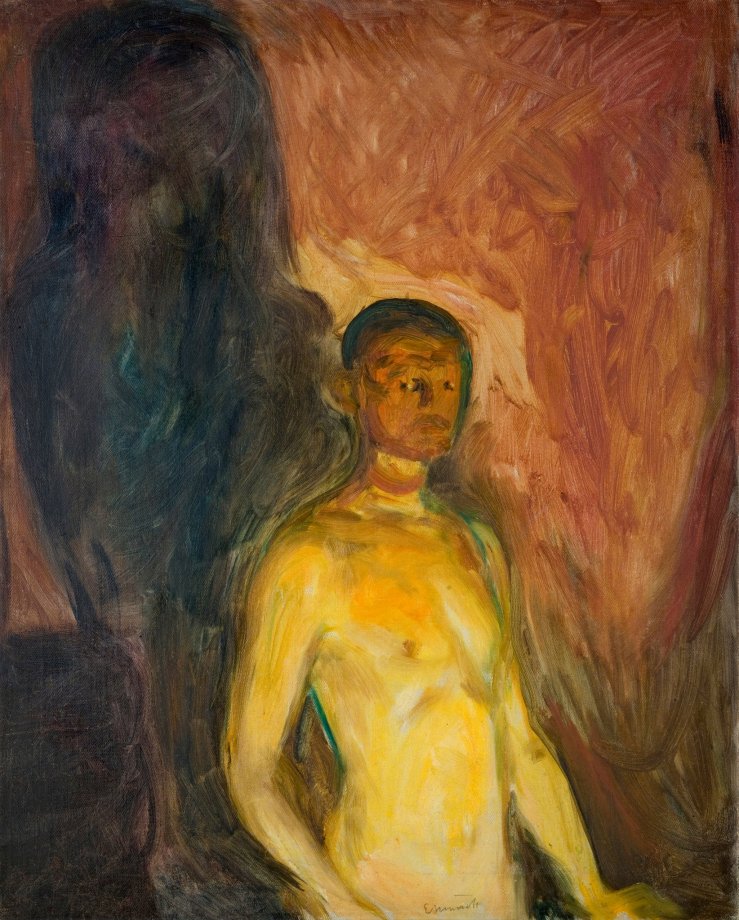
Self Portrait in Hell — Edvard Munch

Self Portrait in Hell, 1903 by Edvard Munch (1863–1944)

North (1971 Ford Torino) — Eric White

North (1971 Ford Torino), 2020 by Eric White (b. 1968)

“The Death of Me” — Gordon Lish

“The Death of Me”

by

Gordon Lish


I wanted to be amazing. I wanted to be so amazing. I had already been amazing up to a certain point. But I was tired of being at that point. I wanted to go past that point. I wanted to be more amazing than I had been up to that point. I wanted to do something which went beyond that point and which went beyond every other point and which people would look at and say that this was something which went beyond all other points and which no other boy would ever be able to go beyond, that I was the only boy who could, that I was the only one.

I was going to a day camp which was called the Peninsula Athletes Day Camp and which at the end of the summer had an all-campers, all-parents, all-sports field day which was made up of five different field events, and all of the campers had to take part in all five of all of the five different field events, and I was the winner in all five of the five different field events, I was the winner in every single field event, I came in first place in every one of the five different field events — so that the head of the camp and the camp counselors and the other campers and the other mothers and the other fathers and my mother and my father all saw that I was the best camper in the Peninsula Athletes Day Camp, the best in the short run and the best in the long run and the best in the high jump and the best in the broad jump and the best in the event which the Peninsula Athletes Day Camp called the ball-throw, which was where you had to go up to a chalk line and then put your toe on the chalk line and not go over the chalk line and then go ahead and throw the ball as far as you could throw.

I did.

I won.

It was 1944 and I was ten years old and I was better than all of the other boys at that camp and probably all of the boys at any other camp and all of the boys everywhere else.

I felt more wonderful than I had ever felt. I felt so thrilled with myself. I felt like God was whispering things to me inside of my head to me. I felt like God was asking me for me to have a special secret with him or for me to have a secret arrangement with him and that I had better keep on listening to his secret recommendations to me inside of my head. I felt like God was telling me to realize that he had made me the most unusual member of the human race and that he was going to need for me to be ready for him for me to go to work for him at any minute for him on whatever thing he said.

They gave me a piece of stiff cloth which was in the shape of a shield and which was in the camp colors and which had five blue stars on it. They said that I was the only boy ever to get a shield with as many as that many stars on it. They said that it was unheard-of for any boy ever to get as many as that many stars on it. But I could already feel that I was forgetting what it felt like for somebody to do something which would get you a shield with as many as that many stars on it. I could feel myself forgetting and I could feel everybody else forgetting — even my mother and father and God forgetting. It was just a little while afterwards, but I could tell that everybody was already forgetting everything about it — that the head of the camp was and the camp counselors were and the other campers were and that the other mothers and the other fathers were and that my mother and my father were and that even that I myself was, even though I was trying with all of my might for me to be the one person who never would.

I felt like God was ashamed of me. I felt like God was sorry that I was the one which he had picked out and that he was getting ready for him to make a new choice and for him to choose another boy instead of me and that I had to hurry up before God did it, that I had to be quick about showing God that I could be just as amazing again as I used to be and that I could do something, do anything, else.

It was August.

I was feeling the strangest feeling that I have ever felt. I was standing there with my parents and with all of the people who had come there for the field day and I was feeling the strangest feeling which I have ever felt.

I felt like lying down on the field. I felt like killing all of the people. I felt like going to sleep and staying asleep until someone came and told me that my parents were dead and that I was all grown up and that there was a new God in heaven and that he liked me better than even than the old God had.

My parents kept asking me where did I want to go now and what did I want to do. My parents kept trying to get me to tell them where I thought we should all of us go now and what was the next thing for us as a family to do. My parents kept saying they wanted for me to be the one to make up my mind if we should all of us go someplace special now and what was the best thing for the family, as a family, to do. But I did not know what they meant — do, do, do?

My father took the shield away from me and held it in his hands and kept turning it over in his hands and kept looking at the shield in his hands and kept feeling the shield with his hands and kept saying that it was made of buckram and of felt. My father kept saying did we know that it was just something which they had put together out of buckram and of felt. My father kept saying that the shield was of a very nice quality of buckram and of felt but that we should make every effort for us not to ever get it wet because it would run all over itself, buckram and felt.

I did not know what to do.

I could tell my parents did not know what to do.

We just stood around with the people all around all going away to all of the vehicles that were going to take them to places and I could tell that we did not, as a family, know if it was time for us to go.

The head of the camp came over and said that he wanted to shake my hand again and to shake the hands of the people who were responsible for giving the Peninsula Athletes Day Camp such an outstanding young individual and such a talented young athlete as my mother and father had.

He shook my hand again.

It made me feel dizzy and nearly asleep.

I saw my mother and my father get their hands ready. I saw my father get the shield out of the hand that he thought he was going to need for him to have his hand ready to shake the hand of the head of the camp. I saw my mother take her purse and do the same thing. But the head of the camp just kept shaking my hand, and my mother and my father just kept saying thank you to him, and then the head of the camp let go of my hand and took my father’s elbow with one hand and then touched my father on the shoulder with the other hand and then said that we were certainly the very finest of people, and then — he did this, he did this! — and then he went away.
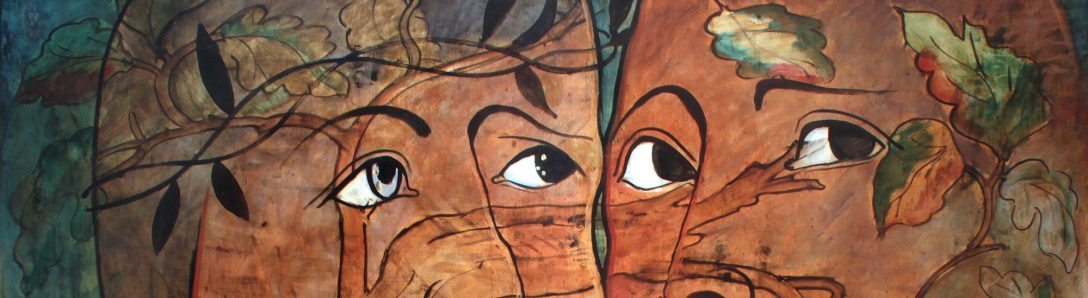
“November for Beginners” — Rita Dove

“November for Beginners”

by

Rita Dove


Snow would be the easy
way out—that softening
sky like a sigh of relief
at finally being allowed
to yield. No dice.
We stack twigs for burning
in glistening patches
but the rain won’t give.

So we wait, breeding
mood, making music
of decline. We sit down
in the smell of the past
and rise in a light
that is already leaving.
We ache in secret,
memorizing

a gloomy line
or two of German.
When spring comes
we promise to act
the fool. Pour,
rain! Sail, wind,
with your cargo of zithers!

Halloween is over (Peanuts)