No more my splintered heart and maddened hand were turned against the wolfish world | Riff 4 on rereading Herman Melville’s Moby-Dick (A Bosom Friend/Nightgown/Biographical/Wheelbarrow)

Moby-Dick illustration by Barry Moser

I. “A Bosom Friend” (Ch. 10)  is another one of the remarkable key early chapters of Moby-Dick. It twins Ch. 4, “The Counterpane,” book-ending Ishmael’s Wild New Bedford Nights with Queequeg.

II. While Ishmael’s largehearted acceptance and quick love for Queequeg probably does not seem as eccentric to contemporary readers as it might have been to Melville’s 1851 audience, it’s nevertheless an enduring emblem of Moby-Dick’s expansive spirit.

“Better sleep with a sober cannibal than a drunken Christian,” Ish intones in Ch. 3; by Ch. 10, he admiringly attests that, “Queequeg was George Washington cannibalistically developed.” In a curt but not impolite dismissal of his own culture’s moral compass, Ish declares he’ll, “try a pagan friend…since Christian kindness has proved but hollow courtesy.” Like Huck Finn, another American prototype who wishes to escape into the wild, Ishmael will always value raw truth over empty artifice.

III. There are so many good lines in “A Bosom Friend,” but I think this must be my favorite:

…I began to be sensible of strange feelings. I felt a melting in me. No more my splintered heart and maddened hand were turned against the wolfish world.

Ishmael claims that Queequeg, a “soothing savage” has “redeemed” the world for him.

IV. It is more than possible (and so much has been written on M-D that I’m sure much has been made on the topic) that Ish (and Melville) has (have) taken what might be a complex and nuanced character in Queequeg and othered it into a flat projection screen.

Ishmael, who finds “no civilized hypocrisies and bland deceits” in Queeg, might be accused of turning his bosom friend into a romanticized avatar of Ish’s own desire for a noble “savage” unconstrained by the dictates of Christian morality. However, the events of the novel and its developed characterization of Queequeg do not merit such a facile reading (or is my estimation at this point).

V. Indeed—and to jump ahead, maybe—in Ch. 12, “Biographical,” we learn Queequeg’s origin story.

Queeg is a prince of “Rokovoko, an island far away to the West and South.”

Pause a moment, and look it up, seek it out.

(Wait! “It is not down in any map; true places never are.”)

Queequeg desires to travel the world in the hopes of advancing his culture, and, like so many folks in M-D, runs away to sea (to see). However, his time on whaleboats and in ports of the western world soon soon reveal to him that “it’s a wicked world in all meridians.”

He decides to “die a pagan.”

VI. Notably and necessarily, Queequeg’s “Biographical” chapter is delivered entirely in Ishmael’s voice (unlike Ch. 9, “The Sermon,” where Father Mapple overtakes the narrative).

Queequeg is always a linguistic outsider in M-D—and indeed, an outsider in general, an outsider among outsiders—but also a superhuman superhero, as the events of Ch. 13, “The Wheelbarrow,” show.

VII. I seem to be skipping around, so, fine, okay—

—in “The Wheelbarrow,” Ish and Queeg take a packet schooner from New Bedford to Nantucket, where they plan to join a whaling ship’s crew. On the schooner, one of the several “boobies and bumpkins” aboard mocks Queequeg. Queeg catches ahold of the redneck and tosses him playfully into the air, leaving him shaken but unhurt. Captain, crew, and passengers threaten the “devil” outsider, but chaos erupts when the main-sail’s boom sets loose due because of high winds. The boom knocks the redneck into the ocean. Others panic; Queeg calmly secures the spar dives into the ocean, and rescues his mocker: “The poor bumpkin was restored,” Ishmael remarks. He then tells us that “From that hour I clove to Queequeg like a barnacle; yea, till poor Queequeg took his last long dive,” foreshadowing that not all are to be resurrected in Moby-Dick.

VIII. (Or, alternately—all are to be resurrected in Moby-Dick, but only through Ishmael’s wailing tale.)

IX. But I have skipped around so much—back to Ch. 10, “A Bosom Friend.” In one of the more-remarked upon moments in the book, Ish and Queeg tie the knot after a good smoke:

…he pressed his forehead against mine, clasped me round the waist, and said that henceforth we were married; meaning, in his country’s phrase, that we were bosom friends; he would gladly die for me, if need should be. In a countryman, this sudden flame of friendship would have seemed far too premature, a thing to be much distrusted; but in this simple savage those old rules would not apply.

X. Ishmael then, through a kind of tortuous logic, describes why he, “a good Christian; born and bred in the bosom of the infallible Presbyterian Church,” “must turn idolator” and pray to Queeg’s pagan idol. It’s what God would want him to do, see? Ishmael’s logic is predicated on two simple principles:

–He is “to do to my fellow man what I would have my fellow man to do to me”

and

–“Queequeg is my fellow man”

For me, the remarkable part of Ishmael’s commitment to Queequeg isn’t the first Jesusian imperative to do unto others—it is, in other terms, to recognize the other as a fellow man.This recognition is the moral imperative of Moby-Dick.

XI. And then a sweet ending: “Thus, then, in our hearts’ honeymoon, lay I and Queequeg—a cosy, loving pair.”

XII. “Nightgown,” Ch. 11, is a short chapter where something remarkable and likely inexplicable occurs: Ishmael and Queequeg learn to communicate.

And not just communicate at the level of base transaction or simple need, but rather share philosophical and even aesthetic viewpoints, as born out in the details of Queequeg’s story in Ch. 12, “Biographical.” Again, we might criticize Ishmael as ventriloquizing Queequeg, painting his own broad romantic visions over the possibility of a complex and nuanced character that Melville can’t muster. But I ultimately believe—or at least, I believe up until now on this reread—that Ish and Queeg’s accelerated ability to communicate points to an aspirational transcendental horizon, post-culture, post-language.

XIII. “Nightgown” also has one of my favorite moments in Moby-Dick, a little riff by Ishmael that anticipates the deconstruction of oppositions we later locate in the work of late twentieth-century language theorists:

We felt very nice and snug, the more so since it was so chilly out of doors; indeed out of bed-clothes too, seeing that there was no fire in the room. The more so, I say, because truly to enjoy bodily warmth, some small part of you must be cold, for there is no quality in this world that is not what it is merely by contrast. Nothing exists in itself. If you flatter yourself that you are all over comfortable, and have been so a long time, then you cannot be said to be comfortable any more. But if, like Queequeg and me in the bed, the tip of your nose or the crown of your head be slightly chilled, why then, indeed, in the general consciousness you feel most delightfully and unmistakably warm.

XIV. (As a final note—I remembered this passage in Thanksgiving, 2020, after receiving a very sad text message from my aunt, who we would not be seeing that year, after having not seen her for July 4th—like so many other people feeling the smallbig losses of the year, of the absences of festival and visitation—but also feeling those traditions of festival and visitation so much dearer and warmer in their absence. Nothing exists in itself.)
“Living” — C.D. Wright

“Living”

by

C.D. Wright


If this is Wednesday, write Lazartigues, return library books, pick up passport form, cancel the paper.

If this is Wednesday, mail B her flyers and K her shirts. Last thing I asked as I walked K to her car, “You sure you have everything?” “Oh yes,” she smiled, as she squalled off. Whole wardrobe in front closet.

Go to Morrison’s for paint samples, that’s where housepainter has account (near Pier One), swing by Gano St. for another bunch of hydroponic lettuce. Stop at cleaners if there’s parking.

Pap smear at 4. After last month with B’s ear infections, can’t bear sitting in damn doctor’s office. Never a magazine or picture on the wall worth looking at. Pack a book.

Ever since B born, nothing comes clear. My mind like a mirror that’s been in a fire. Does this happen to the others.

If this is Wednesday, meet Moss at the house at noon. Pick B up first, call sitter about Friday evening. If she prefers, can bring B to her (hope she keeps the apartment warmer this year).

Need coat hooks and picture hangers for office. Should take car in for air filter, oil change. F said one of back tires low. Don’t forget car payment, late last two months in a row.

If this is Wednesday, there’s a demo on the green at 11. Took B to his first down at Quonset Point in August. Blue skies. Boston collective provided good grub for all. Long column of denims and flannel shirts. Smell of patchouli made me so wistful, wanted to buy a woodstove, prop my feet up, share a J and a pot of Constant Comment with a friend. Maybe some zucchini bread.

Meet with honors students from 1 to 4. At the community college I tried to incite them to poetry. Convince them this line of work, beat the bejesus out of a gig as gizzard splitter at the processing plant or cleaning up after a leak at the germ warfare center. Be all you can be, wrap rubber band around your trigger finger until it drops off.

Swim at 10:00 before picking up B, before demo on the green, and before meeting moss, if it isn’t too crowded. Only three old women talking about their daughters-in-law last Wednesday at 10:00.

Phone hardware to see if radon test arrived.

Keep an eye out for a new yellow blanket. Left B’s on the plane, though he seems over it already. Left most recent issue of Z in the seat. That will make a few businessmen boil. I liked the man who sat next to me, he was sweet to B. Hated flying, said he never let all of his weight down.

Need to get books in the mail today. Make time pass in line at the P.O. imagining man in front of me butt naked. Fellow in the good-preacher-blue-suit, probably has a cold, hard bottom.

Call N for green tomato recipe. Have to get used to the Yankee growing season. If this is Wednesday, N goes in hospital today. Find out how long after marrow transplant before can visit.

Mother said she read in paper that Pete was granted a divorce. His third. My highschool boyfriend. Meanest thing I could have done, I did to him, returning a long-saved-for engagement ring in a Band-Aid box, while he was stationed in Da Nang.

Meant to tell F this morning about dream of eating grasshoppers, fried but happy. Our love a difficult instrument we are learning to play. Practice, practice.

No matter where I call home anymore, feel like a boat under the trees. Living is strange.

This week only; bargain on laid paper at East Side Copy Shop.

Woman picking her nose at the stoplight. Shouldn’t look, only privacy we have anymore in the car. Isn’t that the woman from the colloquium last fall, who told me she was a stand-up environmentalist. What a wonderful trade, I said, because the evidence of planetary wrongdoing is overwhelming. Because because because of the horrible things we do.

If this is Wednesday, meet F at Health Department at 10:45 for AIDS test.

If this is Wednesday, it’s trash night.

All these things are not without their meanings | Riff 3 on rereading Herman Melville’s Moby-Dick (Breakfast/The Street/The Chapel/The Pulpit/The Sermon)

I. Chapters 5 through 8 of Moby-Dick are all pretty short and showcase the novel’s ever-shifting moods. Ch. 5, “Breakfast,” brims with humor and energy, which extends through Ch. 6, “The Street.” However, by the time we get off the street and into “The Chapel” (Ch. 7), Ishmael takes a sober, somber turn, meditating on death. Ch. 8, “The Pulpit,” continues the serious, philosophical tone, setting the stage for Father Mapple to take over the narrative in Ch. 9, “The Sermon.”

II. “Breakfast” begins with Ishmael forgiving the landlord Peter Coffin for “skylarking with me not a little in the matter of [Ish’s] bedfellow,” Queequeg. Ish values the humor:

…a good laugh is a mighty good thing, and rather too scarce a good thing; the more’s the pity. So, if any one man, in his own proper person, afford stuff for a good joke to anybody, let him not be backward, but let him cheerfully allow himself to spend and be spent in that way. And the man that has anything bountifully laughable about him, be sure there is more in that man than you perhaps think for.

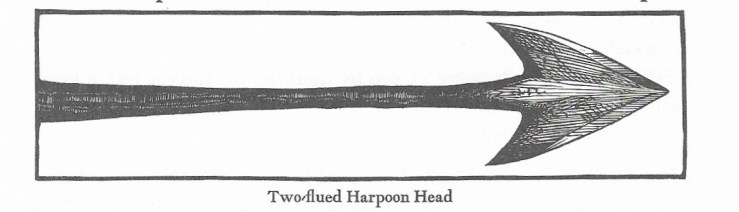
“Breakfast” has a bustling comic energy. Ish describes the various whalemen setting down to eat: “a brown and brawny company, with bosky beards; an unshorn, shaggy set, all wearing monkey jackets for morning gowns.” (I encourage you to read that line aloud.) We also get the spectacle of Queequeg, “cool as an icicle,” eating bloody beefsteaks at the head of the table—with his harpoon no less!

Moby-Dick illustration by Barry Moser

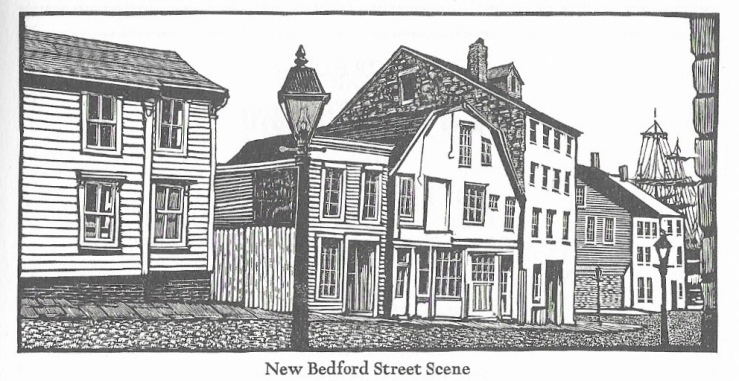
III. The comedic energy carries out into “The Street.” Here, Ishmael describes for us a carnival of cultures in New Bedford, a pavement teeming with “Feegeeans, Tongatobooarrs, Erromanggoans, Pannangians, and Brighggians” as well as “other sights still more curious, certainly more comical.” He gently mocks “the green Vermonters and New Hampshire men,” who head to New Bedford “athirst for gain and glory in the fishery,” pointing out their tendencies to overdress: “No town-bred dandy will compare with a country-bred one—I mean a downright bumpkin dandy.” Ish’s portrait of New Bedford extends to a description of its wealth and its beautiful homes, parks—and women. We get the sense that he’s over those “hypos” he was suffering in the novel’s opening chapter—or, rather, he’s intoxicated by the newness of his adventure.

IV. The atmospheric shift in “The Chapel,” is announced with a change in weather: “The sky had changed from clear, sunny cold, to driving sleet and mist.” Ishmael makes his way to a church peopled by “a small scattered congregation of sailors, and sailors’ wives and widows.” (A “scattered congregation” strikes me as an oxymoron.)

In strong contrast to the babble and verve of the two preceding chapters, in the chapel “muffled silence reigned, only broken at times by the shrieks of the storm.”

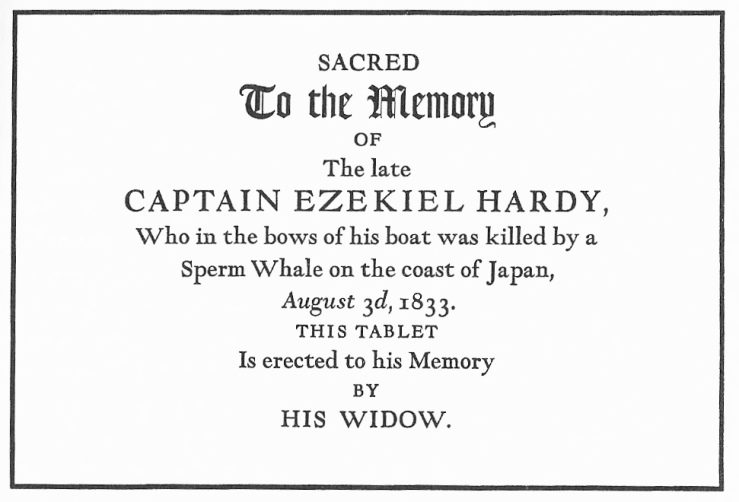
Ishmael gazes upon marble placards memorializing dead sailors, sailors who never returned, and reflects,

Oh! ye whose dead lie buried beneath the green grass; who standing among flowers can say—here, here lies my beloved; ye know not the desolation that broods in bosoms like these. What bitter blanks in those black-bordered marbles which cover no ashes! What despair in those immovable inscriptions! What deadly voids and unbidden infidelities in the lines that seem to gnaw upon all Faith, and refuse resurrections to the beings who have placelessly perished without a grave.

The line “refuse resurrections” calls back to Ch. 4, “The Counterpane,” where Ishmael gives us a rare glimpse into his past. Punished as a child to a kind of small death on the summer solstice (okay, he’s made to go to bed early)—the punished Ish hopes for a “resurrection” from his fate and is visited by some “nameless, unimaginable, silent form or phantom,” an ineffable something that simultaneously signals dread and hope.

Ishmael’s morbid pondering turns philosophical:

…how it is that we still refuse to be comforted for those who we nevertheless maintain are dwelling in unspeakable bliss; why all the living so strive to hush all the dead; wherefore but the rumor of a knocking in a tomb will terrify a whole city. All these things are not without their meanings.

And then in bit of foreshadowing of the book’s catastrophic conclusion, our narrator, thinking of the countless sailors lost and dead at sea, indulges in a bit of self-talk: “Yes, Ishmael, the same fate may be thine.”

V. “The Pulpit” isn’t a particularly memorable chapter, but it serves a significant rhetorical purpose. “The Chapel” gives us some of Ish’s most melancholy philosophizin’, culminating in self-talk about his own death. It’s an introspective, insular chapter; indeed, even as Ishmael furnishes us the details of the memorial placards, he confesses that he does “not pretend to quote.” Ish’s concern is ultimately not for the concrete particulars but for the abstract—the unnamed and unknown dead.

“The Pulpit” refocuses the narrative gaze, moving from Ishmael’s introspection to the imagery of Father Mapple ascending the stage to deliver his sermon.

VI. “The Sermon” is one of many chapters of Moby-Dick that can be read independent of the novel proper. It is one of my favorite chapters. Up until this point, we’ve largely been in Ishmael’s head, and the spare voices we get—a few lines of pidgin from Queequeg, some bantering with Peter Coffin—have the feel of reported speech. In “The Sermon” though, Ish’s consciousness gives way to Father Mapple’s. Mapple retells the story of Jonah in rapt detail, bringing “this book, containing only four chapters—four yarns—” to vivid life. His Jonah is a sympathetic deject on the run who finds himself resurrected in the belly of a whale.

Mapple’s sermon quickly edges out any of Ishmael’s stage directions, flowing out uninterrupted for paragraphs. It usurps the voice of the novel, prefiguring Ahab, whose voice will dominate in future chapters. Ghostly Ishmael seems to fall into the background of his own adventure at times, and “The Sermon” is an early rhetorical example of this phenomenon.

As Mapple’s sermon comes to its conclusion, Ishmael returns to the narrative, but he’s still at a distance, still a mechanical describer of sights and sounds, not an analyzer or thinker here.

And it’s the final line of the chapter that stuck out to me the most in this reread:

He said no more, but slowly waving a benediction, covered his face with his hands, and so remained kneeling, till all the people had departed, and he was left alone in the place.

If he is truly alone, then how does Ishmael witness his solitude?

Nameless, unimaginable, silent form or phantom | Riff 2 on rereading Herman Melville’s Moby-Dick (The Carpet-Bag/The Spouter-Inn/The Counterpane)

I. Much has been made of Ishmael’s first night with Queequeg, and I don’t aim to add to it in any estimable way. Ch. 4 of Moby-Dick—what I take to be a key chapter, although there are probably too many supposed keys to this great big book—Ch. 4 of Moby-Dick, “The Counterpane,” begins: “Upon waking next morning about daylight, I found Queequeg’s arm thrown over me in the most loving and affectionate manner.”

II. (Later Ish refers to Queeg’s “bridegroom clasp”; in the previous chapter, he tells us that he “never slept better in [his] life” — this after initially finding it impossible to fall asleep in Peter Coffin’s old bed, its mattress possibly “stuffed with corn-cobs or broken crockery.”)

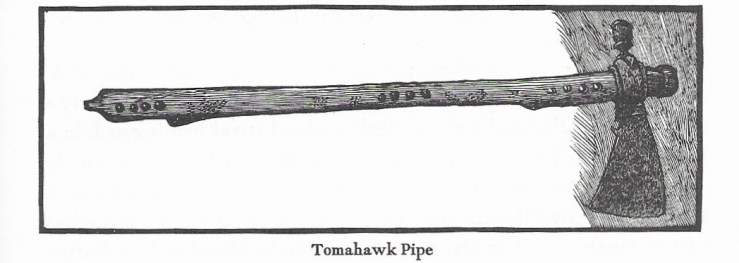
III. Like I said, much has been made of Ish & Queeg, and I don’t know what else I can say. I just love it. I love Ishmael’s initial horror, his yelling for landlord Coffin, his quick realization that his prejudices might be undone via first-hand/eye experience. “Better sleep with a sober cannibal than a drunken Christian,” he tells us, even if he’s wary of Queeg smoking his tomahawk pipe in bed: “It’s dangerous. Besides, I ain’t insured.”

Moby-Dick illustration by Barry Moser

IV. (M-D might be like the main American text in homosocial studies, I guess.)

V. Let’s come back to that key chapter “The Counterpane” in a moment—how about chapters 2 and 3, “The Carpet-Bag” and “The Spouter-Inn”? I guess here is a good place to be clear,

I don’t know who these riffs are for. I mean, I hope if you’ve never read Moby-Dick they make you want to read it and if you’ve read it before maybe it’ll spark you to read again. I don’t want this to just be me summarizing the book. Let me release my anxiety by leaving the italics and maybe opening a new numeral—

VI. “The Carpet-Bag”:

Ish leaves “Manhatto” and arrives in New Bedford, although he’s too late to make it to Nantucket to join the crew of a whaler and fulfill his mission of Not Being Suicidal. The chapter ends with this remarkable paragraph:

Now, that Lazarus should lie stranded there on the curbstone before the door of Dives, this is more wonderful than that an iceberg should be moored to one of the Moluccas. Yet Dives himself, he too lives like a Czar in an ice palace made of frozen sighs, and being a president of a temperance society, he only drinks the tepid tears of orphans.

The Lazarus theme twists all through M-D, right through its cataclysmic ending. It’s clearly there from the opening paragraphs—Ish’s wishes to revive himself—but this is the first overt reference.

VII. The resurrection motif is enriched in “The Counterpane.”

VIII. (Quote above—I really just love the imagery of rich boy Dives who “only drinks the tepid tears of orphans”! And the knock on his being in a temperance society!)

IX. “The Spouter-Inn”: A nice bit of worldbuilding, as the kids might say (M-D is surely a phantasy).

Proprietor Peter Coffin (“Coffin?—Spouter?—Rather ominous in that particular connexion”)—Peter Coffin is far funnier than I remembered. He fucks with Ish, setting him up for a night with Queeg, who’s been out selling a shrunken head. (In a marvelous little episode, he begins to sand down a dining bench for Ish to sleep on.)

Coffin (a carpenter of sorts) prefigures much of the death/rebirth theme to come in M-D. He also tiptoes the novel’s comic-tragic-something-else axis; his initial japes and jabs at Ish in this chapter give way to a heartfelt moment of near-tragedy, as he explains the origin of the bed Ish will share with Queeg:

—it’s a nice bed; Sal and me slept in that ere bed the night we were spliced. There’s plenty of room for two to kick about in that bed; it’s an almighty big bed that. Why, afore we give it up, Sal used to put our Sam and little Johnny in the foot of it. But I got a dreaming and sprawling about one night, and somehow, Sam got pitched on the floor, and came near breaking his arm. Arter that, Sal said it wouldn’t do.

The marriage bed is spliced to infanticidal violence, to the violent exclusion of children.

Moby-Dick illustration by Barry Moser

X. So let’s get to Ch. 4, to “The Counterpane,” Ishmael’s first night with Queequeg in ole Coffin’s marriage bed.

XI. I wrote “first night” above, but that’s wrong—it’s first morning I mean—the first morning after the first night. The day after.

XII. And yesterday, I wrote, in a riff on rereading M-D, that we get to know little of Ishmael’s past. I think that that statement’s true, but Ish does give us crucial information about the worst moment of his life, a kind of founding trauma that the rest of the novel’s quest might be set against.

XIII. Forgive the long quote:

My sensations were strange. Let me try to explain them. When I was a child, I well remember a somewhat similar circumstance that befell me; whether it was a reality or a dream, I never could entirely settle. The circumstance was this. I had been cutting up some caper or other—I think it was trying to crawl up the chimney, as I had seen a little sweep do a few days previous; and my stepmother who, somehow or other, was all the time whipping me, or sending me to bed supperless,

—Okay I have to pause here and ask—Why chimney?

XIV. Continue, Ish:

—my mother

Wait — “my mother”? Not “stepmother”?

XV. –sorry–

…my mother dragged me by the legs out of the chimney and packed me off to bed, though it was only two o’clock in the afternoon of the 21st June, the longest day in the year in our hemisphere. I felt dreadfully. But there was no help for it, so up stairs I went to my little room in the third floor, undressed myself as slowly as possible so as to kill time, and with a bitter sigh got between the sheets.

Our boy Ish is punished, sent to relinquish his consciousness (and any and all adventuring) on the summer solstice.

XVI. He continues (again, emphasis mine):

I lay there dismally calculating that sixteen entire hours must elapse before I could hope for a resurrection. Sixteen hours in bed! the small of my back ached to think of it. And it was so light too; the sun shining in at the window, and a great rattling of coaches in the streets, and the sound of gay voices all over the house.

Ish is without hope here. No Lazarus thing, no resurrection dealie. And all in the whitest brightest light. This in the satanic dark black white novel Moby-Dick.

XVII. Lil’ Ish’s trauma intensifies, and he begs reprieve from the wicked step-mom, but “she was the best and most conscientious of stepmothers, and back I had to go to my room.”

XVIII. He continues; the bold-face emphasis is mine:

For several hours I lay there broad awake, feeling a great deal worse than I have ever done since, even from the greatest subsequent misfortunes.

And then Ishmael has this wild nightmare-not-epiphany:

At last I must have fallen into a troubled nightmare of a doze; and slowly waking from it—half steeped in dreams—I opened my eyes, and the before sun-lit room was now wrapped in outer darkness. Instantly I felt a shock running through all my frame; nothing was to be seen, and nothing was to be heard; but a supernatural hand seemed placed in mine.

XIX. (Melville hits on the terror of a metaphysical encounter here, a phantom moment encoded into a childhood consciousness that cannot name what is happening to it.)

XX: And then Lil’ Ish’s counterpane of days past entangles with the current counterpane of “The Counterpane” in an

My arm hung over the counterpane, and the nameless, unimaginable, silent form or phantom, to which the hand belonged, seemed closely seated by my bed-side. For what seemed ages piled on ages, I lay there, frozen with the most awful fears, not daring to drag away my hand; yet ever thinking that if I could but stir it one single inch, the horrid spell would be broken. I knew not how this consciousness at last glided away from me; but waking in the morning, I shudderingly remembered it all, and for days and weeks and months afterwards I lost myself in confounding attempts to explain the mystery. Nay, to this very hour, I often puzzle myself with it.

XXI. (That “nameless, unimaginable, silent form or phantom” — prefiguration of Moby-Dick? of Ahab? of the cruel wet cold world? or just a child’s small big fears?)

XXII. (In any case, this seems to be Ishmael’s epiphanic founding trauma.)

XXIII. And to bring it back to where I started,

Much has been made of Ishmael’s first night with Queequeg.

Let’s end on the morning after—a kind of healing epiphany, coded in otherness, exploration, and strange love:

Now, take away the awful fear, and my sensations at feeling the supernatural hand in mine were very similar, in their strangeness, to those which I experienced on waking up and seeing Queequeg’s pagan arm thrown round me.

The great flood-gates of the wonder-world swung open | Riff 1 on rereading Herman Melville’s Moby-Dick (Etymology/Extracts/Loomings)

Moby-Dick illustration by Barry Moser


I. I last reread Herman Melville’s 1851 novel Moby-Dick in full way back in 2013.

II. I’ve read chunks and excerpts of it over the intermittent seven years though—there’s always some bit in it that calls to me, prompted by events personal, political, cultural. I read Melville’s 1846 novel Typee during the beginning of 2020’s quarantine, and knew I’d need to reread M-D in full sooner than later.

III. (Why later, why now? I guess I made this kinda sorta tacit promise to myself not to reread in 2020—to expand my palate, to go past all the Dead White Guys.)

IV. I started Moby-Dick this afternoon. I read the two opening salvos, “Etymology” and “Extracts,” and then the first chapter, “Loomings.”

V. (I have read that some folks skip the “Extracts”: No.)

VI. I started Moby-Dick in an edition that I bought years ago but haven’t actually read: the California UP/Arion Press edition with Barry Moser illustrations. It’s lovely—grand, generous, rich on the page.

VII. So I’ve probably read “Etymology” more than any other section of M-D. It was certainly the section I messed around with for years before reading the actual novel in full. The etymology has supposedly been given to the author of M-D — HM? Ishmael? Some other ghost — by a “pale Usher” (not Poe’s), “threadbare in coat, heart, body, and brain…” The poor fellow “loved to dust his old grammars; it somehow mildly reminded him of his mortality.”

VIII. I don’t dwell on the pale Usher, but I’ve long found the next line of “Etymology” fascinating. It’s a quote attributed to the sixteenth-century English author Richard Hakluyt:

While you take in hand to school others, and to teach them by what name a whale-fish is to be called in our tongue, leaving out, through ignorance, the letter H, which almost alone maketh up the signification of the word, you deliver that which is not true.

A former teacher of mine, A. Samuel Kimball (who I am forever indebted to for teaching me to read again) made much of this citation. For Kimball, the foregrounding of the “H” calls attention to one of Melville’s central themes: whaling as wailing—Moby-Dick as a wail, a grief, maybe a resistance to the infanticidal, genocidal scope of American culture. Ishmael, an orphan, goes to sea to resist his suicide-impulse on a ship named after a near-extinct tribe of American Indians. Ishmael, whose very name is marks him, at least in the KJV context Melville was working within, as the rejected son of the patriarch Abraham. In the novel’s last moments, Ishmael is saved (is he though?) by the ship the Rachel, which, “in her retracing search after her missing children, only found another orphan.”

IX. (Whale-wail / whiteness-witness. Etc. etc.)

X. And those “Extracts,” supplied by a “burrower and grub-worm of a poor devil of a Sub-Sub” — who’s the dom?

XI. I remembered the “Extracts” more fondly than I experienced them.

I just really wanted to get into Ishmael’s head (voice). (And then get out of it, into the drama of Ahab and His Whale.)

XII. And so I got into Ishmael’s head (voice).

XIII. “Loomings” is such a great, great, perfect chapter, and the joy in re-reading Melville is having already worked out most of the plot kinks. Instead of dwelling on What is happening? you can experience What is.

XIV. (I always forget how terribly sad poor Ish is at the outset of M-D. He’s depressed, suffering from hypos, the spleen. He’s not just suicidal, he’s homicidal, wanting to step in the street and knock people’s hats off.)

XV. One of the fascinating things about Moby-Dick, at least in my memory of it, which maybe I’ll expand upon in riffs on this reread, is how little we get to know Ishmael. Like his wanderer namesake, he’s an outsider who, despite taking us in to his tale, nevertheless keeps us out: We know very little about his past or his future, and his present (by which I mean Moby-Dick) is mediated in voyeurism, questioning, and philosophy.

XVI. And “Loomings” — well, what a great title, maybe obvious, but great — the indistinct coming into view, but also the mount of the warp, the initial move in a great tapestry: Moby-Dick.

XVII. I’ll close on the closing line of “Loomings,” which point to the great wonder-world to come, and the grand hooded phantom at the end of Ishmael’s journey:

By reason of these things, then, the whaling voyage was welcome; the great flood-gates of the wonder-world swung open, and in the wild conceits that swayed me to my purpose, two and two there floated into my inmost soul, endless processions of the whale, and, mid most of them all, one grand hooded phantom, like a snow hill in the air.

Sauron — J.R.R. Tolkien

Sketch of Sauron by John Ronald Reuel Tolkien (1892–1973). Via/more.

“Blown Away” — Tom Clark

Manifesto — Toyin Ojih Odutola

Manifesto, 2017 by Toyin Ojih Odutola (b. 1985)

RIP MF DOOM

RIP MF DOOM, 1971-2020

What a stupid fucking year.

Happy New Year! // Some books I’ll try to read/re-read in 2021

Happy New Year!

Time for the cliched “Stuff I May or May Not Read This Year” post!

Bottom to top–

A Frolic of His Own is the only Gaddis I haven’t read. I read the first fifty or so pages a few years ago, but got distracted with something else.

I haven’t re-read Moby-Dick in a few years, but I found myself sifting through it a bit at the end of 2020. Time for a re-read, sooner than later.

I’ll continue the Walker Percy reading with The Last Gentleman.

I actually finished Chester Himes’s The Real Cool Killers about 45 minutes ago—it’s a wonderful mix of breezy brutality and brutal humor. This one had an unexpectedly sweet ending. More Himes in 2021.

I’ve been reading through Anakana Schofield’s novel in “warnings,” Bina, and I really dig it so far—very different stuff. It reminds me a bit of Claire-Louise Bennett’s Pond or Helen DeWitt’s The Last Samurai or David Markson’s Wittgenstein’s Mistress, but also unlike those things.

I read a bunch of Muriel Spark in 2020 and I aim to read more in 2021. The ones I have (unread) by her are Robinson and A Far Cry from Kensington.

I also look forward to Azareen Van der Vliet Oloomi’s short novel Fra Keeler as well.

I hope this year is better for all of us than the last one. Peace and love &c.