Mario Levrero’s The Luminous Novel (Book acquired, 30 March 2021)

Mario Levrero’s The Luminous Novel is forthcoming in English translation by Annie McDermott from the good folks at And Other Stories. It’s a big ole book! Here is And Other Stories’ blurb:

A writer attempts to complete the novel for which he has been awarded a big fat Guggenheim grant, though for a long time he succeeds mainly in procrastinating – getting an electrician to rewire his living room so he can reposition his computer, buying an armchair, or rather, two: ‘In one, you can’t possibly read: it’s uncomfortable and your back ends up crooked and sore. In the other, you can’t possibly relax: the hard backrest means you have to sit up straight and pay attention, which makes it ideal if you want to read.’

Insomniacs, romantics and anyone who’s ever written (or failed to write) will fall in love with this compelling masterpiece told by a true original, with all his infuriating faults, charming wit and intriguing musings.

I loved the last two And Other Stories editions I read, by the way. I highly recommend Norah Lange’s Notes from Childhood (translated by Nora Whittle) — I wrote about it here.

The other AOS book was Ann Quin’s 1969 avant garde novel Passages, which is unlike anything else I’ve ever read (although Joyce’s Ulysses, Jane Bowles’s Two Serious Ladies, Beckett, Derrida’s Glas, and Julia Kristeva come to mind). I reread it last weekend in an attempt to outline a review, which I hope to have up soon.
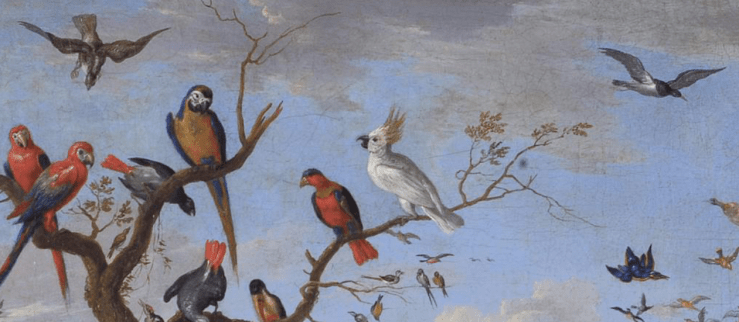
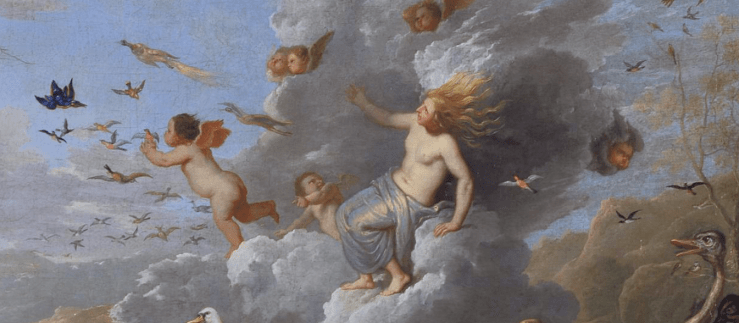
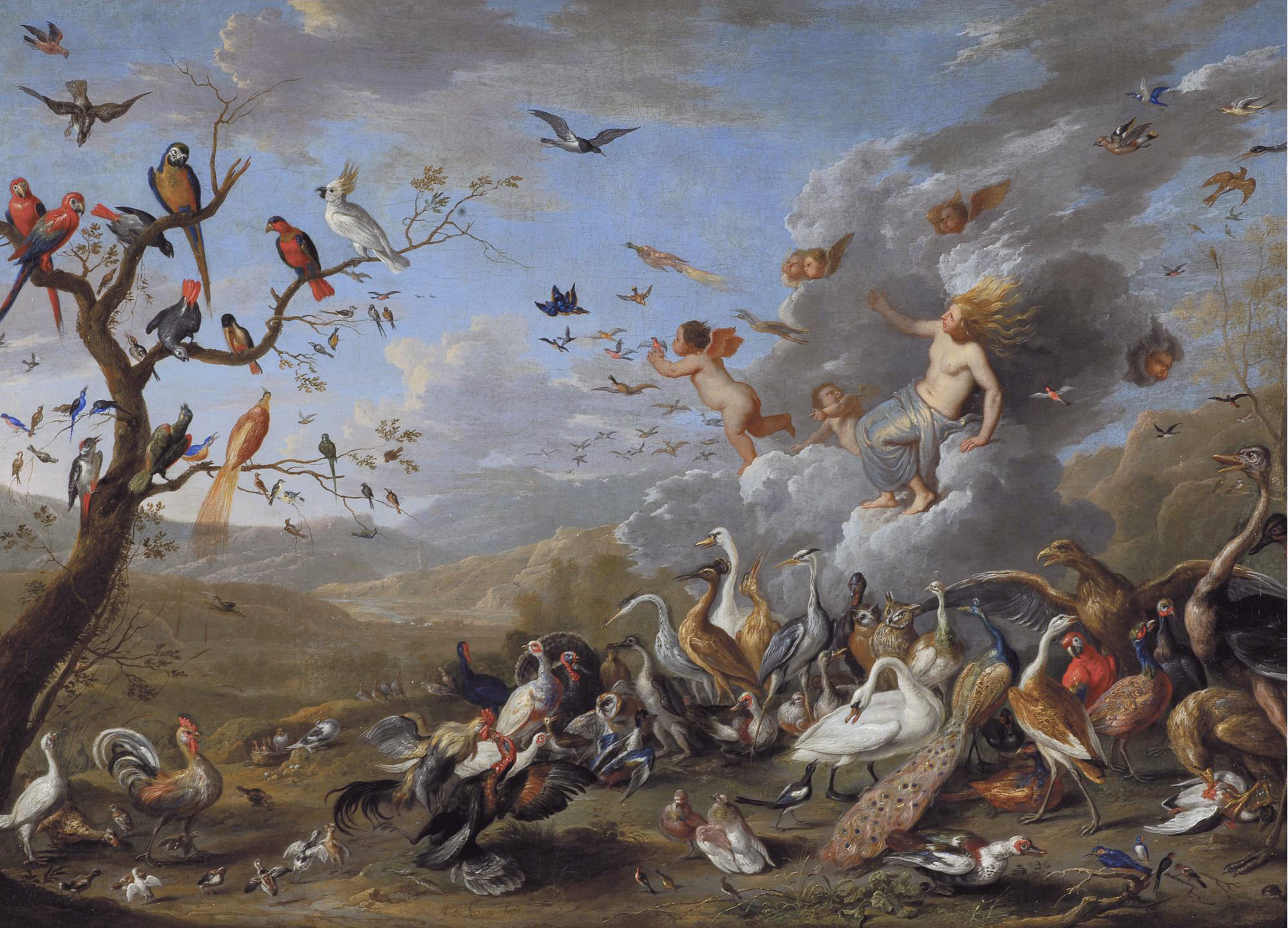
Allegory of Air (Detail) — Jan van Kessel the Elder

Allegory of Air (detail), 1661 by Jan van Kessel the Elder (1626-1679)

Chaos XLIX — Michael Palmer

Chaos XLIX by Michael Palmer (b. 1942)

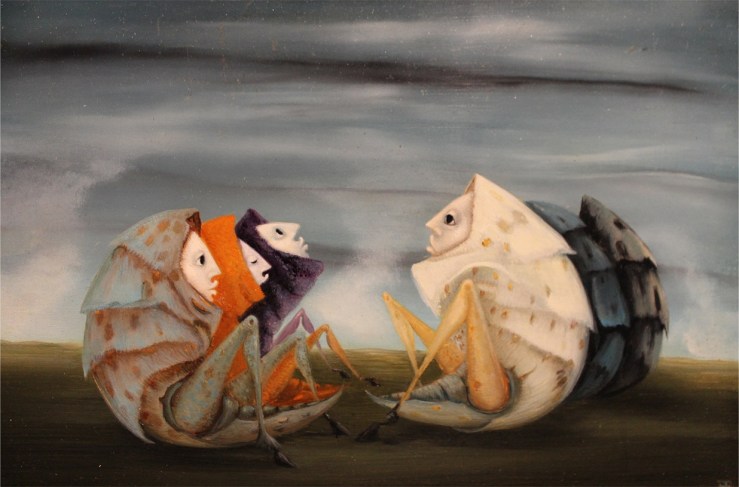
Wait — Bridget Tichenor

Wait, 1961 by Bridget Tichenor (1917-1990)

Allegory of Air (Detail) — Jan van Kessel the Elder

Allegory of Air (detail), 1661 by Jan van Kessel the Elder (1626-1679)

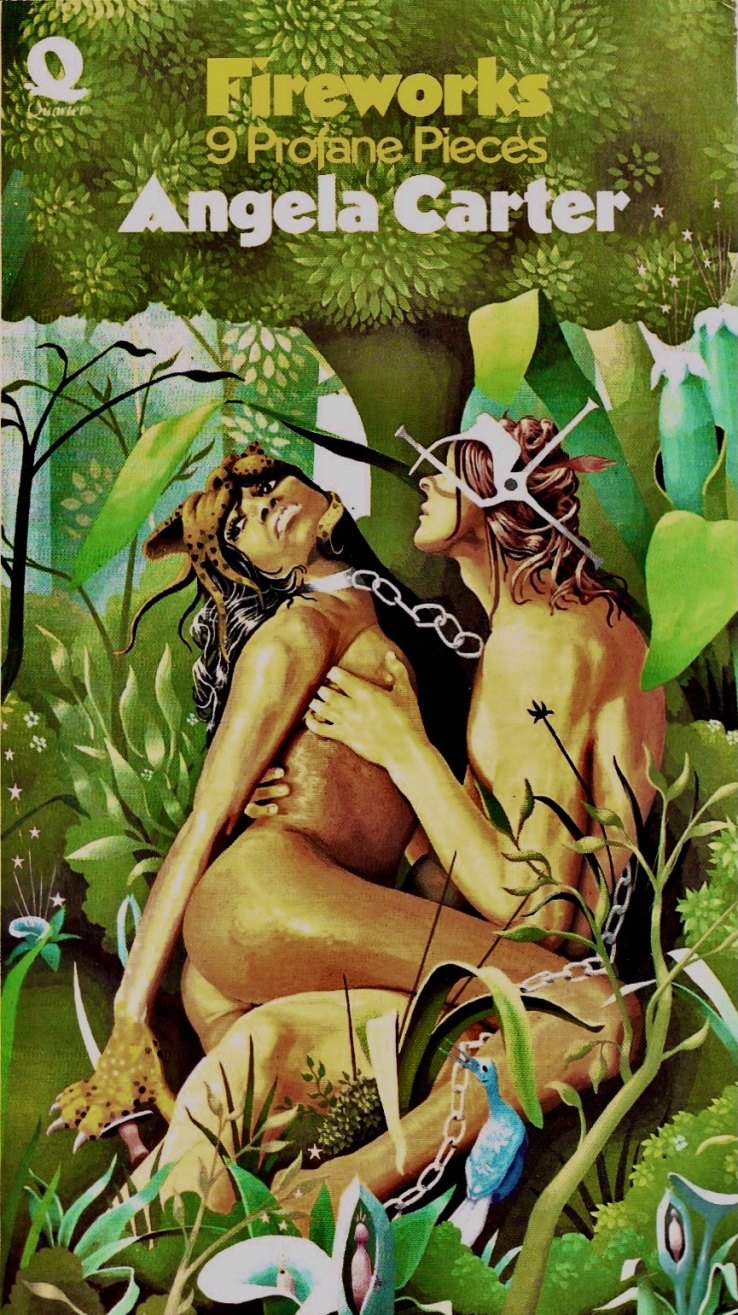
Angela Carter’s Fireworks (Book acquired, 2 April 2021)

I came across this 1976 first edition paperback of Angela Carter’s collection Fireworks two weeks ago and couldn’t pass it up, even though all of Fireworks is collected in Burning Your Boats, which I already own. I love the hornyassed cover by Bob Foulke. I cannot find anything else by Foulke on the internet.

Here is the opening of “The Executioner’s Beautiful Daughter”:

Here, we are high in the uplands.

A baleful almost-music, that of the tuneless cadences of an untutored orchestra repercussing in an ecstatic agony of echoes against the sounding boards of the mountains, lured us into the village square where we discover them twanging, plucking and abusing with horsehair bows a wide variety of crude stringed instruments. Our feet crunch upon dryly whispering shifting sawdust freshly scattered over impacted surfaces of years of sawdust clotted, here and there, with blood shed so long ago it has, with age, acquired the colour and texture of rust . . . sad, ominous stains, a threat, a menace, memorials of pain.

There is no brightness in the air. Today the sun will not irradiate the heroes of the dark spectacle to which accident and disharmony combined to invite us. Here, where the air is choked all day with diffuse moisture tremulously, endlessly the point of becoming rain, light falls as if filtered through muslin so at all hours a crepuscular gloaming prevails; the sky looks as though it is about to weep and so, gloomily illuminated through unshed tears, the tableau vivant before us is suffused with the sepia tints of an old photograph and nothing within it moves. The intent immobility of the spectators, wholly absorbed as they are in the performance of their hieratic ritual, is scarcely that of living things and this tableau vivant might be better termed a nature morte for the mirthless carnival is a celebration of a death. Their eyes, the whites of which are yellowish, are all fixed, as if attached by taut, invisible strings upon a wooden block lacquered black with the spilt dews of a millennia of victims.

And now the rustic bandsmen suspend their unmclodious music. This death must be concluded in the most dramatic silence. The wild mountain-dwellers are gathered together to watch a public execution; that is the only entertainment the country offers.

Time, suspended like the rain, begins again in silence, slowly.

News or Something — Pablo Martinez

News or Something, 2017 by Pablo Martinez

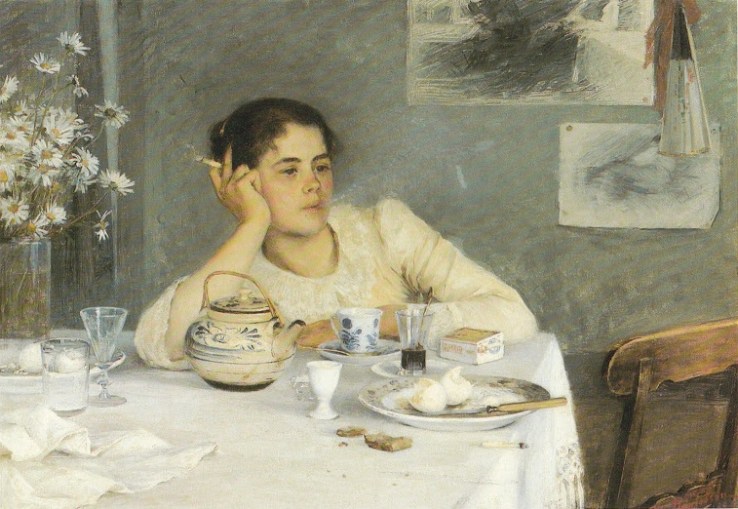
After Breakfast — Elin Danielson-Gambogi

After Breakfast, 1890 by Elin Danielson-Gambogi (1861-1919)

Posted in Art

“Seascape” — Elizabeth Bishop

“Seascape”

by

Elizabeth Bishop


This celestial seascape, with white herons got up as angels,
flying high as they want and as far as they want sidewise
in tiers and tiers of immaculate reflections;
the whole region, from the highest heron
down to the weightless mangrove island
with bright green leaves edged neatly with bird-droppings
like illumination in silver,
and down to the suggestively Gothic arches of the mangrove roots
and the beautiful pea-green back-pasture
where occasionally a fish jumps, like a wildflower
in an ornamental spray of spray;
this cartoon by Raphael for a tapestry for a Pope:
it does look like heaven.
But a skeletal lighthouse standing there
in black and white clerical dress,
who lives on his nerves, thinks he knows better.
He thinks that hell rages below his iron feet,
that that is why the shallow water is so warm,
and he knows that heaven is not like this.
Heaven is not like flying or swimming,
but has something to do with blackness and a strong glare
and when it gets dark he will remember something
strongly worded to say on the subject.

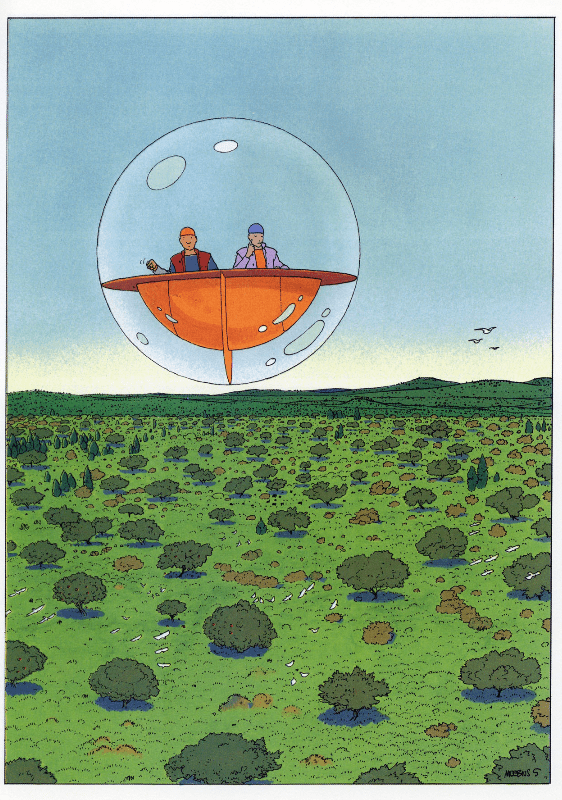
A page from Moebius’ The Gardens of Aedena

A page from The Gardens of Aedena by Moebius.

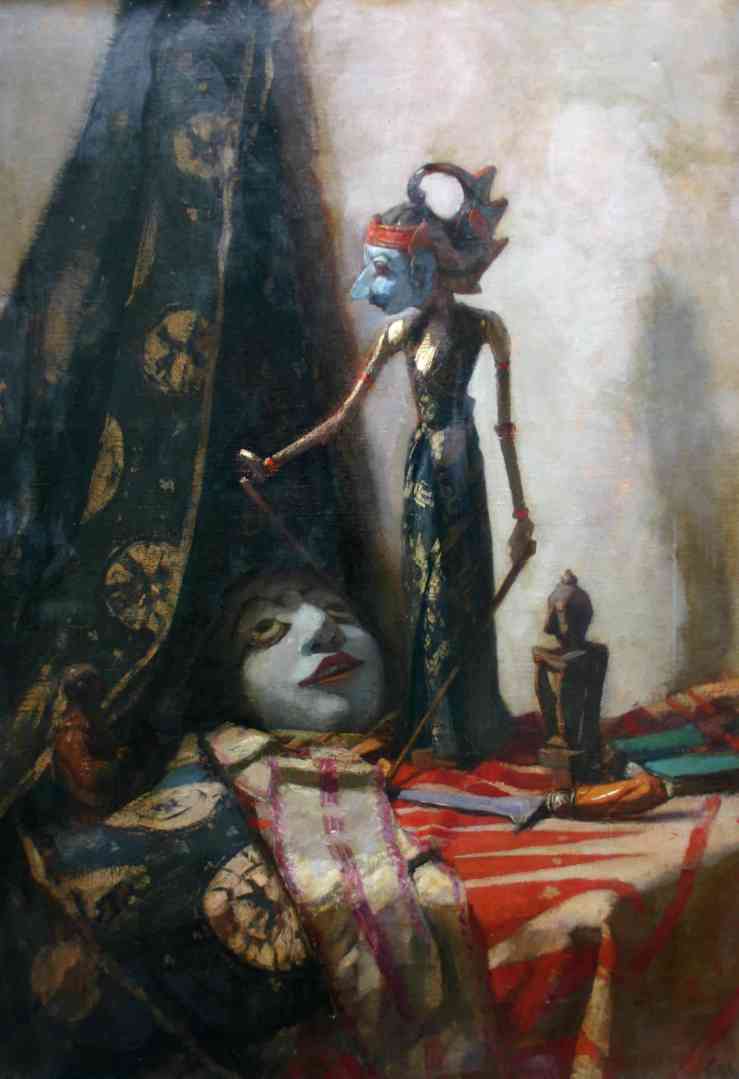
Still life with Wajang — Salomon Garf

Still Life with Wajang by Salomon Garf (1873-1943)

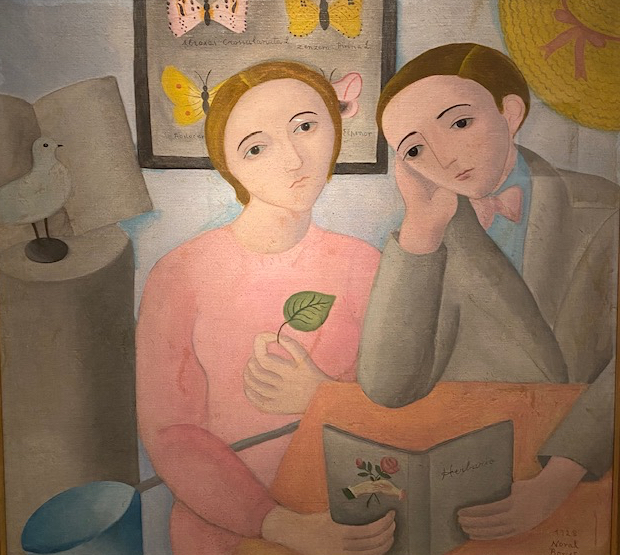
Herbario — Norah Borges

Herbario, 1928 by Norah Borges (1901–1998)

Theory of Relativity — Eduardo Paolozzi

Theory of Relativity, 1967 by Eduardo Paolozzi (1924–2005)

Lost to any sense of a continuous tradition | Thomas Pynchon

Perhaps history this century, thought Eigenvalue, is rippled with gathers in its fabric such that if we are situated, as Stencil seemed to be, at the bottom of a fold, it’s impossible to determine warp, woof or pattern anywhere else. By virtue, however, of existing in one gather it is assumed there are others, compartmented off into sinuous cycles each of which comes to assume greater importance than the weave itself and destroys any continuity. Thus it is that we are charmed by the funny-looking automobiles of the ’30s, the curious fashions of the ’20s, the peculiar moral habits of our grandparents. We produce and attend musical comedies about them and are conned into a false memory, a phony nostalgia about what they were. We are accordingly lost to any sense of a continuous tradition. Perhaps if we lived on a crest, things would be different. We could at least see.

From Thomas Pynchon’s novel V.


Baudelaire’s Paris Spleen (Book acquired, sometime in February 2021)

The nice people at Contra Mundum continue to put out new Charles Baudelaire translations. Paris Spleen is out in a new translation from Rainer J. Hanshe. A little taste:

I wish I could get drunk on virtue. I’ll settle for wine.

Here’s Contra Mundum’s blurb:

In the 1850s, ancien and Haussmannian Paris clash, giving birth to a violent disjunction. At that moment in time, an other present is born, a new history, like Baudelaire’s poet freely abandoning his halo on the macadam. The laurel crown has been discarded; the pastoral poet is dead; classical lyric poetry is dead. The steam-driven, gaslit, electrically-charged poet is born. “Retreat Academic Muse!,” Baudelaire commands, “I don’t care about that old stutterer.”

With Paris Spleen, we move toward a new rhythm, a rhythm born of the pace, speed, and reality of a metropolis hitherto never seen or experienced. It is the rhythm of the street, of the swift-moving eye, of overloaded senses and hyper-perception, of newspapers and optical devices. Baudelaire’s life spans the essential birth of whole new forms of technology, including steam locomotives, gas light, and electricity, not to speak of the typewriter and the Daguerreotype. The dandy sees and moves with the coming speed of light. His life is one lived in the midst of illumination, mechanics, and simulacra.

Baudelaire’s Paris is a place of experience, a metropolis that spawns unique and particular realities, a kaleidoscope of visions and mirror of alternative societies. The grist of his poems is not ancient Greece or the Renaissance. As he stated in the so-called preface to Paris Spleen, it is especially from frequenting great cities, from the crossroads of their innumerable relations, that the haunting ideal of the prose poem was born. Our flâneur wanders swiftly through crowds, in contact, but anonymous, extracting from the city material to forge his new ars poetica, like a bricolage artist.

The future is called forth. The street is the new Olympus; the phantasmagoric city is a big harlot whose infernal charm continually rejuvenates the poet. The ironic, infernal beacon is the totem of the new age: the age of dissonance, the age of artificial paradises. “I love you, O infamous capital!” the poet exults.

Here is Paris Spleen, an invitation to voyage, to have the entirety of Baudelaire’s Paris enter into our flesh and for us to undergo contagion, if our spleens can handle it.

A panel from Hayao Miyazaki’s Air Meal, a 1994 comic about the first in-flight meal

The Kitchen Garden on the Eyot — Leonora Carrington

The Kitchen Garden on the Eyot, 1946 by Leonora Carrington (1917–2011)