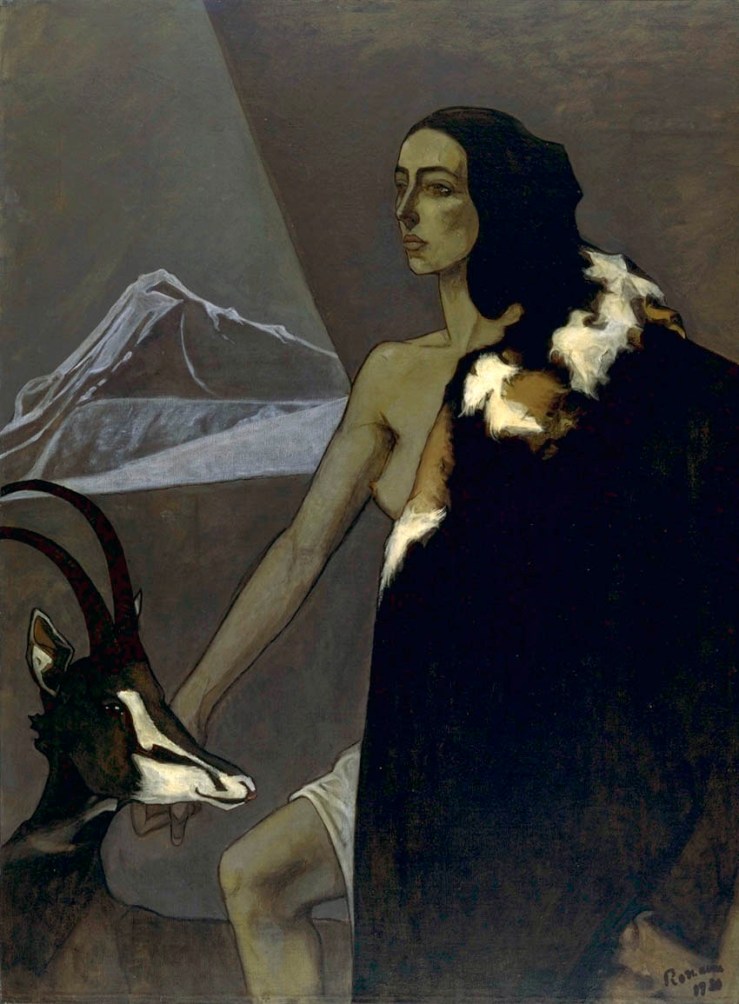
Chasseress — Romaine Brooks

Chasseress, 1920 by Romaine Brooks (1874-1970)

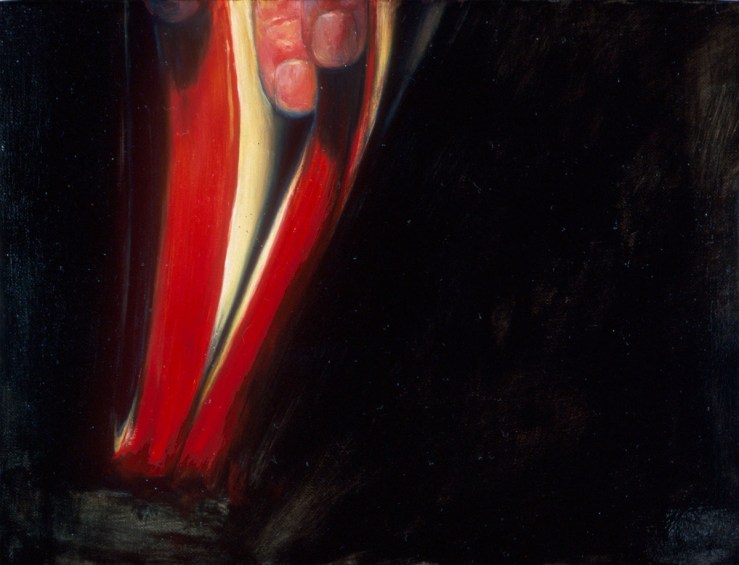
Red Letter No. 12 — Jen Mazza 

Red Letter No. 12, 2007 by Jen Mazza (b. 1972)

Many Irish heroes and heroines of antiquity | From James Joyce’s Ulysses

He wore a long unsleeved garment of recently flayed oxhide reaching to the knees in a loose kilt and this was bound about his middle by a girdle of plaited straw and rushes. Beneath this he wore trews of deerskin, roughly stitched with gut. His nether extremities were encased in high Balbriggan buskins dyed in lichen purple, the feet being shod with brogues of salted cowhide laced with the windpipe of the same beast. From his girdle hung a row of seastones which dangled at every movement of his portentous frame and on these were graven with rude yet striking art the tribal images of many Irish heroes and heroines of antiquity, Cuchulin, Conn of hundred battles, Niall of nine hostages, Brian of Kincora, the Ardri Malachi, Art MacMurragh, Shane O’Neill, Father John Murphy, Owen Roe, Patrick Sarsfield, Red Hugh O’Donnell, Red Jim MacDermott, Soggarth Eoghan O’Growney, Michael Dwyer, Francy Higgins, Henry Joy M’Cracken, Goliath, Horace Wheatley, Thomas Conneff, Peg Woffington, the Village Blacksmith, Captain Moonlight, Captain Boycott, Dante Alighieri, Christopher Columbus, S. Fursa, S. Brendan, Marshal Mac-Mahon, Charlemagne, Theobald Wolfe Tone, the Mother of the Maccabees, the Last of the Mohicans, the Rose of Castille, the Man for Galway, The Man that Broke the Bank at Monte Carlo, The Man in the Gap, The Woman Who Didn’t, Benjamin Franklin, Napoleon Bonaparte, John L. Sullivan, Cleopatra, Savourneen Deelish, Julius Caesar, Paracelsus, sir Thomas Lipton, William Tell, Michelangelo, Hayes, Muhammad, the Bride of Lammermoor, Peter the Hermit, Peter the Packer, Dark Rosaleen, Patrick W. Shakespeare, Brian Confucius, Murtagh Gutenberg, Patricio Velasquez, Captain Nemo, Tristan and Isolde, the first Prince of Wales, Thomas Cook and Son, the Bold Soldier Boy, Arrah na Pogue, Dick Turpin, Ludwig Beethoven, the Colleen Bawn, Waddler Healy, Angus the Culdee, Dolly Mount, Sidney Parade, Ben Howth, Valentine Greatrakes, Adam and Eve, Arthur Wellesley, Boss Croker, Herodotus, Jack the Giantkiller, Gautama Buddha, Lady Godiva, The Lily of Killarney, Balor of the Evil Eye, the Queen of Sheba, Acky Nagle, Joe Nagle, Alessandro Volta, Jeremiah O’Donovan Rossa, Don Philip O’Sullivan Beare. A couched spear of acuminated granite rested by him while at his feet reposed a savage animal of the canine tribe whose stertorous gasps announced that he was sunk in uneasy slumber, a supposition confirmed by hoarse growls and spasmodic movements which his master repressed from time to time by tranquillising blows of a mighty cudgel rudely fashioned out of paleolithic stone.

A passage from the “Cyclops” episode of Joyce’s Ulysses. 

  I asked Kelley what it feels like to be hanged | From William S. Burroughs’ Cities of the Red Night

An excerpt from

Cities of the Red Night

by

William S. Burroughs


Kelley told me his story. He started his career as a merchant seaman. In the course of an argument he killed the quartermaster, for which he was tried and sentenced to hang. His ship at that time was in the harbor of Tangier. The sentence was carried out in the marketplace, but some pirates who were present cut him down, carried him to their ship, and revived him. It was thought that a man who had been hanged and brought back to life would not only bring luck to their venture but also ensure protection against the fate from which he had been rescued. While he was still insensible the pirates rubbed red ink into the hemp marks, so that he seemed to have a red rope always around his neck.

The pirate ship was commanded by Skipper Nordenholz, a renegade from the Dutch Navy who was still able to pass his ship as an honest merchant vessel flying the Dutch flag. Strobe was second in command. Barely had they left Tangier headed for the Red Sea via the Cape of Good Hope when a mutiny broke out. The crew was in disagreement as to the destination, being minded to head for the West Indies. They had also conceived a contempt for Strobe as an effeminate dandy. After he had killed five of the ringleaders they were forced to revise this opinion. The mutinous crew was then put ashore and a crew of acrobats and dancing boys taken on, since Nordenholz had already devised a way in which they could be put to use.

Kelley claims to have learned the secrets of death on the gallows, which gives him invincible skill as a swordsman and such sexual prowess that no man or woman can resist him, with the exception of Captain Strobe, whom he regards as more than human. “Voici ma lettre de marque,” he says, running his fingers along the rope mark. (A letter of marque was issued to privateers by their government, authorizing them to prey on enemy vessels in the capacity of accredited combatants, and thus distinguishing them from common pirates. Such a letter often, but by no means always, saved the bearer from the gallows.) Kelley tells me that the mere sight of his hemp marks instills in adversaries a weakness and terror equal to the apparition of Death Himself.

I asked Kelley what it feels like to be hanged.

“At first I was sensible of very great pain due to the weight of my body and felt my spirits in a strange commotion violently pressed upwards. After they reached my head, I saw a bright blaze of light which seemed to go out at my eyes with a flash. Then I lost all sense of pain. But after I was cut down, I felt such intolerable pain from the prickings and shootings as my blood and spirits returned that I wished those who cut me down could have been hanged.”

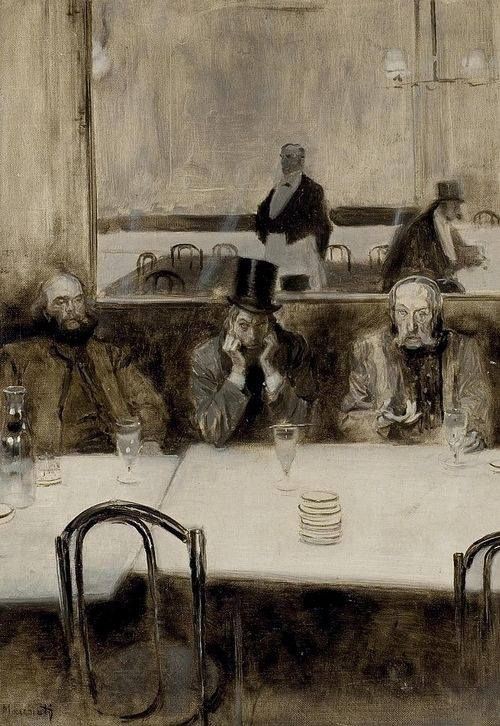
Paul Verlaine, Bibi la Purée and Stéphane Mallarmé at the Café Procope — Serafino Macchiati

Paul Verlaine, Bibi la Purée and Stéphane Mallarmé at the Café Procope, 1890 by Serafino Macchiati (1861-1916)

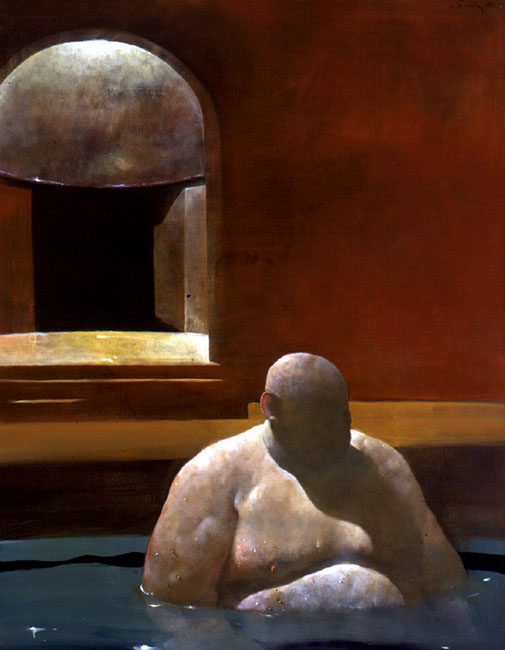
The Giant — Julio Larraz

The Giant, 1975 by Julio Larraz (b. 1944)

Posted in Art

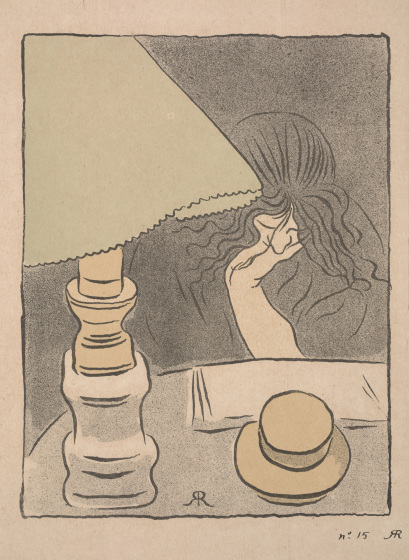
Reader with a Lamp — József Rippl-Rónai

T43204_2_8, 6/26/07, 11:25 AM, 8C, 5968×7480 (0+344), 100%, Custom, 1/50 s, R72.3, G53.7, B60.6

Reader with a Lamp, 1895 by József Rippl-Rónai (1861-1927 )

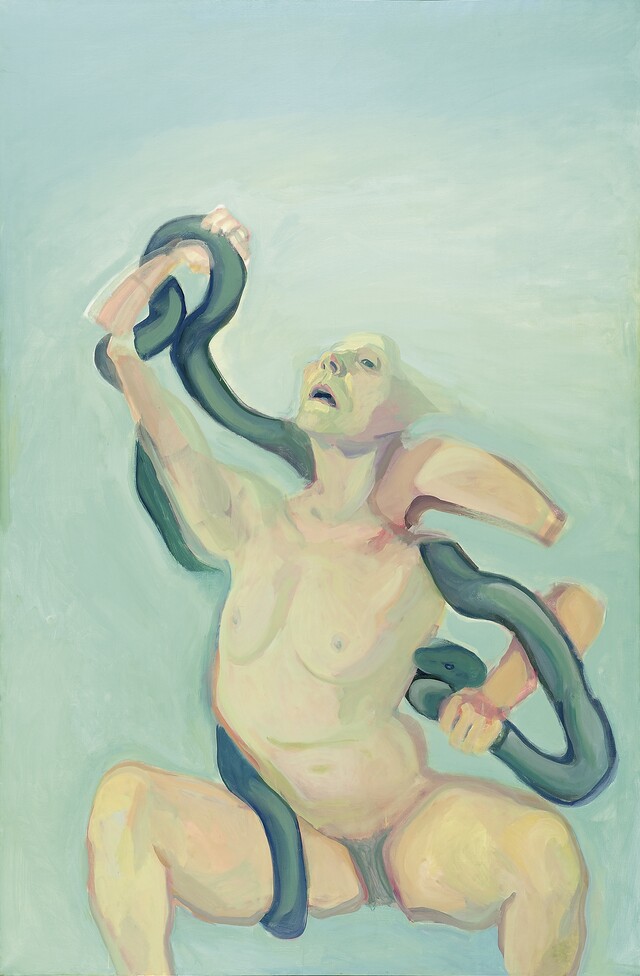
 Woman Laocoön — Maria Lassnig

Woman Laocoön, 1976 by Maria Lassnig (1919-2014)

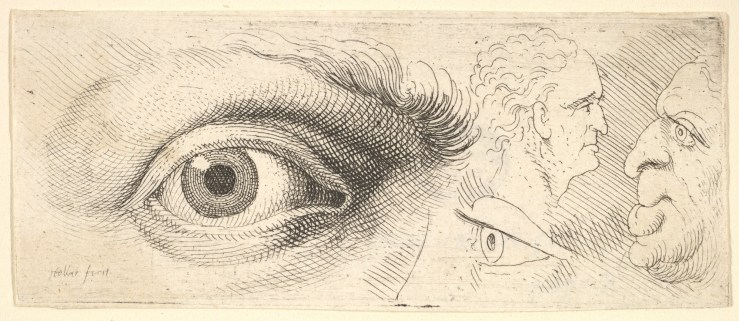
Two Eyes and Two Heads — Wenceslaus Hollar

Two Eyes and Two Heads (between 1644–52), by Wenceslaus Hollar (1607–1677)

Posted in Art

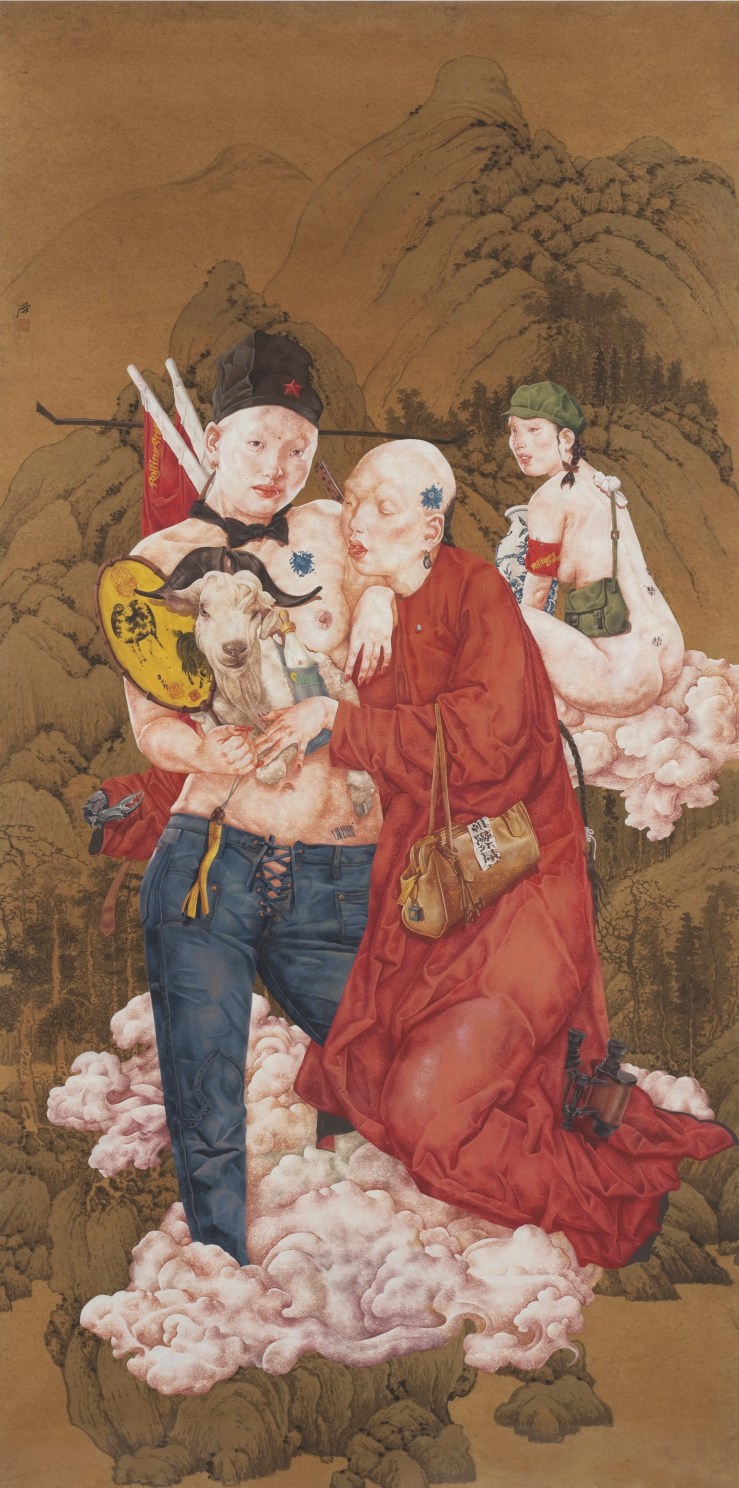
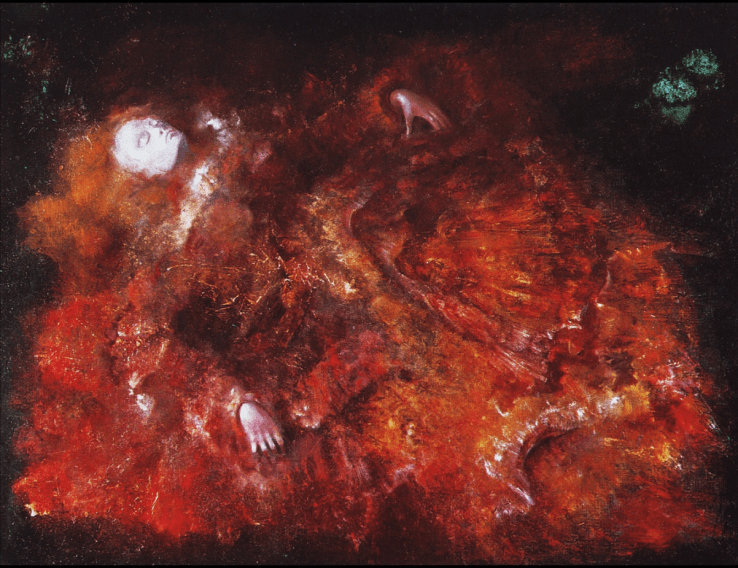
In the Clouds No. 1 — Wei Dong

In the Clouds No. 1, 2002 by Wei Dong (b. 1968)

Read Donald Barthelme’s uncollected short story “The Ontological Basis of Two”

Donald Barthelme published a short story called “The Ontological Basis of Two” under the pseudonym “Michael Houston” in the June, 1963 issue of Cavalier, a “men’s” magazine. In her biography Donald Barthelme: The Genesis of a Cool Sound, Barthelme’s ex-wife Helen Moore Barthelme writes,

…Don had with him the June issue of Cavalier. In it was a story he had written the previous December and submitted to Playboy. But “killing my hopes of a warm winter,” the story was turned down. He then submitted it under a pseudonym to a Playboy-styled magazine, Cavalier…

The story was “The Ontological Basis of Two,” and it appeared under the name of Michael Houston, a pseudonym he had used for Forum. A parody of B.F. Skinner’s Walden Two, it is an ironical tale of a girl–Peridot Concord– “who was raised in a glass box by a Harvard Professor.” He says of Peridot that because she inhabited the box until her fourth year, she “is as healthy and natural as a shrub.” Although she is free of the inhibitions of appearing nude that beset the narrator and everyone else, four years in the box have also left her “lacking in basic carnality.

The story remains uncollected, but you can read “The Ontological Basis of Two” online thanks to Jessamyn West’s fantastic Barthelme page.

Here’s the opening paragraph of the story:

A voice in her head that sound like her voice | Another report from Marlon James’s novel Moon Witch, Spider King

My last report from Marlon James’s Moon Witch, Spider King found the novel’s political machinations kicking in after its first seven chapters. Our hero Sogolon finds herself in the Northern Kingdom’s capital Fasisi. The capital is soaked in paranoia. The king is dying, a fact that cannot be admitted publicly or even privately (“The King is about his business,” courtiers and officials repeat). According to custom, it is the son of the king’s daughter who will take up his crown—only Princess Emini has been unable to conceive a child. Meanwhile, her brother Prince Lukid plots a coup, assisted (and likely designed, really), by the Aesi, a Machiavellian who may or may not have magic powers. The Aesi has engineered a literal witch hunt, accusing, arresting, and executing any woman who threatens his hold on power, with the aid of the Sangomin, a band of children necromancers with mutant powers (there’s a two-headed boy, a “razor boy,” a lizard girl, etc.)

The Aesi takes special note of Sogolon, recognizing an emerging power in her that others overlook. She’s wary of him, a feeling that only intensifies as she strikes up an odd friendship with Commander Ulu, a former commander of the Royal Guard who has no memories. Sogolon intuits that it’s likely that the Aesi is responsible for the memory loss, a suspicion that solidifies later in the novel. In an attempt to retain his memories, Ulu writes them down, filling every surface of his living quarters, and even writing in blood. Over time, Sogolon learns to read, with Ulu as a kind if unwitting teacher. Sogolon’s relationship with Keme also deepens, although she learns he has a wife and family.

The relative stability of Sogolon’s life ends when the king dies and Prince Likud claims the throne, taking up the mantle Kwash Moki. The Aesi’s schemes bear fruit-in a sequence that foregrounds the novel’s background trope of witch hunting, princess Emini is put on a trial for adultery. She’s exiled to a walled city of nuns, where she is to spend the rest of her life, and Sogolon is sent with her.

They never make it to the nunnery though. Presumably at the secret command of the Aeisi, the Sangomin attack their caravan killing everyone except Sogolon. She escapes, but the Sangomin track her down. As they attack, she seems to black out. She awakes to a scene of devastating violence she has no memory of. She appears to be in a giant crater, a “smooth bowl that she will have to climb out of.” There, she sees

…them floating, first the top half of the razor finger boy, his entrails dangling, his eyes gazing into nothing, and his legs nowhere to be seen. Slabs of loose white rock and cut white stone—the big man shattered in a multitude of pieces. She climb out and walk past the red and blue girl with the lizard tongue, her hands and legs swaying as if underwater, her face sleepy, the back of her head exploded with all of her shooting out. Perplexing it be, all three floating in air like they underwater, but everything stuck as if whatever happen don’t finish.

Sogolon comes to realize that she was the author of this destruction. When her life is threatened, Sogolon musters a telekinetic force that she refers to sometimes as “wind” or as the “push”–but she can’t control it (yet).

After wandering in the wilderness and cold, she’s found by Keme and other former members of the royal guard who are now part of the Red Army—the king Kwash Moki’s army. Keme has no memory of Sogolon. He brings her back to Fasisi, despite her protest (“They sent us on a fact finding mission, and you are the fact that we found”). Thus ends part one of Moon Witch, Spider King.

I’ve cobbled together a plot summary here, but I’m sure there are many gaps (and maybe some mistakes). In Moon Witch, we’re only privy to what Sogolon sees and hears, and while she’s a curious and perceptive girl, she’s also quite young and lacks any formal education. Much of our understanding of the plot is filtered through Sogolon’s intuition, and a major motif that emerges in these chapters is memory loss, as well as the power that controlling a narrative confers. The Aesi is able to rewrite history, to make people believe things that they witnessed first-hand could not be true.

At the same time the first part of Moon Witch, subtitled “No Name Woman,” is about a consciousness creating itself. Sogolon grew up imprisoned first in a termite mound, then in a whorehouse, then in the home of a fallen aristocrat. She had to name herself, teach herself to read, to scrape together her memories into a slim personal history. In the final sections of “No Name Woman,” the narrator repeats an attribution each time Sogolon enters into a dialogue with her emerging consciousness, as in the following example:

Wake up early girl, will yourself, say a voice in her head that sound like her.

This “voice in her head that sound like her” is Sogolon’s self-making, a consciousness reaching toward the “I” that disappears after the novel’s opening sentences:

One night I was in the dream jungle. It was not a dream, but a memory that jump up in my sleep to usurp it. And in the dream memory is a girl. See the girl.

After that second sentence, the first-person narrator disappears—only to reappear in the beginning of part two, “A Girl Is a Hunted Thing.” More thoughts to come.

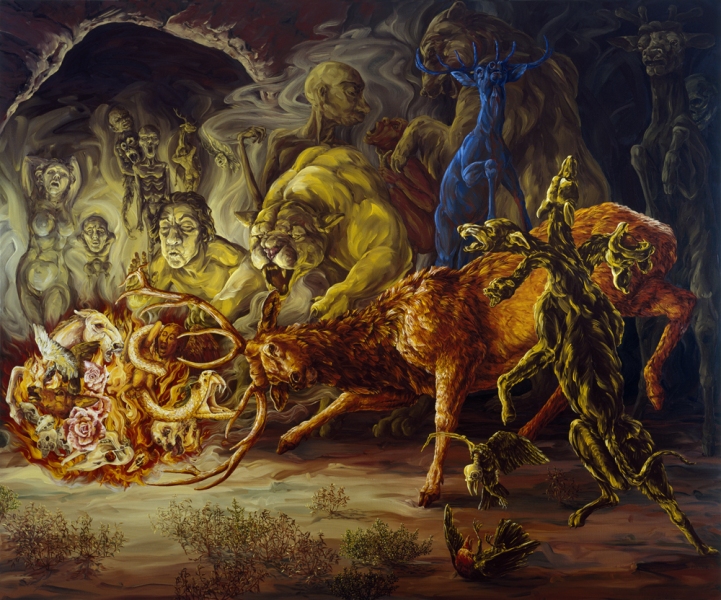
Temptation of St. Anthony — Melissa Miller

Temptation of St. Anthony, 1993 by Melissa Miller (b. 1951)

Useless Dress — Leonor Fini

Useless Dress, 1964 by Leonor Fini (1908-1996)

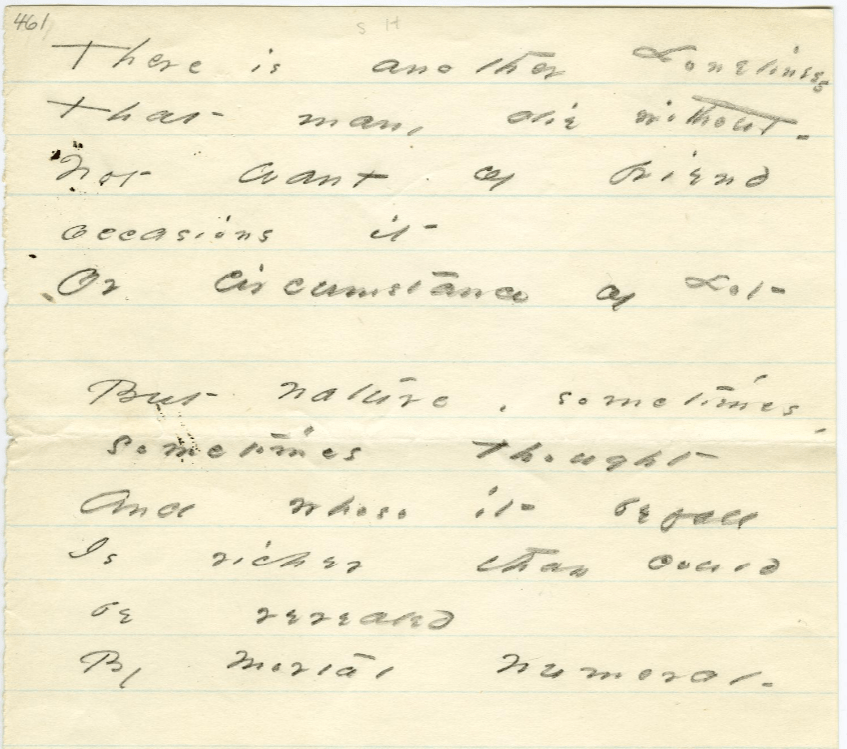
“There is another Loneliness” — Emily Dickinson

There is another Loneliness
That many die without —
Not want of friend occasions it
Or circumstances of Lot

But nature, sometimes, sometimes thought
And whoso it befall
Is richer than could be revealed
By mortal numeral —

Woman Bathing — Mary Cassatt

Woman Bathing, 1891 by Mary Cassatt (1844-1926)

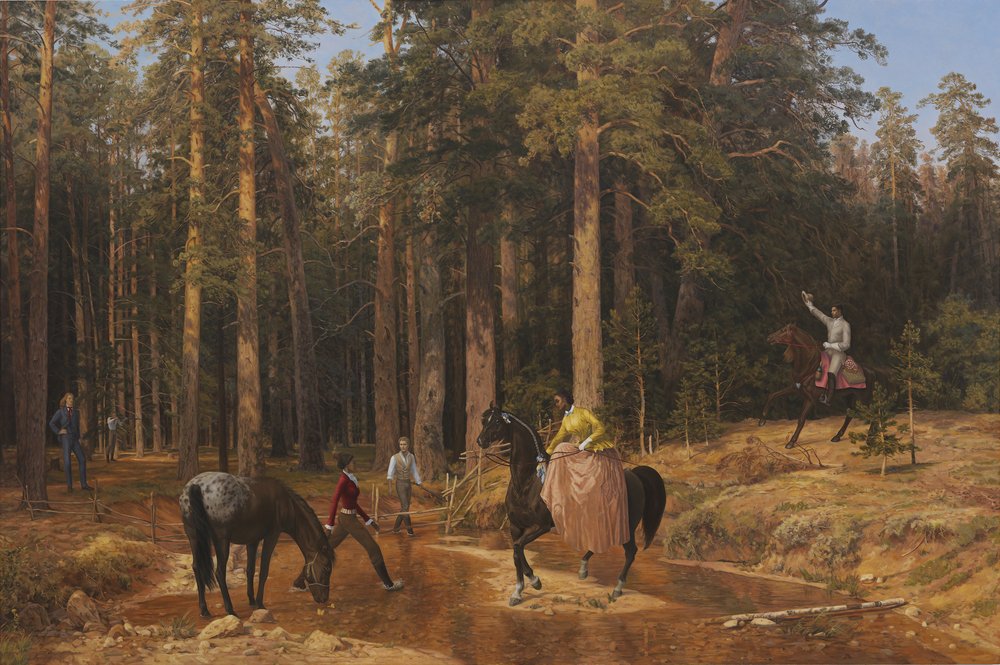
Before — Hilary Harkness

Before, 2021 by Hilary Harkness (b. 1971)