
Girl With Curious Hair–David Foster Wallace

dfw.gif

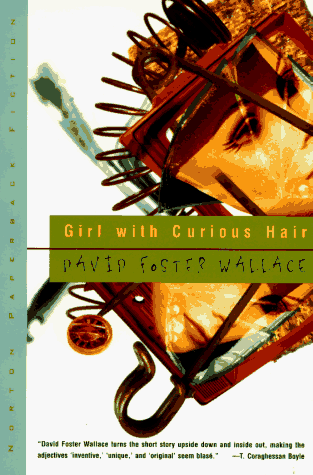
Scott Martin was kind enough to loan me this book. Did he know that it would forever change the way I read? It was the first semester of my freshman year in college, and I was slowly reaching beyond stuff like Henry Miller, Wm Burroughs and Franz Kafka. David Foster Wallace’s short story collection Girl With Curious Hair introduced me to a whole new world of writing. Reading DFW is like having a very witty friend tell you a moving and funny story over a  few beers. He’s hilarious, thought-provoking, and not nearly as hard to read as people seem to think (by the way, simply googling “David Foster Wallace” will yield several vitriolic essays by people who think that DFW is somehow duping his readers. He’s not. These people don’t know a good story when they read one.)

Girl features “real people” like Alex Trebek, David Letterman, and Lyndon Johnson as characters, but constantly destabilizes any realism these figures might lend to the story. The novella included in this collection, Westward the Course of Empire Takes Its Way, alludes directly to John Barth’s Lost in the Funhouse (another book I’ve loaned out and never gotten back). Westward takes a critical but humorous look at how culture is commodified: the plot centers around a reunion for everyone who has ever acted in a McDonald’s commercial. At the reunion, plans are revealed for a series of real-life “Funhouses,” based on the work of “Dr. Ambrose” (Barth’s stand-in in Westward).

Girl with Curious Hair is probably the best starting point for anyone interested in DFW but daunted by 1000 pages of Infinite Jest (IJ is yet another one I loaned out and never got back). Girl‘s stories have a little more ‘pop’ to them than DFW’s latest collection, Oblivion, and Girl tends to be easier to find used than DFW’s other collections, Brief Interviews with Hideous Men (actually a better collection, in my opinion) and A Supposedly Fun Thing I’ll Never Do Again (a collection of hilarious essays and nonfiction).

To sum up: if you still haven’t read DFW go consume this book; when you’re done you’ll be left wondering: “What other good stuff have I been missing out on?”

Foucault’s Pendulum — Umberto Eco

fp.jpg

Go here to see a Foucault Pendulum at work.

Snagged as part of the same cache from the Shinjuku-nishiguchi school that yielded Kinski Uncut. Not really a theft–I traded a VHS tape of a six-hour Cosby Show marathon into the book trade for these books.

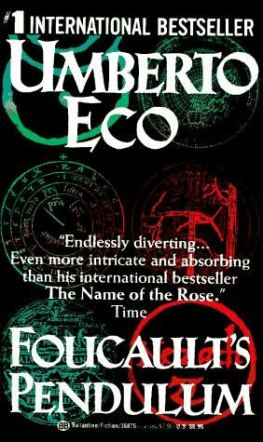
Foucault’s Pendulum is a detective story fertile with semiotic pranks–a ludic maze of meaning, history, and logic. Dan Brown’s The Da Vinci Code basically rips off Eco, keeping some of the gnostic speculation, and dumbing down both the plot and the writing. Steal from the greats, I guess…

Something I love about this book is that it was a huge bestseller and I always find meet people who’ve read it (or find out that people I know have read it). Have you, gentle reader, read this book?

I loaned the book to RP a few years back; perhaps he’ll consider loaning it to you.

Danny Rolling: From Hell–Part II

 While I took an afternoon nap, serial killer Danny Rolling was killed by the State of Florida. Sixteen years ago in Gainesville, FL, Rolling went on a killing spree, murdering and mutilating five college students.

I graduated from the University of Florida in 2001. A decade after the murders, you would meet someone–a grad student, a law student, a native–who had a story about that weekend. They made it sound scary as hell.

Anyone who’s lived in Gainesville or even spent some time there will be familiar with the 34th Street mural wall. One panel of the wall is dedicated to the victims of the slaying: Sonja Larson, Christina Powell, Christa Hoyt, Tracy Paules, and Manuel Taboada. The panel seems to be repainted annually; sometimes due to vandalism.

Go here for a detailed chronological account of the murders

These murders were horrific, terrible crimes; random and indeterminate, but premeditated nonetheless. Rolling mutilated the corpses, beheading one of them; he also took body parts from the victims. There is no doubt in my mind that this man was a monster, a killer out of the woods like Grendel. And he got exactly what he wanted: fame and infamy and attention. He channeled hell and brought it to earth; I’m sure that hell still exists for some of his victim’s families to this day. Pragmatically, it is right and proper that Rolling be executed.

I still find myself opposed to the death penalty. I don’t pity Rolling and I don’t aim to add to his fame–but he has bought his fame by personifying abject horror, and this is Halloween horror-time. And as just and right as it seems that Rolling die, I still believe that it is wrong for our state government to kill him. I am not arguing that the death penalty is not a deterrent, or that the appeals process death row inmates go through is just as costly as life imprisonment; my argument is simple: murdering people is wrong. It is wrong and therefore against the law, so we (the “we” of community and society who consent to just government) do not kill. If we kill each other we cannot thrive. Rolling’s crime illustrates the human and social disruption of murder. These killings, these gruesome hyperboles of annihilation, show exactly why it is so important that government discontinue use of the death penalty.

Many, many times I have thought: “That person should be killed. That person should be shot.” I have had these murderous thoughts about awful psychopaths and child molesters and about people I am in strong disagreement with and people who have cut me off in traffic. I have had them in brief passing and I have concentrated on them with intensity, giving them much of my time. However, I know that these feelings are rooted in revenge fantasy and rotten wish-fulfillment. I think that when we buy into the death penalty as a punishment, we validate murder. We endorse a moral paradox: killing is wrong, so we will kill you. This type of social paradox becomes a vicious circle. The revenge cycle is metonymized so perfectly in everything from gang warfare to the Israeli–Palestinian conflict. Confronted with the sheer evidence of such futility and emptiness in violence, I think it only sensical and right that we choose to end capital punishment. Otherwise we only help to maintain the hell that Rolling has channelled, a hell we choose to keep.

The Shins — Wincing The Night Away

AUDIOKLEPT (SPECIAL EDITION)

Not a book, but nonetheless obtained by extra-legal means. Piracy baby!

SubPop is set to drop The Shins’ third album Wincing The Night Away in January of 2007, but the thing leaked like a sieve this weekend. Similarly, Of Montreal’s album Hissing Fauna, Are You The Destroyer?, set for a January release, leaked over the last two weeks. I don’t understand why these labels delay releases so long after the record’s been mastered. It’s almost impossible these days to keep a record from leaking–although Thom Yorke managed to keep his solo record The Eraser from leaking right up until it was released.

On paper, The Shins are the type of band I would love to hate. They write tight pop songs with keen melodies and spare harmonies with frequent nods to classic 60s acts like The Kinks, The Beatles, The Zombies and The Beach Boys (unlike every other indie band made up of four white guys). They are name-dropped in the epitome of bad indie films, Zach Braff’s Garden State (Natalie Portman’s character declares them “life-changing”). They appeared in an episode of The Gilmore Girls as a band playing to a club full of improbably ecstatic springbreakers in Ft. Lauderdale.

Despite all of this, I like them quite a bit. Their songs are catchy in a good way. They certainly aren’t re-inventing the wheel, but if you’re going to listen to an indie rock band, you might as well listen to The Shins. All that said, I like their new album a lot, much better than their last Chutes Too Narrow actually, which I thought was too airy. Wincing evinces some growth in songwriting and arrangements, and on the whole the production is much fuller than the past two albums. Wincing features a more prominent use of atmospheric sounds. Synthesizers are utilized to greater advantage advantage with respect to both melodies and atmosphere, and the band even brings in what I believe to be a small string section one one song. They even play with vocal loops on this record.

I don’t know if this band will ever top their first record Oh, Inverted World, a record that somehow was simultaneously breezy and profound, and produced at least four songs that can never go wrong on a mixtape. I’ve listened to it a few times, but there doesn’t seem to be a “New Slang” or “Know Your Onion” on this album. Wincing however seems to work better as a whole album than The Shins’ previous efforts, and the stronger production and fuller arrangements will probably earn the group a broader fanbase.


Riddley Walker–Russell Hoban

I never gave Riddley Walker back to Patrick Tilford (aka TLFRD). A few years ago I loaned it to a student who never returned it. Said student never returned Dune, or The Left Hand of Darkness, or several Jules Verne novels either. Doesn’t matter, I know that he read them.

This book is a favorite. Russell Hoban’s coming-of-age story takes place in a future that has regressed to the iron age due to a catastrophic war. Hoban writes in his own language, a mutated English, full of fragments of the 20th century.

I couldn’t find an image of the edition I stole/lost. This edtion from 2000 features an introduction by Will Self, whose latest book, The Book of Dave, apparently was directly influenced by Riddley Walker. Will Self’s book Great Apes deeply, deeply disturbed me. Nothing repulses me more than images of chimpanzees dressed as humans; Great Apes is the literary equivalent.

Great Apes was an airport bookstore buy; I suppose at some point on this blog I will address the “airport bookstore buy.”

Tim Hecker — Harmony in Ultraviolet

Yes yes yes. I know I know I know. It’s not a book. It’s an album of music. But see now so and yes–it’s just so beautiful. It’s the best “reading music” I’ve come across in a long time. And, in keeping with the theme of this blog, I did obtain it by extra-legal means (it comes out Oct 16, so go buy it from your local record store!)

KR102

Harmony in Ultraviolet is Hecker’s third or fourth album, depending on how you want to count his EPs and sundries. This music might be described as “ambient,” although I’m not sure I like that term. Harmony‘s tracks seem to contain impossible oppositions; they hover and sink, they pulsate but are static, they are digital-ice and analog-heat, they express the abstract in a concrete mode. Why write about it here? Well, really, I just love an album that lends itself to reading, and Hecker’s new disc is fantastic to read to. 

James Weldon Johnson — Part II

In 1912, James Weldon Johnson anonymously published The Autobiography of an Ex-Colored Man. It was later republished under Johnson’s name in 1927, at the acme of the Harlem Renaissance.

The Autobiography of an Ex-Colored Man strikes me as a thoroughly postmodern move. This fictional novel is presented as the true life story of a talented man who chooses to “pass” as white so that he might have greater–or at least equal–access to opportunity in America. Autobiography is a fictional novel “passing” as another genre, autobiography. This mirroring wasn’t intended as just a fancy rhetorical device–it was a subversive, incendiary gesture on JWJ’s part, meant to question the mores of white America. In fact, after it’s initial publication, several reviews were written suggesting that the book was a hoax, the premise of these reviews being that a black man could never pass as a white man–let alone marry a white woman and become a landowner of some importance.

Ultimately, the voice in Autobiography problematizes all easy readings. The ex-colored man is a bona fide narcissist with an almost preternatural ability to succeed at everything he attempts–except of course when he is thwarted by racist social norms. The reader seems most encouraged to sympathize with the narrator at these times, when the ex-colored man’s natural and cultivated abilities are confronted or ousted by the dominant system. At other times, the narrator condescends working class blacks he terms “inferior”; he also frequently wishes to sanitize “primitive” forms of black art, such as spirituals and ragtime music, by recasting them in a classical, canonical mode. The ex-colored man clearly feels frustration that the acumen of his genius is constantly delimited by his color, but this frustration sometimes seems aimed at his fellow blacks.

All of this makes for a challenging but brisk and enjoyable read. Paired with JWJ’s real autobiography, Along This Way, a savvy reader can come up with all kinds of ironic, postmodern readings. Or straightforward readings. Or whatever. Read it yourself.

James Weldon Johnson — Part I

Everything in Jacksonville, Florida should be named after native son James Weldon Johnson.


Well, maybe not everything–that could get confusing. But as it stands, the only thing we Jacksonvillians have bearing that great man’s name is a middle school, and an obscure plaque somewhere downtown–which is great. People love plaques.

James Weldon Johnson Middle School feeds Stanton College Preparatory School, an excellent school that JWJ served as principal of from 1894 to 1902. In the interest of full disclosure, I should point out that I’m a proud graduate of the Stanton School (go Blue Devils!). Under JWJ’s plan, Stanton became the first black high school in Florida. In his autobiography, Along This Way, JWJ discloses the genius of his plans for educational reform: he simply asked the eighth grade class to come back again, partitioned off some rooms, and based the new high school program on the curriculum of his alma mater Atlanta University (now known as Clark). The real genius of this is that he didn’t bother to ask the all-white board of education, who undoubtedly would’ve found some way to say “no.” He just did it, and then let the board come see what he had done. Brilliant.

Why isn’t there a single prominent statue of JWJ in Jacksonville? Or a library named after him? Or even a street? It seems to me that the average Jacksonvillian simply isn’t aware of JWJ, or has only a passing knowledge of who he was, not realizing that he was born and raised here.

So:

1. I will continue writing about James Weldon Johnson on this blog.

2. I challenge every Jacksonvillian to read a book by James Weldon Johnson.

 3. Maybe if we read his books, we’ll come to feel his genius, celebrate the fact that he is from our hometown, and honor him appropriately.

The Fortress of Solitude — Jonathan Lethem

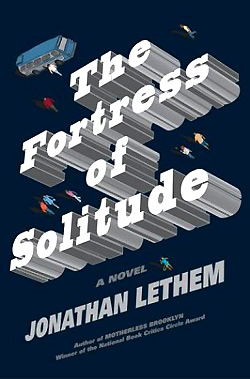
Jonathan Lethem’s The Fortress of Solitude deserved the rave reviews it got back in 2003 when it first came out. I think it was a review in The Believer (although I’m pretty sure it wasn’t in Nick Hornby’s sometimes-entertaining “Stuff I’ve Been Reading” column) that prompted me to order a used copy via Amazon. I loved this book so much that of course I offered it up to Ricotta Parks, who apparently doesn’t read anything longer than a soup label anymore. Never fear, RP, I procured a nice cheap copy at the local B&N yesterday afternoon.

This book has it all: two main characters named after music legends, a magic ring, numerous Brian Eno references, gentrification, a Stan Brakhage-like filmmaker, 1970s Marvel comic books, confused sex, Brooklyn’s pre-hiphop hiphop culture, and a pretty cool Beatles archetype theory. Here is the Beatles archetype theory:

“‘Everything naturally forms into a Beatles, people can’t help it.’

‘Say the types again.’

‘Responsible-parent genius-parent genius-child clown-child.’

‘Okay, do Star Wars.’

‘Luke Paul, Han Solo John, Chewbacca George, the robots Ringo.'”

Biblioklept’s turn: Cheney Paul, Rove John, Condi Rice George, Bush Ringo.