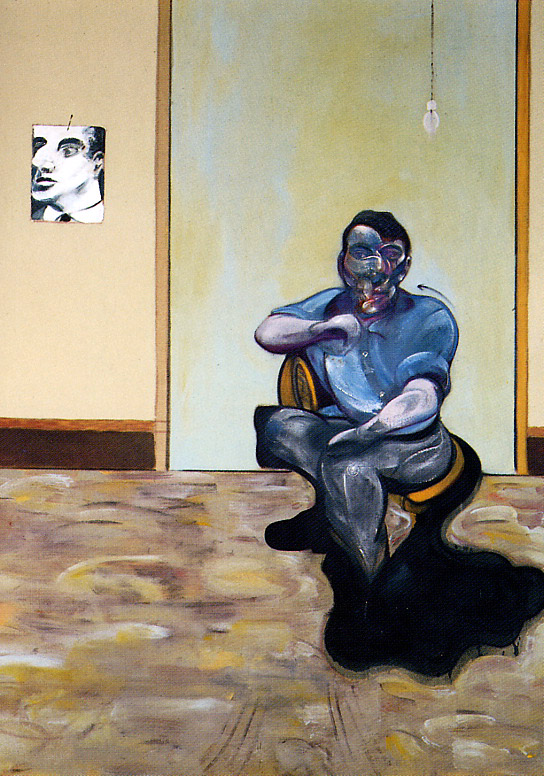
Portrait of the Artist’s Mother

Portrait of the Artist’s Mother — Vincent van Gogh
The Artist’s Mother — Pierre-Auguste Renoir
Portrait of the Artist’s Mother — Camille Pissarro

Continue reading “Portrait of the Artist’s Mother”

“Mothers” — William Gaddis

“Mothers” by William Gaddis

When Ralph Waldo Emerson informed—or rather, perhaps, warned us—that we are what our mothers made us, we might dismiss it as received opinion and let it go at that, like the broken clock which is right twice a day, like the self-evident answer contained in Freud’s oft-quoted query “What do women want?” when, as nature’s handmaid, she must want what nature wants which is, quite simply, More. But which woman? Whose mother, Emerson’s? A woman so in thrall to religion that we confront another dead end; or Freud’s? or even one’s own, even mine, offering an opportune bit of wisdom to those of us engaged in the creative arts, where paranoia is almost an occupational hazard: “Bill, just try to remember,” she said, “there is much more stupidity than there is malice in the world,” an observation lavish with possibilities recalling Anatole France finding the fool more dangerous than the rogue because “the rogue does at least take a rest sometimes, the fool never.”

This is hardly to see stupidity and malice as mutually exclusive: look at your morning paper, where their combined forces explode exponentially (women and children first) from Bosnia to Belfast, unlike the international “intelligence community” so self-contained in its malice-free exercises that it generally ensnares only its own dubious cast of players. Of further importance is the distinction between stupidity and ignorance, since ignorance is educable, while stupidity’s self-serving mission is the cultivation and exploitation of ignorance, as politicians are keenly aware.

How, then, might Emerson’s mother have seen herself stumbling upon Thomas Carlyle’s vision of her son as a “hoary-headed and toothless baboon”? Or Freud’s, in the gross unlikelihood of her reading the Catholic World’s review of her son’s book Moses and Monotheism as “poorly written, full of repetitions . . . and spoiled by the author’s atheistic bias and his flimsy psychoanalytic fancies”? Goethe’s Wilhelm Meister dismissed as “sheer nonsense” by the Edinburgh Review and, a good century later, the hero of Saul Bellow’s Dangling Man ridiculed as a “pharisaical stinker” in Time magazine, John Barth’s The End of the Road recommended by Kirkus Reviews “for those schooled in the waste matter of the body and the mind,” and William Faulkner’s Absalom, Absalom! shrugged off as the “final blowup of what was once a remarkable, if minor, talent” by The New Yorker magazine where, just forty years later, “a group of avant-garde critics has put forward the idea that books should be made unreadable. This movement has manifest advantages. Being unreadable, the text repels reviewers, critics, anthologists, academic literati, and other parasitical forms of life,” indicting the author of the novel J R wherein “to produce an unreadable text, to sustain this foxy purpose over 726 pages, demands rare powers. Mr. Gaddis has them.” “You’re a fool, a fool!” the distraught mother of Dostoevski’s ill-fated hero Nikolay Stavrogin cries out at the “parasitical forms of life” surrounding her. “You’re all ungrateful fools. Give me my umbrella!”

(“Mothers” is collected in The Rush to Second Place).

The Guest — Francesco Balsamo

opere05

On the Beach — Hans Thoma

On the beach. 1886. Hans Thoma

Pynchon in Public, 8 May 2015


Chameleon with a Grain of Pomegranate — Agostino Arrivabene

tumblr_lxi0pf85ce1qhvnw6o1_1280

The Captive Seven — Michael Ayrton

The Captive Seven 1949-50 Michael Ayrton 1921-1975 Presented by the Friends of the Tate Gallery 1990 http://www.tate.org.uk/art/work/T05854

Watch a film about Thomas Pynchon, A Journey into the Mind of P


This 2002 documentary by Donatello Dubini and Fosco Dubini is kind of a mess, but it’s a fun mess. Interviews with old friends, like Jules Siegel, superfans and webdudes, and critics (George Plimpton shows up a few times), are interspliced with a lot of stock footage. The Residents’ fantastic pop appropriations from The Third Reich Rock n’ Roll help to stitch the movie together. The film occasionally indulges in a kind of obvious paranoid rambling, and the last section, detailing an attempt to photograph Thomas Pynchon (you remember that silly CNN report?) is not nearly as interesting as Allen Rush or other Pynchonians analyses…. Sort of a for completists only deal.

Invocation — Remedios Varo

La Femme Lune — Leonor Fini

tumblr_l21vzkX54e1qa7guao1_r1_1280

The New Generation — Jan Toorop

The politics was all theatre, all just to keep the people distracted (Gravity’s Rainbow)

It means this War was never political at all, the politics was all theatre, all just to keep the people distracted… secretly, it was being dictated instead by the needs of technology… by a conspiracy between human beings and techniques, by something that needed the energy-burst of war, crying, “Money be damned, the very life of [insert name of Nation] is at stake,” but meaning, most likely, dawn is nearly here, I need my night’s blood, my funding, funding, ahh more, more… . The real crises were crises of allocation and priority, not among firms—it was only staged to look that way—but among the different Technologies, Plastics, Electronics, Aircraft, and their needs which are understood only by the ruling elite…

Yes but Technology only responds (how often this argument has been iterated, dogged and humorless as a Gaussian reduction, among the younger Schwarzkommando especially), “All very well to talk about having a monster by the tail, but do you think we’d’ve had the Rocket if someone, some specific somebody with a name and a penis hadn’t wanted to chuck a ton of Amatol 300 miles and blow up a block full of civilians? Go ahead, capitalize the T on technology, deify it if it’ll make you feel less responsible—but it puts you in with the neutered, brother, in with the eunuchs keeping the harem of our stolen Earth for the numb and joyless hardons of human sultans, human elite with no right at all to be where they are—”

We have to look for power sources here, and distribution networks we were never taught, routes of power our teachers never imagined, or were encouraged to avoid… we have to find meters whose scales are unknown in the world, draw our own schematics, getting feedback, making connections, reducing the error, trying to learn the real function… zeroing in on what incalculable plot? Up here, on the surface, coaltars, hydrogenation, synthesis were always phony, dummy functions to hide the real, the planetary mission yes perhaps centuries in the unrolling… this ruinous plant, waiting for its Kabbalists and new alchemists to discover the Key, teach the mysteries to others…

From page 521 of Thomas Pynchon’s novel Gravity’s Rainbow

“Population Explosion” — Archibald MacLeish

Screenshot 2015-05-07 at 8

Frida Kahlo’s painted body cast

9ee22765-9023-4452-8822-0f52b4417dd3-1357x2040

Via/more. About:

After her bus accident, Kahlo was in a full body cast for three months, and she remained in pain for the rest of her life. She painted her casts and corsets, turning them from medical equipment into artworks

Charles Burns’s Toronto Comic Arts Festival Poster

tumblr_nkb79pJ4Ah1rp7p8xo1_1280

Orson Welles on making fun of Ernest Hemingway

“The Hunter Gracchus,” a short tale by Franz Kafka

“The Hunter Gracchus”

by

Franz Kafka

Two boys were sitting on the wall by the jetty playing dice. A man was reading a newspaper on the steps of a monument in the shadow of a hero wielding a sabre. A young girl was filling her tub with water at a fountain. A fruit seller was lying close to his produce and looking out to sea. Through the empty openings of the door and window of a bar two men could be seen drinking wine in the back. The landlord was sitting at a table in the front dozing. A small boat glided lightly into the small harbour, as if it were being carried over the water. A man in a blue jacket climbed out onto land and pulled the ropes through the rings. Behind the man from the boat, two other men in dark coats with silver buttons carried a bier, on which, under a large silk scarf with a floral pattern and fringe, a man was obviously lying.

No one bothered with the newcomers on the jetty, even when they set the bier down to wait for their helmsman, who was still working with the ropes. No one came up to them, no one asked them any questions, no one took a closer look at them.

The helmsman was further held up a little by a woman with disheveled hair, who now appeared on deck with a child at her breast. Then he came on, pointing to a yellowish two-story house which rose close by, directly on the left near the water. The bearers took up their load and carried it through the low door furnished with slender columns. A small boy opened a window, noticed immediately how the group was disappearing into the house, and quickly shut the window again. The door closed. It had been fashioned with care out of black oak wood. A flock of doves, which up to this point had been flying around the bell tower, came down in front of the house. The doves gathered before the door, as if their food was stored inside the house. One flew right up to the first floor and pecked at the window pane. They were brightly coloured, well cared for, lively animals. With a large sweep of her hand the woman on the boat threw some seeds towards them. They ate them up and then flew over to the woman. Continue reading ““The Hunter Gracchus,” a short tale by Franz Kafka”