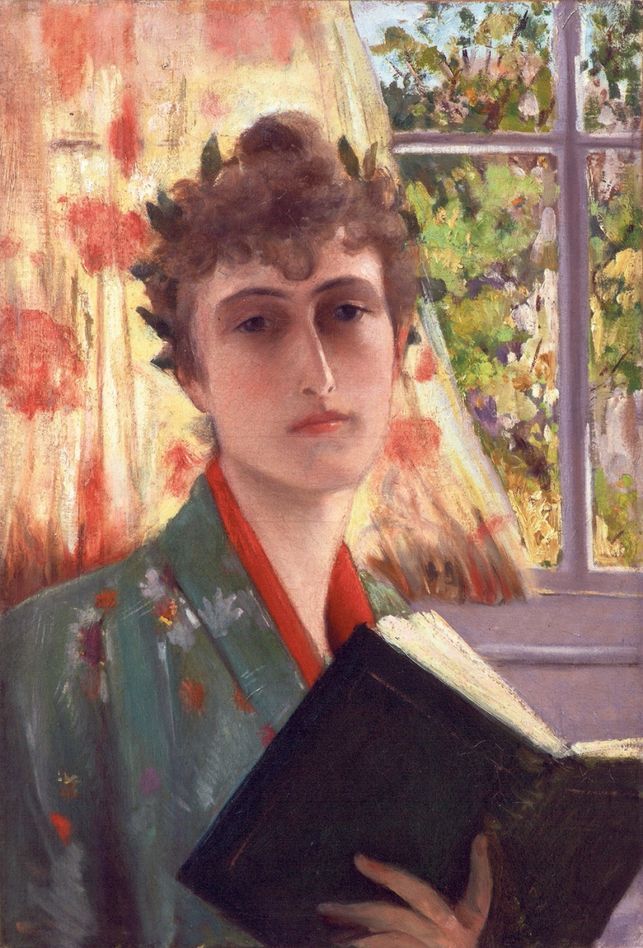
Mr. and Mrs. Clark and Percy — David Hockney

Sentimental Conversation — René Magritte

Independence — Du Zhenjun

05-Independence

No good will come of this!

20140512-142534.jpg

The Mincing Mockingbird Guide to Troubled Birds (Book Acquired, 5.09.2014)

20140514-085207.jpg

The Mincing Mockingbird Guide to Troubled Birds is new from Penguin next month. It’s a handsome little book. Amusing.20140514-085230.jpg

20140514-085238.jpg

20140514-085245.jpg

“The Locket” — Kate Chopin

“The Locket”

by

Kate Chopin

I

One night in autumn a few men were gathered about a fire on the slope of a hill. They belonged to a small detachment of Confederate forces and were awaiting orders to march. Their gray uniforms were worn beyond the point of shabbiness. One of the men was heating something in a tin cup over the embers. Two were lying at full length a little distance away, while a fourth was trying to decipher a letter and had drawn close to the light. He had unfastened his collar and a good bit of his flannel shirt front.

“What’s that you got around your neck, Ned?” asked one of the men lying in the obscurity.

Ned—or Edmond—mechanically fastened another button of his shirt and did not reply. He went on reading his letter.

“Is it your sweet heart’s picture?”

“‘Taint no gal’s picture,” offered the man at the fire. He had removed his tin cup and was engaged in stirring its grimy contents with a small stick. “That’s a charm; some kind of hoodoo business that one o’ them priests gave him to keep him out o’ trouble. I know them Cath’lics. That’s how come Frenchy got permoted an never got a scratch sence he’s been in the ranks. Hey, French! aint I right?” Edmond looked up absently from his letter. Continue reading ““The Locket” — Kate Chopin”

The Lord Is My Shepherd — Eastman Johnson

The Mad Woman — Chaim Soutine

Read “Der Kulterer,” a 1962 Thomas Bernhard Short Story, New in Translation

At his wonderful blog The Philosophical Worldview Artist, Douglas Robertson has posted his English translation of Thomas Bernhard’s 1962 story “Der Kulterer.”

Opening lines:

The closer he drew to the day of his release from the penal institution, the more Kulterer dreaded returning to his wife.  He led an existence that was completely withdrawn and completely unheeded by his fellow-inmates, and during his free time, which was often much too long, because in accordance with regulations they worked only five or six hours a day at the printing machines, he would write down his ideas, or as he termed them, “trifling thoughts,” which preoccupied him almost uninterruptedly. 

Robots! — Kilian Eng

robots

Histoire Naturelle — Fabien Mérelle

221

“All art constantly aspires towards the condition of music”

“Spotted Horses,” A Short Story by William Faulkner

“Spotted Horses”

by

William Faulkner

I

A little while before sundown the men lounging about the gallery of the store saw, coming up the road from the south, a covered wagon drawn by mules and followed by a considerable string of obviously alive objects which in the levelling sun resembled vari-sized and -colored tatters torn at random from large billboards-circus posters, say -attached to the rear of the wagon and inherent with its own separate and collective motion, like the tail of a kite.
“What in the hell is that?” one said.

“It’s a circus,” Quick said. They began to rise, watching the wagon. Now they could see that the animals behind the wagon were horses. Two men rode in the wagon.

“Hell fire,” the first man – his name was Freeman – said “It’s Flem Snopes.’ They were all standing when the wagon came up and stopped and Snopes got down and approached the steps. He might have departed only this morning. He wore the same cloth cap, the minute bow tie against the white shirt, the same gray trousers. He mounted the steps. Continue reading ““Spotted Horses,” A Short Story by William Faulkner”

RIP H.R. Giger

AP_Giger_140513_DG_16x9_992

RIP H.R. Giger, 1940-2014

Continue reading “RIP H.R. Giger”

Hermit Saints Triptych (Right Panel) — Hieronymus Bosch

Three Ages of Man and Three Graces — Hans Baldung

“To the Not Impossible Him” — Edna St. Vincent Millay

him