The NewerYork #3 (Book Acquired, 6.17.2013)

20130709-154848.jpg

I kept meaning to do a book acquired post of the forthcoming issue of TheNewerYork but the smallish book was sort of with me in a lot of places, like tucked in my pocket or a car or my backpack. I actually should review it at this point, but I haven’t read everything in it yet. Short review: An increase in print quality over the last issue (read my review of The NewerYork #2), and the same spirit.

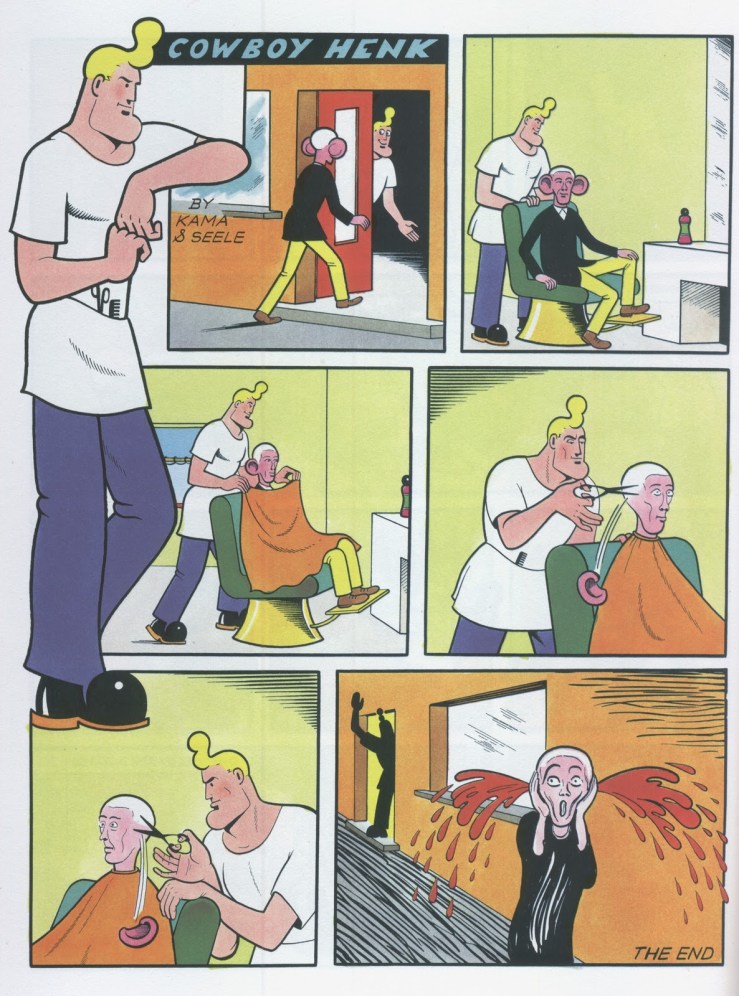
This little anthology’s vision might be bizarre, but it’s also clear. Anyway, good stuff (Anton Nimblett’s “Show & Tell: An American Game” might be my favorite—simultaneously witty and devastating). Full review to come. In the meantime, some samples: 

20130709-154256.jpg

20130709-154303.jpg
Detail from The Beauty Curse by Lori Nelson

20130709-154308.jpg


The Seventh Trumpet (Book Acquired, 7.01.2013)

20130709-140949.jpg

The Seventh Trumpet, another mystery from Peter Tremayne. Publisher Minotaur’s blurb:

When a murdered corpse of an unknown young noble is discovered, Fidelma of Cashel is brought in to investigate

Ireland, AD 670. When the body of a murdered young noble is discovered not far from Cashel, the King calls upon his sister, Fidelma, and her companion Eadulf to investigate. Fidelma, in addition to being the sister of the king, is a dailaigh—an advocate of the Brehon Law Courts—and has a particular talent for resolving the thorniest of mysteries.

But this time, Fidelma and Eadulf have very little to work with—the only clue to the noble’s identity is an emblem originating from the nearby kingdom of Laign. Could the murder be somehow related to the wave of violence erupting in the western lands of the kingdom? The turmoil there is being stirred up by an unknown fanatical figure who claims to have been summoned by “the seventh angel” to remove the “impure of faith.” Fidelma and Eadulf, once again grappling with a tangled skein of murder and intrigue, must somehow learn what connects the dead noble, a murdered alcoholic priest, and an abbot who has turned his monastery into a military fortress. When it appears that things cannot get more complex, Fidelma herself is abducted, and Eadulf must rescue her before the mystery can be solved.


Watch All the Memory in the World, A Short Film by Alain Resnais

Sanctuary — Earl Cunningham

“A Sea of Troubles” — P.G. Wodehouse

“A Sea of Troubles” by P.G. Wodehouse

Mr Meggs’s mind was made up. He was going to commit suicide.

There had been moments, in the interval which had elapsed between the first inception of the idea and his present state of fixed determination, when he had wavered. In these moments he had debated, with Hamlet, the question whether it was nobler in the mind to suffer, or to take arms against a sea of troubles and by opposing end them. But all that was over now. He was resolved.

Mr Meggs’s point, the main plank, as it were, in his suicidal platform, was that with him it was beside the question whether or not it was nobler to suffer in the mind. The mind hardly entered into it at all. What he had to decide was whether it was worth while putting up any longer with the perfectly infernal pain in his stomach. For Mr Meggs was a martyr to indigestion. As he was also devoted to the pleasures of the table, life had become for him one long battle, in which, whatever happened, he always got the worst of it.

He was sick of it. He looked back down the vista of the years, and found therein no hope for the future. One after the other all the patent medicines in creation had failed him. Smith’s Supreme Digestive Pellets—he had given them a more than fair trial. Blenkinsop’s Liquid Life-Giver—he had drunk enough of it to float a ship. Perkins’s Premier Pain-Preventer, strongly recommended by the sword-swallowing lady at Barnum and Bailey’s—he had wallowed in it. And so on down the list. His interior organism had simply sneered at the lot of them.

‘Death, where is thy sting?’ thought Mr Meggs, and forthwith began to make his preparations. Continue reading ““A Sea of Troubles” — P.G. Wodehouse”

Maxim Gorky Reading in The Penates His Drama Children of the Sun — Ilya Repin

The Mystery of a Summer Night — Edvard Munch

George Catlin Biography (Book Acquired, Some Time Back in the End of June)

20130708-151619.jpg

The end of June kinda got away with me with these books acquired posts.

Anyway, I haven’t really made any time to check out Benita Eisler’s biography of lawyer-turned-painter George Catlin, a self-taught artist who chronicled the lives and culture of the Indians of the Great Plains in the nineteenth century. I like Catlin’s work, so this one might be interesting.

Publisher Norton’s blurb, followed by two of Catlin’s paintings:

The first biography in over sixty years of a great American artist whose paintings are more famous than the man who made them.

George Catlin has been called the “first artist of the West,” as none before him lived among and painted the Native American tribes of the Northern Plains. After a false start as a painter of miniatures, Catlin found his calling: to fix the image of a “vanishing race” before their “extermination”—his word—by a government greedy for their lands. In the first six years of the 1830s, he created over six hundred portraits—unforgettable likenesses of individual chiefs, warriors, braves, squaws, and children belonging to more than thirty tribes living along the upper Missouri River.

Political forces thwarted Catlin’s ambition to sell what he called his “Indian Gallery” as a national collection, and in 1840 the artist began three decades of self-imposed exile abroad. For a time, his exhibitions and writings made him the most celebrated American expatriate in London and Paris. He was toasted by Queen Victoria and breakfasted with King Louis-Philippe, who created a special gallery in the Louvre to show his pictures. But when he started to tour “live” troupes of Ojibbewa and Iowa, Catlin and his fortunes declined: He changed from artist to showman, and from advocate to exploiter of his native performers. Tragedy and loss engulfed both.

This brilliant and humane portrait brings to life George Catlin and his Indian subjects for our own time. An American original, he still personifies the artist as a figure of controversy, torn by conflicting demands of art and success.


Demon Splash Page — Jack Kirby

demon

(More; via).

“Motorway to Roswell” — Pixies (Live in 1991)

“Of Seeming Wise” — Francis Bacon

“Of Seeming Wise” by Francis Bacon

IT HATH been an opinion, that the French are wiser than they seem, and the Spaniards seem wiser than they are. But howsoever it be between nations, certainly it is so between man and man. For as the Apostle saith of godliness, Having a show of godliness, but denying the power thereof; so certainly there are, in point of wisdom and sufficiently, that do nothing or little very solemnly: magno conatu nugas. It is a ridiculous thing, and fit for a satire to persons of judgment, to see what shifts these formalists have, and what prospectives to make superficies to seem body, that hath depth and bulk. Some are so close and reserved, as they will not show their wares, but by a dark light; and seem always to keep back somewhat; and when they know within themselves, they speak of that they do not well know, would nevertheless seem to others, to know of that which they may not well speak. Some help themselves with countenance and gesture, and are wise by signs; as Cicero saith of Piso, that when he answered him, he fetched one of his brows up to his forehead, and bent the other down to his chin; Respondes, altero ad frontem sublato, altero ad mentum depresso supercilio, crudelitatem tibi non placere. Some think to bear it by speaking a great word, and being peremptory; and go on, and take by admittance, that which they cannot make good. Some, whatsoever is beyond their reach, will seem to despise, or make light of it, as impertinent or curious; and so would have their ignorance seem judgment. Some are never without a difference, and commonly by amusing men with a subtilty, blanch the matter; of whom A. Gellius saith, Hominem delirum, qui verborum minutiis rerum frangit pondera. Of which kind also, Plato, in his Protagoras, bringeth in Prodius in scorn, and maketh him make a speech, that consisteth of distinction from the beginning to the end. Generally, such men in all deliberations find ease to be of the negative side, and affect a credit to object and foretell difficulties; for when propositions are denied, there is an end of them; but if they be allowed, it requireth a new work; which false point of wisdom is the bane of business. To conclude, there is no decaying merchant, or inward beggar, hath so many tricks to uphold the credit of their wealth, as these empty persons have, to maintain the credit of their sufficiency. Seeming wise men may make shift to get opinion; but let no man choose them for employment; for certainly you were better take for business, a man somewhat absurd, than over-formal.

Young Girl Reading a Manuscript — Thomas Cooper Gotch

c4e94758b1b56d43a661def4de68ed60

Lace and Ghosts — Victor Hugo

Manuscript Page of Dostoevsky’s Demons (With Doodles)

Dostoyevsky_The_Demons_Manuscript

Ecology — Charles Burns

burns

(Via).

The Henry Miller Odyssey

Cyclops Among the Eternally Dead — Eric Fischl