“The Ambitious Guest” — Nathaniel Hawthorne

“The Ambitious Guest” by Nathaniel Hawthorne

One September night a family had gathered round their hearth and piled it high with the driftwood of mountain-streams, the dry cones of the pine, and the splintered ruins of great trees that had come crashing down the precipice. Up the chimney roared the fire, and brightened the room with its broad blaze. The faces of the father and mother had a sober gladness; the children laughed. The eldest daughter was the image of Happiness at seventeen, and the aged grandmother, who sat knitting in the warmest place, was the image of Happiness grown old. They had found the “herb heart’s-ease” in the bleakest spot of all New England. This family were situated in the Notch of the White Hills, where the wind was sharp throughout the year and pitilessly cold in the winter, giving their cottage all its fresh inclemency before it descended on the valley of the Saco. They dwelt in a cold spot and a dangerous one, for a mountain towered above their heads so steep that the stones would often rumble down its sides and startle them at midnight.

The daughter had just uttered some simple jest that filled them all with mirth, when the wind came through the Notch and seemed to pause before their cottage, rattling the door with a sound of wailing and lamentation before it passed into the valley. For a moment it saddened them, though there was nothing unusual in the tones. But the family were glad again when they perceived that the latch was lifted by some traveller whose footsteps had been unheard amid the dreary blast which heralded his approach and wailed as he was entering and went moaning away from the door.

Though they dwelt in such a solitude, these people held daily converse with the world. The romantic pass of the Notch is a great artery through which the life-blood of internal commerce is continually throbbing between Maine on one side and the Green Mountains and the shores of the St. Lawrence on the other. The stage-coach always drew up before the door of the cottage. The wayfarer with no companion but his staff paused here to exchange a word, that the sense of loneliness might not utterly overcome him ere he could pass through the cleft of the mountain or reach the first house in the valley. And here the teamster on his way to Portland market would put up for the night, and, if a bachelor, might sit an hour beyond the usual bedtime and steal a kiss from the mountain-maid at parting. It was one of those primitive taverns where the traveller pays only for food and lodging, but meets with a homely kindness beyond all price. When the footsteps were heard, therefore, between the outer door and the inner one, the whole family rose up, grandmother, children and all, as if about to welcome some one who belonged to them, and whose fate was linked with theirs. Continue reading ““The Ambitious Guest” — Nathaniel Hawthorne” →

Reading — Nicolae Vermont

Milky Way Gold — Marlene Yu

l_milky_way_gold

“Standing on the bare ground, my head bathed by the blithe air, and uplifted into infinite space, all mean egotism vanishes. I become a transparent eyeball-I am nothing; I see all; the currents of the Universal Being circulate through me-I am part or particle of God” — Ralph Waldo Emerson, Nature

Avengers — Mike Mignola

avengers

“Je t’adore” — Robert Walser

rw

On Vacation — Kazimir Malevich

Five Scenes from Anton Chekhov’s Note-Books

* * * * *

Daughter: “Felt boots are not the correct thing.”

Father: “Yes they are clumsy, I’ll have to get leather ones.” The father fell ill and his deportation to Siberia was postponed.

Daughter: “You are not at all ill, father. Look, you have your coat and boots on….”

Father: “I long to be exiled to Siberia. One could sit somewhere by the Yenissey or Obi river and fish, and on the ferry there would be nice little convicts, emigrants…. Here I hate everything: this lilac tree in front of the window, these gravel paths….”

* * * * *

A bedroom. The light of the moon shines so brightly through the window that even the buttons on his night shirt are visible.

* * * * *

A nice man would feel ashamed even before a dog….

* * * * *

A certain Councillor of State, looking at a beautiful landscape, said:
“What a marvelous function of nature!” From the note-book of an old
dog: “People don’t eat slops and bones which the cooks throw away.
Fools!”

* * * * *

He had nothing in his soul except recollections of his schooldays.

* * * * *

–From Anton Chekhov’s Note-Books.

Reading — Octav Angheluta

See Step Across the Border, A Documentary About Avant-Garde Guitarist Fred Frith

Marvelous moment at 1:18:14 (in a film full of marvelous moments) worth transcribing here.

Frith says:

There’s not much that happens that wakes people up. People are very happy to receive all the time—information. This information is usually coming from central source, like a television station or a government.  And people don’t question this at all, anymore. But there are some things you can do in cultural terms that will make people react in a different way. More–finding something in themselves that they didn’t know about. Because the kinds of concerts that we do, or theater events, or dance, or anything like this, when it works, it’s because it strikes a cord inside somebody, and they have to look at themselves, and they have to look at themselves in relation to the society that they’re in. And there aren’t many things that make people do that. Most of the time, people don’t even think about it.

Dude for a Day — Carl Barks

cb

Books Acquired, 7.26.2013

20130726-150353.jpg

20130726-150358.jpg

20130726-150402.jpg

20130726-150415.jpg

20130726-150421.jpg

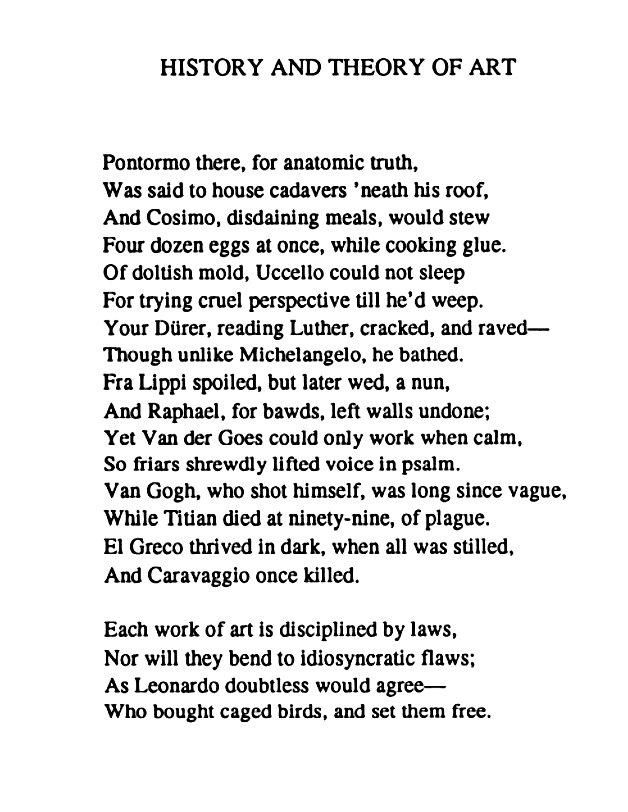
“History and Theory of Art” — David Markson

dm

(Via).

The Ants — Salvador Dali

“Hawthorne” — Charles Ives

“Hawthorne” by Charles Ives

from Essays Before a Sonata

The substance of Hawthorne is so dripping wet with the supernatural, the phantasmal, the mystical—so surcharged with adventures, from the deeper picturesque to the illusive fantastic, one unconsciously finds oneself thinking of him as a poet of greater imaginative impulse than Emerson or Thoreau. He was not a greater poet possibly than they—but a greater artist. Not only the character of his substance, but the care in his manner throws his workmanship, in contrast to theirs, into a kind of bas-relief. Like Poe he quite naturally and unconsciously reaches out over his subject to his reader. His mesmerism seeks to mesmerize us—beyond Zenobia’s sister. But he is too great an artist to show his hand “in getting his audience,” as Poe and Tschaikowsky occasionally do. His intellectual muscles are too strong to let him become over-influenced, as Ravel and Stravinsky seem to be by the morbidly fascinating—a kind of false beauty obtained by artistic monotony. However, we cannot but feel that he would weave his spell over us—as would the Grimms and Aesop. We feel as much under magic as the “Enchanted Frog.” This is part of the artist’s business. The effect is a part of his art-effort in its inception. Emerson’s substance and even his manner has little to do with a designed effect—his thunderbolts or delicate fragments are flashed out regardless—they may knock us down or just spatter us—it matters little to him—but Hawthorne is more considerate; that is, he is more artistic, as men say.

Hawthorne may be more noticeably indigenous or may have more local color, perhaps more national color than his Concord contemporaries. But the work of anyone who is somewhat more interested in psychology than in transcendental philosophy, will weave itself around individuals and their personalities. If the same anyone happens to live in Salem, his work is likely to be colored by the Salem wharves and Salem witches. If the same anyone happens to live in the “Old Manse” near the Concord Battle Bridge, he is likely “of a rainy day to betake himself to the huge garret,” the secrets of which he wonders at, “but is too reverent of their dust and cobwebs to disturb.” He is likely to “bow below the shriveled canvas of an old (Puritan) clergyman in wig and gown—the parish priest of a century ago—a friend of Whitefield.” He is likely to come under the spell of this reverend Ghost who haunts the “Manse” and as it rains and darkens and the sky glooms through the dusty attic windows, he is likely “to muse deeply and wonderingly upon the humiliating fact that the works of man’s intellect decay like those of his hands” … “that thought grows moldy,” and as the garret is in Massachusetts, the “thought” and the “mold” are likely to be quite native. When the same anyone puts his poetry into novels rather than essays, he is likely to have more to say about the life around him—about the inherited mystery of the town—than a poet of philosophy is. Continue reading ““Hawthorne” — Charles Ives” →

Reading — Nicolae Tonitza

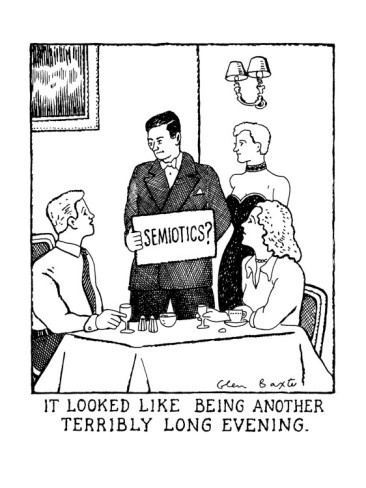
Semiotics — Glen Baxter

semiotics

Barry Hannah Visits a Louisiana Leper Colony

Barry Hannah visits a Louisiana leper colony in “Old Terror, New Hearts,” republished this week in Oxford Americans; the piece originally ran in the October/November 1995 issue of the magazine. Opening paragraphs:

It was a massive Federalist plantation, lazy and handsome among two-century oaks and palm trees. You could imagine FDR had just visited to cut a ribbon last week. I had heard throughout my life the curious rumor of a leper “colony” down in south Louisiana. This news reached me when I was a boy in Clinton, Mississippi, and one did not know quite what to do with it. Colony evoked folks lost in an exotic fastness. Leper of course was as bad as it got, poor devils. I had a sense of these creatures execrated and driven onto some isle in a vicious swamp. In that, my young imagination was not far wrong. Louisiana was alarming and peculiar anyway. There were plenty of Catholics, many seemed touched by at least mild cases of voodoo, and adults went public with their gaudiest dreams.

Nothing at the time was more peculiar to me than the armored mammal of Louisiana, the armadillo, which I had seen dead on the road as I traveled to relatives in Baton Rouge. It was a thing aggressively obsolete in animal history but still mucking its way along, its stupid ranks torn to flat bits by modern autos on pavement laid down through the bogs. I could not know how closely related these creatures were to the poor lepers themselves. Among animals, only armadillos have leprosy. Among mankind, nobody has suffered opprobrium for six thousand years like the leper. At Carville, where I finally got over forty years of mildly curious ignorance, I saw the doubloons from last year’s Mardi Gras at Carville were imprinted on one side with an armadillo. On the other was the Federalist infirmary building: Gillis W.Long Hansen’s Disease Center1921. Hansen was the Norwegian doctor who first isolated the leprosy bacillus in the late nineteenth century. In 1921 the state leprosarium was taken over by the Public Health Service.

Now it is the Service’s last remaining hospital. In that state of advanced idiocy that has made me a living so far and may be the birthright of a Mississippi writer, I asked a therapist working with two Asian-American patients after their hand surgery if he was a flight surgeon, his uniform so naval and all. He explained, as further did Captain Jim Birke, most formidable pedorthist, that the Public Health Service originated after the Revolutionary War as a naval medical branch. Thus the costume of the Surgeon General, which has baffled others too tactful to ask.

Read the rest of Hannah’s essay “Old Terror, New Hearts.”