Flower Shell — Max Ernst

Apostle Islands/Another Country (Books Acquired, Some Time Last Week)

20120624-101945.jpg

Tommy Zurhellen’s Apostle Islands is forthcoming from indie Atticus. Their write up:

It’s not easy for a messiah to grow up in the Badlands of North Dakota. And it’s even harder for him to share his message when radical ideas and so-called “miracles” are the surest way to get the FBI breathing down your neck. The sequel to Nazareth, North DakotaApostle Islandsfollows Sam Davidson and his group of roughneck followers as they save wedding receptions, cure cancer patients, and boost a flagging fishing season, all while breaking bread and laws and making peace and enemies.

On a mission to change one botched up world, Sam knows he will one day be called to make the ultimate sacrifice, and indeed he sees the writing on the shores of Lake Superior when one of his inner circle betrays him. A playful and delightfully irreverent take on the New Testament, Apostle Islands reveals what it takes to shake up the status quo while paying the price to save the ones you love.

20120624-101953.jpg

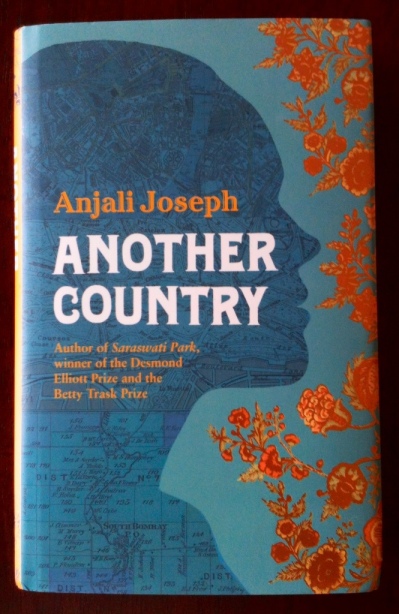
Anjali Josephs’s Another Country also has a map on its cover. This one got a bit of a scathing review in The Guardian last week; the first few pages seem well written though. Blurb:

Paris, London, Bombay: three cities form a backdrop to a journey through Leela’s twenties at the dawn of the new millennium, as she learns to negotiate the world, work, relationships and sex, and find some measure of authenticity. Sharp, funny, and melancholy, Another Country brings a cool eye to friendship, love, and the idea of belonging in its movements through old and new worlds. As with her debut, Saraswati Park (2010), which won the Desmond Elliott Prize, the Betty Trask Prize and India’s Vodafone Crossword Prize, Anjali Joseph’s beautiful, clear writing captures exactly both emotions and surroundings.

Woman Reading (1960) — Pablo Picasso

Boy Cutting Grass with a Sickle — Vincent van Gogh

“I Zimbra” (Live, 1980) — Talking Heads

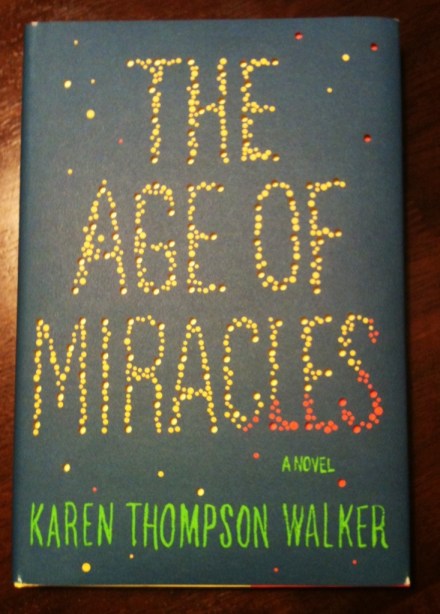
The Age of Miracles (Book Acquired, 6.08.2012)

20120622-180358.jpg

The design folks at Random House has been killing it lately with good hardback designs that integrate dust jackets in handsome ways. Check out what’s under the jacket for The Age of Miracles 

20120622-180407.jpg

I know I should write about what’s in the book, but, jeez, I hate dust jackets so much, so when the designers do something cool or innovative, it’s worth remarking on.

So, what’s in Karen Thompson Walker’s (much buzzed about) debut? Here’s the pub’s copy:

On a seemingly ordinary Saturday in a California suburb, Julia and her family awake to discover, along with the rest of the world, that the rotation of the earth has suddenly begun to slow. The days and nights grow longer and longer, gravity is affected, the environment is thrown into disarray. Yet as she struggles to navigate an ever-shifting landscape, Julia is also coping with the normal disasters of everyday life—the fissures in her parents’ marriage, the loss of old friends, the hopeful anguish of first love, the bizarre behavior of her grandfather who, convinced of a government conspiracy, spends his days obsessively cataloging his possessions. As Julia adjusts to the new normal, the slowing inexorably continues.

Walker’s book has been compared to The Lovely Bones by the publishers (Kakutani compares it favorably as well in her gushy review) as well as Margaret Atwood. I dunno. First 20 pages were not for me. It’s likely the book’s not for me.

Clarice Lispector/Malcolm Braly (Books Acquired 6.22.2012)

20120622-184839.jpg

It’s a sickness. Should I explain that the bookstore is like 1.1 miles from my house? And that it holds somewhere between one and two million books? (No exaggeration). That it’s like three or four buildings  cobbled together in snaking passages, all said passages lined by books? It’s also like .2 miles from the grocery store I/we usually shop at. Which I had to go by to get mozzarella. For make your own pizza night. But of course, I had to stop off and browse. (Is it weird I set the timer on my iPhone? Gave myself 17 minutes?).

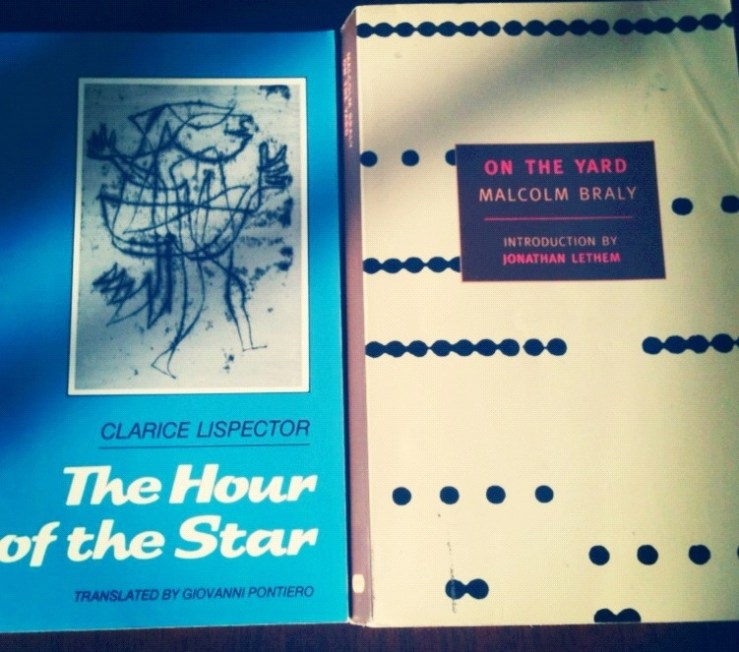
Anyway. Picked up these two.

The Lispector comes via recommendation of Scott Esposito, although this New Directions edition is not the latest translation, but, I dunno. It’s short. The Braly, well, I’d never heard of it, honestly, but it’s an NYRB edition, and the spines of those books always standout, and Lethem introduces it, and even though I haven’t liked Lethem’s last few books, well, he’s still a tastemaker par excellence, and Kurt Vonnegut blurbs it on the back, calling it, “Surely the great American prison novel.” And I just finished “The Part About the Crimes” in 2666 (yet again, more on that to come) and maybe a prison novel seems especially intriguing.

St. Jerome Reading — Giovanni Bellini

Shark Fishing — Winslow Homer

Charles Frazier’s Nightwoods (Book Acquired, 6.14.2012)

20120622-100218.jpg

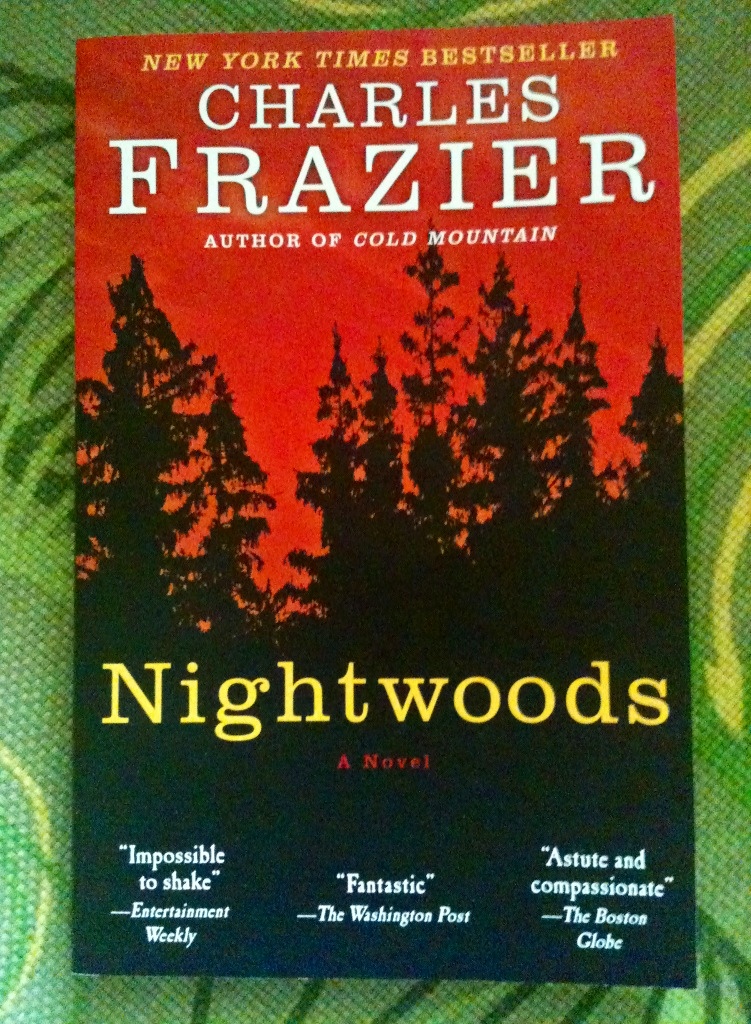
Charles Frazier’s Nightwoods, new in trade paperback. From Randy Boyagoda’s NY Times review:

“Nightwoods,” Frazier’s new novel, is a departure from its predecessors in some respects. It’s set in the early 1960s rather than the 19th century, and it involves no literary or historical elements of comparable grandeur and gravity. Indeed, based on its premise, the new book feels remarkably stripped down: a young woman named Luce, the caretaker of an old lodge in small-town North Carolina, becomes the guardian of the twin children of her murdered sister. In turn, she must defend them from Bud, their former stepfather, who killed their mother while they watched, and who believes the traumatized children know the location of some stolen money. As a setup, this promises suspense and mystery, to which Frazier adds family tension (when Luce’s lawman-cum-drug-addict father buddies up with Bud) and romance (after the shy, handsome grandson of the lodge’s deceased owner visits his inheritance and falls for Luce).

Tom McCarthy on William Burroughs’s Verbal Remix Software

A passage from Tom McCarthy’s essay “Transmission and the Individual Remix:”

It might be inferred, from what I’ve said, that any old remix will do. Not so: there are good and bad ones. Tristan Tzara cutting Shakespeare sonnets up and pulling their words from hats is an exercise in randomizing. William Burroughs and Brion Gysin mixing poems in with sliced-up pages of The New York Times is quite another matter: it is assiduous composition—composition understood in all its secondary nature: as reading, tracing, reconfiguring. Using the same technique, Gysin comes up with a few clumsy permutations along the lines of “Rub the Word Right Out . . . Word Right Rub the Out” and so on—whereas Burroughs generates such gorgeous sequences as:

Visit of memories. Only your dance and your voice house. On the suburban air improbable desertions . . . all harmonic pine for strife.

or

The great skies are open. Supreme bugle burning flesh children to mist.

Why does Burroughs conjure so much more richness from the same source material? Because (unlike the painter Gysin, whose skill lies primarily in the domain of images), he has uploaded the right verbal remix software. He has read and memorized his Dante, his Shakespeare, his Eliot—to such an extent that his activity as a composer consists of giving himself over to their cadences and echoes, their pulses, codas, loops, the better that these may work their way, through him, The New York Times and any other body thrown into the mix, into an audibility that, booming and echoing in the here-and-now, transforms all the mix’s elements, and time itself.

This is what all good writers are doing, and always have been.

St. Jerome Reading — Rembrandt

Heads of Torture Victims (Study for The Raft of the Medusa) — Theodore Gericault

Slavoj Žižek: “More Than Ever, We Need Philosophy Today” (On Philosophy vs. Science)

The Magdelene Reading — Rogier van der Weyden

RIP Andrew Sarris

RIP film critic Andrew Sarris, 1928-2012.

Sarris wrote film criticism—meaningful, real writing, not just film “reviews”—for half a century, publishing several books, and writing regularly for first The Village Voice and then The New York Observer. Sarris was one of the earliest proponents in the US of the auteur theory of film (he’s credited with coining the word in his essay “Notes on the Auteur Theory in 1962“), first put forward by Truffaut and other persons active in the French New Wave. In 1971, Sarris got into a good ole fashioned fight with fellow film critic Pauline Kael over the auteur issue when he responded to her Citizen Kane essay “Raising Kane,” contending that, yes, the film was guided by the unique vision of Orson Welles (even if others helped). His response essay is still worth reading.

In his 1968 book The American Cinema: Directors and Directions 1929-1968, Sarris famously named a “pantheon” of 14 top-tier directors: here’s that list:

Charlie Chaplin

Robert Flaherty

John Ford

D.W. Griffith

Howard Hawks

Alfred Hitchcock

Buster Keaton

Fritz Lang

Ernst Lubitsch

F.W. Murnau

Max Ophuls

Jean Renoir

Joseph Von Sternberg

Orson Welles

Sarris later added Billy Wilder to this pantheon.

If you like lists, check out this archive of Sarris’s favorite films by year—from 1958 to 2006.

Like any great critic, whether or not one ultimately agreed with Sarris was beside the point—his scholarship and criticism was insightful and enlightening the kind of writing that frankly makes for better film audiences.

For a more detailed obit, check out Scott Tobias’s piece at AV Club.
Brian Wilson Goes on The Rock & Roll Chef; Discusses Surfer Chicken, His Deafness, and His Love of Thai Food; Raps a Little (1990 Interview)