“Gut Feeling”/Zissou

This Certainly Is Reading — Francisco Goya

Summer — Giuseppe Arcimboldo

Woman Reading (1935) — Pablo Picasso

Occupy Gaddis (A William Gaddis Resource Page)

Why Occupy Gaddis?

 The Gaddis Annotations is, like, the source

Biblioklept reviews J R (part 1)

Biblioklept reviews J R (part 2)

“Trickle-Up Economics: JR Goes to Washington” (1987 sequel to J R)

“Fire the Bastards!”: Jack Green’s wonderful rant against the critics who panned The Recognitions

Biblioklept reviews The Recognitions

William Gaddis fiction-to-music entelechy transducer

Gaddis’s interview with The Paris Review

Julian Schnabel’s Gaddis portrait:

Gaddis interview at The Dalkey Archive

Why did Gaddis write J R?

Biblioklept reviews Agapē Agape

“A well-meaning, sincere hypocrite” : Gaddis on his title character, JR (and capitalism)

“Authenticity’s wiped out” — A passage from Agapē Agape

“Recognizing Gaddis” (1987 NYT article)

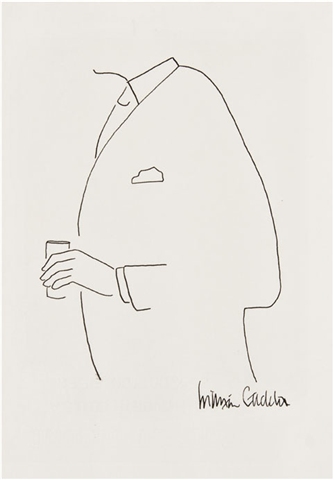
William Gaddis’s self-portrait:

William Gaddis on the Pulitzer Prize: “The Ultimate Seal of Mediocrity”

Gaddis on hipsters

“Mr. Difficult” (Jonathan Franzen whines about Gaddis)

William Gaddis on James Joyce

The State of Gaddis

The Guardian review of Agapē Agape

Cynthia Ozick’s review of Carpenter’s Gothic

Gaddis annotates Thomas Bernhard

The failure of Gaddis

LRB review of Agapē Agape/The Rush for Second Place

The Flood — Hans Baldung

Drawing of a Flood — Leonardo da Vinci

Titus Reading — Rembrandt

Tom McCarthy: “All Writing Is Conceptual”

From Tom McCarthy’s essay “Transmission and the Individual Remix”:

All writing is conceptual; it’s just that it’s usually founded on bad concepts. When an author tells you that they’re not beholden to any theory, what they usually mean is that their thinking and their work defaults, without even realizing it, to a narrow liberal humanism and its underlying—and always reactionary—notions of the (always) “natural” and preexisting, rather than constructed self, that self’s command of language, language as vehicle for “expression,” and a whole host of fallacies so admirably debunked almost fifty years ago by the novelist Alain Robbe-Grillet.

“This Is What All Good Writers Are Doing” — Tom McCarthy on Library as Source Code

A passage from Tom McCarthy’s essay “Transmission and the Individual Remix”:

This is what all good writers are doing, and always have been. Here I’d part company even with Robbe-Grillet: there is nothing “new” about this. Shakespeare was remixing Ovid, Plutarch, Holinshed, not to mention the authors of the King Leirs and Hamlets already in circulation when he penned his versions. Cervantes was remixing Montalvo, Ariosto, Apuleius, and any number of picaresque authors—and doing this with such delirious selfconcsiousness that at one point he even makes the characters of Don Quixote pause to take stock of the library, the engine room behind their mad associate’s reenactments, perusing it as though it were some kind of source code—which it is. Pound was remixing Villon, Daniel, and Sordello; De Mailla, Marco Polo, and Malatesta; Jefferson, Adams, and Jackson, merging all these feed together as he wound them through his typewriter, splicing them in with fragments of newsprint, shards of radio transmissions—merging them yet in a manner that made no attempt to mask their fragmentary, collated character, to “naturalise” them. With the Cantos, he kept up this furious enterprise for five whole decades, ramping its intensity up and up until the overload destroyed him, blew his mind to pieces, leaving him to murmur, right toward the end: “I cannot make it cohere.”

Speaking for Trees — Cat Power

Woman Reading — Camille Corot

“This Never Happened” — A Clip from Malick’s Badlands

Wind Fallen Trees (1880) — Ivan Shishkin

Great Bather Reading — Pablo Picasso

Book Shelves #26, 6.24.2012

20120624-143352.jpg

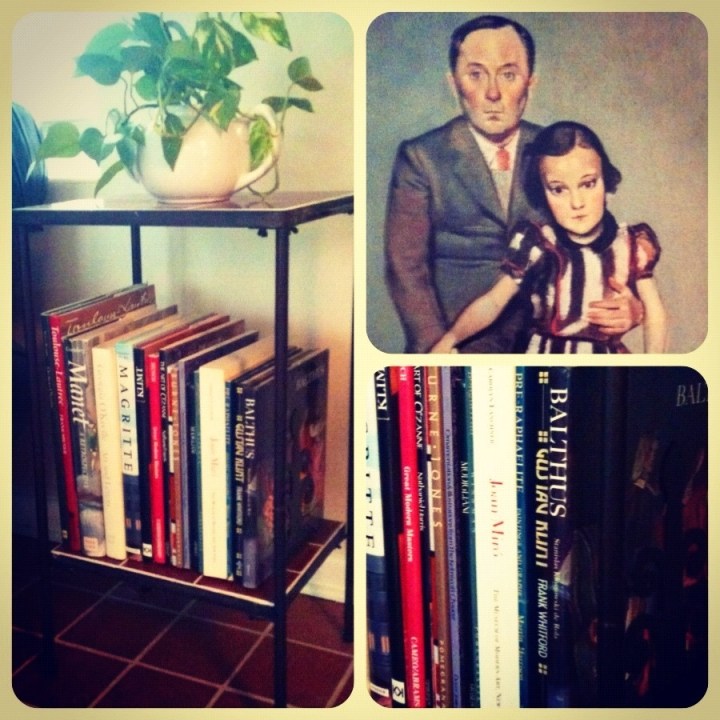
Book shelves series #26, twenty-sixth Sunday of 2012: Some old art books.

This little shelf sits next to a solitary couch in a den/fireplace room that abuts the eat-in kitchen. The shelf is mostly to hold the occasional drink if feet are propped on the coffee table. There are old art books in here, dating back to high school and college, when my wife and I (separately, of course, in those days) still bought lots and lots of art books, before the internet made accessibility to images so ubiquitous. As such, the shelf holds books that reflected our tastes of fifteen, sixteen, seventeen years ago: Lots of Pre-Raphaelite and Romantic stuff (hers) and lots of surrealist/modernist/cubist stuff (mine). Anyway. These rarely get dug out these days. If I want to check out Burne-Jones I usually visit an online gallery.

The portrait of Joan Miro and his daughter in the upper right corner is by the painter who called himself Balthus. I love the painting. It’s deeply creepy but also tender.

The Evil Thief — Albrecht Dürer