I Like America and America Likes Me — Joseph Beuys

Great American Nude — Tom Wesselmann

NEVER FORGET

Mark Twain’s Fourth of July Speech in Keokuk, Iowa July 3, 1886

Mark Twain’s Fourth of July speech, delivered in Keokuk, Iowa, 1886—

Ladies and gentlemen: I little thought that when the boys woke me with their noise this morning that I should be called upon to add to their noise. But I promise not to keep you long. You have heard all there is to hear on the subject, the evidence is all in and all I have to do is to sum up the evidence and deliver the verdict. You have heard the declaration of independence with its majestic ending, which is worthy to live forever, which has been hurled at the bones of a fossilized monarch, old King George the III, who has been dead these many years, and which will continue to be hurled at him annually as long as this republic lives. You have heard the history of the nation from the first to the last–from the beginning of the revolutionary was, past the days of its great general, Grant, told in eloquent language by the orator of the day. All I have to do is to add the verdict, which is all that can be added, and that is, ‘It is a successful day.’ I thank the officers of the day that I am enabled to once more stand face to face with the citizens that I met thirty years ago, when I was a citizen of Iowa, and also those of a later generation. In the address to-day, I have not heard much mention made of the progress of these last few years–of the telegraph, telephone, phonograph, and other great inventions. A poet has said, ‘Better fifty years of England than all the cycles of Cathay,’ but I say ‘Better this decade than the 900 years of Methuselah.’ There is more done in one year now than Methuselah ever saw in all his life. He was probably asleep all those 900 years. When I was here thirty years ago there were 3,000 people here and they drank 3,000 barrels of whisky a day, and they drank it in public then. I know that the man who makes the last speech on an occasion like this has the best of the other speakers, as he has the last word to say, which falls like a balm on the audience–though this audience has not been bored to-day–and though I can’t say that last word, I will do the next best thing I can, and that is to sit down.

(More).

Girl Reading — Camille Corot

Moonlight — Edvard Munch

Woman Reading (1920) — Pablo Picasso

Book Shelves #27, 7.01.2012

20120701-115719.jpg

Book shelves series #27, twenty-seventh Sunday of 2012

There are 27 Sundays in 2012, so today’s post is the half way mark for this series, I guess.

This is an obscure little shelf on the side of a piece of furniture that holds the TV in our den. These are travel books, phrase books, etc., which I’m not sure if people still buy—I mean, I don’t buy them anymore, at least not if I’m going to go somewhere. I use the internet, or iPhone apps. Maybe I need to go to some place without 3G or wireless coverage.

There are some other relics here, too, on the shelf above this one—CDs and DVDs.

“Jiffy Squid” (Mystery Train)

Lydia Reading on a Divan — Mary Cassatt

Chess Lesson (The Wire)

Melting Ice Cream — Norman Rockwell

“The Solider Who Sold His Soul to God” — An Excerpt from Roberto Bolaño’s Novel 2666

A standalone excerpt from Roberto Bolaño’s novel 2666. This is from the final section, “The Part About Archimboldi”:

During the train trip Hans heard an odd story about a soldier of the 79th who had gotten lost in the tunnels of the Maginot Line. The section of tunnel he was lost in, as far as the soldier could tell, was called the Charles Sector. The soldier, of course, had nerves of steel, or so it was told, and he kept searching for a way to the surface. After walking some five hundred yards underground he came to the Catherine Sector. The Catherine Sector, it goes without saying, was in no way different from the Charles Sector, except for the signs. After walking half a mile, he got to the Jules Sector. By now the soldier was nervous and his imagination had begun to wander. He imagined himself imprisoned forever in those underground passageways, with no comrade coming to his aid. He wanted to yell, and although at first he restrained himself, for fear of alerting any French soldiers still hiding nearby, at last he gave in to the urge and began to shout at the top of his lungs. But no one answered and he kept walking, in the hope that at some point he’d find the way out. He left behind the Jules Sector and entered the Claudine Sector. Then came the Emile Sector, the Marie Sector, the Jean-Pierre Sector, the Berenice Sector, the Andre Sector, the Sylvie Sector. When he got to the Sylvie Sector, the soldier made a discovery (which anyone else would’ve made much sooner). He noticed the curious neatness of the nearly immaculate passageways. Then he began to think about the usefulness of the passageways, that is their military usefulness, and he came to the conclusion that they were of absolutely no use and there had probably never been soldiers here.

At this point the soldier thought he’d gone mad or, even worse, that he’d died and this was his private hell. Tired and hopeless, he lay down on the floor and slept. He dreamed of God in human form. The soldier was asleep under an apple tree, in the Alsatian countryside, and a country squire came up to him and woke him with a gentle knock on the legs with his staff. I’m God, he said, and if you sell me your soul, which already belongs to me anyway, I’ll get you out of the tunnels. Let me sleep, said the soldier, and he tried to go back to sleep. I said your soul already belongs to me, he heard the voice of God say, so please don’t be a fool, and accept my offer.

Then the soldier awoke and looked at God and asked where he had to sign. Here, said God, pulling a paper out of the air. The soldier tried to read the contract, but it was written in some other language, not German or English or French, of that he was certain. What do I sign with? asked the soldier. With your blood, as is only proper, God answered. Immediately the soldier took out a penknife and made a cut in the palm of his left hand, then he dipped the tip of his index finger in the blood and signed.

“All right, now you can go back to sleep,” God said.

“I’d like to get out of the tunnels soon,” the soldier pleaded.

“All will proceed as ordained,” said God, and he turned and started down a little dirt path toward a valley where there was a village of houses painted green and white and light brown.

The soldier thought it might be wise to say a prayer. He joined his hands and raised his eyes to the heavens. Then he saw that all the apples on the tree had dried up. Now they looked like raisins, or prunes. At the same time he heard a noise that sounded vaguely metallic.

“What is this?” he exclaimed.

From the valley rose long plumes of black smoke that hung in the air when they reached a certain height. A hand grabbed him by the shoulder and shook him. It was soldiers from a company that had come down the tunnel into the Berenice Sector. The soldier began to weep with joy, not much, but enough to find relief.

That night, as he ate, he told his best friend about the dream he’d had in the tunnels. His friend told him it was normal to dream nonsense when one found oneself in such situations.

“It wasn’t nonsense,” the soldier answered, “I saw God in my dreams, I was rescued, I’m back among friends again, but I can’t quite be easy.”

Then, in a calmer voice, he corrected himself:

“I can’t quite feel safe.”

To which his friend responded that in war no one could feel entirely safe. The friend went to sleep. Silence fell over the town. The sentinels lit cigarettes. Four days later, the soldier who had sold his soul to God was walking along the street when he was hit by a German car and killed.

“Without Her” — Nilsson

The Virgin and Child Reading — Jan van Eyck

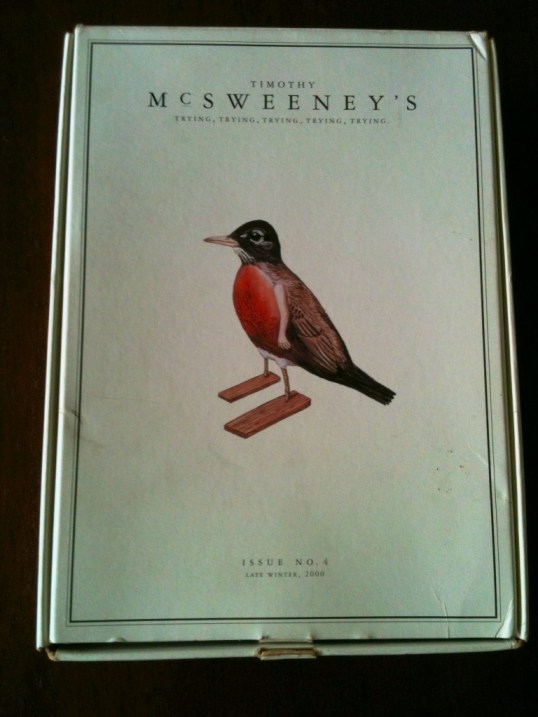
McSweeney’s #4 (Box of Books Acquired 6.14.2012)

20120626-095248.jpg

The novelist John Warner (The Funny Man), in an act of incredible kindness, sent me a copy of McSweeney’s #4, which he helped to put out years ago. In one of our emails, John offers the following:

It could be the best issue ever, a kind of platonic ideal of the McSweeney’s aesthetic before people started saying that things had a McSweeney’s aesthetic, a more innocent time if you will. My memory is that we were selling them at a live event at the Ethiopian Diamond restaurant in Chicago that we set up to help promote Neal Pollack’s book, and somehow the leftovers wound up in my trunk and I’ve been hauling them place to place ever since. . .

It’s a sort of fun artifact of the early/carefree days of McSweeney’s before Dave was DAVE, and the whole thing was still very haphazard.

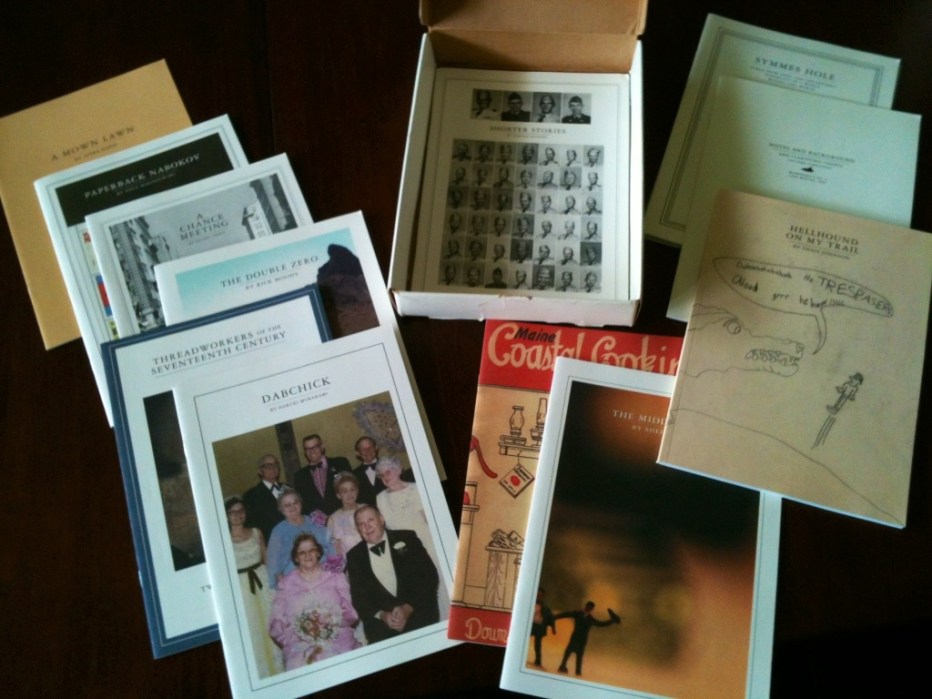
It’s difficult to overstate the range of writers here: Lydia Davis, Jonathan Lethem, George Saunders, Rick Moody, Haruki Murakami, a three-act play by Denis Johnson, and much, much more:

20120626-100530.jpg

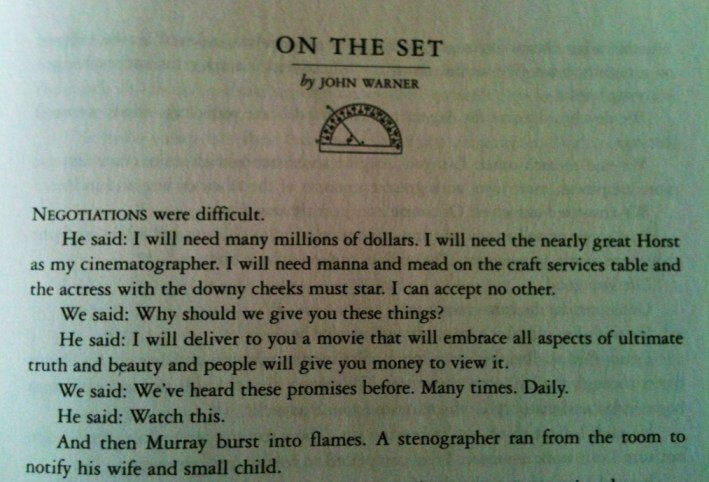
 There are also many short stories, including “On the Set” by John Warner, his second published story:

20120626-100545.jpg

It’s wonderfully absurd.

To read something hilarious and absurd and ultimately kind of touching, read John’s interview with critic Kevin Morris, who hated The Funny Man.

Summer Morning — Konstantin Somov