How to Open a New Book

20110911-082527.jpg

Citizen Sade

From Roland Barthes’ “Life of Sade,” a short biography of The Marquis de Sade. Translated from the French by Richard Miller.  Read the entire essay at Supervert.

20. A plurality of which Sade was well aware, since he laughs at it: in 1793, Citizen Sade was proposed as a juror in a common-law case (a matter of forged promissory notes): the dual hearing of the Sadian text (of which Sade’s life is a part): the apologist of crime and its judge are united in the same subject, as the Saussurian anagram is inscribed in a Vedic verse (but what remains of a subject that subjects itself with alacrity to a dual inscription?).

Books Acquired, 9.10.11

20110910-040358.jpg

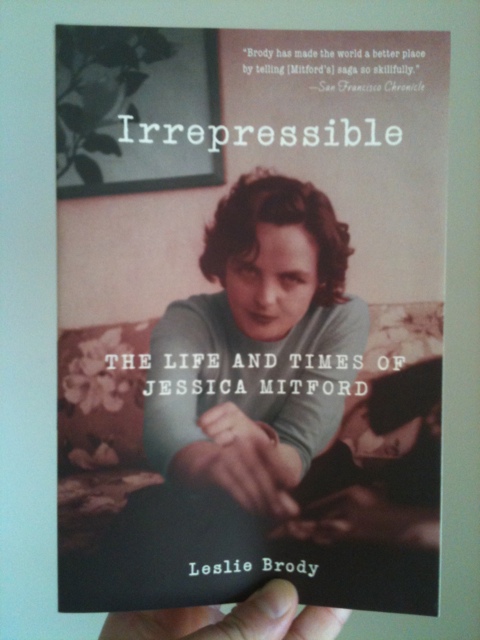
Two books in the mail today from Counterpoint Press, an expanding indie press with a broad but sharp catalog (including Soft Skull Press). The first is Irrepressible: The Life and Times of Jessica Mitford, a biography of the progressive upstart. From the press release—

Admirers and detractors use the same words to describe Jessica Mitford: subversive, mischief-maker, muckraker. J.K. Rowling calls Mitford her “most influential writer.” Those who knew her best simply called her “Decca.” Born into one of Britain’s most famous aristocratic families, Mitford eloped with Winston Churchill’s nephew to America as a teenager in 1939. A no-holds barred civil rights activist, outspoken communist, and feared journalist, Mitford rose to one of the New Deal’s most notorious bureaucrats. For her the personal was political. She coined the term “frenemies,”  and as a member of the American Communist Party, she made several, though not among the Cold War witch hunters. When she left the Communist Party in 1958 after fifteen years, she promised to be subversive whenever the opportunity arose. True to her word, late in life she hit her stride as a writer, publishing nine books before her death in 1996. With unrestricted access to the Mitford Family archives, Leslie Brody presents a moving, impeccably researched biography of one of the most influential women of the 20th century.

20110910-040407.jpg

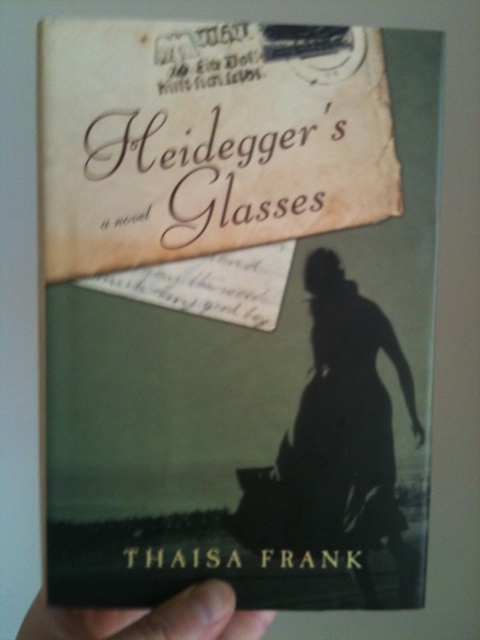
Heidegger’s Glasses is a novel by Thaisa Frank that seems promising. Description—

Magical and surreal, Heidegger’s Glasses offers a completely original vantage point on the Holocaust.  The story opens during the end of World War II in a failing Germany coming apart at the seams. The Third Reich’s strong reliance on the occult and the leading officials’ obsession with the astral plane has led to the formation of a secret Compound of Scribes–multilingual translators that have been spared from deportation to answer returned letters written to the dead in the concentration camps. Ellie Schacten, the mysterious heroine of the novel, supervises the Scribes, yet secretly uses the compound to hide a steadily growing number of refugees. When a letter arrives, written by eminent German philosopher Martin Heidegger to his friend and optometrist––a man who is now lost in the dying thralls of Auschwitz––a series of events unfold that turn the Reich’s attention to the compound and threaten Ellie’s operation and the lives of the Scribes.

Based on the real Third Reich procedure, Operation Mail, which forced concentration camp prisoners to send letters to loved ones extolling conditions in the camps, Heidegger’s Glasses explores a dark, absurd world in which fear and death are a constant companion, and yet, Frank’s characters show how that when stripped of their freedom and virtually all material possessions, the human spirit perseveres and thrives.

Sade’s Passion Was Theatrical, Not Erotic

From Roland Barthes’ “Life of Sade,” a short biography of The Marquis de Sade. Translated from the French by Richard Miller.  Read the entire essay at Supervert.

19. Throughout his life, the Marquis de Sade’s passion was not erotic (eroticism is very different from passion); it was theatrical: youthful liaisons with several young ladies of the Opéra, engaging the actor Bourdais to play for six months at La Coste, and in his torment, one idea: to have his plays performed; barely out of prison (1790), repeated requests to the actors of the Comédie Française; and finally, of course, theater at Charenton.

Sade Loved His Big Pillow

From Roland Barthes’ “Life of Sade,” a short biography of The Marquis de Sade. Translated from the French by Richard Miller.  Read the entire essay at Supervert.

18. Suddenly transferred from Vincennes to the Bastille, Sade made a great fuss because he had not been allowed to bring his big pillow, without which he was unable to sleep, since he slept with his head unusually high: “The barbarians!”.

It Is the Point One Is at that Makes a Thing Good or Bad, and Not the Thing Itself

From Roland Barthes’ “Life of Sade,” a short biography of The Marquis de Sade. Translated from the French by Richard Miller.  Read the entire essay at Supervert.

17. At Vincennes in 1783, the penitentiary administration forbade the prisoner’s receiving Rousseau’sConfessions. Sade comments: “They honor me in thinking that a deist author could be a bad book for me; I wish I were at that point… Understand, it is the point one is at that makes a thing good or bad, and not the thing itself… Start there, dear sirs, and by sending me the book I request, be sensible enough to understand that for died-in-the-wool bigots like yourselves, Rousseau can be a dangerous author, and that makes it an excellent book for me. For me, JeanJacques is what the Imitation of Christ is for you…” Censorship is abhorrent on two levels: because it is repressive, because it is stupid; so that we always have the contradictory urge to combat it and to teach it a lesson.

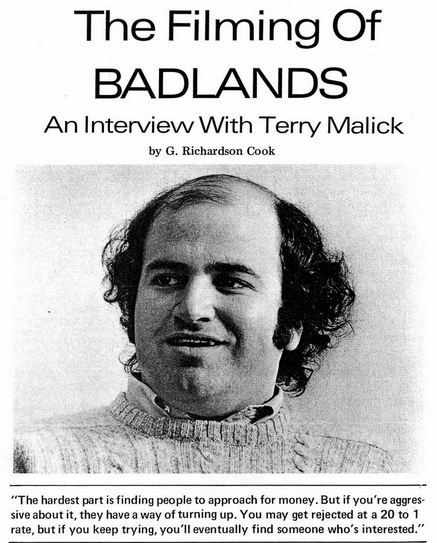
Read a Rare 1974 Interview with Terrence Malick

If you’re a fan of Terrence Malick, you may know how hard it is to come across interviews with the director. In the interview, Malick talks in some depth about making his moving début Badlands. Kudos to All Things Shining for unearthing a rare 1974 interview from Filmmakers Newsletter. (Chain of Twitter thanks: @NekoCase, @kurt_loder, @Coudal).

Chingado — Walton Ford

Books Acquired, 9.08.11

20110908-034509.jpg

20110908-034521.jpg

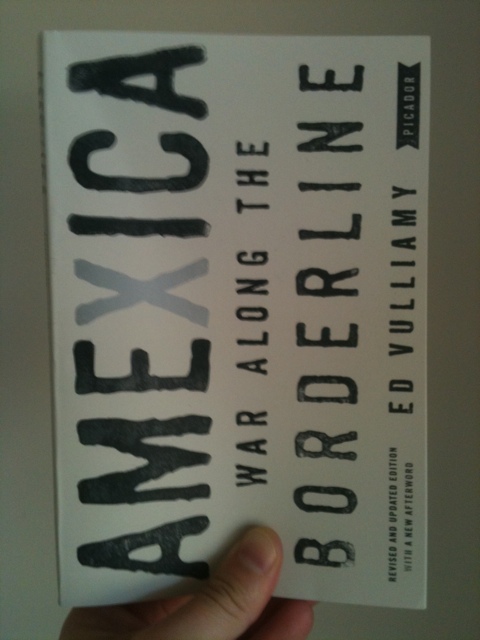
Big stack of reader copies on the homestead’s porch this afternoon, including two works of nonfiction from Picador, new in trade paperback. I’ve been itching to read Ed Vulliamy’s Amexica for a while, perhaps one of the weird aftereffects of 2666 . . . anyway, it should be a nice, visceral antidote to all the middling novels that pile up in the fall. Ian Frazier’s no slouch either, and Travels in Siberia looks pretty cool as well. A few weeks ago, Picador sent me a copy of Jason Elliot’s An Unexpected Light: Travels in Afghanistan, which also got great reviews in hardback last summer—I think I’ll make it my fall reading mission to read more nonfiction (particularly travel writing, which I’ve always loved), and these three books seem like a great way to go.

20110908-034540.jpg

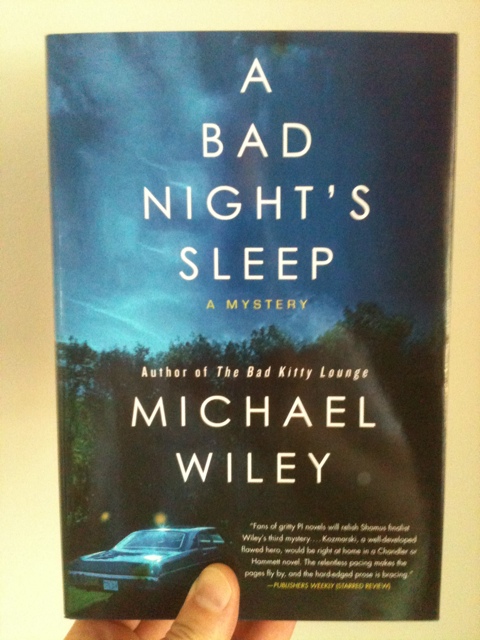
A Bad Night’s Sleep is the latest from crime writer Michael Wiley (I interviewed Wiley about his last book, The Bad Kitty Lounge, back in May of 2010, and he mentioned this book was underway, although he also talked about something called Wordsworth with a Glock, which, hey, I’d still love to see).

20110908-034550.jpg

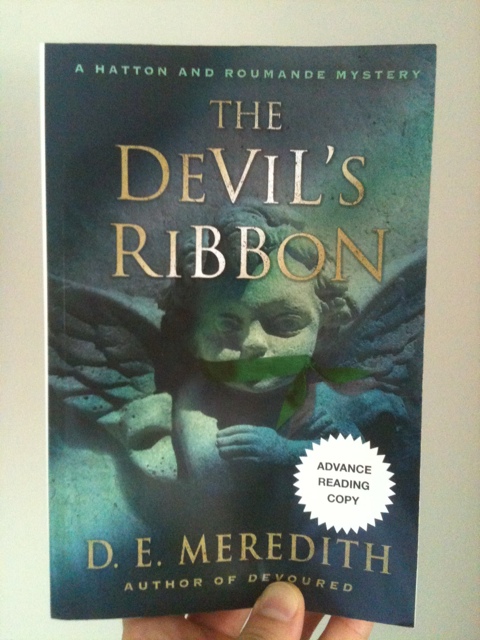
Wiley’s novel is new from Minotaur, who are also putting out a crime novel called The Devil’s Ribbon by D.E. Meredith.

Sade Was Very Fond of Dogs

From Roland Barthes’ “Life of Sade,” a short biography of The Marquis de Sade. Translated from the French by Richard Miller.  Read the entire essay at Supervert (or here over the next few days, parceled out over 22 sections)—

16. Sade was very fond of dogs, spaniels, and setters; he had them at Miolans, asked for them at Vincennes. Through what moral (or worse: virile) law should the greatest of subversions exclude minor affection, that for animals?

Sade, the Social Joker

From Roland Barthes’ “Life of Sade,” a short biography of The Marquis de Sade. Translated from the French by Richard Miller.  Read the entire essay at Supervert (or here over the next few days, parceled out over 22 sections)—

15. In the social game of his time, doubly complicated because — rare in history — it was both synchronic and diachronic, displaying the (apparently immobile) tableau of classes under the Ancien Régime and class changes (under the Revolution), Sade was extremely mobile: a social joker, able to occupy any niche in the class system; Lord of LaCoste, he was supplanted in Mlle Colet’s affections by a bourgeois, a collector of rents, who presented the actress with a magnificent sultan (a dressing table); later, a member of the Piques sector, he assumes the socially neutral figure of a man of letters, a dramatist; struck from the list of émigrés and owing to a confusion of first names that exists today, he was able (or at least his family was) to appear as he wished according to the varied moments of History on this turnstile of social class. He honors the sociological notion of social mobility, but in a ludic sense; he moves up and down on the social scale like a bottle imp; a reflection, once again in the socio-economic meaning of the term, he makes this reflection not the imitation or product of a determination, but the unselfconscious game of a mirror. In this carrousel of roles, one fixed point: manners, way of life, which were always aristocratic.

Wig Fetishist

From Roland Barthes’ “Life of Sade,” a short biography of The Marquis de Sade. Translated from the French by Richard Miller.  Read the entire essay at Supervert (or here over the next few days, parceled out over 22 sections)—

14. One of Sade’s principal persecutors, Police Lieutenant Sartine, suffered from a psychopathological condition which in a just (equal) society would have entailed his imprisonment on the same footing as his victim: he was a wig fetishist: “His library contained all kinds of wigs of all sizes: he put them on according to the circumstances; among others, he owned a good-luck wig (with five loosely hanging little curls) and a wig for interrogating criminals, a kind of snake headdress called the inexorable” (Lély, II, 90). Aware of the phallic value of the braid, we can imagine how Sade must have longed to clip the toupees of his hated cop.

Contra Mundum Press

Some of the good people at Hyperion, the journal of the Nietzsche Circle, have begun a new publishing venture: Contra Mundum Press. Their first project is a new translation of the Gilgamesh epic by Stuart Kendall; it should be ready next month. In December, CMP is planning to release the first English language translation of Nietzsche’s “Greek Music Drama.” Their list of future titles looks quite promising, and it’s always great to see a new indie publisher making a go of it in an era where print books are being eulogized (with no small level of hyperbole) on what seems to be a weekly basis.

Book Acquired, 9.06.11

20110906-034002.jpg

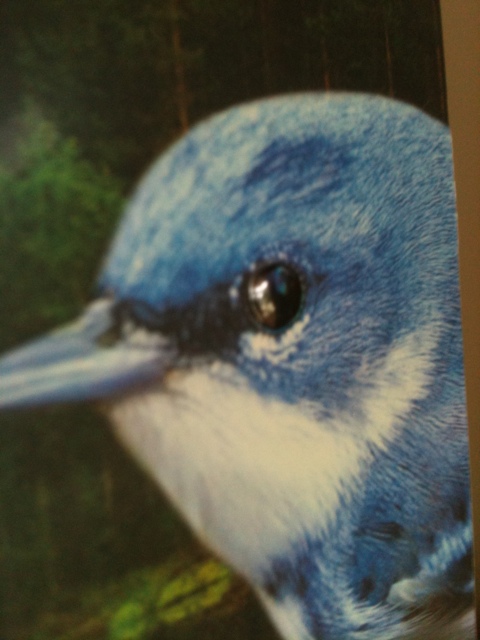
The kind people at Picador sent me a copy of the trade paperback of this book called Freedom by some guy named Jonathan Franzen. The hardback came out last year, but it kinda went under the radar; one of those obscure underground reads. Maybe he’ll have more success in the paperback (it’s certainly lighter). The book has apparently been BeDazzled, too—a nice touch. The bird’s eye is this bumpy little bumpy bump—I tried to angle the cover so you might see it in the closeup below, but I’m not sure if it comes across.

20110906-034014.jpg

Sade Had a Phobia: The Sea

From Roland Barthes’ “Life of Sade,” a short biography of The Marquis de Sade. Translated from the French by Richard Miller.  Read the entire essay at Supervert (or here over the next few days, parceled out over 22 sections)—

13. Sade had a phobia: the sea. What will be given schoolchildren to read: Baudelaire’s poem (“Free man, you will always cherish the sea…”) or Sade’s avowal (“I’ve always feared and immensely disliked the sea…”)?

“Just Asking” — David Foster Wallace’s 9/11 Thought Experiment

Here’s David Foster Wallace’s “Just Asking,” from the November, 2007 issue of The Atlantic

Are some things still worth dying for? Is the American idea* one such thing? Are you up for a thought experiment? What if we chose to regard the 2,973 innocents killed in the atrocities of 9/11 not as victims but as democratic martyrs, “sacrifices on the altar of freedom”?* In other words, what if we decided that a certain baseline vulnerability to terrorism is part of the price of the American idea? And, thus, that ours is a generation of Americans called to make great sacrifices in order to preserve our democratic way of life—sacrifices not just of our soldiers and money but of our personal safety and comfort?

In still other words, what if we chose to accept the fact that every few years, despite all reasonable precautions, some hundreds or thousands of us may die in the sort of ghastly terrorist attack that a democratic republic cannot 100-percent protect itself from without subverting the very principles that make it worth protecting?

Is this thought experiment monstrous? Would it be monstrous to refer to the 40,000-plus domestic highway deaths we accept each year because the mobility and autonomy of the car are evidently worth that high price? Is monstrousness why no serious public figure now will speak of the delusory trade-off of liberty for safety that Ben Franklin warned about more than 200 years ago? What exactly has changed between Franklin’s time and ours? Why now can we not have a serious national conversation about sacrifice, the inevitability of sacrifice—either of (a) some portion of safety or (b) some portion of the rights and protections that make the American idea so incalculably precious?

In the absence of such a conversation, can we trust our elected leaders to value and protect the American idea as they act to secure the homeland? What are the effects on the American idea of Guantánamo, Abu Ghraib, Patriot Acts I and II, warrantless surveillance, Executive Order 13233, corporate contractors performing military functions, the Military Commissions Act, NSPD 51, etc., etc.? Assume for a moment that some of these measures really have helped make our persons and property safer—are they worth it? Where and when was the public debate on whether they’re worth it? Was there no such debate because we’re not capable of having or demanding one? Why not? Have we actually become so selfish and scared that we don’t even want to consider whether some things trump safety? What kind of future does that augur?

FOOTNOTES:
1. Given the strict Gramm-Rudmanewque space limit here, let’s just please all agree that we generally know what this term connotes—an open society, consent of the governed, enumerated powers, Federalist 10, pluralism, due process, transparency … the whole democratic roil.

2. (This phrase is Lincoln’s, more or less)
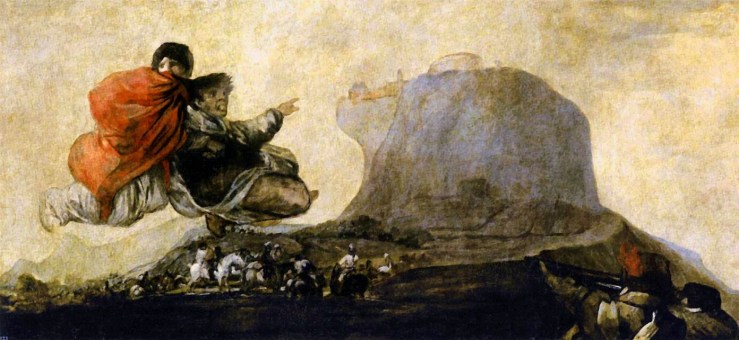
Fantastic Vision — Goya