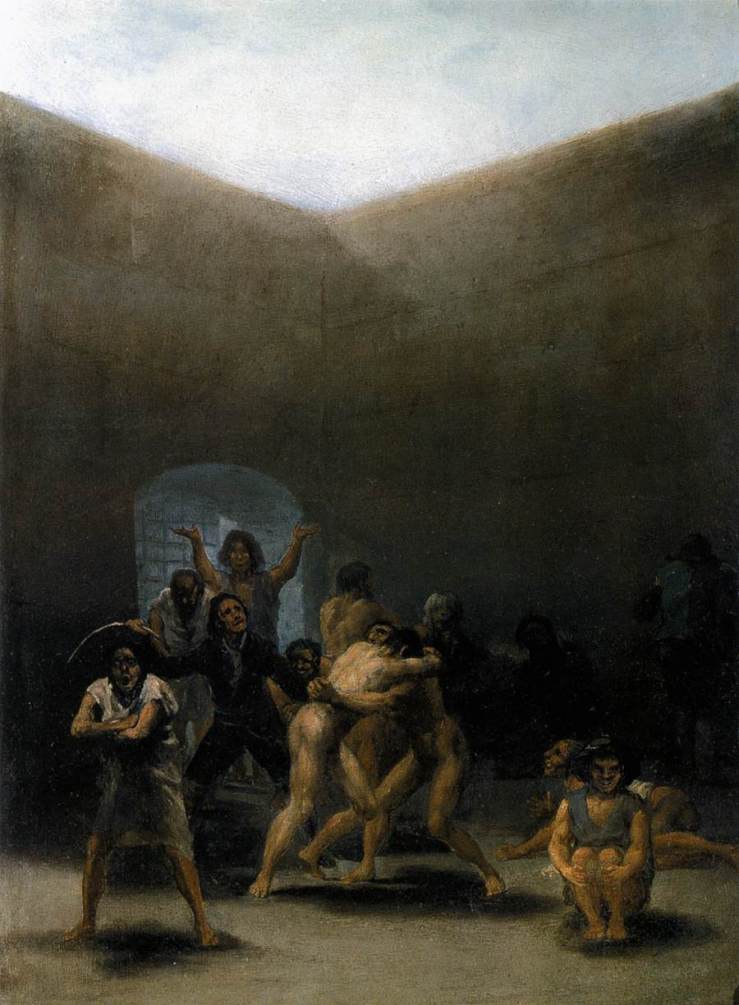
Courtyard with Lunatics — Francisco Goya

“Let’s just say, on occasion, the police were involved and emergency rooms and courtrooms” — Raymond Carver Talks About Drinking

More from Raymond Carver’s 1983 Paris Review interview

INTERVIEWER

Could you talk a little more about the drinking? So many writers, even if they’re not alcoholics, drink so much.

CARVER

Probably not a whole lot more than any other group of professionals. You’d be surprised. Of course there’s a mythology that goes along with the drinking, but I was never into that. I was into the drinking itself. I suppose I began to drink heavily after I’d realized that the things I’d wanted most in life for myself and my writing, and my wife and children, were simply not going to happen. It’s strange. You never start out in life with the intention of becoming a bankrupt or an alcoholic or a cheat and a thief. Or a liar.

INTERVIEWER

And you were all those things?

CARVER

I was. I’m not any longer. Oh, I lie a little from time to time, like everyone else.

INTERVIEWER

How long since you quit drinking?

CARVER

June second, 1977. If you want the truth, I’m prouder of that, that I’ve quit drinking, than I am of anything in my life. I’m a recovered alcoholic. I’ll always be an alcoholic, but I’m no longer a practicing alcoholic.

INTERVIEWER

How bad did the drinking get?

CARVER

It’s very painful to think about some of the things that happened back then. I made a wasteland out of everything I touched. But I might add that towards the end of the drinking there wasn’t much left anyway. But specific things? Let’s just say, on occasion, the police were involved and emergency rooms and courtrooms.


“None of my stories really happened, of course” — Raymond Carver on Realism (and Drinking) in His Stories

Raymond Carver talks realism, autobiography (and drinking) in his 1983 Paris Review interview. A taste–

INTERVIEWER

Where do your stories come from, then? I’m especially asking about the stories that have something to do with drinking.

CARVER

The fiction I’m most interested in has lines of reference to the real world. None of my stories really happened, of course. But there’s always something, some element, something said to me or that I witnessed, that may be the starting place. Here’s an example: “That’s the last Christmas you’ll ever ruin for us!” I was drunk when I heard that, but I remembered it. And later, much later, when I was sober, using only that one line and other things I imagined, imagined so accurately that they could have happened, I made a story—“A Serious Talk.” But the fiction I’m most interested in, whether it’s Tolstoy’s fiction, Chekhov, Barry Hannah, Richard Ford, Hemingway, Isaac Babel, Ann Beattie, or Anne Tyler, strikes me as autobiographical to some extent. At the very least it’s referential. Stories long or short don’t just come out of thin air. I’m reminded of a conversation involving John Cheever. We were sitting around a table in Iowa City with some people and he happened to remark that after a family fracas at his home one night, he got up the next morning and went into the bathroom to find something his daughter had written in lipstick on the bathroom mirror: “D-e-r-e daddy, don’t leave us.” Someone at the table spoke up and said, “I recognize that from one of your stories.” Cheever said, “Probably so. Everything I write is autobiographical.” Now of course that’s not literally true. But everything we write is, in some way, autobiographical. I’m not in the least bothered by “autobiographical” fiction. To the contrary. On the Road. Céline. Roth. Lawrence Durrell in The Alexandria Quartet. So much of Hemingway in the Nick Adams stories. Updike, too, you bet. Jim McConkey. Clark Blaise is a contemporary writer whose fiction is out-and-out autobiography. Of course, you have to know what you’re doing when you turn your life’s stories into fiction. You have to be immensely daring, very skilled and imaginative and willing to tell everything on yourself. You’re told time and again when you’re young to write about what you know, and what do you know better than your own secrets? But unless you’re a special kind of writer, and a very talented one, it’s dangerous to try and write volume after volume on The Story of My Life. A great danger, or at least a great temptation, for many writers is to become too autobiographical in their approach to their fiction. A little autobiography and a lot of imagination are best.

 

Raymond Carver: Dreams Are What You Wake Up From

Continue reading “Raymond Carver: Dreams Are What You Wake Up From”

“Drinking While Driving” — Raymond Carver

“Drinking While Driving” by Raymond Carver–

It’s August and I have not
Read a book in six months
except something called The Retreat from Moscow
by Caulaincourt
Nevertheless, I am happy
Riding in a car with my brother
and drinking from a pint of Old Crow.
We do not have any place in mind to go,
we are just driving.
If I closed my eyes for a minute
I would be lost, yet
I could gladly lie down and sleep forever
beside this road
My brother nudges me.
Any minute now, something will happen.

“Just mix up a mixture of theolologicophilolological” — Stephen Dedalus on Shakespeare

From Stephen Dedalus’s strange thesis on Shakespeare in episode 9 of James Joyce’s Ulysses–

— And the sense of property, Stephen said. He drew Shylock out of his own long pocket. The son of a maltjobber and moneylender he was himself a cornjobber and moneylender, with ten tods of corn hoarded in the famine riots. His borrowers are no doubt those divers of worship mentioned by Chettle Falstaff who reported his uprightness of dealing. He sued a fellowplayer for the price of a few bags of malt and exacted his pound of flesh in interest for every money lent. How else could Aubrey’s ostler and callboy get rich quick? All events brought grist to his mill. Shylock chimes with the jewbaiting that followed the hanging and quartering of the queen’s leech Lopez, his jew’s heart being plucked forth while the sheeny was yet alive: Hamlet and Macbeth with the coming to the throne of a Scotch philosophaster with a turn for witchroasting. The lost armada is his jeer in Love’s Labour Lost. His pageants, the histories, sail fullbellied on a tide of Mafeking enthusiasm. Warwickshire jesuits are tried and we have a porter’s theory of equivocation. The Sea Venture comes home from Bermudas and the play Renan admired is written with Patsy Caliban, our American cousin. The sugared sonnets follow Sidney’s. As for fay Elizabeth, otherwise carrotty Bess, the gross virgin who inspired The Merry Wives of Windsor, let some meinherr from Almany grope his life long for deephid meanings in the depths of the buckbasket.

I think you’re getting on very nicely. Just mix up a mixture of theolologicophilolological. Mingo, minxi, mictum, mingere.


“I’m Like a Tiger” — A Scene from If . . . .

(Read our review of If. . . .).

Girl with Kitten — Lucian Freud

“Wake for Susan” — Cormac McCarthy

Great find by Reddit user db_usher, who’s unearthed Cormac McCarthy’s early short story, “Wake for Susan” (okay, “unearthed” might be an extreme verb; you can get the story via interlibrary loan from the University of Tennessee, but hey, that takes effort). The piece was published in 1959 in The Phoenix; it’s a bit of juvenilia with its faults, to be sure, but will interest fans of course. Usher’s Reddit post links to a .pdf file; I’ve posted the story after the jump for those who wish to read it on a screen.

Continue reading ““Wake for Susan” — Cormac McCarthy”

Frank Delaney Honors James Joyce’s Birthday with His “re:Joyce Rap”

Frank Delaney honors today’s double anniversary of James Joyce’s birthday and the publication of Ulysses with his “re:Joyce rap.” Marvelous.

Is Infinite Jest Just David Foster Wallace’s Way of Imposing His Phallus on the Consciousness of the World?

From David Foster Wallace’s 1997 interview with Charlie Rose. I love Rose’s response–

DFW: Feminists are always saying this. Feminists are saying white males say, “Okay, I’m going to sit down and write this enormous book and impose my phallus on the consciousness of the world.”

ROSE: And you say?

DFW: I — I — if that was going on, it was going on on a level of awareness I do not want to have access to.

ROSE: Do you still play tennis?

“The West” — Carson Mell

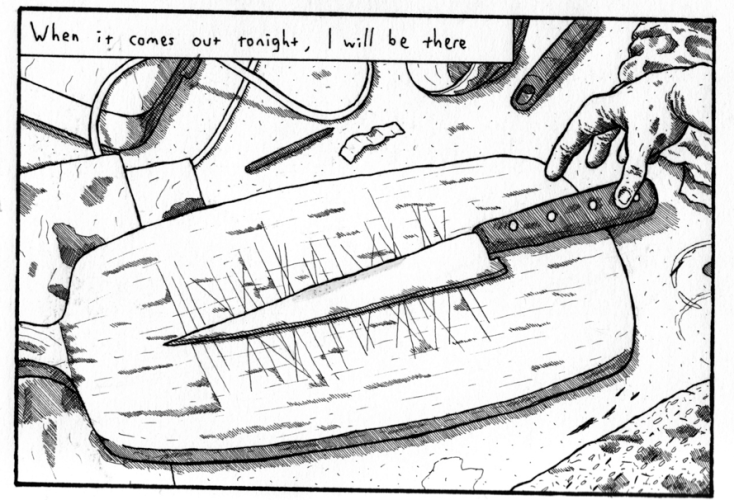
London Intrusion — China Miéville’s New Webcomic

London Intrusion is a new webcomic by weird fiction writer China Miéville.

“Part of the Fun for Me Was Being Part of Some Kind of Exchange Between Consciousnesses” — David Foster Wallace on the Pleasures of Writing

William Burroughs Plays the Drums

Girl with White Dog — Lucian Freud

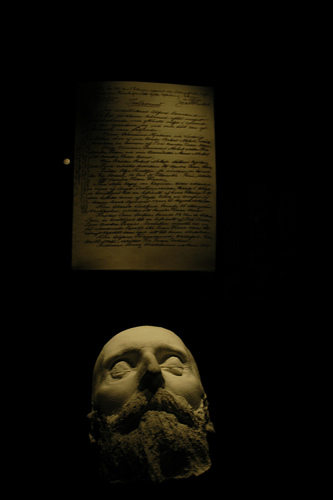
Alfred Nobel’s Death Mask