Odds and Ends

Hamlet: The Facebook feed edition.

Every book mentioned on Mad Men so far.

Betting odds for the 2010 Nobel Prize for Literature (our boy Cormac McCarthy is at 8 to 1; Bob Dylan is at 150 to 1).

Folks are gettin’ hot and bothered about MFA programs.

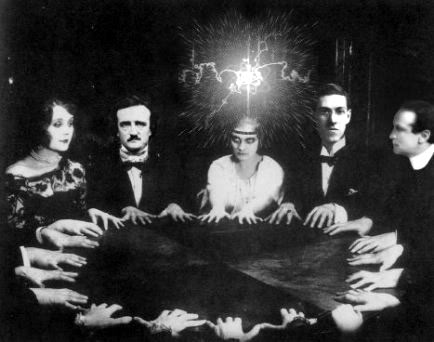
Linking to this post that is tangentially about Jean-Christophe Valtat’s awesome new book Aurorarama gives us an excuse to publish this weird pic of Edgar Allan Poe at a séance–

An inventory of opening sentences.

Raymond Carver Mad Libs.

Vintage Portuguese book covers at A Journey Round My Skull.

John Keats’s Death Mask

“He’s a good editor. Maybe he’s a great editor.” — Raymond Carver on Gordon Lish

We continue to raid The Paris Review’s vault of interviews. Here’s Raymond Carver on Gordon Lish–

INTERVIEWER: Where does Gordon Lish enter into this? I know he’s your editor at Knopf.

CARVER: Just as he was the editor who began publishing my stories at Esquire back in the early 1970s. But we had a friendship that went back before that time, back to 1967 or 1968, in Palo Alto. He was working for a textbook publishing firm right across the street from the firm where I worked. The one that fired me. He didn’t keep any regular office hours. He did most of his work for the company at home. At least once a week he’d ask me over to his place for lunch. He wouldn’t eat anything himself, he’d just cook something for me and then hover around the table watching me eat. It made me nervous, as you might imagine. I’d always wind up leaving something on my plate, and he’d always wind up eating it. Said it had to do with the way he was brought up. This is not an isolated example. He still does things like that. He’ll take me to lunch now and won’t order anything for himself except a drink and then he’ll eat up whatever I leave in my plate! I saw him do it once in the Russian Tea Room. There were four of us for dinner, and after the food came he watched us eat. When he saw we were going to leave food on our plates, he cleaned it right up. Aside from this craziness, which is more funny than anything, he’s remarkably smart and sensitive to the needs of a manuscript. He’s a good editor. Maybe he’s a great editor. All I know for sure is that he’s my editor and my friend, and I’m glad on both counts.

“. . . and seizing them up by their hair and passing their blades about the skulls of the living and the dead alike and snatching aloft the bloody wigs”

Blood Meridian week continues–more jolly times.

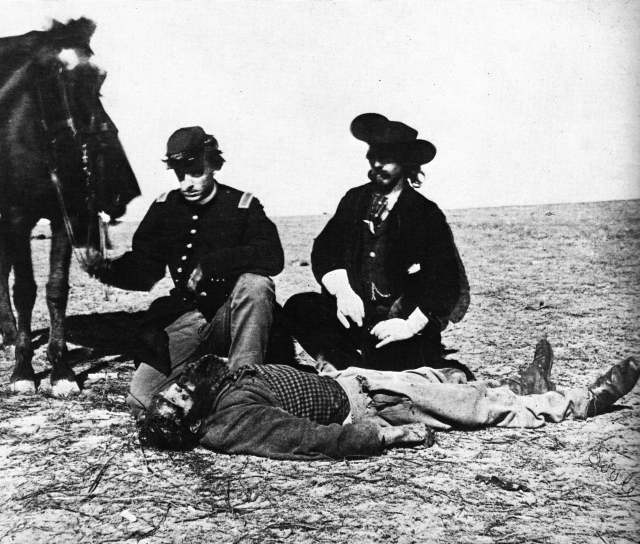
Buffalo hunter Ralph Morrison killed and scalped by Cheyennes in December 1868, near Fort Dodge, Kansas. Photographer: William S. Soule (1836-1908).
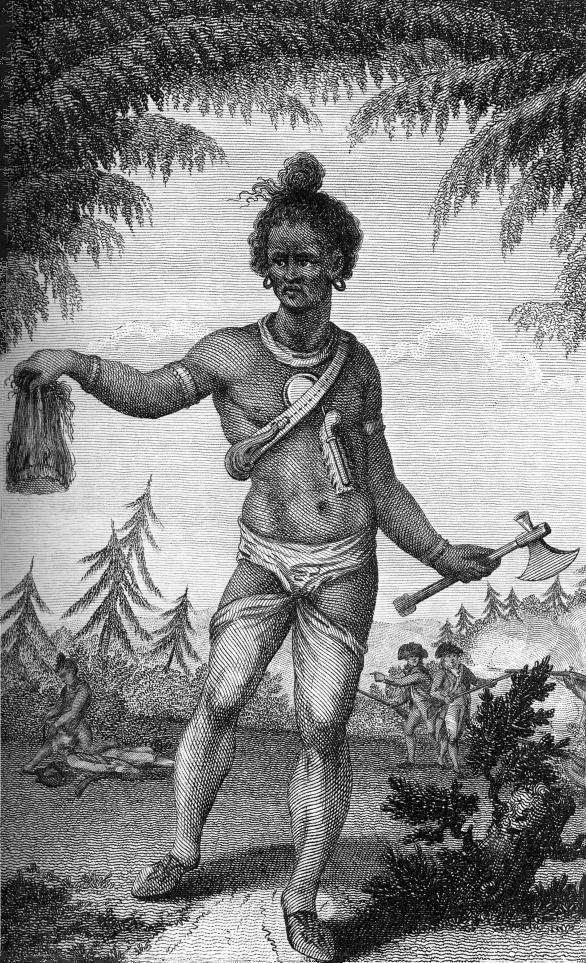
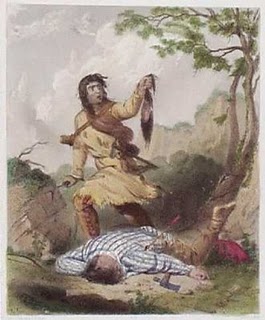
Indian Warrior with Scalp, 1789, by Barlow.
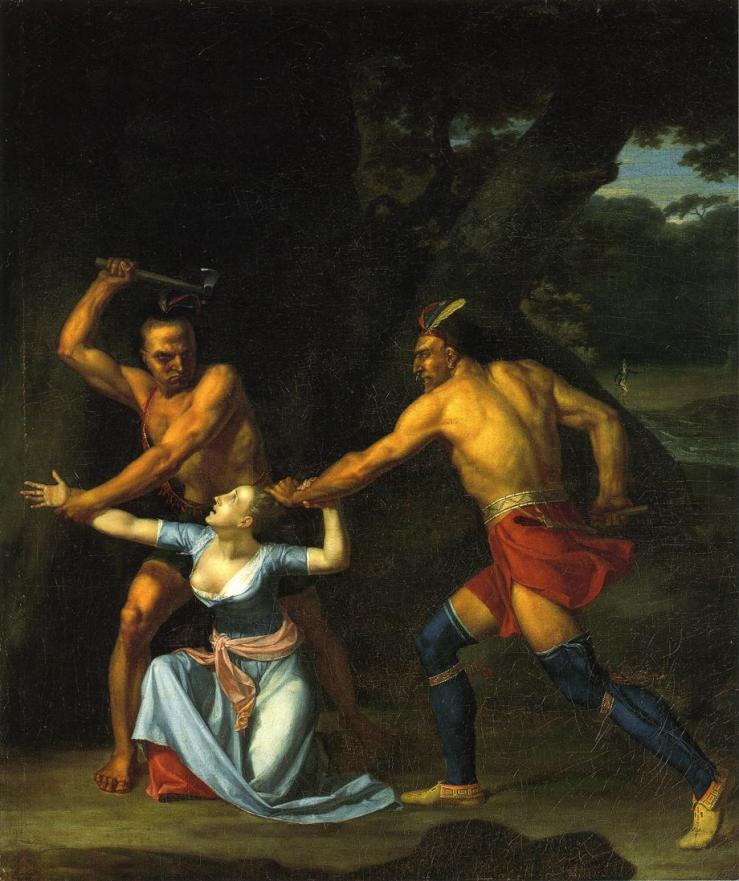
The Death of Jane McCrea, by John Vanderlyn, 1804.
Robert McGee, circa 1861.
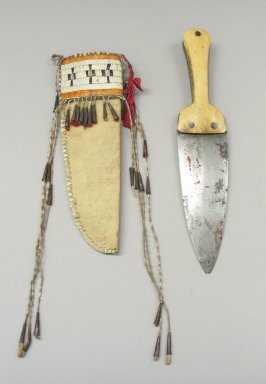
Eastern, Sioux (Native American). Scalping Knife and Sheath, 1801-1833
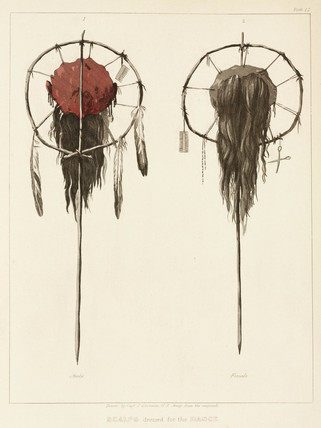
Engraving after Captain Seth Eastman, US Army, of a male and female scalp strung on frames, with combs, feathers and a pair of scissors. Circa 1847.
Hannah Duston
Death Whoop by Seth Eastman. Late nineteenth century.
"A scene on the frontiers as practiced by the 'humane' British and their 'worthy' allies," attributed to William Charles, 1812.

A Map of Blood Meridian

John Sepich's Map of Blood Meridian

John Sepich created this map of the geographic terrain covered in Cormac McCarthy’s Blood Meridian for his companion piece, Notes On Blood Meridian. Blogger The Brooklyn added color.

Blood Meridian — Judge Holden on the Raising of Children

Cormac McCarthy’s Blood Meridian is larded with strange little pockets of the black humor, humor so black that it’s hard to catch on the first or second reading. Re-reading the book again this week, I was struck by how funny a passage in Chapter XI is. The passage comes immediately after one of the more confounding moments of the book. Judge Holden, the giant, malevolent, Mephistophelean antagonist who dominates the narrative, has just told a puzzling parable about a harness maker who commits a murder and then begs for his son’s forgiveness. It’s a strange story and I’m not sure exactly what it means. Anyway, after he tells this story, Tobin, the ex-priest asks the Judge, “So what is the way of raising a child?” Here’s the reply–

At a young age, said the judge, they should be put in a pit with wild dogs. They should be set to puzzle out from their proper clues the one of three doors that does not harbor wild lions. They should be made to run naked in the desert until…

Hold on now, said Tobin. The questions was put in all earnestness.

And the answer, man, said the judge. If God meant to interfere in the degeneracy of mankind, would he not have done so by now? Wolves cull themselves, man. What other creature could? And is the race of man not more predacious yet?

The humor of the Judge’s initial, concrete answer rests on the fact that it is wholly earnest: even in his bizarre, hyperbolic surrealism, the judge is serious. Pits, wild dogs, wild lions. Running naked in the desert. That’s how kids should be raised. The move to the abstract–to highlight humanity’s predatory instincts–is a retreat from humor to philosophy, a pattern that McCarthy repeats in the novel. The effect stuns the impulse to find humor in the language. Humor cannot sustain throughout the narrative, even though it is present.

Blood Meridian — The Open Yale Lectures

Dr. Amy Hungerford’s lectures on Cormac McCarthy’s Blood Meridian are part of Yale University’s “Open Yale” series. The lectures were originally presented as part of ENGL 291, The American Novel Since 1945. From the course description–

In this first of two lectures on Blood Meridian, Professor Hungerford walks us through some of the novel’s major sources and influences, showing how McCarthy engages both literary tradition and American history, and indeed questions of origins and originality itself. The Bible, Moby-Dick, Paradise Lost, the poetry of William Wordsworth, and the historical narrative of Sam Chamberlain all contribute to the style and themes of this work that remains, in its own right, a provocative meditation on history, one that explores the very limits of narrative and human potential.

And again–

In this second lecture on Blood Meridian, Professor Hungerford builds a wide-ranging argument about the status of good and evil in the novel from a small detail, the Bible the protagonist carries with him in spite of his illiteracy. This detail is one of many in the text that continually lure us to see the kid in the light of a traditional hero, superior to his surroundings, developing his responses in a familiar narrative structure of growth. McCarthy’s real talent, and his real challenge, Hungerford argues, is in fact to have invoked the moral weight of his sources–biblical, literary, and historical–while emptying them of moral content. Much as the kid holds the Bible an object and not a spiritual guide, McCarthy seizes the material of language–its sound, its cadences–for ambiguous, if ambitious, ends.

David Foster Wallace on Blood Meridian

David Foster Wallace on Cormac McCarthy’s Blood Meridian: “Don’t even ask.” From his 1999 piece in Salon, “Five direly underappreciated U.S. novels > 1960.”

Win a Copy of Blood Meridian

Biblioklept wants to give you a copy of Random House’s new 25th anniversary edition of Cormac McCarthy’s Blood Meridian. But you’ll have to earn it because if Blood Meridian teaches us anything (beyond spitting and scalping and riding on), it’s that existence costs. So, if you’d like one to win a handsome new hardback, send us a postcard–the most Blood Meridianish one you can muster. (Do not put blood or anything like blood on the postcard. Seriously). If you’re a fan of the book, include a favorite quote. If you’ve never read it before, let us know why you want to read it. Email us at biblioklept.ed at gmail dot com to get our snail mail address (please make “Blood Meridian contest” the subject of your email). The sender of our favorite postcard will receive a copy of the book, courtesy Biblioklept and Random House. Contest closes October 12, 2010 and is limited to addresses in the continental US.
Six Versions of Blood Meridian

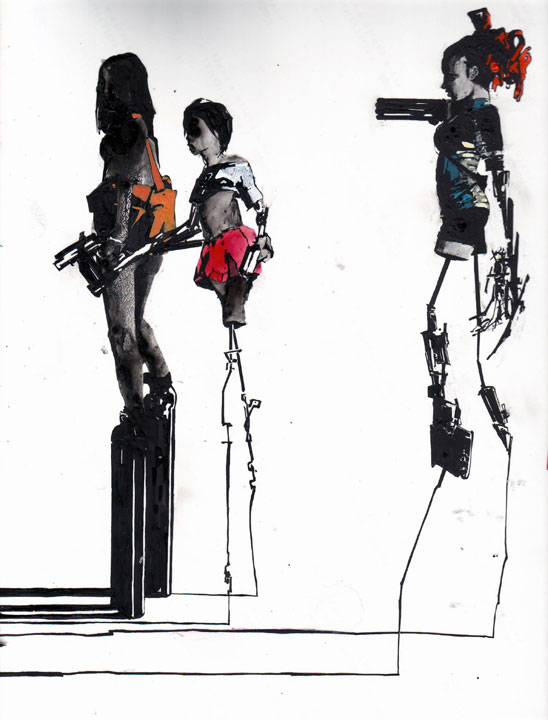
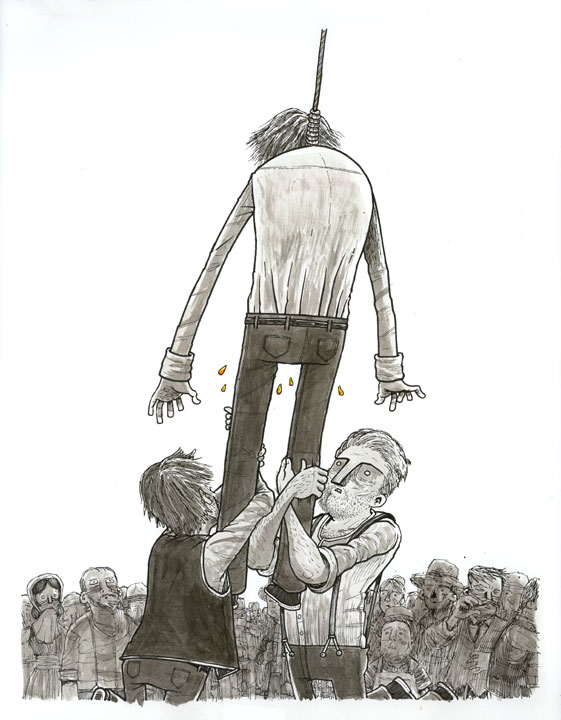
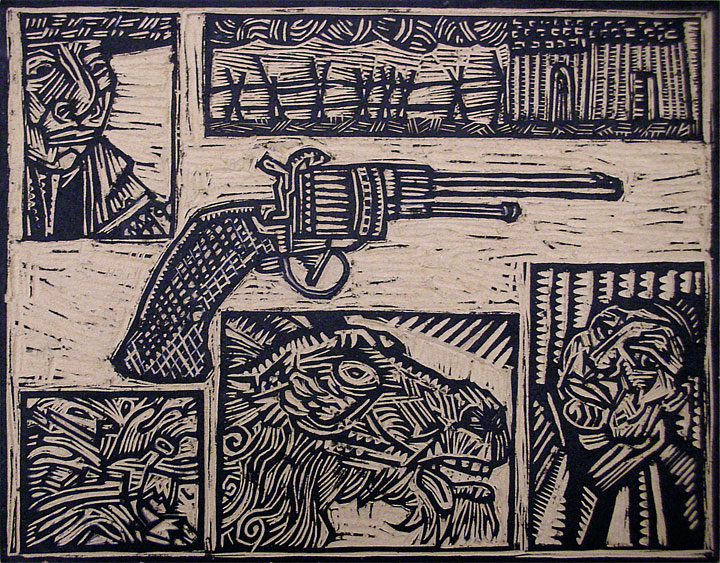
Six Versions of Blood Meridian is an ongoing project where six artists–Zak Smith, Sean McCarthy, John Mejias, Craig Taylor, Shawn Cheng, and Matt Wiegle–illustrate each page of Cormac McCarthy’s novel Blood Meridian. Zak Smith’s illustrations are particularly intriguing; he depicts the Glanton gang as women, a strange inversion that for some reason recalls the “Circe/Nighttown” episode of Joyce’s Ulysses. The Six Versions project’s eclectic range of styles and interpretations makes for one of the more fascinating approaches to a contemporary illuminated manuscript that I’ve seen on the internet (I’m also keen on Matt Kish’s handling of Moby-Dick). A few examples–

They aint worth no fifty dollars.
Dawn saw them deployed in a long file over the plain...
He sees a parricide hung in a crossroads hamlet...

“The Dungeon Master” — Sam Lipsyte

Read “The Dungeon Master,” a new story from Biblioklept fave Sam Lipsyte (from The New Yorker). From the story–

The Dungeon Master has detention. We wait at his house by the county road. The Dungeon Master’s little brother Marco puts out corn chips and orange soda.

Marco is a paladin. He fights for the glory of Christ. Marco has been many paladins since winter break. They are all named Valentine, and the Dungeon Master makes certain they die with the least possible amount of dignity.

It’s painful enough when he rolls the dice, announces that a drunken orc has unspooled some Valentine’s guts for sport. Worse are the silly accidents. One Valentine tripped on a floor plank and cracked his head on a mead bucket. He died of trauma in the stable.

“Take it!” the Dungeon Master said that time. Spit sprayed over the top of his laminated screen. “Eat your fate,” he said. “Your thread just got the snippo!”

The Dungeon Master has a secret language that we don’t quite understand. They say he’s been treated for it.

Blood Meridian — 25th Anniversary Edition

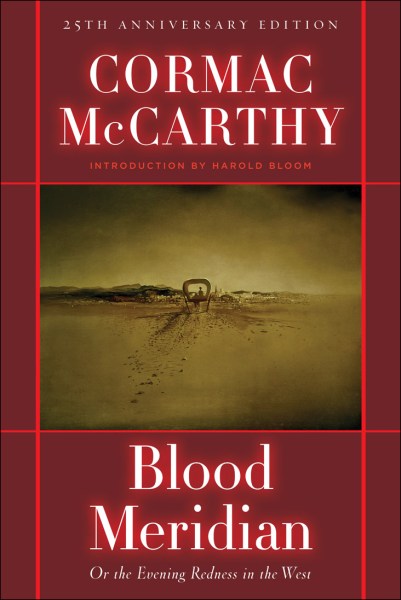
This week, Random House celebrates the 25th anniversary of Cormac McCarthy’s masterpiece Blood Meridian by releasing a new hardback edition of the book. This new Modern Library version retains Harold Bloom’s now-oft-cited introductory essay and features a new cover design by Richard Adelson that echoes the first edition and restores its original art work, The Phantom Cart by Salvador Dali. Here is the new cover–

The release of this new edition and the book’s anniversary give us a great excuse to declare the next five days Blood Meridian Week on Biblioklept. (Yes, we know that it’s also Banned Books Week this week. But celebrating Blood Meridian seems to gel with that). We’ll re-run our original review, take a look at what different critics have had to say about the book, quote some of our favorite passages at length, share some of the better resources at large for tackling this often difficult book, examine some of the history behind it, and generally laud it for its horrifying excellence. We’ll also be giving away a copy of the new 25th anniversary edition to one lucky reader, so keep your eyes peeled for details.

Leo Tolstoy’s Death Mask

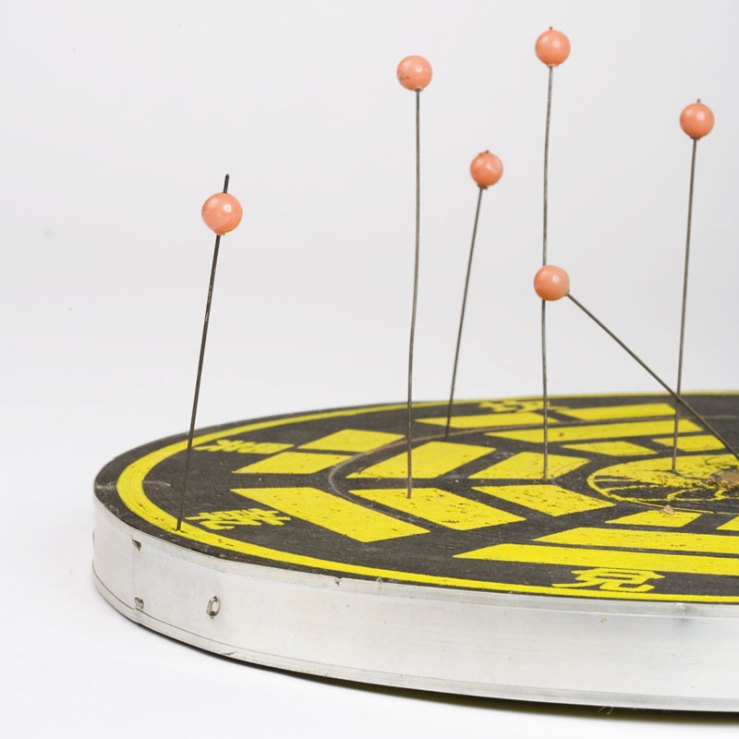
William Burroughs’s Blowdarts

(Via).

JG Ballard on William Burroughs

We continue to raid The Paris Review’s interview archive. Here’s J.G. Ballard on William Burroughs, in a 1984 interview–

INTERVIEWER: Burroughs wrote an eccentric and laudatory, in its way, introduction to the American edition of Atrocity Exhibition. Do you know him?

BALLARD: Burroughs, of course, I admire to the other side of idolatry, starting with Naked Lunch, then Ticket, Soft Machine, and Nova Express. I’m less keen on his later books. In his way he’s a genius. It’s a pity that his association with drugs and homosexuality has made him a counterculture figure, but I suppose his real links are with Jack Kerouac, Allen Ginsberg, and the Beats. Still, I think he’s much more of an establishment figure, like Dean Swift, with a despairing disgust for the political and professional establishments of which he is a part. I have met Burroughs quite a few times over the last fifteen years, and he always strikes me as an upper-class Midwesterner, with an inherent superior attitude towards blacks, policemen, doctors, and small-town politicians, the same superior attitude that Swift had to their equivalents in his own day, the same scatological obsessions and brooding contempt for middle-class values, thrift, hard work, parenthood, et cetera, which are just excuses for petit-bourgeois greed and exploitation. But I admire Burroughs more than any other living writer, and most of those who are dead. It’s nothing to do with his homosexual bent, by the way. I’m no member of the “homintern,” but a lifelong straight who prefers the company of women to most men. The few homosexual elements in Crash and Atrocity Exhibition, fucking Reagan, et cetera, are there for reasons other than the sexual—in fact, to show a world beyond sexuality, or, at least beyond clear sexual gender

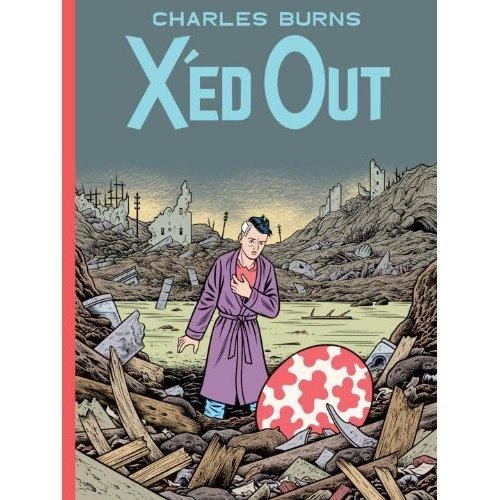
Charles Burns’s X’ed Out Is Fantastic

I devoured Charles Burns’s X’ed Out last night. Then I read it again this afternoon. I’ll read it again before I give it a proper review closer to its release date near the end of October. It’s weird, wild stuff, working in the idioms of William Burroughs and Hergé, brimming with punk rock energy and druggy art madness. It’s thoroughly Burnsian. X’ed Out is the first volume in what the publisher promises will be “an epic masterpiece of graphic fiction in brilliant color.” Like I said, full review down the line, but look out for this book. X’ed Out comes from the good folks at Pantheon, who’ve already proven their commitment to the graphic novel medium in stunners by publishing soon-to-be classics like David Mazzucchelli’s Asterios Polyp and Dash Shaw’s BodyWorld.