So. Yes. Well. OK. With holiday rehab served and “exhaustion” surmounted, Biblioklept is now back in production for the ’08. A few things:
2008, you might’ve heard, is an election year. Biblioklept’s official position is that all career politicians are scoundrels in the pocket of corporations. But. We do love Ralph Nader, and he’s come out in support of South Carolina pretty boy John Edwards. So maybe there’s something to that.
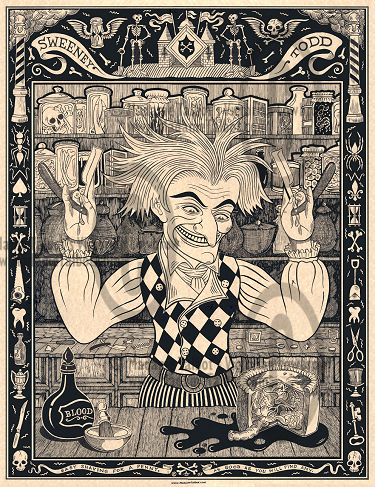
By our reckoning, Tim Burton hasn’t made a good movie since 1999’s Sleepy Hollow or a great movie since 1994’s Ed Wood. Finally though, his adaptation of Stephen Sondheim’s Sweeney Todd: The Demon Barber of Fleet Street marks a return to excellence. Why aren’t there more musical horror films? Go see this film in the theater.
Speaking of musical Stephens, Stephin Merritt’s Magnetic Fields will unleash their new album Distortion on January 15th. We weren’t crazy about 2004’s i, but Distortion marks a return to a more straightforward pop sound with plenty of (surprise) distortion. We’re really digging this album. Check out a few of the tracks for yourself.
And yes, this is still a blog about books. Look out for upcoming reviews of R. Crumb’s Kafka biography, Eggers’s What is the What, stuff from Chris Ware, a few short story collections, and a collection of William Blake’s work. Also, we haven’t abandoned our 50 Guitarists series or the Alphabet Soup project. So there’s that. Anyway. Biblioklept will be back in full-scale, proper review mode next week. In the meantime, check out Bibliokid for random daily Internet detritus.
Forms: 7 hogmynae, 8 hagmane, -menai, 8-9 hagmena, -menay, (hagman heigh), hogmanay, (9 hogmena, -menay, -maney, hanganay). [Of obscure history, noted only from 17th c. App. of French origin: see note below.]
The name given in Scotland (and some parts of the north of England) to the last day of the year, also called Cake-day; the gift of an oatmeal cake, or the like, which children expect, and in some parts systematically solicit, on that day; the word shouted by children calling at friends’ houses and soliciting this customary gift.
c1680 [see b]. 1693Scotch Presbyt. Eloq. (1738) 120 It is ordinary among some Plebeians in the South of Scotland, to go about from Door to Door upon New-Year’s Eve, crying Hagmane. 1790Gentl. Mag. LX. I. 499/1 Concerning the origin of the expression Hagman Heigh. Ibid., In..Scotland, and in the North of England, till very lately, it was customary for every body to make and receive presents amongst their friends on the eve of the new year, which present was called an Hagmenay. Ibid. II. 616/2 On the last night of the old year (peculiarly called Hagmenai). 1792Caledonian Mercury 2 Jan. (Jam.), The cry of Hogmanay Trololay is of usage immemorial in this country. 1805J. NICOLPoems I. 27 (Jam.) The cottar weanies, glad an’ gay..Sing at the doors for hogmanay. 1825BROCKETT s.v. Hagmena, The poor children in Newcastle, in expectation of their hogmena, go about from house to house knocking at the doors, singing their carols, and [saying] Please will you give us wor hogmena. 1826-41R. CHAMBERSPop. Rhymes Scot. (1858) 295 The children on coming to the door, cry Hogmanay! which is in itself a sufficient announcement of their demands. Ibid. 296 Cries appropriate to the morning of Hogmanay..Get up, goodwife, and shake your feathers, And dinna think that we are beggars; For we are bairns come out to play, Get up and gie’s our hogmanay. 1827HONETable-Bk. I. 7 The Hagman Heigh is an old custom observed in Yorkshire on new year’s eve. 1830SCOTTJrnl. II. 360 We spent our Hogmanay pleasantly enough. 1884St. James’s Gaz. 27 Dec. 6/1 Seasonable mummery..was reserved for Hogmanay. 1890Scott. Antiq. June 40 This is the sort of thing they used to sing as their Hagmena Song in Yorkshire. 1893HESLOPNorthumb. Gloss. s.v., In North Northumberland the hogmanay is a small cake given to children on Old Year’s Day; or the spice bread and cheese, with liquor, given away on the same day. 1897E. W. B. NICHOLSONGolspie 100-108.
b.attrib. and Comb., as hogmanay cake, day, night, concert, song, etc.
c1680 in Law Mem. 191 note [Protest of the Gibbites] They solemnly renounce..Pasch-Sunday, Hallow-even, Hogmynae-night, Valentine’s even [etc.]. 1826-41R. CHAMBERSPop. Rhymes Scot. (1858) 295 A particular individual..has frequently resolved two bolls of [oat]meal into hogmanay cakes. 1864BURTONScot Abr. I. v. 297 The eve that ushers in the new year is called in Scotland Hogmanay Night. 1897Westm. Gaz. 21 Dec. 6/3 On New Year’s Eve there is to be a grand Hogmanay concert for the special benefit of patriotic Scots in London.”
Thanks to Bobby Tomorrowland for hipping me to Tumblr. This is probably the simplest, cleanest way to blog; it’s actually kind of addictive. Check out Bob’s new blogSupper’s Ready, and my new blog, Bibliokid, and then say, “Jeez, I can do better than that,” and make your own damn blog.
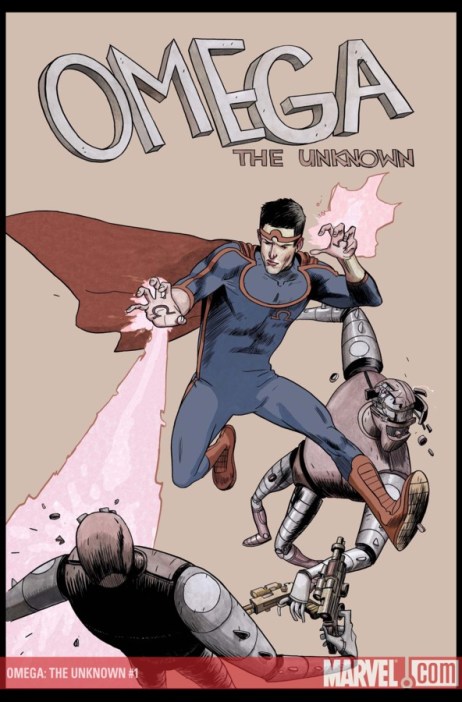
Earlier this year, in an interview with the AV Club, Jonathan Lethem briefly mentioned that he was working on “kind of an emo comic book” for Marvel Comics. The first issue of that comic–part one of a ten issue run–came out back in October, prompting me to go to a comic book store–something that I haven’t done in years. Lethem’s Omega the Unknown is essentially an update of the original Omega the Unknown series, written by Steve Gerber and Mary Skrenes with art by Jim Mooney. The original ten issue run was published by Marvel Comics twenty years ago.
Lethem’s Omega the Unknown centers on robotically erudite teenager Alex Island and his new life after the bizarre death of his parents (who turn out to be–gasp!–robots). Alex has a strange (and still unexplained in the first three issues) relationship with a superhero who doesn’t speak, but who seems to be watching over him, protecting him from alien androids who are out to get him. Also watching over him after his parents’ deaths are a callow young nurse and a cynical social worker. All the while, local Brooklyn “superhero” The Mink tries to figure out how he can turn this new superhero and his robot villains into an opportunity for more publicity.
I haven’t read Marvel comics in over 15 years, but Omega the Unknown is quite a bit better than even the best comics I remember reading in the late eighties/early nineties (um, Chris Claremont’s X-books). Still, despite its introspection, lack of huge splash pages or silly, purposeless fights, Omega is deeply entrenched in superhero terrain: this isn’t an indie comic. Also, I was able to wait a week between reading issues two and three, even though I had both of them in my possession–compare this to a “superhero” comics like Alan Moore’s Watchmen, which I had to read in one sitting.
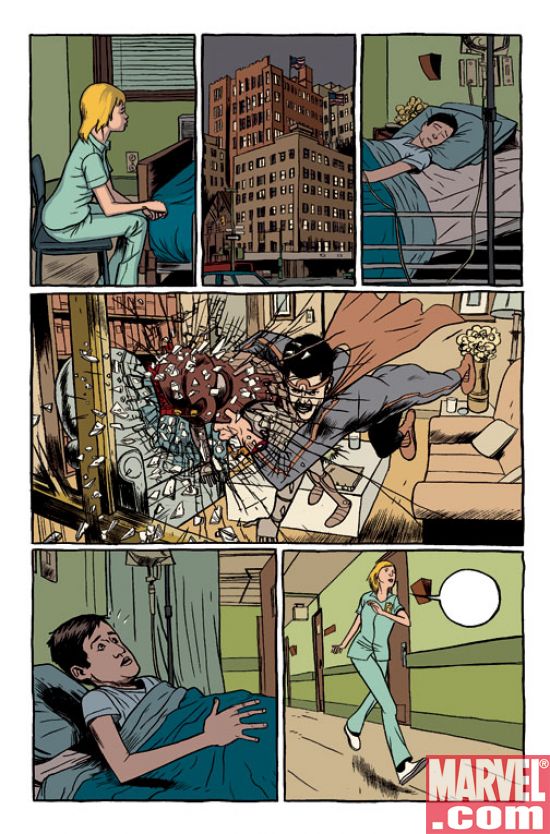
Farel Dalrymple’s art is fantastic, especially given Marvel’s current penchant for anime-inspired overly-muscled cartooning. Dalrymple’s figures recall many of my favorite artists, capturing the quintessential stark simplicity of Jack Kirby’s squarish hulks and the wild energy of early John Romita Jr. coupled with the attention and detail to line Art Adams always puts into his illustrations.
I’ll continue to pick up the issues of Omega the Unknown, but so far, it’s hardly essential Lethem, or, for that matter, essential comic reading. Still, for now, I’ll give it the benefit of the doubt.
Time to round up all the awful people of 2007. This list is in no way definitive, and it’s barely in hierarchal order, but I think it’s sound enough. Just like last year’s list (for the record, everyone on that list was also horrible in 2007), the miscreants represented are limited to Americans only–there are simply too many assholes out there to take on the whole world.
10. Michael Vick:
Organizing the killing of dogs for sport and entertainment–and to make money–makes you a complete asshole.
9. The multitude of vacuous, soulless, slutty “celebrities,” whose malfeasance and just plain general dumbness passes for “culture” these days:
We’re not going to name them, because we’re sick of them and so are you. Still, coverage of their worthless exploits continues to metastasize like cancer. Perhaps we should blame the American people? Nah…this blog is pro-America! Which brings us to an attack on–
8. The Democratic Party:
The Democratic Party has spent this entire decade as impotent mugwumps, a collection of scaredy-cat politicians who fell into every trap the well-organized Republicans set for them. Even with the Congressional and Senate majority, they still couldn’t manage to do anything to stop the steady growing institutionalizing of a stark divide between the haves and the have-nots.
7. The Republican Party and every fool who still supports them:
I’m still amazed to run into Bush supporters. I got over my liberal outrage a few years ago (it became unsustainable in the face of the sheer ludicrous evil perpetuated by the Neocons in the name of “security”), and my liquid rage has now gelled into detached cynicism. Still, when I encounter any “Republicans” who defend the Bush administration, I love to ask them why they support a monster who has so dramatically increased government spending, as well as the role of the federal government in the lives of Americans. The average Republican seems to respond only in hypothetical rhetorical questions–“You think Gore would’ve done a better job?” or worse, points out that Bush was the “moral” candidate (uh…Katrina?). Still, I get the sad feeling that these chumps were fooled by one of the most organized political efforts in American history to consolidate power and revoke civil liberties.
6. OJ Simpson:
Speaking of hypothetical rhetoric, before he was roughing up sports memorabilia dealers in Las Vegas, OJ Simpson was hard at work getting If I Did It: Confessions of the Murderer published. According to a Fox press release (there was going to be a tell-all interview aired; for once moral outrage trumped poor taste): “O.J. Simpson, in his own words, tells for the first time how he would have committed the murders if he were the one responsible for the crimes. In the two-part event, Simpson describes how he would have carried out the murders he has vehemently denied committing for over a decade.”
Wow. What a fucking asshole.
5. Alberto Gonzales:
Gonzales was either lying when he repeatedly said he didn’t or couldn’t recall any details about the 2006 firing of eight US attorneys for their political persuasions (um, they weren’t “loyal Bushies“), or he was just grossly incompetent in his position as US Attorney General. It took him months to resign, and even then, the Bush administration continued to support him.
4. Nancy Grace, Bill O’Reilly, and every other douchebag who perpetuates sensationalist, divisive nonsense under the guise of “journalism”:
This brand of yellow journalism has been around forever, but in recent years its proliferation has become unbearable. Even worse, it’s starting to infect mainstream journalism, which increasingly tells “stories,” instead of simply reporting the news. Plus, Nancy Grace is an awful bitch.
3. Dick Cheney:
Make no mistake, Dick Cheney’s evil hasn’t fallen off any–sure he came in at #2 last year, but, as I said at the beginning of this list, the rankings are somewhat arbitrary. I suppose he got a little bit of cred this year for not shooting any old men in the face (at least none that we know of). Evil and secretive, Cheney believes that Americans are idiots, sheep who need to be sheparded.
2. The perpetrator of the Virginia Tech Massacre, and every other asshole who feels like mass murder will make them famous and heal their sick spirit:
I won’t publish his name or even link to it, for that matter. These people want fame and recognition, a glory after death, to be remembered and recognized, and I don’t wish to be part of that. But still. This guy was clearly one of the worst–if not the worst–persons of 2007. These types of killings keep happening again and again, and I am in no way discounting or ignoring the other slayings this year–some as recent as last week–but this particular massacre is the worst school shooting in American history. I am still shocked that this tragedy never sparked a full-scale debate leading to gun control reform. Hell, gun control isn’t even a major issue in the 2008 presidential election.
Here are the names of the victims (for a detailed list, go here): Ryan Clark (22), Emily Hilscher (19), Liviu Librescu (76), Minal Panchal (26), G. V. Loganathan (53), Jarrett Lane (22), Brian Bluhm (25), Matthew Gwaltney (24), Jeremy Herbstritt (27), Partahi Lumbantoruan (34), Daniel O’Neil (22), Juan Ortiz (26), Julia Pryde (23), Waleed Shaalan (32), Christopher James Bishop (35), Lauren McCain (20), Michael Pohle Jr. (23), Maxine Turner (22), Nicole White (20), Jocelyne Couture-Nowak (49), Ross Alameddine (20), Austin Cloyd (18), Daniel Perez Cueva (21), Caitlin Hammaren (19), Rachael Hill (18), Matthew La Porte (20), Henry Lee (20), Erin Peterson (18), Mary Read (19), Reema Samaha (18), Leslie Sherman (20), Kevin Granata (45).
1. George W. Bush:
I may now anticipate a response on the order of: “OK, Biblioklept–Bush is awful, but he didn’t murder 33 people in cold blood–what makes him #1 on your list?” Here’s the deal: although Bush hasn’t technically murdered anyone, his war has led to the deaths of thousands and thousands of people, and his radically conservative policies on everything from environmental protection to child health care will have long term detrimental effects on American society for decades to come. He claims that history will judge his presidency, and I believe him: Bush will go down in history as the worst president since Richard Nixon, and will no doubt be judged even more harshly.
Since we’ve already had our say about the best books of ’07, here’s what some other clowns thought:
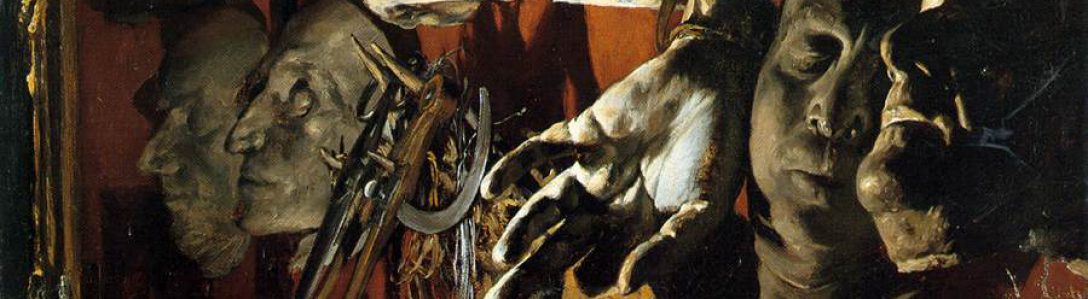
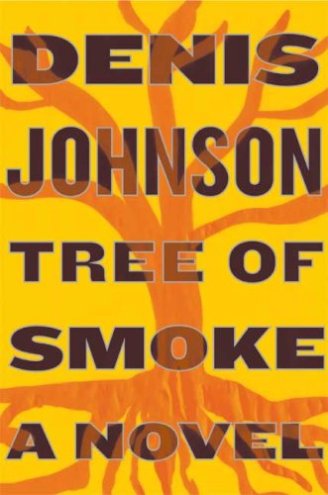
The New York Times agreed with us that Denis Johnson’s Tree of Smoke was fantastic. They also give props to Roberto Bolaño’s The Savage Detectives, the reading of which is high on our “to do” list. In their non-fiction superlatives, they highlight music critic Alex Ross’s The Rest is Noise, as do the a couple of the folks over at Slate–although Slate‘s list fails to recognize Tree of Smoke (the book is seriously seriously good good good). The editors of Publisher’s Weekly also cite Johnson’s novel as one of ’07’s best, and they’re one of the few sites out there to mention Don DeLillo’s Falling Man. I’ve just started listening to the audiobook version of Falling Man, and I should be able to weigh in before ’07 is kaput. There’s a better-than-you-would-think-it-would-be write-up at Time of the top-ten graphic novels of 2007. The School Library Journal effectively organizes its list by grade level, a boon to teachers and parents everywhere. That bastion of literary criticism, The Economist, seems to think that Michael Chabon’s The Yiddish Policemen’s Union was something special, although we know better. The writers over at theVillage Voice are sensible enough to append the adjective “favorite” instead of “best,” perhaps excusing them from also giving a nod to Chabon’s book (although their mistaking Miranda July for an author cannot be forgiven). When you get sick of reading other people’s list, head over to Book Covers and check out the Best Book Shelves of 2007 (the images in this post are from said list).
Not only does the end of each year bring ugly barefaced consumerism, nightmare traffic, and hellish stress, it invariably leads up to oodles of lists, hierarchies, rankings, and tabulations. We here at Biblioklept are not above marshaling the cultural detritus of the year into our own list, as follows. But before we even get to all that, I have to say that The Year of the Golden Pig (whether it was really a Golden Pig year or not) was a wonderful and special year for me, thanks to the birth of my lovely little girl. So: very good year. Best Fiction Book I read in 2007
This is really tough, because I read so many great books this year. Cormac McCarthy’s The Road really stuck with me, and although I thought the end was a cop-out, I found myself thinking about the book constantly and rereading it in bits and pieces. For sheer entertainment, I also really enjoyed Chris Bachelder’s US! I also read or reread most of James Joyce’s oeuvre, and I really did enjoy Ulysses, despite the torture it put me through, and I can’t leave it out of this group. Still, I have to give the award to a book published last year, Chris Adrian’s astounding and astonishing The Children’s Hospital, a book so good that I actually had to stand up to read it at times.
Best Nonfiction Book I read in 2007
Although Consider the Lobster, David Foster Wallace’s “sequel” to his hilarious collection of essays A Supposedly Fun Thing I’ll Never Do Again, isn’t quite as funny as that earlier book of essays, it shows a maturation of scope and a control of language that I would’ve thought impossible ten years ago, simply because DFW has been such a master of words from the outset of his writing career. Great book.
Best Book Published in 2007 that I Read in 2007
Denis Johnson’s Tree of Smokewas the best book I read all year, although it’s only fair to point out that I listened to the audiobook–maybe I should put quotation marks around read, or just use the verb listen instead. In fact almost all of the books published in 2007 that I…uh…”read” were audiobooks, including two of the bigger releases this year, Michael Chabon’s The Yiddish Policemen’s Union and Jonathan Lethem’s You Don’t Love Me Yet. Which brings us to…
Most Disappointing Book of 2007
Jonathan Lethem’s You Don’t Love Me Yet was pretty awful.
Best Movie I Saw in the Theater in 2007
Tie: Children of Men (yeah, I know it came out in 2006–I saw it in 2007 though) and Superbad. If you were to make a graph of emotional matrices, these two films would probably fit quite comfortably at ends opposite of each other. Still, they have plenty in common–great stories, emotional impact, and most importantly, they meet the ultimate criterion for an excellent movie: they start out great and only get better.
Best Movie I Saw on DVD in 2007
David Lynch’s INLAND EMPIRE. Watch it at night in the dark, preferably alone, preferably in the cold.
Most Disappointing Movie of 2007
Although it was by no means bad, I was disappointed in the Coen’s adaptation of Cormac McCarthy’s No Country for Old Men. It was a good movie–Javier Badem was fantastic, great pacing and tone–but still it didn’t blow me away like, say, Fargo or Blood Simple or Miller’s Crossing did. Ditto Werner Herzog’s Rescue Dawn. Chalk it up to hyperbolic expectations, I guess. Maybe I need to watch these films again on DVD and reconsider.
Best Album of 2007
This is always a tough one, and there were plenty of great albums that came out this year. Late in the year I found myself unexpectedly in love with The National’s Boxer, a serious album that’s still growing on me like a weird moss. Battles’s Mirrored was superb; I found myself listening to James Blackshaw’s The Cloud of Unknowing whenever I wanted my mind to mush out; Menomena’s Friend and Foe was the perfect soundtrack for a long drive; the psychedelic progrock of Frog Eyes’s Tears of the Valedictorian made me itch in a good way; and with Strawberry Jam, Animal Collective finally let us know what they were singing. Fiery Furnaces, my favorite band, put out Widow City, their most “rock” album to date, a great collection of songs about widows and hieroglyphics and mysticism and bored Spanish royals and automatic husbands and perverts in Japanese slippers. But if I had to pick just one album of the year, it would have to be Panda Bear’s Person Pitch, a gorgeous pastiche of loveliness that I consistently put on repeat. Bring your own harmonies and sing along.
Best Single of 2007
Just when I’d given up on Outkast–what with Big Boi doing that awful Caddyshack ripoff and Andre busy with his silly cartoon–they show up on UGK’s “International Players Anthem,” easily the best track of the year. From Andre’s opening meditation on the virtues of commitment to the final verse’s warnings about Paul McCartney’s messy divorce, this song is pure magic. The death of Pimp C earlier this week adds a darker shade to the poignancy and sweet nostalgia of “International Players Anthem.”
I haven’t been interested in Blonde Redhead in years, really–chalk it up to a sense of propriety stemming from following them since their earliest (and best) albums (and 7″s!)–but 23 was a dreadful bore. Ditto the Sea and Cake’s Everybody: even the addition of a few fuzzy edges couldn’t muddle the Chicago quartet’s vanilla smoothiness. But it was Smokey Rolls Down Thunder Canyon, Devendra Banhart’s follow up to 2005’s Cripple Crow that stood out as the biggest disappointment. Banhart’s unfocused, overblown, tossed-off collection of songs copped riffs left and right without adding anything new or inventive. My wife reviewed the album best while riding in the car with me: “Why are you listening to The Doors?”
Best Network TV Show of 2007
I love NBC’s 30 Rock so much that I wanna take it out behind the middle school and get it pregnant.
Best Cable TV Show of 2007
It’s Always Sunny in Philadelphia: bad awful people doing rotten awful things. Charlie is a personal hero of mine.
Best New TV Show of 2007
Flight of the Conchords is hilarious. That’s lousy writing/reviewing, but it’s true: the show is just really really funny. You should watch it. You’ll like it a lot (unless there’s a yawning abyss where your soul should be…)
Best Out of Control Local News Appearance of 2007
Two way tie: Tracy Morgan–
vs. Tracy Morgan–
Best Abs of 2007
With a body like that, Putin can curtail my civil liberties any time!
Best Makeover of 2007
When he’s not terrorizing bands in the studio, making awesome Christmas albums, or just having a few tequila drinks with a lady friend, Phil Spector takes time out to make sure that he’s looking fine and dandy like cotton candy.
Most Enjoyable Blog of 2007
I’ve looked forward to and greatly enjoyed each entry in Nathan Rabin’s ambitious project My Year of Flops over at the Onion AV Club. Is it too much to ask him to do this again in 2008?
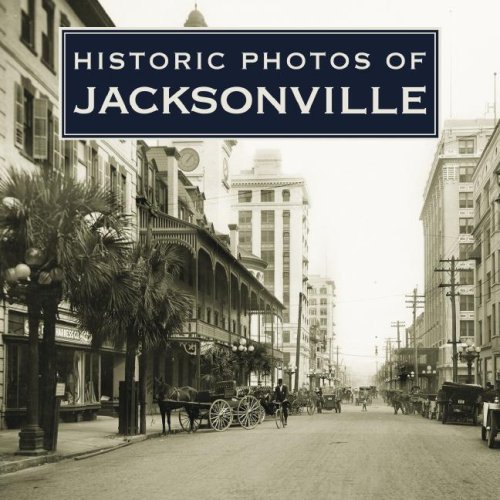
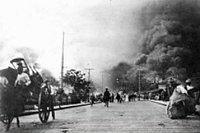
In just over 200 black and white archival photographs, Turner Publishing Company’sHistoric Photos of Jacksonville depicts a vision of the Bold New City of the South that might surprise even native Jacksonvillians. The pictorial narrative begins around the same time as the advent of popular photography, before the Civil War (or, the War of Northern Aggression, as some old-school Jacksonvillian’s might say), and continues into the late 1960s. University of North Florida history professor Carolyn Williams’s captions provide insightful but never obtrusive explanations and commentary for the images, and her short essays before each section help to explicate the historical contexts of each of the particular periods of Jacksonville’s history into which the book. Particularly engaging are the smoke-hazed photos of the Great Fire of 1901, a devastating blaze that reduced much of the city to ashes.
Also fascinating are the post-fire/pre-WWI images of Jacksonville. These detail an overlooked period when the city was a major tourist destination boasting a burgeoning film industry. Northern travelers would flock to luxury resorts like the St. James Hotel, where native Jacksonvillian James Weldon Johnson‘s father worked. When looking at photos of the crowded streets of downtown and the busy industry of the shipyards and train stations, it’s easy to feel a twinge of nostalgia for a time that passed before you ever lived, a time before the strip malls and suburban sprawl, a time before Jacksonville looked more-or-less like Every Other Place in America.
Historic Photos of Jacksonville will look great on your coffee table or on your shelf, preferably next to James Weldon Johnson‘s outstanding autobiography, Along This Way.
Last year, Rick Santorum made our list of the worst people of 2006 for, among other nefarious deeds, using imagery from J.R.R. Tolkien’s Lord of the Rings as a half-assed metaphor supporting the Iraq war. Apparently, Santorum’s literary criticism has sparked a whole new approach in conservative thinking.
The new issue of Harper’s Magazine contains a section from James P. Pinkerton’s essay, “The Once and Future Christendom” (click the link to read it in full at its original publication site, The American Conservative). In this essay (which, incidentally, I highly recommend reading for a larf), Pinkerton argues that, with its declining birthrates, “Old Europe” will become Muslimized, and hence a threat to the US. Pinkerton suggests that this Muslimization is akin to Sauron and his evil horde in the land of Mordor using the Ring of Power to unite all the creatures of Middle Earth as slaves to his dark power. Not one to point out a problem and offer no solution, Pinkerton recommends that, in order to “save” Western civilization, “poor children from such countries as Argentina [be brought] home to Europe.”
In Pinkerton’s analogy, Americans are like Hobbits–simple folk who “like to smoke and drink,” but on whom “all grander forms of world-girdling intoxication are lost.” “The Hobbits just want their Shire to return to normalcy,” writes Pinkerton. For Pinkerton, “normalcy” clearly means the Hibernian/Nordic values embodied by the Hobbits, an ideology starkly contrasted in Toklien’s Middle Earth with the bestial, murderous existence of the black-skinned orcs and the savage, dark-skinned Southrons. Although I love The Lord of the Rings trilogy and The Hobbit, I was somewhat bothered in my post-college reading of the books by their clearly xenophobic values. Pinkerton takes these values and suggests that a whole new foreign policy be created from them: “Tolkien offers a different sort of diversity–of genuine difference, with no pretense of similarity, let alone universal equality. In his world, it is perfectly natural that all creatures great and small–the Hobbits are indeed small, around three feet high–have their own place in the chain of being.” You’ve got to love any ideology that values the great chain of being.
The part of Pinkerton’s essay that bothers me the most–and I enjoyed it tremendously, as an application of literary criticism, I must admit–is that he’s dead serious. He’s not joking. He’s for real. Furthermore, taken in conjunction with Santorum’s comments, and everything the neo-cons have achieved over the past eight years, it’s more evident than ever that the modern conservative movement in America is quite willing to use a fantasy novel published in the 1950s as a basis for not just foreign policy, but also for its ideology as to just how America is to relate to the rest of the world. And that’s not just funny, it’s also scary.
Even a die-hard Simpsons fan such as myself–I’ve been watching the show for over half of my life on a near-daily basis–cannot deny that the show has been in a slump for the past couple (some might say dozen) years. And so far, the 2007 season has been pretty awful–even the highly anticipated “Treehouse of Horror” episode failed to elicit a single laugh. So I was unduly excited by the first segment of last night’s episode, which featured three of our favorite comic book writers: Art Spiegelman, Daniel Clowes, and Alan Moore. Jack Black guest-starred as the owner of Coolsville, a new comic book shop where the elite underground trio gathers for a book signing (much to the ire of Comic Book Guy, of course). Somehow (and of course, if you watch The Simpsons, you know exactly how), this plot lasts exactly until the commercial break: in part two Marge opens a gym, and in part three Homer gets plastic surgery. Sigh. Luckily, Youtube allows us to preserve and isolate the most pleasing fragment of last night’s episode and watch it again and again obsessively.
Check out the super trio here (and take note of the prominent display of one of our favorite graphic novels ever, From Hell):
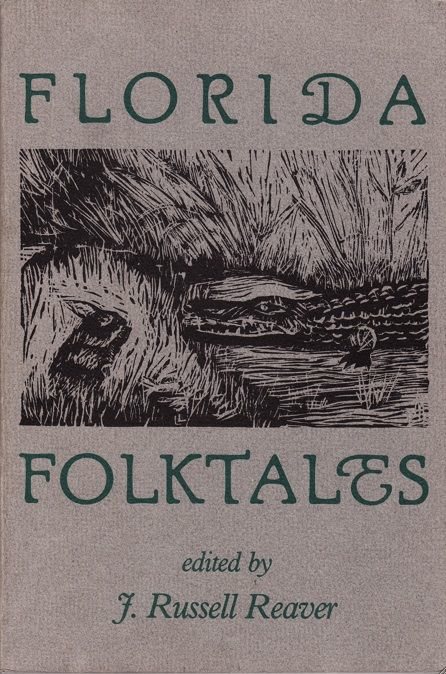
I found this little gem at the bottom of a cardboard box in a locked cabinet in an abandoned teacher’s lounge. I had to break the lock: hidden treasure. Florida Folktales collects a range of folklore, ranging from ghost stories and trickster tales, to modern urban legends. I was intrigued by the back cover blurb by my one of my old professors at the University of Florida, Dr. Robert Thomson (he was the instructor for a folklore class I took. My project: I collected stories told by people who claimed to have had supernatural experiences while on drugs. Lots of LSD angels-and-demons stuff. I think I got an A-). Lovely book, University of Florida Presses.
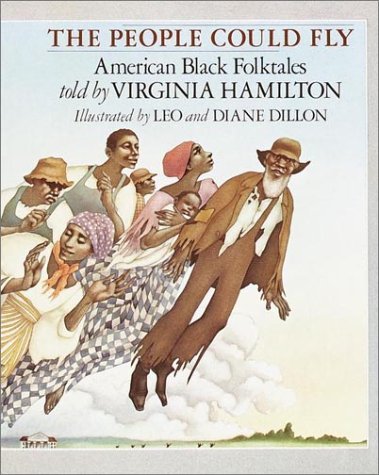
Under Florida Folktales I was pleased as punch (yes, punch: like this guy) to discover Virginia Hamilton’s retelling of traditional American Black folktales, The People Could Fly. I used a few of the tales the same day in class. Beautiful illustrations by Leo and Diane Dillon perfectly capture the axis of waking life and dreamworld these folktales express. Again, a lovely book.
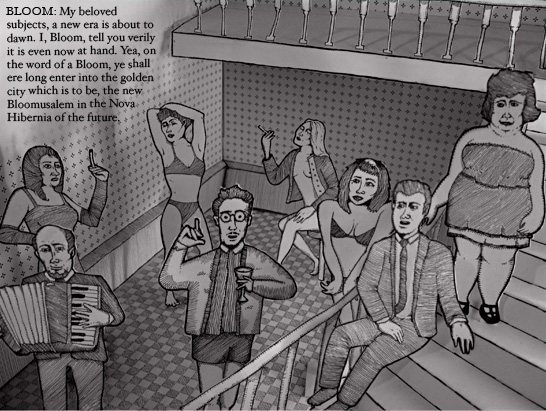
I was delighted to stumble across the design work of Itamar Lerner whilst looking for Joycean images on the web (I now give myself one demerit for using the execrable phrasal verb “stumble across” to describe a web search, two demerits for using the unforgivably pretentious and archaic conjunction “whilst,” a hundred demerits for not editing the original sentence in the first place, and a thousand demerits for this long-winded excuse).
Lerner’s images of Ulysses do justice to both the humor and the pathos of Joyce’s complex episodes. Lerner’s self-described medium of “ink on cut out papers” creates a shaded depth that evokes comic strip art by way of a Punch and Judy show. I like it!
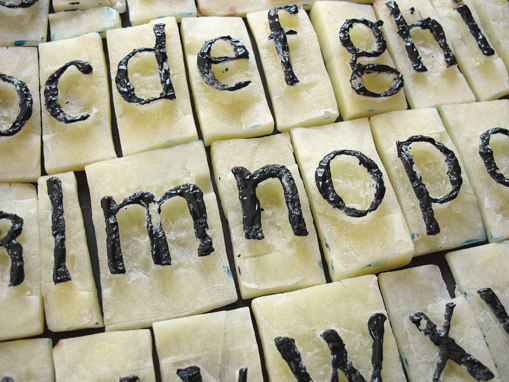
Lerner’s portfolio attests to his masterful fontsciousness: in addition to his original typefaces, he’s designed alphabets in wax, cement, and–my favorite–potatoes:
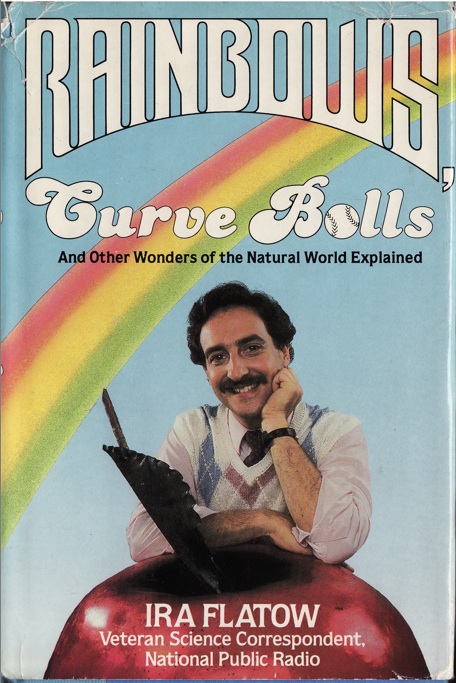
Who can resist a face like that? I found Rainbows, Curve Balls this week in a super-secret cache of books (dusty box inside of locked cabinet in corner of former teachers’ lounge). Some fool was going to throw the whole dealy away; luckily I was armed with curiosity and my trusty hammer (yes, I keep a hammer in my classroom)
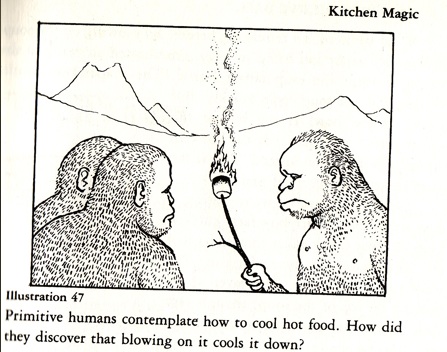
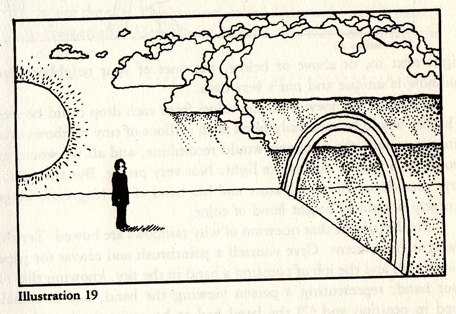
In 1988’s Rainbows, Curve Balls, NPR’s own Ira Flatow explains belching, “Kitchen Magic,” the difference between vinyl and CDs and answers the age-old question, “Do airplane wings flap?” Good stuff.
Felici@ Noll*y’s “Eyes of a Baby” makes stunning use of what I like to call “the fetal voice.” Noll*y’s narrative begins in a “bubble […] so safe and warm with extra soft walls.” However, her hapless narrator is soon confronted with “monsters” who “torture” the poor kid, ripping it out of its safe haven, depriving it of its immediate source of food. The poor dear ends up in a “jail cell with big bars,” contemplating a strange new existence in a world populated by demons. Noll*y’s narrative captures the jarring dissonance of new beginnings contrasted with the ever-present ideal of a perfect, unattainable “safe haven.”
L@ur@ Cunningh@m submitted a trio of vignettes, each as unfinished as a fetus, each showing some serious promise as contenders in an Anne Rice parody contest–only I think Cunningh@m’s serious about her work. In “Implied Consent,” she dips into her idea of an adult vampire world, one reminiscent of the early nineties goth scene. She also uses the phrase “nary a word.” Yes, “nary.” Ugh. In “Duality,” she takes a stab at a postmodern trope–the characters in the story are being written into existence by other characters in the story (somebody get Charlie Kaufman on the phone). In the blandly-titled “Something,” Cunningh@m demonstrates public high school’s complete failure to teach human anatomy with this clunker: “Hot bile rose to the back of her throat.” Bile is produced by the liver, sweetheart. Maybe it’s just a very, very complicated metaphor.
Sh@t@vi@ E@dy’s “Down in the Crowd,” written as a screenplay, finds rumors to be the root of all evil. I’m not sure exactly what happened in E@dy’s tale, but I do know that gossip and misinformation are sites of extreme horror for her. Also, there’s a predominate preoccupation with “the cool kids” and the “not cool kids”–social scientists are now clamoring to adopt these specialized terms as their own.
M@tik@ Bl@l@rk’s “Taken” begins in media res, a bold step that none of the other young writers attempted. Good for her! Unfortunately, Bl@l@rk’s cluttered imagery and frantic pace leave no room for the reader to have any sense of what’s going on. In the end, she pulls what is to be a recurring motif in many of these stories: “It was all just a dream” (alternately: “It was all just a nightmare”). So says I: “It was all just a cop out.” People didn’t like that shit on Dallas back in the 1980s, and I don’t like it now.
Far more ambitious is Ch@ntel R**d*r’s “Fight of the Gods,” written entirely in a marvelous backwoods dialect (at one point, her narrator points out that the “man war havin’ a Caesar,”–he means “seizure”–a line compounded in semiotic resonance when one considers the fact that Caesar suffered from epileptic fits. I applaud R**d*r’s Joycean wordplay!) After thirty-five pages, it became clear that R**d*r had submitted not a self-contained story, but the initial chapter of a book about demonic possession over the ages of man. She says she has more, and I’d love to read it.
Mel@nie River@’s “Breathe,” like a number of the stories this year, seems to take several of its cues from the recent Saw franchise: torture chambers as puzzles, ambitious killers, that sort of thing. River@’s story stands out on several counts, beginning with her adventurous use of verbs: in “Breathe,” we find that bones can be “emasculated” (these are not metaphorical bones; she is referring to ulnas and tibias and metatarsils and shit like that). There is a fascinating episode where a bus driver bites a hapless victim, who astoundingly replies: “Who are you to put your hands on someone else’s child, huh?!” I was astounded because that’s just what I say when a weirdo stranger bites me unprovoked out of nowhere. It turns out that the bus driver is a killer, and not just “a normal killer, he was an advanced killer.” Coming soon to a theater near you: Advanced Killers 4: The Matriculation.
As its title suggests, D@nchelle Jon*s’s “Scary Story” is a self-reflexive postmodern comment that seeks to pull at the very roots of just what can qualify as a “scary story,” or for that matter, as a story at all! Who says you have to have mood, tone, or setting? What traditionalists (patriarchalists, no doubt!) decree that a story should have a beginning, middle and end? Jon*s attacks our notions of just what the narrative arts can do, leaving us scratching our heads as we applaud her audacity.
In “REVENGE OF THE EX!!!!!”, M@h@ Mi@n also pushes the limits of traditional writing, this time challenging those awful standards of typography and punctuation: why can’t a story be typed in italicized, 18-point font? Isn’t it obvious that some questions deserve multiple question marks???? And who’s to say that multiple exclamation marks are redundant?!!!!?!?!?!?!?!?!?!?
Sh@net@ Oliv*r’s “Black Outs” examines the mood swings typical of teenagers, pushing those mood swings into the fascinating trope of split personalities. Also, the first half of Oliv*r’s story consists of rhymed couplets, a rhetorical strategy that mirrors the tension between conflict and harmony inherent in every person afflicted with multiple personality disorder.
Finally, M@j@ C@v@r makes a bold move by naming her story “Extra Credit.” Again, I can only assume this is a kind of postmodern tongue-in-cheek gesture on C@v@r’s part, a reference to the fact that I offered the “Scary Story” assignment as a way to earn–you guessed it–extra credit. Nothing slips by these kids. C@v@r is an innovator in what I like to call the “I-filled-up-all-the-lines-on-the-paper-so-now-the-story’s-over-regardless-of-the fact-that-so-much-still-remains-unresolved” style of writing. Courageously sacrificing any sense of closure, C@v@r instead opts for this stunning closer, shifting jarringly from third-person omniscient to first-person singular: “I only need a point from only a B and I really need a B, okay?” Sorry, sweetheart, I don’t think that’ll quite do it.
Eve Arnold’s famous photo of Marilyn Monroe reading Ulysses. Supposedly, she’s reading Molly Bloom’s sexy monologue at the end of Joyce’s novel. This pic is good too–
Plenty of cool stencils to be found here, including this Imperial Storm Trooper design that my wife talked me out of attempting (not “Halloweeny” enough):
And, in our sorry tradition of lazy blogging, we still stand by everything we did last year around Halloween:

 h
h gm
gm
 )
)
















 Biblioklept