Word of the Week

Ignicolist–

From the OED:

“A fire-worshipper.

1816 T. MAURICE Ruins Babylon II. 43 In whatever region of the earth this infatuated race of ignicolists took up their abode, the sacred fire immediately began to burn. 1859 R. F. BURTON Centr. Afr. in Jrnl. Geog. Soc. XXIX. 340 The ancient Persians were ignicolists, adoring etherial fire.”

Famous ignicolists include:

Moses

The Human Torch

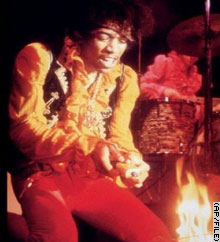
Jimi Hendrix

–Serial arsonist John Orr


storyhendrix3.jpg

The Wings of Our Dreams

Chills! So inspirational!

The Evolution Will Be Televised

If you missed The Simpsons last night, you need to check out the extended couch-gag intro below (may god bless Youtube). Marvel as Homer demonstrates eons of evolution in just over a minute. Best. Intro. Ever.

This isn’t the first time The Simpsons has dealt with evolution and its (nonsensical) opponents. An unbiased comparison between creationism and Darwinism:

And of course, the horror of the Flanders (note the sweet soundtrack to the end of this one courtesy of the Doobie Brothers):

Goodbye Blue Monday

A few things:

1. I am still exhausted after my sister-in-law’s wedding this weekend. I was the best man, which was more involved than I had originally believed. Special props to the photographers, the DJ, and the caterer, all friends and family who went above and beyond what was expected. Contact these guys for your next wedding, bar mitzvah, super sweet sixteen, or Guy Fawkes Day party.

2. Luckily, this week is Spring Break, and I have the next couple of days off of work and grad school. What does this mean to you? Well, hopefully I’ll get back on track with the Ontology 101 project, and actually start posting again about books that I’ve stolen (I know that’s what you come here for). You can also look forward to an interview with Eddie de Oliveira, author of Lucky and Johnny Hazzard, to be published later this week. Until then…

3. A few placeholders to quell some of that Monday boredom:

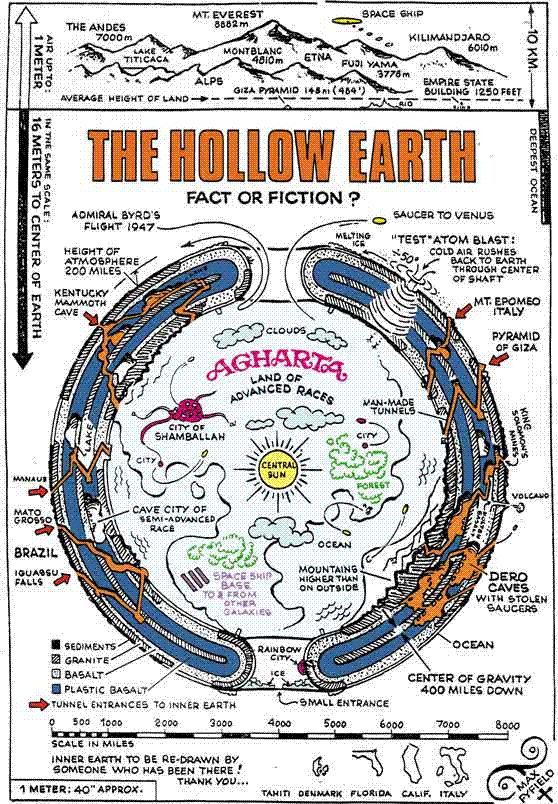
A. Go to Strange Maps. Another great WordPress blog that lives up to its name. Love it!

hollowearth.GIF

B. Tarantino/Rodriguez’s Grindhouse comes out the first week of April. Looks like good old fashioned fun. Check out the full theatrical trailer–

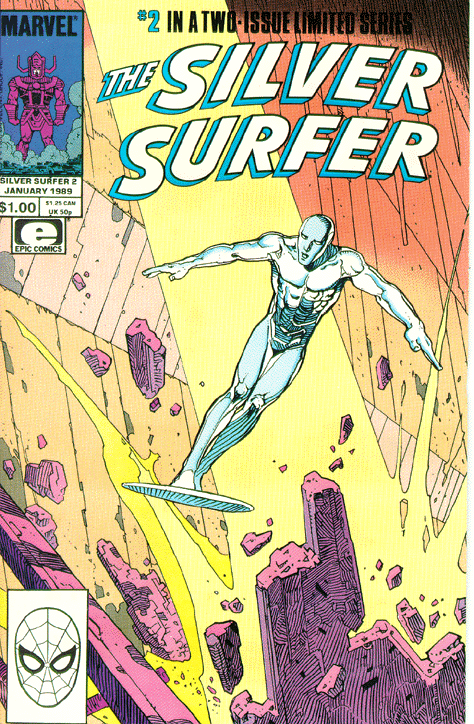
C. Enjoy this Silver Surfer cover art gallery before the upcoming Fantastic Four sequel ruins the best Marvel Comics character ever.

silversurfermoebius2.gif

Cover art by French artist Moebius, who created a line of comic books with Alejandro Jodorowsky in the 1970s.

Midnight Movies

The San Marco Theater in beautiful San Marco, Jacksonville, FL will be playing two very bizarre movies over the next few weekends: El Topo and The Holy Mountain, both by weirdo director Alejandro Jodorowsky. Both movies are Eastern Westerns featuring Christ-like protagonists who negotiate surreal and brutally violent worlds. Jodorowsky’s heroes ritualistically transgress taboo, exploring and re-interpreting colonialism, mythology, sexuality, and the concept of an idealized, subjective self. The Holy Mountain is particularly worth your two hours and six bucks–who wouldn’t want to see disfigured freaks, alchemical self-improvement, genital mutilation, cannibalism, incest and (my favorite scene) frogs and iguanas dressed as Conquistadors and Indians recreating the conquest of South America? Also features full-frontal nudity and numerous executions. Soundtrack by Don Cherry.

El Topo plays March 23rd and 24th at midnight; The Holy Mountain plays March 30th and 31st at midnight.

Also playing at the San Marco Theater beginning March 18th is Old Joy, a 2006 film starring Daniel London and our favorite Palace Brother, Will Oldham. Soundtrack by Yo La Tengo.

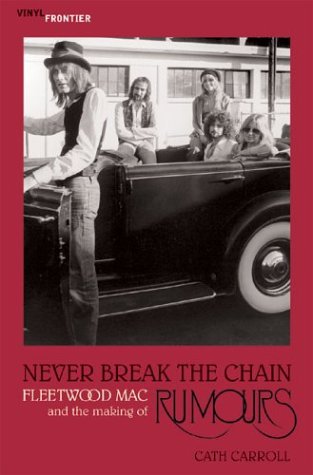
Never Break the Chain–Cath Carroll on Fleetwood Mac

neverbreakthechain.jpg

Never Break the Chain: Fleetwood Mac and the Making of Rumours by Cath Carroll (yes, that Cath Carroll) provides an excellent overview of the long, strange career of Mick Fleetwood and company. Like many of you (I’m guessing), I was introduced to Fleetwood Mac via my parents, who played Rumours ad infinitum. It was one of the first albums I “owned”–from the vinyl, I recorded a cassette copy that I played on my Sony Walkman repeatedly. I believe Born on the USA was on the other side. As the years passed, Fleetwood Mac somehow became very uncool to my ears (i.e., they did not rap, there was a paucity of shredding metallic guitar overtures, etc), then slightly cooler, then totally uncool (i.e. the Clintons, the reunion tour), then very very cool (thank you college, thank you Tusk).

Never Break the Chain is organized chronologically, making it easy for readers such as myself to skip around to sections of greater interest. The majority of Carroll’s research comes from previously published articles from magazines like Creem and Rolling Stone, as well as a few interviews. Carroll navigates the Mac’s bizarre history, detailing the numerous personnel changes. Mick Fleetwood is the book’s undisputed hero, the rock(er) who kept the band together through the tumultuous tempest of three decades. It’s fascinating to see how the band transforms from a British blues rock group from the John Mayall school of rock, to the melodic songwriting team that recorded the utterly-Western masterpiece Rumours.

As the title suggests, the making of Rumours becomes the focal point of the book. Carroll explores the bizarre love quadrangles that erupted within the band during that time, although for my taste there wasn’t quite enough VH1’s Behind the Music trashiness to her analysis. Ditto for the legendary cocaine use that supposedly fueled the FM’s late seventies output, which is largely glossed over.  However, gearheads who can’t get enough descriptions of studio equipment, instrumentation, and production techniques will love this book. Carroll goes into very detailed accounts of how FM approached songwriting–some of the most interesting passages recount how the band arrived at the album sequences. Plenty of in-fighting, plenty of fights with the studio, and a whole chapter devoted to Tusk. On the whole not bad. However, no substitution for actually listening to the albums.

Jesus Warrior

jesus_gun.jpg

I love WordPress. I was searching through random blogs, and I came across the Jesus Warrior (A Homeschooler’s Life). This kid has potential. Check it out. Through JW I hooked up to Answers in Genesis, where I found out all sorts of interesting stuff. Need to know what those cavemen really are? (descendants of Noah, silly!) Want to get the low-down on the Hobbit Bone wars? Or while we’re on the subject, how about soggy dwarf bones? Or this nugget–“Are black people the result of a curse on Ham?” (No, silly–in the past the bible story of Noah and his children may have been used to support certain cultural positions (and said cultural positions may have been presented as and purported to be scientific facts) but that’s all in the past–today’s creation scientists would never fall into such nonsense!) AiG is good stuff–and best of all, it proudly provides not just the “layman’s terms” but also the “semi-technical terms” you’ll need to dazzle your friends with your mad science skills!

Bibliomania

This Saturday, the missus and I headed to the Jacksonville Fairgrounds for the annual Friends of the Library Sale. Parking was no problem, and the event was well attended but not crowded. Amidst the seemingly endless horde of V.C. Andrews and Robert Ludlum leftovers, we grabbed some great stuff.

I got an extremely handsome first edition of Steinbeck’s The Acts of King Arthur and His Noble Knights, which appears to have never been touched, let alone read. This book will fit nicely within an already-large collection of Arthur book’s I’ve never finished (with the exception of T.H. White’s version, which I devoured as a youth).

35b8b340dca0d12aab1d6010_aa240_l.jpg

While searching through kids books, my special lady came across a hardback edition of Persepolis 2. You may recall I wrote about Satrapi’s first book of Persepolis a few weeks ago. I’m happy to report that the books now exist in a special harmony, together at peace on my shelf.

I also picked up a few books I may never get around to reading, including Ian McEwan’s Atonement. This list-topper won all kinds of awards a few years ago, despite accusations of plagiarism. I’m sure that Gabriel Garcia Marquez’s One Hundred Years of Solitude is like, the best book ever: I’ve thoroughly enjoyed the first fifty pages several times now. I keep promising myself: next summer. The strangest thing is that I didn’t actually own this book before now. The “Oprah Book Club” sticker came off no problem, by the way. Another one that I started years ago in college, a library loan, was John Barth’s The Sot-Weed Factor, a humorous tale of Americana that I couldn’t make heads or tails of as an undergrad. The book is huge; the copy I bought, despite being a paperback edition from the early 80s, has no spinal damage and appears unread. Undoubtedly it will stay this way.

Much more useful, I’m sure, will be The Dictionary of Literary Terms by J.A. Cuddon. This book is fantastic, and I’ve already put it to good use. Cuddon’s approach is exciting: he uses plenty of illustrative examples, and even puts the specialized terminology into historical context–in many ways, this book is like a crash course on the history of rhetoric.

I was thrilled (no really, thrilled) to come across two books from the 33 1/3 series. In this series, one writer takes a close look at just one musical album. I’d already read Chris Ott’s take on Joy Division’s Unknown Pleasures; I was lucky enough to snap up Jimi Hendrix’s Electric Ladyland by John Perry and Prince’s Sign O’ the Times by Michaelangelo Matos. So far, John Perry’s take on Hendrix has been one of the best musical biographies I’ve ever read, which is really saying something (for the record, it’s still no contest against the immortal classic, Crazy from the Heat, by one David Lee Roth). In edition to being concise and well-written, these books are small and have a stylish design. Perfect bathroom reading material.

082641571701_ss500_sclzzzzzzz_v1075163157_.jpg

Of course there were other sundry books bought, and plenty abandoned (I still regret not spending the fifty cents on Bikini Planet, a pulp sci-fi that promised “Benny Hill style humor” What was I thinking?) I could hardly carry our box as it was (although, in the interest of full-disclosure, I am very physically weak).

After the book sale, we headed across Downtown to the Prime Osborn Convention Center. My father had given us free passes to the Home and Patio Show. It was shocking. People were paying five bucks to park, waiting in a line that zigzagged out the door to pay who-knows-how-much to gain entry to what amounted to a bunch of vendors trying to sell you crap. I kept shaking my head in disbelief. Down the road were thousands and thousands of books that were practically being given away, but here people were lining up and paying to be sold things. Ah…Jacksonville! You’ve gotta love it.

Friends of the Library Sale

Are you a nerd living in Jacksonville, Florida with nothing to do this weekend? Do you suffer from bibliomania? Do the stacks and stacks of (unread) books cluttering your living space do nothing to prevent you from buying even more books? If you answered in the affirmative to any of these questions, then mosey on down to (or alternately, simply drive to) the illustrious Jacksonville Fairgrounds for the Friends of the Library book sale. Located in glamorous Exhibit Hall B, the sale promises “7 tractor trailer loads of books; 50% donated; 50% hardcover; sorted; .50 & up.” It’s unclear what the exact breakdown of these books will be (are the half that are donated mutually exclusive from the half that are hardcover? You’ll just have to go and see!)

smlogo.gif

(For the record, I look just the same as the woman pictured above does when I read–calm, cool, and reflective, my fist poised gently (philosophically even) under my chiseled chin, book perched  delicately in my manicured hand, thinking deep and profound thoughts)
The details:

Jacksonville Fair Grounds (Exhibit Hall B)

Friday, March 2nd 10am-8pm

Saturday, March 3rd 10am-6pm

Sunday, March 4th noon-6pm

Books You Can’t Live Without?

Via the Guardian, a reader list of the Top 100 books you can’t live without. Jane Austen’s Pride and Prejudice tops the list (I’ve never read it but I’ve endured both movie versions)…the Bronte sisters are also well-represented.

Are these people serious?

No William Burroughs, no Alduous Huxley, no Toni Morrison…but Jane Austen shows up no less than three times–and every Thomas Hardy book I can name is on there!

On the whole, the majority of contemporary fiction (novels published in the last 15 years) is total book-club schlock: Dan Brown, Helen Fielding, Alice Sebold, etc. inexplicably co-mingle with Dostoevsky, Melville, Nabokov and García Márquez.

Sheesh. Can we amend this thing?

Robocop-like Strategies of Carceral Negotiation, Racially Heteroglossic Wilds, and More Bad Writing

Even though Denis Dutton discontinued his annual Bad Writing award (published in Philosophy and Literature) way back in 1999, it’s still fun to take a look at some of the worst sentences in academia from years past. Notable winners (?!) include Judith Butler and Frederic Jameson, but my favorite sample comes courtesy Professor Rob Wilson:

“If such a sublime cyborg would insinuate the future as post-Fordist subject, his palpably masochistic locations as ecstatic agent of the sublime superstate need to be decoded as the “now-all-but-unreadable DNA” of a fast deindustrializing Detroit, just as his Robocop-like strategy of carceral negotiation and street control remains the tirelessly American one of inflicting regeneration through violence upon the racially heteroglossic wilds and others of the inner city.”

With sentences like this, it’s no wonder that many people consider academics to be obscurantists, sophists who rely on the trickery of word play to cover up vacuous thoughts (in a candid moment, I might fess up to occasionally dabbling in such writing. OK. I admit it. I confess. Mea culpa. I’m guilty of thousands and thousands of bad sentences. So there.)

Tomorrow, we’ll take a look at how hoaxes perpetrated by Alan Sokal and others have challenged the often-pseudoscientific field of post-modern cultural studies.

Digital Elegy

I just loved yesterday’s post from the Urban Core: a great collection of photos of the old Main St. Library. Not sure if Tony took these himself. Good stuff.

Ontology is (not) Overrated

A few weeks ago, one gentle reader was kind enough to respond to a post of mine. I reproduce in full said response:

 “Speaking of things ontological: this, from Clay Shirky’s monumental “Ontology is Overrated.”

http://www.shirky.com/writings/ontology_overrated.html

“It comes down ultimately to a question of philosophy. Does the world make sense or do we make sense of the world? If you believe the world makes sense, then anyone who tries to make sense of the world differently than you is presenting you with a situation that needs to be reconciled formally, because if you get it wrong, you’re getting it wrong about the real world.

If, on the other hand, you believe that we make sense of the world, if we are, from a bunch of different points of view, applying some kind of sense to the world, then you don’t privilege one top level of sense-making over the other. What you do instead is you try to find ways that the individual sense-making can roll up to something which is of value in aggregate, but you do it without an ontological goal. You do it without a goal of explicitly getting to or even closely matching some theoretically perfect view of the world.””

Okay. I finally read the essay. Very cool stuff. From Shirky, again:

“It is a rich irony that the word “ontology”, which has to do with making clear and explicit statements about entities in a particular domain, has so many conflicting definitions. I’ll offer two general ones.

The main thread of ontology in the philosophical sense is the study of entities and their relations. The question ontology asks is: What kinds of things exist or can exist in the world, and what manner of relations can those things have to each other? Ontology is less concerned with what is than with what is possible.

The knowledge management and AI communities have a related definition — they’ve taken the word “ontology” and applied it more directly to their problem. The sense of ontology there is something like “an explicit specification of a conceptualization.”

The common thread between the two definitions is essence, “Is-ness.” In a particular domain, what kinds of things can we say exist in that domain, and how can we say those things relate to each other?”

Shirky then discusses the ways that the second definition of “ontology”–the one used by the “knowledge management”–bumps up against the first definition of ontology (the one that is “less concerned with what is than with what is possible”). I don’t really think Shirky is anti-ontology, I just think he sees a problematized, ironic “ontology.” In a sense, Shirky uses a deconstructionist approach, destabilizing the hierarchies enforced by the second definition of ontology (notably, the term “metaphysical” is absent from Shirky’s defs of “ontology,” another move we could link to a deconstructionist mindset which strikes at the foundations of Platonic ideals). Shirky again:

“But this is the ontological dilemma. Consider the following statements:

A: "This is a book about Dresden."
B: "This is a book about Dresden, 
 and it goes in the category 'East Germany'."

That second sentence seems so obvious, but East Germany actually turned out to be an unstable category. Cities are real. They are real, physical facts. Countries are social fictions. It is much easier for a country to disappear than for a city to disappear, so when you’re saying that the small thing is contained by the large thing, you’re actually mixing radically different kinds of entities. We pretend that ‘country’ refers to a physical area the same way ‘city’ does, but it’s not true, as we know from places like the former Yugoslavia.”

Throughout “Ontology is Overrated,” Shirky is specifically working out ontological quandaries as they relate to the ever-expanding world of internet technology, but he’s also concious of the underpinnings of the first definition of ontology–of the possibilities of “isness” and being and the relational (infinite multiplicity) of meanings this entails (Shirky’s discussion of Yahoo and Google sheds light on this somewhat abstract problematic. Shirky privileges Google as the company who, rather than reinforcing (false) hierarchies in their ontological method, take a more deconstructive approach–meanings are relational, and exist in a fluid, transformative space).

I think that Shirky’s essay works in the same spirit that I would like to believe I’m working in: a playful, disruptive mode that pokes, prods, and jabs at the foundational traditions of hierarchies that (we allow to) resist examination, traditions that are explained away as simply being “natural.”

Finally, Shirky proposes this approach to knowledge:
“[Y]ou try to find ways that the individual sense-making can roll up to something which is of value in aggregate, but you do it without an ontological goal. You do it without a goal of explicitly getting to or even closely matching some theoretically perfect view of the world.”

There is a paradox here, one which I’m sure Shirky is aware of, yet nonetheless it’s a problematic one: Shirky wants to do away with “ontology,” or “ontological goals,” yet he wants “individual sense-making” (and value-based sense-making at that) to somehow remain. If Shirky’s problem is with the word “ontology” (a word he qualifies as “ironic”), that’s a separate issue: however, following from Shirky’s own first-definition of “ontology”–a definition that I think gets to the spirit of ontology, the spirit of possibility–ontology is simply a tool, a way of seeing, an approach, a method. Calling ontology “overrated” seems like a cynical solution; one doesn’t have to hold a metaphysical (Platonic) viewpoint which privileges “perfect” ideals and truths in order to practice ontology. Rather, ontological questioning–questioning “isness” and the possiblities of “isness,” how that “isness” finds meaning in language and representation (or how language and representation create that “isness”)–is the root of philosophical inquiry.
Word of the Week

bird-man, birdman

From the OED:

1. A man concerned with birds; an ornithologist.

1697 Lond. Gaz. No. 3269/4 At Black Joe’s, the German Bird-man..canary-birds. 1729 M. BROWNE Pisc. Eclog. VIII. (1773) 119 The Fisher on the green-sea-deep, And Birdsman in the osier copse. 1796 MORSE Amer. Geog. II. 17 The birdmen or climbers..bringing away the birds and their eggs. 1844 C. WATERTON Ess. Nat. Hist. (ed. 3) p. lxviii, These birdmen outwardly had the appearance of Italian banditti, but it was all outside and nothing more. 1969 Observer 16 Feb. 7/5 The Smithsonian staff itself is..envious of the birdmen for getting so much money. Those involved in the ornithological expedition have had to receive military clearance.

    2. An aviator, airman. colloq.

1909 Daily Chron. 27 Oct. 4/4, I shall say: ‘I saw the first bird-men in England, my dears.’ 1917 ‘CONTACT’ Airman’s Outings 244 Even intrepid birdmen (war correspondentese for flying officers) tire of trying to be offensive on a patrol. 1957 J. BRAINE Room at Top iv. 44 You were both intrepid birdmen, weren’t you?”

Famous bird-men include:

Audubon

The Birdman of Alcatraz

Tony Hawk

Howard Hughes

Icarus and Daedalus

Amelia Eirehart

Hawkman

Harvey Birdman

Joe Sacco

 Joe Sacco’s comic book journalism captures the human elements in disaster, bringing the world’s worst phenomena–war, political oppression, genocide–into a perspective that the average American can understand. Although I was certainly old enough to follow media coverage of the Bosnian War in the nineties, I didn’t really have any clue as to what the whole thing was about until I read Sacco’s alarmingly real Safe Area Goražde, a masterpiece of graphic journalism that puts a human face on planned extinction. Ditto for Palestine, a work detailing Sacco’s years in the Gaza Strip, exploring the Israeli-Palestinian conflict. Palestine distills an ancient and ungraspable conflict into a series of frames, images, faces, and words that becomes somehow easier to confront. Palestine certainly can’t explain the incursions and the stone-throwing and the land grabs and the refugee camps and the food shortages and the torture and the kidnapping–it doesn’t even try–but it does make these abstractions thoroughly concrete. 

Sacco is by no means an impartial, objective observer–he eats and lives with the people he’s writing about, and appears in all his stories as a character. Some of the most poignant moments in Sacco’s work concern simple pleasures–like watching bad action movies on pirated VHS or sharing fresh coffee with a new friend–set against a backdrop of disaster. Like Marjane Satrapi’s Persepolis, Sacco’s comics work as an education in both politics and the humanities. Highly recommended.

Check out Sacco’s recent comics on Iraq, downloadable as pdfs–Trauma on Loan and Complacency Kills.

Also available online in-full, The Underground War in Gaza, originally published by The New York Times Magazine in 2003.

Don’t Ban Books

I rarely write about “local” events (although “local” blogs are my favorite), but circumstances provoke me tonight. According to Jacksonville’s own Citadel of Truth, First Coast News, Eddie de Oliveira’s novel Lucky is under review by Duval County Public Schools (my Esteemed Employer, I add in the interest of full disclosure). A parent has complained that the book contains “questionable” material and should be banned from the school library. Aparently even in the late oughties the theme of a sexually-confused teenager is “questionable.” According to the (short) report, the parent was particularly offended by “gay themes” and the words “swinger’s party.” The story was barely a blip in the background as the wife and I prepared fresh pesto, so I didn’t catch what particular school said parent’s spawn attends [ed. note–I found out Tuesday morning that the school is none other than LaVilla School of the Arts (emphasis mine)–Jiminy Cricket, what’s up when it’s the art school parents attacking books!] but even if it is an elementary school (which it probably isn’t, not that that matters), banning books from our public school system is regressive at best, and ultimately an abasement of knowledge and intellect. In the past, DCPS has restricted and/or banned The Autobiography of Malcolm X, Catcher in the Rye, Of Mice and Men and at least a dozen more books (I haven’t been able to locate a complete list as of now). Of course, every year many books are challenged (the Harry Potter series springs immediately to mind, and Judy Blume has always caused problems for uptight parents who don’t want to talk honestly with their kids) and as an English teacher I’ve dealt with this in my own classroom, from both parents and administration (an administrator advised [i.e. told] me not to have my students read The Adventures of Huckleberry Finn; another time an administrator was shocked by the diction of Zora Neale Hurston’s classic Their Eyes Were Watching God). This particular mother’s concern is the “questionable” nature of the Lucky‘s themes which might cause readers to uhm, you know, question stuff. If super-mom doesn’t want her kid to read so-and-so, that’s fine with me (and what a great, attentive parent to be all up in the grill of said child’s reading material. Seriously. We (educationeers) really encourage reading with your kids. For real)–but why attempt to ban the book? Why can’t the rest of us make these decisions for ourselves? I could go and on, but I think that my readers don’t need convincing (if you need convincing that banning books is an anti-progress gesture indicative of a caveman mentality, email me at biblioklept.ed@gmail.com). Let’s not add to Jax’s reputation as a bastion of provincial attitudes (particularly in light of recent vagina-controversies): if necessary, we must fight for this book, and every other book’s, place on the library shelf.

For a list of the 100 Most Frequently Challenged Books, go here.

Persepolis

“It was funny to see how Marx and God looked like each other.”

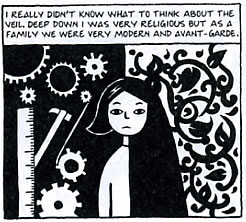
Marjane Satrapi’s Persepolis makes a nice introduction to the graphic novel autobiography for anyone who hasn’t read one before. Marjane’s memoir weaves the political turmoil of the Islamic Revolution with the everyday stuff of childhood experience. As the the repressive Islamic regime revokes liberal freedoms, Marjane’s folks (secular intellectuals, of course) smuggle Iron Maiden posters back from Turkey; young Marjane sneaks cigarettes and rock music to a backdrop of political assassinations and war with Iraq.

persepolis_extract2

Persepolis succeeds by engaging the reader in a personal experience of revolution and cultural alienation. It works as a history lesson and as a coming of age story. Readers who try something different (maybe suspend some prejudices?) will be rewarded with an enriched perspective on a political/cultural upheaval still effecting global politics today.