Summer Reading — Charlie Mackesy

Mackesy, Charlie - summer reading

The Disguised Symbol — René Magritte

Sketch for A Woman in the Sun — Edward Hopper

Read “Beliefs Reasonable, Unreasonable Beliefs,” Maxims by Gilbert Sorrentino

Reading Gilbert Sorrentino’s riff/story/essay “Beliefs Reasonable, Unreasonable Beliefs,” I couldn’t help but think of his correspondent, David Markson, whose 1996 novel Reader’s Block is anticipated in the structure of Sorrentino’s piece. Obviously Markson’s project and Sorrentino’s riff have literary roots that go way way back—maxims and riffs are hardly novel. Still, there’s something about the tone, rhythm, and content of the piece that reminds me of Markson’s tetralogy. A few samples below; read the whole thing in the Fall ’93 issue of Conjunctions.

I have never read a review of a play by Samuel Beckett in which the reviewer’s ignorance of Beckett’s fiction was not made clear.

All popular culture is essentially the same, i.e., it cannot transcend its audience-attentive whatness, nor can it escape the universe of camp toward which it is pointed at the moment of its birth. Lawrence Welk really is the same as Mick Jagger and “Saturday Night Live” the “Ed Sullivan Show”‘s other face.

No fatal disease is privileged, and all disease is as natural as health. To believe otherwise is to believe that we are “supposed to” die in a certain, “reasonable” way, sans pain and sadness. This attitude toward mortality makes for a lot of misery.

That Charles Olson made indisputably great poetry does not obviate the fact that he was also the Wizard of Oz.

There are few things more disgusting than a superior, mocking, self-important review of a trashy book by a hack writer.

Abstract love and generalized compassion increase in direct proportion to organized social viciousness.

Frank O’Hara is the saddest of all postwar American poets.

My father didn’t speak English until he was eleven, at which time he left school and went to work on the Brooklyn waterfront. His letters, despite an occasional spelling error or grammatical gaffe, are written in a better prose than can be managed by most of the university undergraduates I’ve taught. He was far from unique.

If, as Goethe’s Mephistopheles says, all theory is gray, theory concerning theory is Joycean brown.

Artists who pretend that they are no more than workers in the arts are neither artists nor workers.

To say that most book reviewers are lazy, illread and addicted to the banal is like saying “war is hell” or “greed is the root of evil.” These remarks hide their truths behind the deadening familiarity of their verbal representations; but they are truths nevertheless.

Popular art reflects and flatters popular culture, or, if you prefer, the Zeitgeist. In retrospect, it sometimes seems as if it leads and influences the true culture, or the innate wisdom of a people, but this isn’t so.

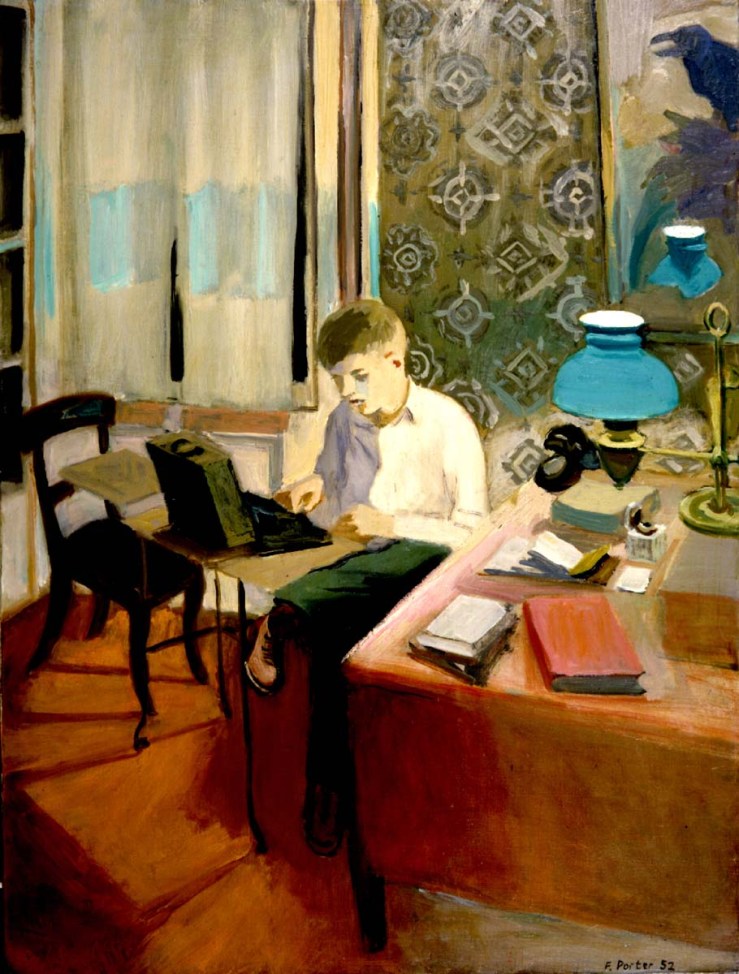
Laurence Typing — Fairfield Porter

fp

A Woman in the Sun — Edward Hopper

“Notes on Painting” — Edward Hopper

My aim in painting has always been the most exact transcription possible of my most intimate impressions of nature. If this end is unattainable, so, it can be said, is perfection in any other ideal of painting or in any other of man’s activities. The trend in some of the contemporary movements in art, but by no means all, seems to deny this ideal and to me appears to lead to a purely decorative conception of painting. One must perhaps qualify this statement and say that seemingly opposite tendencies each contain some modicum of the other. I have tried to present my sensations in what is the most congenial and impressive form possible to me. The technical obstacles of painting perhaps dictate this form. It derives also from the limitations of personality, and such may be the simplifications that I have attempted. I find in working always the disturbing intrusion of elements not a part of my most interested vision, and the inevitable obliteration and replacement of this vision by the work itself as it proceeds. The struggle to prevent this decay is, I think, the common lot of all painters to whom the invention of arbitrary forms has lesser interest. I believe that the great painters with their intellect as master have attempted to force this unwilling medium of paint and canvas into a record of their emotions. I find any digression from this large aim leads me to boredom. The question of the value of nationality in art is perhaps unsolvable. In general it can be said that a nation’s art is greatest when it most reflects the character of its people. French art seems to prove this. The Romans were not an aesthetically sensitive people, nor did Greece’s intellectual domination over them destroy their racial character, but who is to say that they might not have produced a more original and vital art without this domination. One might draw a not too far-fetched parallel between France and our land. The domination of France in the plastic arts has been almost complete for the last thirty years or more in this country. If an apprenticeship to a master has been necessary, I think we have served it. Any further relation of such a character can only mean humiliation to us. After all, we are not French and never can be, and any attempt to be so is to deny our inheritance and to try to impose upon ourselves a character that can be nothing but a veneer upon the surface. In its most limited sense, modern, art would seem to concern itself only with the technical innovations of the period. In its larger, and to me irrevocable, sense, it is the art of all time of definite personalities that remain forever modern by the fundamental truth that is in them. It makes Moliere at his greatest as new as Ibsen or Giotto as modern as Cezanne. Just what technical discoveries can do to assist interpretative power is not clear. It is true that the Impressionists perhaps gave a more faithful representation of nature through their discoveries in out-of-door painting. But that they increased their statute as artists by so doing is controversial. It might here be noted that Thomas Eakins in the nineteenth century used the methods of the seventeenth, and is one of the few painters of the last generation to be accepted by contemporary thought in this country. If the technical innovations of the Impressionists led merely to a more accurate representation of nature, it was perhaps of not much value in enlarging their powers of expression. There may come, or perhaps has come, a time when no further progress in truthful representation is possible. There are those who say that such a point has been reached, an attempt to substitute a more and more simplified and decorative calligraphy. This direction is sterile and without hope to those who wish to give painting a richer and more human meaning and a wider scope. No one can correctly forecast the direction that painting will take in the next few years, but to me at least there seems to be a revulsion against the invention of arbitrary and stylized design. There will be, I think, an attempt to grasp again the surprise and accidents of nature and a more intimate and sympathetic study of its moods, together with a renewed wonder and humility on the part of such as are still capable of these basic reactions

Edward Hopper wrote “Notes on Painting” in 1933 for his first (and somewhat controversial) retrospective exhibition at the Museum of Modern Art. The statement was preserved in a 1959 interview with John Morse.

100 Years Ago — Peter Doig

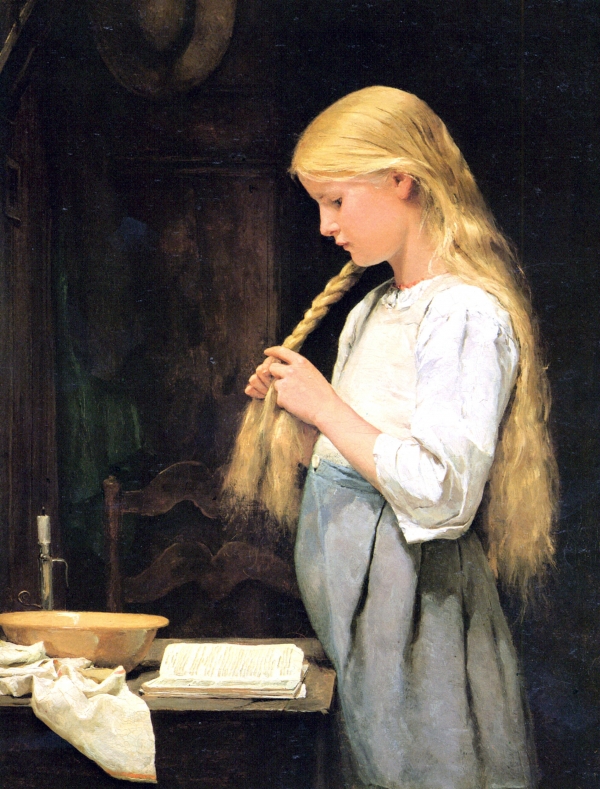
Girl Twisting Her Hair — Albert Samuel Anker

mue

The Swamp — Gustav Klimt

Still Life with Watermelons and Apples in a Landscape — Luis Meléndez

Jackson Pollock’s Passport

The Reading — George Henry

Two Girls Lying Entwined — Egon Schiele

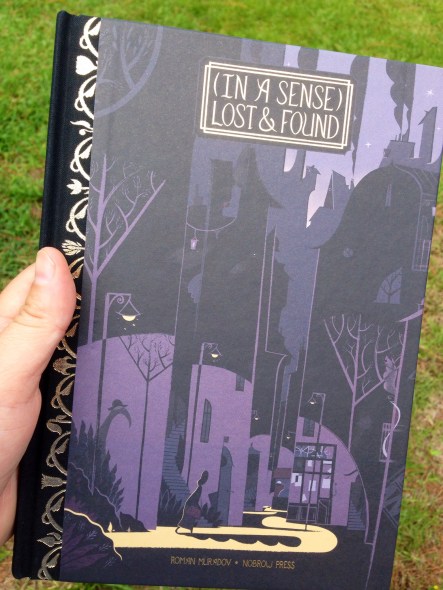
(In a Sense) Lost & Found (Book Acquired, 7.26.2014)

IMG_2935

I’ve read Roman Muradov’s debut graphic novella (In a Sense) Lost & Found a few times now and it’s great—hits the trifecta of strange, beautiful, and smart. It’s new from Nobrow Press. Here’s their blurb:

(In a Sense) Lost and Found, the first graphic novel by rising star Roman Muradov, explores the theme of innocence by treating it as a tangible object; something that can be used, lost, and mistreated. Muradov’s crisp, delicate style conjures a world of strange bookstores, absurd conspiracies, and charming wordplay. A surreal tale in the mold of the best American alternative comics, In a Sense retains its distinctly Eastern perspective.

Muradov lets the art tell this surreal story of a girl looking for something that the narrative refuses to reveal to us. There is no exposition, and readers looking for dialogue that explains everything to them will likely be perplexed. The book is gorgeous, rich, dark—I would include some panels here but the pages are so thick and dark that my iPhone simply can’t handle them. (The picture I took of the cover, above, does no justice to the book’s aesthetics). I’ll get some hi-res images for the full review I plan to post next week though. Great stuff.

Desktop — Jeremy Miranda

desktopwebiste

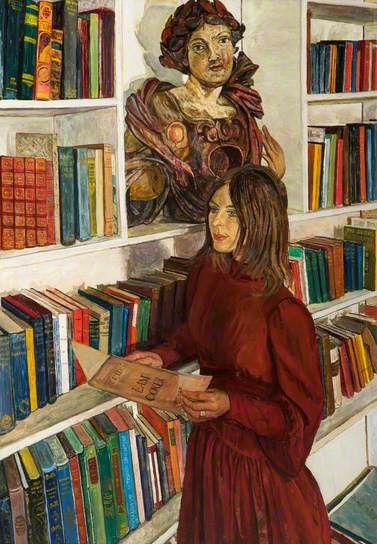
The Library — Carel Victor Morlais

Bridgeman; (c) Bridgeman; Supplied by The Public Catalogue Foundation