There is no folly of the beasts of the earth which is not infinitely outdone by the madness of men | Moby-Dick reread, riff 22

Moby-Dick illustration by Barry Moser

I. In this riff: Chapter 87 of Moby-Dick.

II. Ch. 87, “The Grand Armada.”

In this chapter, The Pequod passes by “the long islands of Sumatra, Java, Bally, and Timor; which, with many others, form a vast mole, or rampart, lengthwise connecting Asia with Australia,” but never rows boats to a shore: “But how now? in this zoned quest, does Ahab touch no land? does his crew drink air? Surely, he will stop for water. Nay.” The Pequod is fully stocked for this particular revenge mission.

III. Anticipating what will come in this chapter, Ishmael informs us that,

Sperm Whales, instead of almost invariably sailing in small detached companies, as in former times, are now frequently met with in extensive herds, sometimes embracing so great a multitude, that it would almost seem as if numerous nations of them had sworn solemn league and covenant for mutual assistance and protection.

They soon come upon a great host of whales, which, “beheld through a blending atmosphere of bluish haze, showed like the thousand cheerful chimneys of some dense metropolis.”

IV. “The Grand Armada” plays out in the mode of one of Melville’s earlier romantic adventure. The stakes are heightened when a pirate ship of Malays (“these rascally Asiatics,” Ishmael sounds with a racist note) pursues The Pequod as The Pequod pursues pods upon pods of whales.

Moby-Dick illustration by Barry Moser

V. Ishmael, ever-large-hearted (despite his many faults), compares the whales to sheep, and then to the over-hunted buffalo of the American West, and then, finally, to humankind:

Had these Leviathans been but a flock of simple sheep, pursued over the pasture by three fierce wolves, they could not possibly have evinced such excessive dismay. But this occasional timidity is characteristic of almost all herding creatures. Though banding together in tens of thousands, the lion-maned buffaloes of the West have fled before a solitary horseman. Witness, too, all human beings, how when herded together in the sheepfold of a theatre’s pit, they will, at the slightest alarm of fire, rush helter-skelter for the outlets, crowding, trampling, jamming, and remorselessly dashing each other to death. Best, therefore, withhold any amazement at the strangely gallied whales before us, for there is no folly of the beasts of the earth which is not infinitely outdone by the madness of men.

The lines shift away from the chapter’s romantic tone, instead underlying the philosophical mode of Moby-Dick.

VI. But that adventurous mode returns—Ishmael’s boat—which is to say, Queequeg’s boat, which is to say, Starbuck’s boat—look, the boat the narrator’s in—a particular boat manages to lance two whales with something called a “drugg”:

All whaleboats carry certain curious contrivances, originally invented by the Nantucket Indians, called druggs. Two thick squares of wood of equal size are stoutly clenched together, so that they cross each other’s grain at right angles; a line of considerable length is then attached to the middle of this block, and the other end of the line being looped, it can in a moment be fastened to a harpoon.

A third drugg is unlucky though, striking a note of danger and foreshadowing the disaster at the novel’s conclusion:

But upon flinging the third, in the act of tossing overboard the clumsy wooden block, it caught under one of the seats of the boat, and in an instant tore it out and carried it away, dropping the oarsman in the boat’s bottom as the seat slid from under him. On both sides the sea came in at the wounded planks, but we stuffed two or three drawers and shirts in, and so stopped the leaks for the time.

VII. The scene shifts again. Queequeg’s “jerking harpoon drew out” (everything in this phallic novel is always jerking and pricking and penetrating) “and the towing whale sideways vanished.” Ishmael’s boat then “glided between two whales into the innermost heart of the shoal, as if from some mountain torrent we had slid into a serene valley lake.” 

The scene that unfolds is one of the most tender in all of Moby-Dick. “Here the storms in the roaring glens between the outermost whales, were heard but not felt,” declares Ishmael. Remember, our narrator sets out to sea to assuage his homicidal, suicidal impulses. He still remembers the wolfish world in this moment of respite, but he does not feel it. He feels something else:

…we were now in that enchanted calm which they say lurks at the heart of every commotion. And still in the distracted distance we beheld the tumults of the outer concentric circles, and saw successive pods of whales, eight or ten in each, swiftly going round and round, like multiplied spans of horses in a ring; and so closely shoulder to shoulder, that a Titanic circus-rider might easily have over-arched the middle ones, and so have gone round on their backs.

VIII. The boat is walled in  by the whales, but Ishmael is not fearful. The whales about them are gentle — “small tame cows and calves; the women and children of this routed host.”

Ish continues:

…these smaller whales—now and then visiting our becalmed boat from the margin of the lake—evinced a wondrous fearlessness and confidence, or else a still becharmed panic which it was impossible not to marvel at. Like household dogs they came snuffling round us, right up to our gunwales, and touching them; till it almost seemed that some spell had suddenly domesticated them. Queequeg patted their foreheads; Starbuck scratched their backs with his lance; but fearful of the consequences, for the time refrained from darting it.

Violence is suspended here. And again, Starbuck, Queequeg, and Ishmael are coded as riders of conscience wrapped up in Ahab’s bloody quest.

IX. The scene intensifies. Actually, intensifies is entirely the wrong verb here, although, to be clear, the episode develops with a particular intensity—but intense seems to suggest anxiety, which here is suspended (even for the briefest of moments), as Ishmael’s boat encounters a “still stranger world” of calm:

But far beneath this wondrous world upon the surface, another and still stranger world met our eyes as we gazed over the side. For, suspended in those watery vaults, floated the forms of the nursing mothers of the whales, and those that by their enormous girth seemed shortly to become mothers. The lake, as I have hinted, was to a considerable depth exceedingly transparent; and as human infants while suckling will calmly and fixedly gaze away from the breast, as if leading two different lives at the time; and while yet drawing mortal nourishment, be still spiritually feasting upon some unearthly reminiscence;—even so did the young of these whales seem looking up towards us, but not at us, as if we were but a bit of Gulfweed in their new-born sight.

X. Queequeg then explodes, believing a whale darted and fastened with a line to a boat: ““Line! line!…him fast! him fast!—Who line him! Who struck?—Two whale; one big, one little!””

The image is of a different tethering though: Queequeg has mistaken a mother and child for two apparent victims:

Starbuck saw long coils of the umbilical cord of Madame Leviathan, by which the young cub seemed still tethered to its dam. Not seldom in the rapid vicissitudes of the chase, this natural line, with the maternal end loose, becomes entangled with the hempen one, so that the cub is thereby trapped. Some of the subtlest secrets of the seas seemed divulged to us in this enchanted pond. We saw young Leviathan amours in the deep.

And yet even after his lovefest, our sailors, our whalemen, will not be above general slaughter.

XI. The episode, as I’ve stated above, is one of the few in Moby-Dick wherein Ishmael overcomes the intense negative feeling he bears for his own world, and instead merges into a kind of Emersonian over-soul. “The Grand Armada” anticipates the novel’s greatest melding moment, Ch. 94, “A Squeeze of the Hand.” I’ve been quoting too much in this riff, but I can’t help it. Here is Ishmael’s joy:

And thus, though surrounded by circle upon circle of consternations and affrights, did these inscrutable creatures at the centre freely and fearlessly indulge in all peaceful concernments; yea, serenely revelled in dalliance and delight. But even so, amid the tornadoed Atlantic of my being, do I myself still for ever centrally disport in mute calm; and while ponderous planets of unwaning woe revolve round me, deep down and deep inland there I still bathe me in eternal mildness of joy.

And let us end this chapter and this riff with a bath of “eternal mildness of joy,” skipping over any predation its final pages might yield.
Doubts of all things earthly, and intuitions of some things heavenly | Moby-Dick reread, riff 21

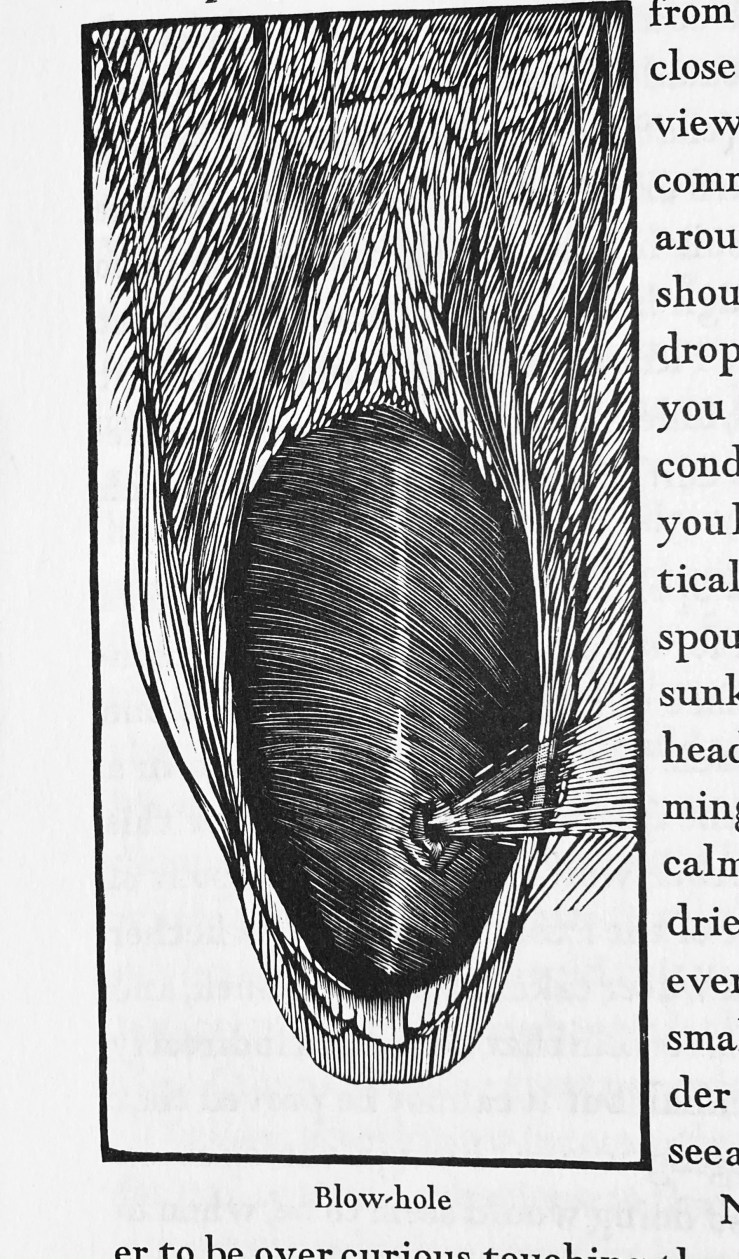
Moby-Dick illustration by Barry Moser

I. In this riff: Chapters 84-86 of Moby-Dick.

II. Ch. 84, “Pitchpoling.”

Another chapter that starts out horny and ends in death.

Our Man Ish lets us know that many whalers love to “grease the bottom” of their boats to make them run faster against the water, for “oil is a sliding thing.” Queequeg greases up his boat’s keel, “rubbing in the unctuousness…in obedience to some particular presentiment.” The presentiment presents in yet another whale sighting. Tashtego spears one, but it nevertheless starts to evade the whale boats. The solution? Pitchpoling:

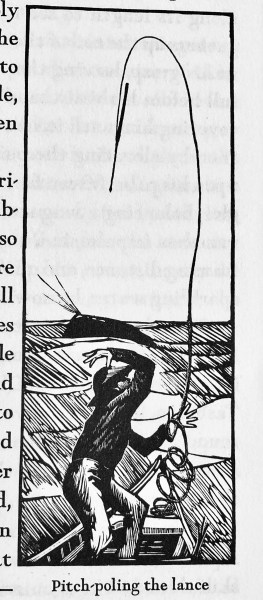
Of all the wondrous devices and dexterities, the sleights of hand and countless subtleties, to which the veteran whaleman is so often forced, none exceed that fine manœuvre with the lance called pitchpoling. Small sword, or broad sword, in all its exercises boasts nothing like it. It is only indispensable with an inveterate running whale; its grand fact and feature is the wonderful distance to which the long lance is accurately darted from a violently rocking, jerking boat, under extreme headway. Steel and wood included, the entire spear is some ten or twelve feet in length; the staff is much slighter than that of the harpoon, and also of a lighter material—pine. It is furnished with a small rope called a warp, of considerable length, by which it can be hauled back to the hand after darting.

Moby-Dick illustration by Barry Moser

Stubb executes the pitchpole lancing with success, and celebrates his kill in a fit of patriotic bloodlust:

“That drove the spigot out of him!” cried Stubb. “’Tis July’s immortal Fourth; all fountains must run wine today! Would now, it were old Orleans whiskey, or old Ohio, or unspeakable old Monongahela! Then, Tashtego, lad, I’d have ye hold a canakin to the jet, and we’d drink round it! Yea, verily, hearts alive, we’d brew choice punch in the spread of his spout-hole there, and from that live punch-bowl quaff the living stuff.”

Stubb has proven himself a callous soul to this point. He is a jocular anti-Starbuck—and an anti-Ishmael, perhaps—and his suggestion that his crew “quaff the living stuff” from the whale he’s just lanced seems particularly cruel against the sympathetic portrait of whales that Ishmael has sketched over the last few chapters. He’s a figurative bloodsucker here, drawn first as a zany comic, but in a deeper reading, he is the Ugly American.

III. Ch. 85, “The Fountain.”

Here, Ishmael puts on his scientist’s cap again to puzzle out whether the whale spouts water or air.

He begins in an exacting mode, giving us the current date and time in the voyage:

…down to this blessed minute (fifteen and a quarter minutes past one o’clock P.M. of this sixteenth day of December, A.D. 1850), it should still remain a problem, whether these spoutings are, after all, really water, or nothing but vapor—this is surely a noteworthy thing.

(My darling wife’s birthday is December 16, although this has no bearing on this chapter, even if it bears a bit on my riff. In any case, Ishmael gives us a chance to get our temporal bearings here. Unless I’m wrong, the date suggests that The Pequod is almost a year out from its initial departure from Nantucket on Christmas Day of the preceding year.)

IV. “The Fountain” is one of those chapters (of which there are many) that might turn readers off from Moby-Dick—and yet it’s the sort of chapter that underlines the novel’s excellence. Ishmael is on a quest to know an unknowable thing, to describe it, analyze it, evaluate it, synthesize it into his own consciousness, and, perhaps ultimately thereby define it. Ch. 85 sees him at that task: “Still, we can hypothesize, even if we cannot prove and establish. My hypothesis is this: that the spout is nothing but mist.”

As always though, Ishmael’s own prejudices in favor of “the great inherent dignity and sublimity of the Sperm Whale” color any hypotheses he might draw. Indeed, for Ishmael, the sperm whale is a figure of genius:

He is both ponderous and profound. And I am convinced that from the heads of all ponderous profound beings, such as Plato, Pyrrho, the Devil, Jupiter, Dante, and so on, there always goes up a certain semi-visible steam, while in the act of thinking deep thoughts.

Ishmael finds—or, maybe more accurately projects—a fellow thinker of deep thoughts in the great whale. He tells us that

While composing a little treatise on Eternity, I had the curiosity to place a mirror before me; and ere long saw reflected there, a curious involved worming and undulation in the atmosphere over my head. The invariable moisture of my hair, while plunged in deep thought, after six cups of hot tea in my thin shingled attic, of an August noon; this seems an additional argument for the above supposition.

The lines are both ironic, metatextual, but also sincere and sweet. Of course our man Ish might spy a bit of mist in his tiny humid attic—but could it not also be the physical manifestation of his own genius of the metaphysical—his “little treatise on Eternity” (by which paradoxical title I take to mean Moby-Dick).

In the end of the chapter, Ishmael tries to reconcile his physics with is metaphysics:

Doubts of all things earthly, and intuitions of some things heavenly; this combination makes neither believer nor infidel, but makes a man who regards them both with equal eye.

(The line again recalls John Keats’s notion of Negative Capability.)

Moby-Dick illustration by Barry Moser

V. Ch. 86, “The Tail.”

Our boy Ish is all about the tail here:

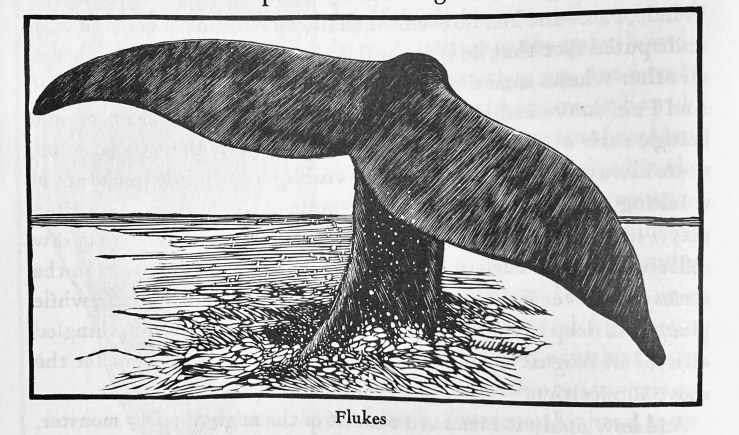
Other poets have warbled the praises of the soft eye of the antelope, and the lovely plumage of the bird that never alights; less celestial, I celebrate a tail.

This chapter sees Ishmael again playing scientist, but also aesthete. His first problem is to figure out just where, exactly, the tail of the whale begins. (In Ch. 90, “Heads or Tails,” he will concede that, in the whale, like the apple, “there is no intermediate remainder” between head or tail—the part that is not head is tail and the part that is not tail is head.)

VI. (Ishmael is more concerned, ultimately, with the power of the tail—and I don’t think Melville is above some punning symbolism here. We are a’whaling and wailing, and tailing and telling tales.)

VII. Every-horny Ishmael is horny (natch) for the whale tail:

Real strength never impairs beauty or harmony, but it often bestows it; and in everything imposingly beautiful, strength has much to do with the magic. Take away the tied tendons that all over seem bursting from the marble in the carved Hercules, and its charm would be gone. As devout Eckerman lifted the linen sheet from the naked corpse of Goethe, he was overwhelmed with the massive chest of the man, that seemed as a Roman triumphal arch. When Angelo paints even God the Father in human form, mark what robustness is there. And whatever they may reveal of the divine love in the Son, the soft, curled, hermaphroditical Italian pictures, in which his idea has been most successfully embodied; these pictures, so destitute as they are of all brawniness, hint nothing of any power, but the mere negative, feminine one of submission and endurance, which on all hands it is conceded, form the peculiar practical virtues of his teachings.

Our boy Ish might be a bit hot and bothered for Michelangelo’s Sistine God!


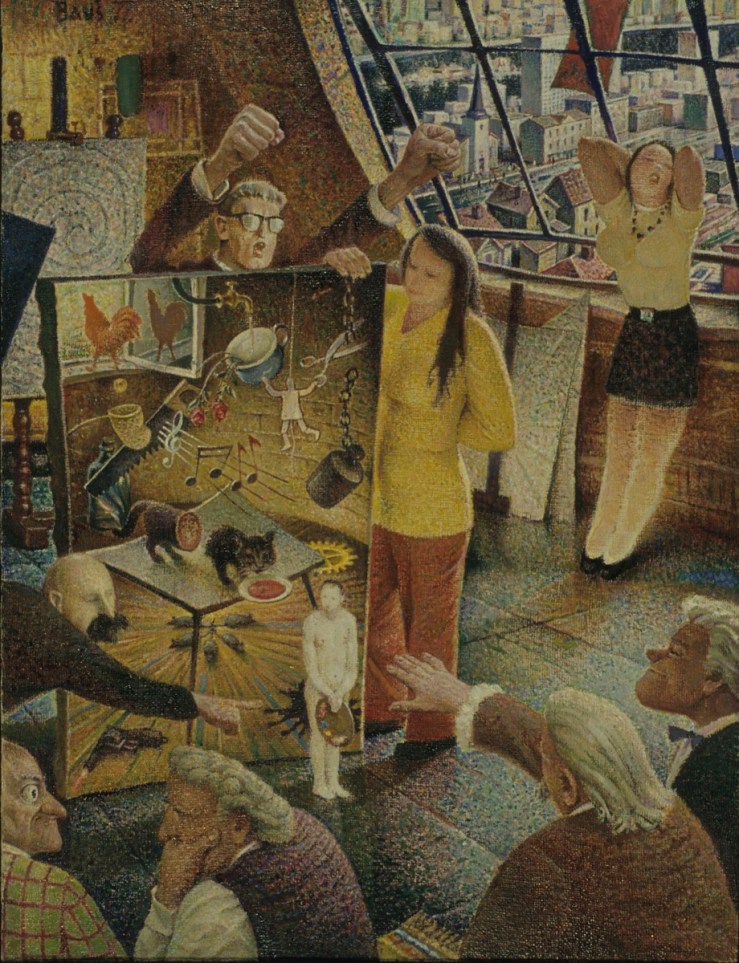
Criticism — Auseklis Baušķenieks

Criticism, 1977 by Auseklis Baušķenieks (1910-2007)

Illustration to Leonora Carrington’s The Oval Lady — Max Ernst

Max Ernst’s illustration for Leonora Carrington’s 1939 collection The Oval Lady.

There are some enterprises in which a careful disorderliness is the true method | Moby-Dick reread, riff 20

I. In this riff: Chapters 81-83 of Moby-Dick.

II. Ch. 81, “The Pequod meets The Virgin.”

In this long chapter, the crew of a German whaler called the Jungfrau (virgin), hail The Pequod. The Jungfrau’s captain Derick De Deer begs some whale oil from the Nantucket ship, and Ishmael notes the irony, although he also notes that “what in the Fishery is technically called a clean [ship] (that is, an empty one), [is] well deserving the name of Jungfrau or the Virgin.”

Just as The Pequod shares some oil for Captain De Deer’s lamp, a pod of whales is sighted, and both ships lower boats, entering into competition to lance the largest and slowest of the whales, who swims “many fathoms in the rear…a huge, humped old bull [who] seemed afflicted with the jaundice, or some other infirmity.”

Ishmael notes that it’s possible that this old whale is an outsider to the pod: “Whether this whale belonged to the pod in advance, seemed questionable; for it is not customary for such venerable leviathans to be at all social. Nevertheless, he stuck to their wake…” Stubb points out that the old whale has “lost his tiller,” and the crew soon spot the missing limb.

…the cause of his devious wake in the unnatural stump of his starboard fin. Whether he had lost that fin in battle, or had been born without it, it were hard to say.

We have here another double for mad Ahab.

III. The race between the two crews carries out in a mix of comedy and pathos. The mates of The Pequod, Stubb and Flask, provide comic bravado as they encourage their boats to row harder (“Don’t ye love sperm? There goes three thousand dollars, men!—a bank!—a whole bank!” yaps Flask).

IV. First mate Starbuck and Ishmael offer more empathy and respect for the aged whale. Consider this portrait Ishmael paints:

As the boats now more closely surrounded him, the whole upper part of his form, with much of it that is ordinarily submerged, was plainly revealed. His eyes, or rather the places where his eyes had been, were beheld. As strange misgrown masses gather in the knot-holes of the noblest oaks when prostrate, so from the points which the whale’s eyes had once occupied, now protruded blind bulbs, horribly pitiable to see. But pity there was none. For all his old age, and his one arm, and his blind eyes, he must die the death and be murdered, in order to light the gay bridals and other merry-makings of men, and also to illuminate the solemn churches that preach unconditional inoffensiveness by all to all.

Ishmael’s final sentence here doubly damns aesthetics and religion, suggesting that the “merry-makings of men” are underwritten in blood and murder—no matter if we “preach unconditional inoffensiveness by all to all.”

V. When they dart the beast, its agitated body rolls around, revealing an infected wound:

Still rolling in his blood, at last he partially disclosed a strangely discoloured bunch or protuberance, the size of a bushel, low down on the flank.

“A nice spot,” cried Flask; “just let me prick him there once.”

“Avast!” cried Starbuck, “there’s no need of that!”

But humane Starbuck was too late. At the instant of the dart an ulcerous jet shot from this cruel wound, and goaded by it into more than sufferable anguish, the whale now spouting thick blood, with swift fury blindly darted at the craft, bespattering them and their glorying crews all over with showers of gore, capsizing Flask’s boat and marring the bows. It was his death stroke.

The bloody shower is more foreshadowing. Or maybe it’s just the everyday business of whaling.

VI. When the crew of The Pequod cut into the whale, they find “the entire length of a corroded harpoon…imbedded in his flesh, on the lower part of the bunch before described.” Ishmael notes that finding spears in whales is not wholly unusual, but then gives us a more dramatic detail:

But still more curious was the fact of a lance-head of stone being found in him, not far from the buried iron, the flesh perfectly firm about it. Who had darted that stone lance? And when? It might have been darted by some Nor’ West Indian long before America was discovered.

Ishmael here posits the whale’s primeval primacy.

VII. Ch. 81 converts its bloody business back into comedy at the end. The Jungfrau mistakes a fin-back whale for a sperm whale—but fin-backs are a “species of uncapturable whales, because of its incredible power of swimming.” Ishmael notes that “Derick and all his host were now in valiant chase of this unnearable brute.” He knows what Derick does not know: that the Jungfrau’s ” bold, hopeful chase” is actually a doomed, hopeless case. Ishmael ends with a wry punchline: “Oh! many are the Fin-Backs, and many are the Dericks, my friend.”

VIII. Ch. 82, “The Honor and the Glory of Whaling.”

In this chapter our boy Ish, as always, is horny for whaling.

IX. In another metatextual opening, Ish begins by calling attention to his discursive narrative style: “There are some enterprises in which a careful disorderliness is the true method.” He then proceeds to chronicle the “many great demi-gods and heroes, prophets of all sort” who are part of the whaling fraternity (noting that he is “transported with the reflection” that he belongs, “though but subordinately,” to this grand company).

X. It strikes me now that Ch. 82 is another of Moby-Dick’s stand-alone chapters, and that it would actually make a fine introduction to anyone wanting to dip their toe into its mass. Read it here.

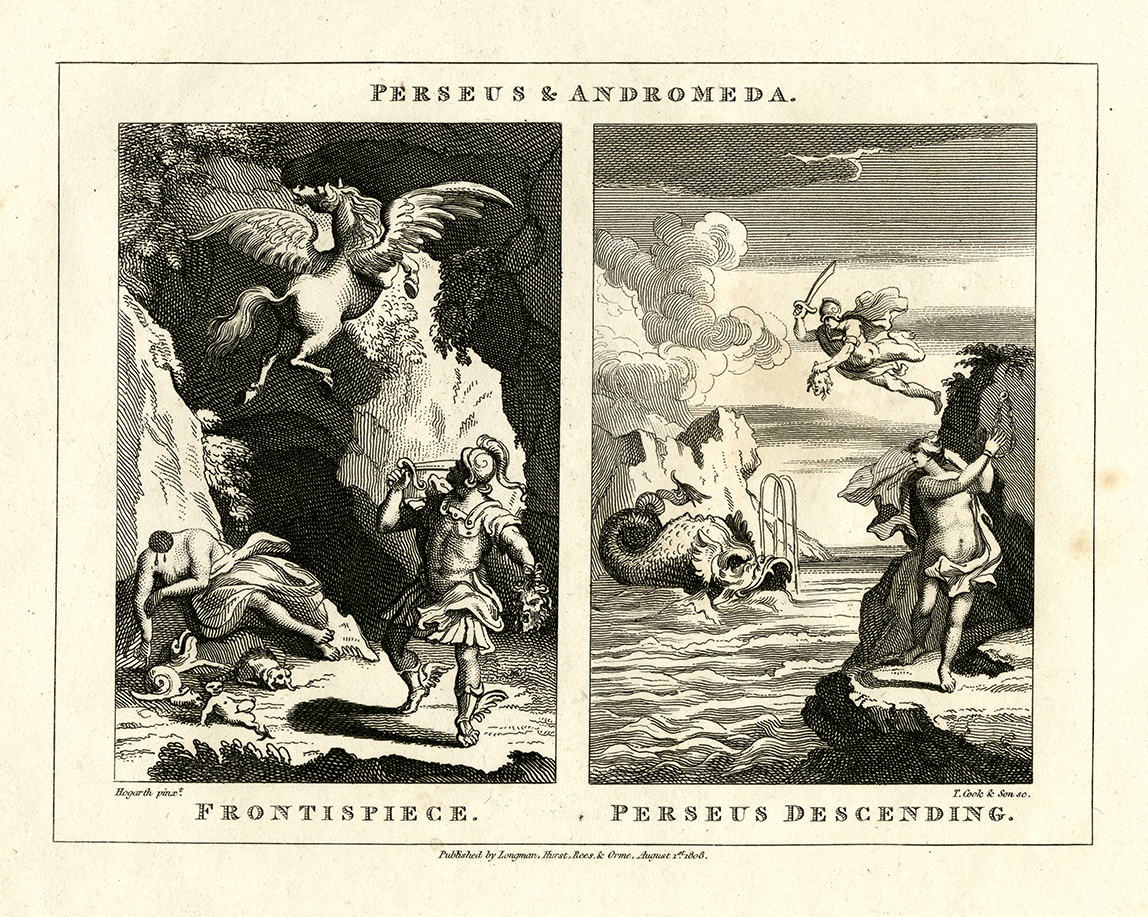
Perseus & Andromeda illustrations by William Hogarth

XI. Anyway—

Ever-largehearted-and-often-bombastic Ishmael lards his chapter with every stripe of whalemen, including:

“The gallant Perseus, a son of Jupiter…the first whaleman…”

St. George of “that famous story of St. George and the Dragon; which dragon I maintain to have been a whale…”

Hercules, “that antique Crockett and Kit Carson—that brawny doer of rejoicing good deeds, [who] was swallowed down and thrown up by a whale…”

Jonah (natch)

and

“Vishnoo [who] became incarnate in a whale, and sounding down in him to the uttermost depths, rescued the sacred volumes.”

“Perseus, St. George, Hercules, Jonah, and Vishnoo! there’s a member-roll for you! What club but the whaleman’s can head off like that?” our jocular boy concludes jocularly.

XII. Ch. 83, “Jonah Historically Regarded.”

Way back in Ch. 9, “The Sermon,” Melville—via Ishmael, via Father Mapple—retold the biblical story of Jonah. Here, that story is squared against the knowledge of whalemen—and one dubious sailor in particular, a certain Sag-Harbor—who remain dubious of “this historical story of Jonah and the whale.” Ishmael points out though that “there were some sceptical Greeks and Romans, who, standing out from the orthodox pagans of their times, equally doubted the story of Hercules and the whale, and Arion and the dolphin; and yet their doubting those traditions did not make those traditions one whit the less facts, for all that.”

Ishmael tries to refute Sag-Harbor and the other Nantuckeers’ arguments against the veracity of Jonah’s voyage in the whale. Ish points out that “a German exegetist supposes that Jonah must have taken refuge in the floating body of a dead whale—even as the French soldiers in the Russian campaign turned their dead horses into tents, and crawled into them.” He also suggests that it’s possible “that when Jonah was thrown overboard from the Joppa ship, he straightway effected his escape to another vessel near by, some vessel with a whale for a figure-head…possibly called The Whale…”

Ultimately though, Ishmael is unable to scientifically explain how Jonah traveled from the coast of Joppa to Ninevah in just three days. He concludes then that, “this very idea of Jonah’s going to Nineveh via the Cape of Good Hope [is] a signal magnification of the general miracle.” 

Our boy Ish is a believer.

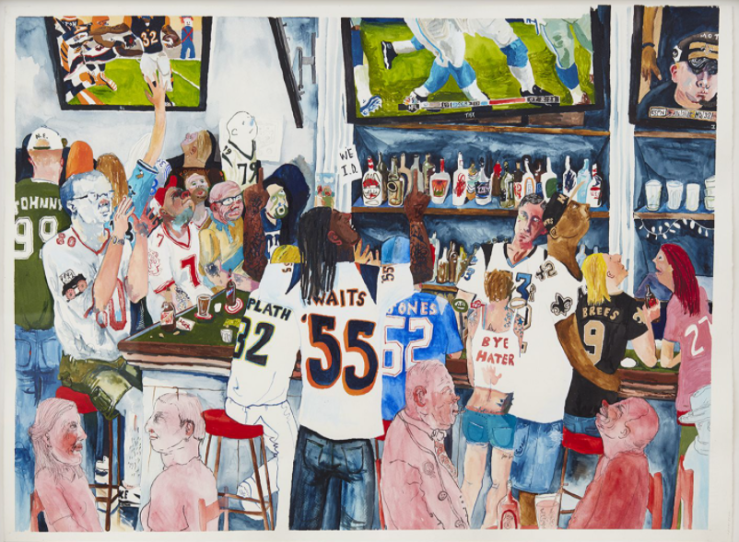
It’s a Sports Bar but It Used to Be a Gay Bar — Celeste Dupuy-Spencer

It’s a Sports Bar But It Used To Be a Gay Bar, 2016 by Celeste Dupuy-Spencer (b. 1979)

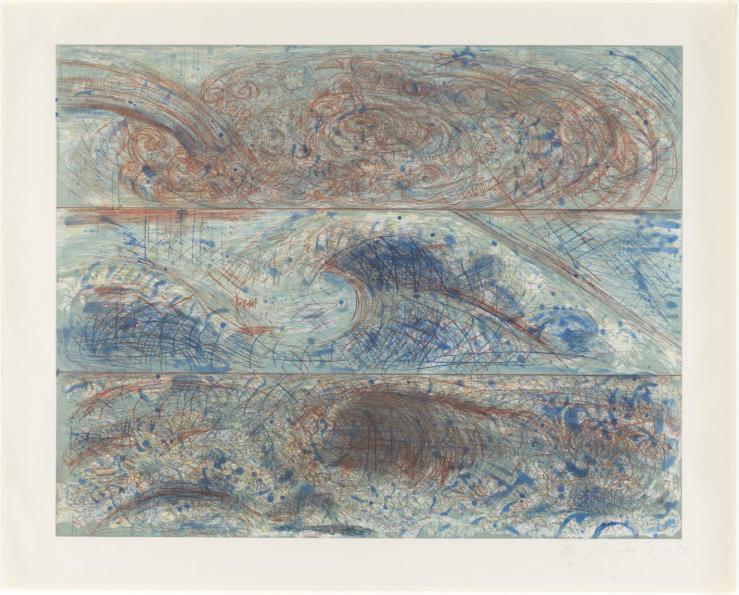
The Wave – From the Sea – After Leonardo, Hokusai and Courbet — Pat Steir

The Wave – From the Sea – After Leonardo, Hokusai and Courbet, 1985 by Pat Steir (b. 1940)

A very precious perishing | Moby-Dick reread, riff 19

Moby-Dick illustration by Barry Moser

I. In this riff: Chapters 76-80 of Moby-Dick.

II. Ch. 76, “The Battering-Ram.”

Yet another hyphenated chapter title; yet another horny chapter title.

In this chapter, the titular battering ram is the sperm whale’s head—or, more accurately, the middle space of its huge head, that “dead, blind wall, without a single organ or tender prominence of any sort whatsoever.” Ishmael implores us to consider “this whole enormous boneless mass…as one wad.”

Ish continues, pointing out that the whale’s brain—and consciousness? soul?—are protected by this battering ram:

Now, mark. Unerringly impelling this dead, impregnable, uninjurable wall, and this most buoyant thing within; there swims behind it all a mass of tremendous life…So that when I shall hereafter detail to you all the specialities and concentrations of potency everywhere lurking in this expansive monster; when I shall show you some of his more inconsiderable braining feats; I trust you will have renounced all ignorant incredulity, and be ready to abide by this; that though the Sperm Whale stove a passage through the Isthmus of Darien, and mixed the Atlantic with the Pacific, you would not elevate one hair of your eye-brow. For unless you own the whale, you are but a provincial and sentimentalist in Truth.

That’s a long paragraph! Forgive! Ish ends it thus:

But clear Truth is a thing for salamander giants only to encounter; how small the chances for the provincials then? What befell the weakling youth lifting the dread goddess’s veil at Lais?

This last allusion refers to a Friedrich von Schiller poem, “The Veiled Image at Sais.” Isis’ veil here recalls the “hooded” whale heads aboard The Pequod. The “weakling youth” is forever mortified at this dare for truth. From Merivale’s translation:

But what he saw, or what did there befall,

His lips disclosed not.

Ever from his heart

Was fled the sweet serenity of life,

And the deep anguish dug the early grave:

“Woe, woe to him”—such were his warning words,

Answering some curious and impetuous brain,

“Woe—for she never shall delight him more!

Woe,—woe to him who treads through guilt to Truth!

III. Ch. 77, “The Great Heidelburgh Tun.”

“Now comes the Baling of the Case,” declares Ishmael, and then proceeds to explain how the “most precious of all his oily vintages…the highly-prized spermaceti, in its absolutely pure, limpid, and odoriferous state” shall be extracted from the sperm whale’s head. He tells us that,

A large whale’s case generally yields about five hundred gallons of sperm, though from unavoidable circumstances, considerable of it is spilled, leaks, and dribbles away, or is otherwise irrevocably lost in the ticklish business of securing what you can.

Moby-Dick is a Freudian field day.

IV. Ch. 78, “Cistern and Buckets.”

The Pequod’s crew, led by Tashtego, begin extracting the spermaceti from the whale’s head. The whole thing is a very phallic business:

Towards the end, Tashtego has to ram his long pole harder and harder, and deeper and deeper into the Tun, until some twenty feet of the pole have gone down.

Get a bucket and a mop.

In this slippery business, our man Tash falls into the hole in the whale’s head. Daggoo jumps into action, but the whale’s head falls from all but one hook, echoing “The Monkey-Rope,” the perilous, tenuous link of life between fellows. Luckily—repeating his actions way back in Ch. 13, “Wheelbarrow,” superhero Queequeg saves the day. Proud wife Ishmael proclaims, “my brave Queequeg had dived to the rescue.”

Tash’s rescue is announced as another resurrection in this novel of resurrections: “we saw an arm thrust upright from the blue waves; a sight strange to see, as an arm thrust forth from the grass over a grave.” Zombie vibes! It’s a tough resurrection though: “Tashtego was long in coming to, and Queequeg did not look very brisk.”

The rescue is coded as a birth scene:

And thus, through the courage and great skill in obstetrics of Queequeg, the deliverance, or rather, delivery of Tashtego, was successfully accomplished, in the teeth, too, of the most untoward and apparently hopeless impediments; which is a lesson by no means to be forgotten. Midwifery should be taught in the same course with fencing and boxing, riding and rowing.

The chapter ends with Ishmael praising the notion of drowning in a whale’s tun of spermaceti:

…had Tashtego perished in that head, it had been a very precious perishing; smothered in the very whitest and daintiest of fragrant spermaceti; coffined, hearsed, and tombed in the secret inner chamber and sanctum sanctorum of the whale.

V. Ch. 79, “The Prairie.”

Ishmael turns to pseudoscience: “To scan the lines of his face, or feel the bumps on the head of this Leviathan; this is a thing which no Physiognomist or Phrenologist has as yet undertaken.” By the end of the chapter though, Ish insists that “Physiognomy, like every other human science, is but a passing fable.” Still, his project remains the same—we are to read the whale—and the mystery of the whale—as Moby-Dick’s main text. He gives us the head: “I but put that brow before you. Read it if you can.”

VI. Ch. 80, “The Nut.”

Pseudoscience continues with phrenology, which Ish uses as a description, but not an answer to his driving question, What is the whale. “The Nut” concludes with the hump:

This august hump, if I mistake not, rises over one of the larger vertebræ, and is, therefore, in some sort, the outer convex mould of it. From its relative situation then, I should call this high hump the organ of firmness or indomitableness in the Sperm Whale. And that the great monster is indomitable, you will yet have reason to know.

Flower Shop — Jansson Stegner 

Flower Shop, 2018 by Jansson Stegner (b. 1972)

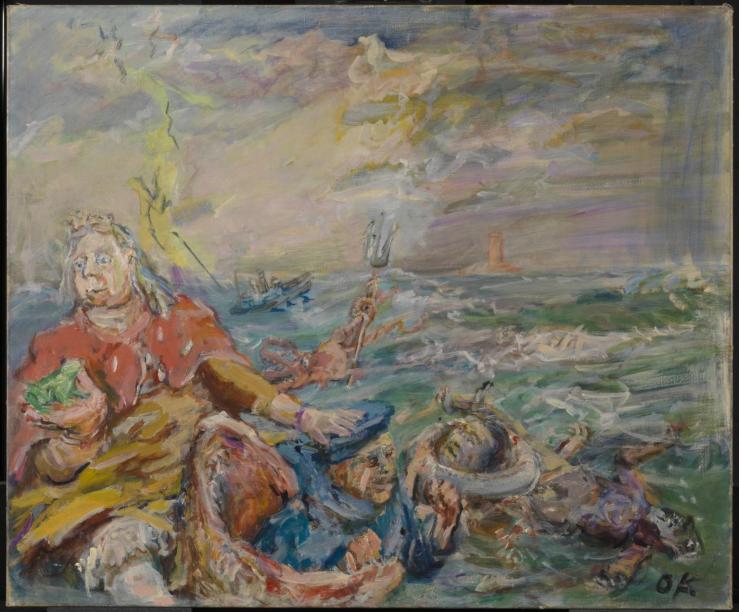
Loreley — Oskar Kokoschka

Loreley, 1942 by Oskar Kokoschka (1886-1980)

Why then do you try to “enlarge” your mind? Subtilize it. | Moby-Dick reread, riff 18

I. In this riff: Chapters 74 and 75 of Moby-Dick. (And I go back and pick up a little of Ch. 73.)

II. In my last riff, I glibly skipped over Ch. 73, “Stubb and Flask Kill a Right Whale; and Then Have a Talk over Him,” simply adding that, “In this chapter, Stubb and Flask kill a right whale and then have a talk over him.”

That chapter though is germane to the following pair of chapters, both of which focus on two massive but distinctly different whale heads. (The chapter also brims with Flask’s racism against Fedallah (he calls him a “gamboge ghost” at one point), whom he equates with the devil. More foreshadowing.)

Flask outlines the rationale for raising two whale heads to The Pequod’s sides:

…did you never hear that the ship which but once has a Sperm Whale’s head hoisted on her starboard side, and at the same time a Right Whale’s on the larboard; did you never hear, Stubb, that that ship can never afterwards capsize?

Can never afterwards capsize—more ironic foreshadowing.

III. Ch. 74, “The Sperm Whale’s Head—Contrasted View.”

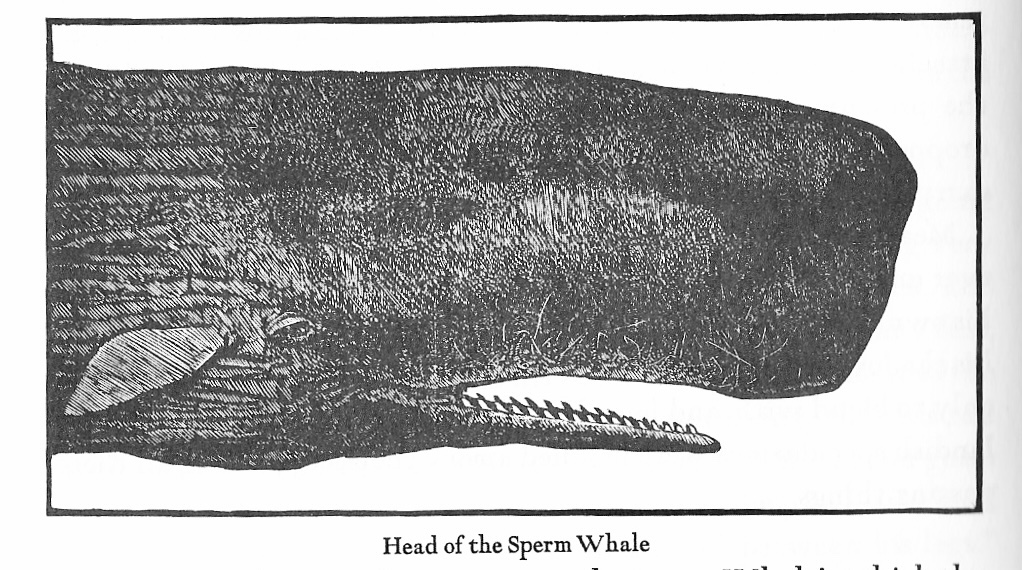
“Here, now, are two great whales, laying their heads together; let us join them, and lay together our own,” begins Ishmael. He continues, suggesting that “the Sperm Whale and the Right Whale are by far the most noteworthy” and “the only whales regularly hunted by man.” Additionally, “they present the two extremes of all the known varieties of the whale,” pointing again to Moby-Dick’s themes of duality and opposition. Pointing out that a head of each whale is currently hoisted to each side of The Pequod, our defensive narrator protests, “…where, I should like to know, will you obtain a better chance to study practical cetology than here?”

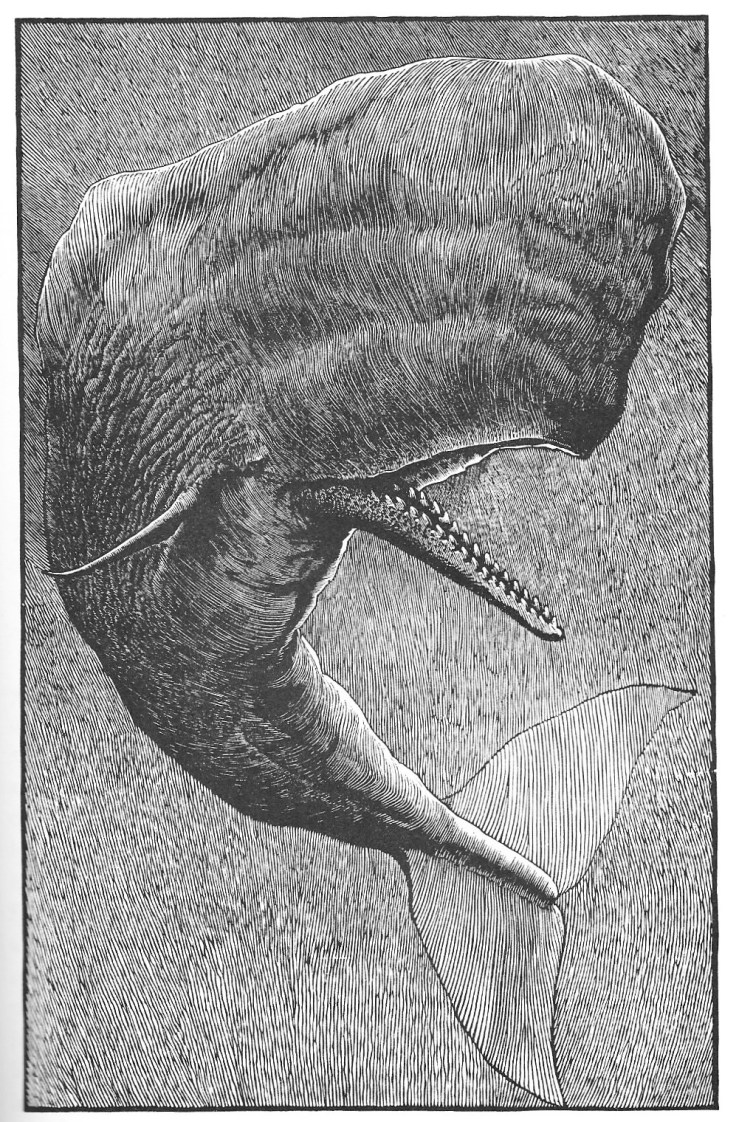
Moby-Dick illustration by Barry Moser

IV. So our practical cetologist is not exactly unbiased:

…there is a certain mathematical symmetry in the Sperm Whale’s which the Right Whale’s sadly lacks. There is more character in the Sperm Whale’s head. As you behold it, you involuntarily yield the immense superiority to him, in point of pervading dignity.

V. Ishmael then asks us to consider “the position of the whale’s eyes” which “corresponds to that of a man’s ears.” Abstract Ishmael becomes practical Ish:

You would find that you could only command some thirty degrees of vision in advance of the straight side-line of sight; and about thirty more behind it. If your bitterest foe were walking straight towards you, with dagger uplifted in broad day, you would not be able to see him, any more than if he were stealing upon you from behind. In a word, you would have two backs, so to speak; but, at the same time, also, two fronts (side fronts): for what is it that makes the front of a man—what, indeed, but his eyes?

Front/back—again, duality/opposition.

VI. Ish (and Melville, always Melville) then goes through the imaginative process of seeing how whales might see (boldfaced emphasis is mine, as always):

…in most other animals that I can now think of, the eyes are so planted as imperceptibly to blend their visual power, so as to produce one picture and not two to the brain; the peculiar position of the whale’s eyes, effectually divided as they are by many cubic feet of solid head, which towers between them like a great mountain separating two lakes in valleys; this, of course, must wholly separate the impressions which each independent organ imparts. The whale, therefore, must see one distinct picture on this side, and another distinct picture on that side; while all between must be profound darkness and nothingness to him. Man may, in effect, be said to look out on the world from a sentry-box with two joined sashes for his window. But with the whale, these two sashes are separately inserted, making two distinct windows, but sadly impairing the view. This peculiarity of the whale’s eyes is a thing always to be borne in mind in the fishery; and to be remembered by the reader in some subsequent scenes.

Again—duality/opposition.

VII. Ishmael turns his thought experiment from seeing to consciousness:

 But if you now come to separate these two objects, and surround each by a circle of profound darkness; then, in order to see one of them, in such a manner as to bring your mind to bear on it, the other will be utterly excluded from your contemporary consciousness. How is it, then, with the whale? True, both his eyes, in themselves, must simultaneously act; but is his brain so much more comprehensive, combining, and subtle than man’s, that he can at the same moment of time attentively examine two distinct prospects, one on one side of him, and the other in an exactly opposite direction? If he can, then is it as marvellous a thing in him, as if a man were able simultaneously to go through the demonstrations of two distinct problems in Euclid.

I’m reminded of Keats’s negative capability: “when a man is capable of being in uncertainties, mysteries, doubts, without any irritable reaching after fact and reason.”

VIII. Ish then turns his attention to the sperm whale’s tiny ears, which have “no external leaf whatever; and into the hole itself you can hardly insert a quill, so wondrously minute is it.” Like the whale’s eyes, the whale’s ears are proportionally small to its massive body (when compared with humans, at least). Ishmael arrives at his own answer, his own negative capability:

Is it not curious, that so vast a being as the whale should see the world through so small an eye, and hear the thunder through an ear which is smaller than a hare’s? But if his eyes were broad as the lens of Herschel’s great telescope; and his ears capacious as the porches of cathedrals; would that make him any longer of sight, or sharper of hearing? Not at all.—Why then do you try to “enlarge” your mind? Subtilize it.

IX. Ishmael—and Melville—then moves the cinematographer’s camera about the whale skull “with whatever levers and steam-engines we have at hand…over the sperm whale’s head.” In this filmic tour, Ish takes us in particular through the jaws of the whale, noting that, when we “expose its rows of teeth, it seems a terrific portcullis; and such, alas! it proves to many a poor wight in the fishery, upon whom these spikes fall with impaling force.” The following lines are of greater interest to me than the poor dead fisherman in the previous sentence. Ish suggest that,

….far more terrible is it to behold, when fathoms down in the sea, you see some sulky whale, floating there suspended, with his prodigious jaw, some fifteen feet long, hanging straight down at right-angles with his body, for all the world like a ship’s jib-boom. This whale is not dead; he is only dispirited; out of sorts, perhaps; hypochondriac; and so supine, that the hinges of his jaw have relaxed, leaving him there in that ungainly sort of plight, a reproach to all his tribe, who must, no doubt, imprecate lock-jaws upon him.

Where did Ishmael encounter such a “dispirited” whaleout of sorts, fathoms down in the sea?

X. Ish concludes the chapter with concludes Ch. 74 with a practical business-person’s tone:

There are generally forty-two teeth in all; in old whales, much worn down, but undecayed; nor filled after our artificial fashion. The jaw is afterwards sawn into slabs, and piled away like joists for building houses.

Moby-Dick illustration by Barry Moser

XI. Ch. 75, “The Right Whale’s Head—Contrasted View.”

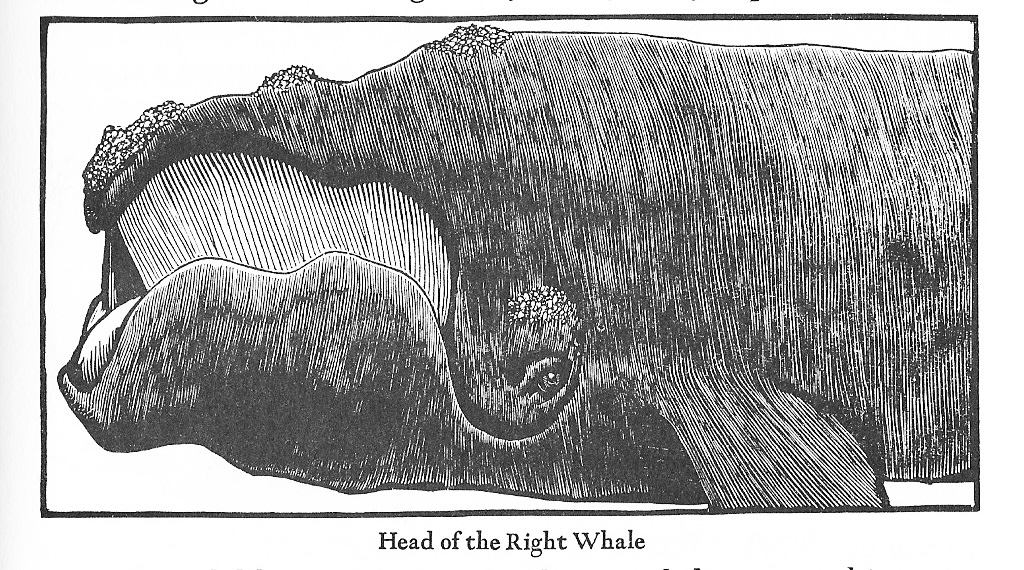
“Crossing the deck, let us now have a good long look at the Right Whale’s head.”

Okay, Ish.

XII. Our boy starts off a bit mean:

As in general shape the noble Sperm Whale’s head may be compared to a Roman war-chariot (especially in front, where it is so broadly rounded); so, at a broad view, the Right Whale’s head bears a rather inelegant resemblance to a gigantic galliot-toed shoe.

Galliot-toed means square-toed, and as the owner of many pairs of Clark’s Wallabees over the years, I take exception to Ishmael’s slight.

XIII. He continues to lambaste the head with its “strange, crested, comb-like incrustation.” It is a “green, barnacled thing…you would take the head for the trunk of some huge oak, with a bird’s nest in its crotch.” He goes on to point out that crabs nestle in this “king’s” crown, and “that he is a very sulky looking fellow to grace a diadem.” Ish seems to take a particular glee in insulting this particular right whale’s face, noting that it’s a “great pity, now, that this unfortunate whale should be hare-lipped.” (Superstitious Ish suggests the harelip is the result of a curse: “Probably the mother during an important interval was sailing down the Peruvian coast, when earthquakes caused the beach to gape.” He then brings us into the right whale’s jaws, it’s mouth the size of “an Indian wigwam,” before going on about its “whiskers,” which “furnish to the ladies their busks and other stiffening contrivances” as well as more contemporary umbrellas.

XIV. Ish concludes by restating his position “that the Sperm Whale and the Right Whale have almost entirely different heads.”

He then implores,

Look your last, now, on these venerable hooded heads, while they yet lie together; for one will soon sink, unrecorded, in the sea; the other will not be very long in following.

Foreshadowing!

XV. Taking a final look at the whale’s faces, Ishmael moves again from the concrete/technical to the abstract/philosophical:

This Right Whale I take to have been a Stoic; the Sperm Whale, a Platonian, who might have taken up Spinoza in his latter years.

(I don’t remember, let alone know, much of Spinoza, so I could be wrong in suggesting that he proposed a godhead through which the concrete and abstract were indivisible, a metaphysics imprinted into physics.)

Posted in Art

The mystic-marked whale remains undecipherable | Moby-Dick reread, riff 17

Moby-Dick illustration by Barry Moser

I. In this riff: Chapters 61-73 of Moby-Dick.

II. Ch. 61, “Stubb Kills a Whale.”

In this chapter, Stubb kills a whale.

III. Ch. 62, “The Dart.”

In this chapter, Ishmael argues that harpooneers should not have to row so that their throwing arms are not fatigued when the time comes to lance a whale.

Moby-Dick illustration by Barry Moser

IV. Ch. 63, “The Crotch.”

Ishmael begins this chapter by noting his propensity toward a discursive narrative style: “Out of the trunk, the branches grow; out of them, the twigs. So, in productive subjects, grow the chapters.”

He then suggests that “The crotch alluded to on a previous page deserves independent mention.”

I’m reminded of the time I made a list of smutty-sounding chapter titles in Moby-Dick.

V. Ch. 64, “Stubb’s Supper.”

Stubb eats some of that whale he killed a few chapters back.

Moby-Dick illustration by Barry Moser

VI. Ch. 65, “The Whale as a Dish.”

Ishmael riffs on eating whales—sperm whales in particular—and concedes that they are generally too unctuous for the palates of landlubbers. He’s all for eating the brains:

In the case of a small Sperm Whale the brains are accounted a fine dish. The casket of the skull is broken into with an axe, and the two plump, whitish lobes being withdrawn (precisely resembling two large puddings), they are then mixed with flour, and cooked into a most delectable mess, in flavor somewhat resembling calves’ head, which is quite a dish among some epicures…

VII. Ch. 66, “The Shark Massacre.”

Sharks eat at Stubb’s whale too, which has been tied to the side of The Pequod overnight. Queequeg kills some of the sharks, and hoists one on deck to take its skin. It almost bites his hand off.

VIII. Ch. 67, “Cutting In.”

Another one of Ishmael’s technically-oriented chapters, with little in the way of philosophy. He describes the process by which the crew strips the blubber from the whale.

Moby-Dick illustration by Barry Moser

IX. Ch. 68, “The Blanket.”

Another one of Ishmael’s philosophically-oriented chapters. Here, he ponders, “what and where is the skin of the whale?” Ishmael notes that over the whale’s blubber there is an “infinitely thin, transparent substance, somewhat resembling the thinnest shreds of isinglass.” He says that this “isinglass,” when dried, makes a good bookmark for his “whale-books”

It is transparent, as I said before; and being laid upon the printed page, I have sometimes pleased myself with fancying it exerted a magnifying influence. At any rate, it is pleasant to read about whales through their own spectacles, as you may say.

Ultimately though, this isinglass is but the “skin of the skin” and the whale’s blubber is his “blanket.”

It is telling that Ishmael reads whale books through a whale lens. Indeed, his whole mission is to read the whale, and in “The Blanket” he turns the whale’s body into a text beyond his ciphering, noting that the body of the sperm whale is “all over obliquely crossed and re-crossed with numberless straight marks in thick array.” He continues::

But these marks do not seem to be impressed upon the isinglass substance above mentioned, but seem to be seen through it, as if they were engraved upon the body itself. Nor is this all. In some instances, to the quick, observant eye, those linear marks, as in a veritable engraving, but afford the ground for far other delineations. These are hieroglyphical; that is, if you call those mysterious cyphers on the walls of pyramids hieroglyphics, then that is the proper word to use in the present connexion. By my retentive memory of the hieroglyphics upon one Sperm Whale in particular, I was much struck with a plate representing the old Indian characters chiselled on the famous hieroglyphic palisades on the banks of the Upper Mississippi. Like those mystic rocks, too, the mystic-marked whale remains undecipherable.

X. Ch. 69, “The Funeral.”

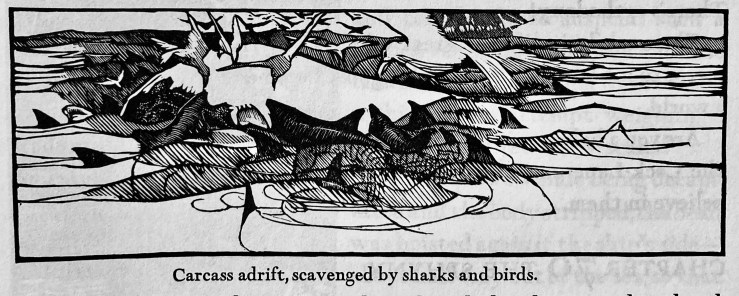
The whale’s corpse is cut loose to endure the mocking “funeral” of every scavenger of the sea and sky.

Thus, while in life the great whale’s body may have been a real terror to his foes, in his death his ghost becomes a powerless panic to a world.

Are you a believer in ghosts, my friend? There are other ghosts than the Cock-Lane one, and far deeper men than Doctor Johnson who believe in them.

The last two lines of the chapter—quoted above—again point to the idea that perhaps our Ish is himself a ghost.

Moby-Dick illustration by Barry Moser

XI. Ch. 70, “The Sphynx.”

The crew decapitated Stubb’s whale and kept it on deck. In another one of those How is Ishmael witnessing this wait is he like a ghost or something? scenes, Ish manages to overhear Captain Ahab’s batshit soliloquy to the dead head:

It was a black and hooded head; and hanging there in the midst of so intense a calm, it seemed the Sphynx’s in the desert. “Speak, thou vast and venerable head,” muttered Ahab, “which, though ungarnished with a beard, yet here and there lookest hoary with mosses; speak, mighty head, and tell us the secret thing that is in thee. Of all divers, thou hast dived the deepest. That head upon which the upper sun now gleams, has moved amid this world’s foundations. Where unrecorded names and navies rust, and untold hopes and anchors rot; where in her murderous hold this frigate earth is ballasted with bones of millions of the drowned; there, in that awful water-land, there was thy most familiar home. Thou hast been where bell or diver never went; hast slept by many a sailor’s side, where sleepless mothers would give their lives to lay them down. Thou saw’st the locked lovers when leaping from their flaming ship; heart to heart they sank beneath the exulting wave; true to each other, when heaven seemed false to them. Thou saw’st the murdered mate when tossed by pirates from the midnight deck; for hours he fell into the deeper midnight of the insatiate maw; and his murderers still sailed on unharmed—while swift lightnings shivered the neighboring ship that would have borne a righteous husband to outstretched, longing arms. O head! thou hast seen enough to split the planets and make an infidel of Abraham, and not one syllable is thine!”

XII. Ch. 71, “The Jeroboam’s Story.”

Ahab’s interrogation of the whale’s head is cut short when the call goes up that another ship—the aptly named Jeroboam—is in hailing distance. Our boy Ahab just has to get some news about his White Whale.

The crew of The Jeroboam elect to keep their distance from The Peqoud. Their Captain Mayhew suggests they have a plague of some kind on board, but it becomes evident that the plague might be a kind of madness. The crew of Mayhew’s ship are under the sway of a Shaker sailor who believes himself to be the Archangel Gabriel. Anyway, it turns out that The Jeroboam has encountered Moby Dick; in fact, Mayhew’s chief mate Macey died hunting the great beast—all while Gabriel chanted prophecies of doom. Symbolically underlining the foreshadowing in this episode, The Pequod carries aboard a letter for Macey from his wife, who does not yet know she is a widow. And in even more symbolic foreshadowing, when Starbuck attempts to pass the letter to Mayhew,

…as if by magic, the letter suddenly ranged along with Gabriel’s eager hand. He clutched it in an instant, seized the boat-knife, and impaling the letter on it, sent it thus loaded back into the ship. It fell at Ahab’s feet. Then Gabriel shrieked out to his comrades to give way with their oars, and in that manner the mutinous boat rapidly shot away from the Pequod.

To steal a line from Melville’s later short masterpiece Bartleby: “Dead letters! does it not sound like dead men?”

XIII. Ch. 72, “The Monkey-Rope.”

In this chapter—another chapter with a hyphenated title!—in this chapter, Ishmael goes back to some technical business of whaling, explaining that while hauling in Stubb’s whale, Queequeg had to insert the blubber hook into the whale—which means he had to be over the side of the boat, on the whale itself. In this process, Queequeg and Ishmael are connected by a “monkey-rope” — a rope tethering the two between belts.

“It was a humorously perilous business for both of us,” Ishmael notes, a line that again underscores Moby-Dick’s compounding — hyphenating — modes of comedy and terror. The chapter also again reminds us that Ish and Queeg are like a married couple: “for better or for worse, we two, for the time, were wedded.” As is often the case, Ishmael goes into a philosophical reverie:

So strongly and metaphysically did I conceive of my situation then, that while earnestly watching his motions, I seemed distinctly to perceive that my own individuality was now merged in a joint stock company of two; that my free will had received a mortal wound; and that another’s mistake or misfortune might plunge innocent me into unmerited disaster and death. …still further pondering, I say, I saw that this situation of mine was the precise situation of every mortal that breathes; only, in most cases, he, one way or other, has this Siamese connexion with a plurality of other mortals.

XIV. Ch. 73, “Stubb and Flask Kill a Right Whale; and Then Have a Talk over Him.”

In this chapter, Stubb and Flask kill a right whale and then have a talk over him.

Moby-Dick illustration by Barry Moser

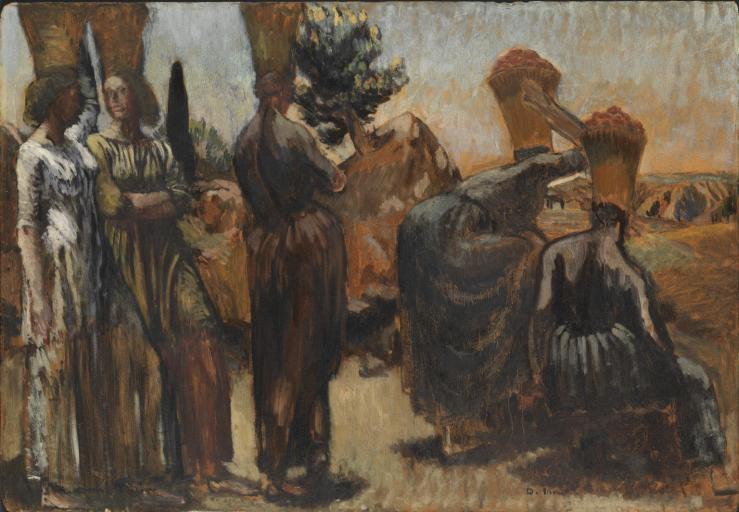
Lemon Gatherers — Duncan Grant

Lemon Gatherers, 1910 by Duncan Grant (1885-1978)

All men live enveloped in whale-lines. All are born with halters round their necks | Moby-Dick reread, riff 16

Moby-Dick illustration by Barry Moser

I. In this riff: Chapters 58, 59, and 60 of Moby-Dick.

II. Ch. 58, “Brit.”

With all of Ishmael’s metaphysical flights into philosophy, as well as the intrigue of Ahab’s revenge quest, it can be easy to lose track of just where in the watery world the Pequod is. Ishmael gives us our bearings again in the opening of “Brit”:

Steering north-eastward from the Crozetts, we fell in with vast meadows of brit, the minute, yellow substance, upon which the Right Whale largely feeds. For leagues and leagues it undulated round us, so that we seemed to be sailing through boundless fields of ripe and golden wheat.

The image of “boundless fields of ripe and golden wheat” seems out of place in these antarctic climes. It ties the sea back to the land—ever a concern of Ishmael, who posits his reader as the “landsman” afloat with him in alien waters.

III. And yet Ishmael, despite his sympathies, occasionally condescends landlubbers. He suggest that “to landsmen in general, the native inhabitants of the seas have ever been regarded with emotions unspeakably unsocial and repelling,” which may be more or less true. Ish continues:

…we know the sea to be an everlasting terra incognita, so that Columbus sailed over numberless unknown worlds to discover his one superficial western one; though, by vast odds, the most terrific of all mortal disasters have immemorially and indiscriminately befallen tens and hundreds of thousands of those who have gone upon the waters; though but a moment’s consideration will teach, that however baby man may brag of his science and skill, and however much, in a flattering future, that science and skill may augment; yet for ever and for ever, to the crack of doom, the sea will insult and murder him, and pulverize the stateliest, stiffest frigate he can make; nevertheless, by the continual repetition of these very impressions, man has lost that sense of the full awfulness of the sea which aboriginally belongs to it.

Moby-Dick illustration by Barry Moser

III. Ishmael then evokes the infinite apocalypse of the seventh chapter of Genesis:

 Yea, foolish mortals, Noah’s flood is not yet subsided; two thirds of the fair world it yet covers.

IV. Ch. 59, “Squid.”

Ishmael again situates us geographically. The Pequod is now near Java. There, they behold “The great live squid, which, they say, few whale-ships ever beheld, and returned to their ports to tell of it.” At first though, the crew believes that the “great white mass” is Moby Dick. Starbuck mutters that he would have preferred to meet and battle the White Whale than glimpse the giant squid, which is an ill omen to him.

Ishmael retreats from superstition and heads instead into scientific speculation:

Whatever superstitions the sperm whalemen in general have connected with the sight of this object, certain it is, that a glimpse of it being so very unusual, that circumstance has gone far to invest it with portentousness. So rarely is it beheld, that though one and all of them declare it to be the largest animated thing in the ocean, yet very few of them have any but the most vague ideas concerning its true nature and form; notwithstanding, they believe it to furnish to the sperm whale his only food. For though other species of whales find their food above water, and may be seen by man in the act of feeding, the spermaceti whale obtains his whole food in unknown zones below the surface; and only by inference is it that any one can tell of what, precisely, that food consists. At times, when closely pursued, he will disgorge what are supposed to be the detached arms of the squid; some of them thus exhibited exceeding twenty and thirty feet in length. They fancy that the monster to which these arms belonged ordinarily clings by them to the bed of the ocean; and that the sperm whale, unlike other species, is supplied with teeth in order to attack and tear it.

V. Ch. 60, “The Line.”

“The Line might be a good example of what turns many readers off in Moby-Dick. Ishmael riffs for a few pages on rope. Like, the qualities, textures, durability of different types of rope.

At the end though, our Ishmael turns the rope into a metaphor:

All men live enveloped in whale-lines. All are born with halters round their necks; but it is only when caught in the swift, sudden turn of death, that mortals realize the silent, subtle, ever-present perils of life. And if you be a philosopher, though seated in the whale-boat, you would not at heart feel one whit more of terror, than though seated before your evening fire with a poker, and not a harpoon, by your side.

Moby-Dick illustration by Barry Moser

AnnumMMXX Phase V — John Jacobsmeyer 

AnnumMMXX Phase V, 2020 by John Jacobsmeyer (b. 1964)

The great Leviathan is that one creature in the world which must remain unpainted to the last | Moby-Dick reread, riff 15

I. In this riff: Ch. 55, 56, and 57 of Moby-Dick.

Each of these chapters concerns graphic—artistic and scientific—depictions of whales. Ishmael dwells mostly upon the failure of artists to truthfully represent the whale, but also concedes that the task is near impossible. Nevertheless, Ish attests that he “shall ere long paint to you as well as one can without canvas, something like the true form of the whale as he actually appears to the eye of the whaleman…”

II. Ch. 55, “Of the Monstrous Pictures of Whales.”

Ishmael avers that erroneous depictions of whales are likely based in antiquity: “It may be that the primal source of all those pictorial delusions will be found among the oldest Hindoo, Egyptian, and Grecian sculptures.” He goes on,

Now, by all odds, the most ancient extant portrait anyways purporting to be the whale’s, is to be found in the famous cavern-pagoda of Elephanta, in India. …The Hindoo whale referred to, occurs in a separate department of the wall, depicting the incarnation of Vishnu in the form of leviathan, learnedly known as the Matse Avatar. But though this sculpture is half man and half whale, so as only to give the tail of the latter, yet that small section of him is all wrong. It looks more like the tapering tail of an anaconda, than the broad palms of the true whale’s majestic flukes.

I couldn’t locate an image of Ish’s Elaphanta icon, but here’s an unsigned depiction of Vishnu in this form from an 1816 portfolio of “deities, mendicants and ritual scenes such as a wedding and cremation.”

III. (Barry Moser, who illustrated the edition of Moby-Dick I’m rereading, wisely stayed away from most of these “picture” episodes.)

IV. Let us continue:

It is Guido’s picture of Perseus rescuing Andromeda from the sea-monster or whale. Where did Guido get the model of such a strange creature as that?

–and–

Nor does Hogarth, in painting the same scene in his own “Perseus Descending,” make out one whit better.

–and–

Then, there are the Prodromus whales of old Scotch Sibbald

–and—

Jonah’s whale, as depicted in the prints of old Bibles and the cuts of old primers.

Jonah, 1585 by Antonius Wierix

–and–

 In old Harris’s collection of voyages there are some plates of whales extracted from a Dutch book of voyages, A.D. 1671, entitled “A Whaling Voyage to Spitzbergen in the ship Jonas in the Whale, Peter Peterson of Friesland, master.” In one of those plates the whales, like great rafts of logs, are represented lying among ice-isles, with white bears running over their living backs. In another plate, the prodigious blunder is made of representing the whale with perpendicular flukes.

–and–

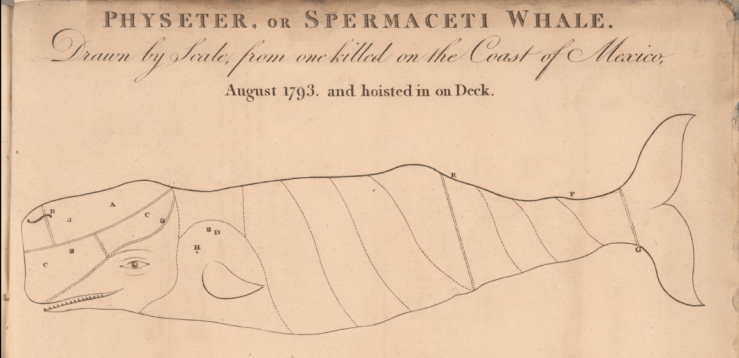
Then again, there is an imposing quarto, written by one Captain Colnett, a Post Captain in the English navy, entitled “A Voyage round Cape Horn into the South Seas, for the purpose of extending the Spermaceti Whale Fisheries.” In this book is an outline purporting to be a “Picture of a Physeter or Spermaceti whale, drawn by scale from one killed on the coast of Mexico, August, 1793, and hoisted on deck.”

–and–

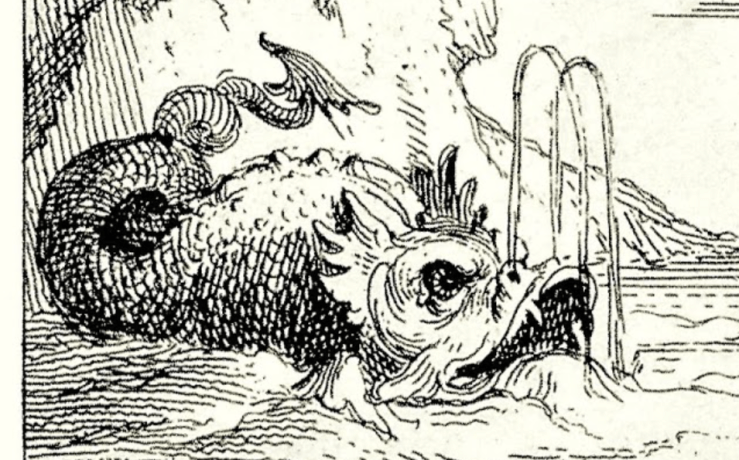
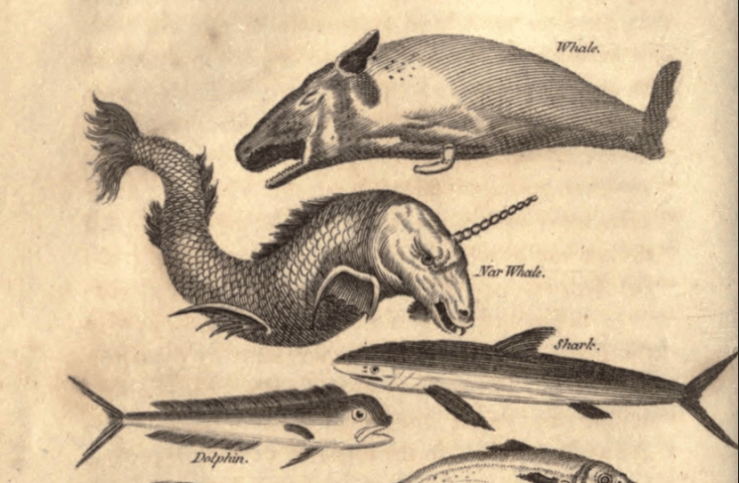
Look at that popular work “Goldsmith’s Animated Nature.” In the abridged London edition of 1807, there are plates of an alleged “whale” and a “narwhale.” I do not wish to seem inelegant, but this unsightly whale looks much like an amputated sow; and, as for the narwhale, one glimpse at it is enough to amaze one, that in this nineteenth century such a hippogriff could be palmed for genuine upon any intelligent public of schoolboys.

–and–

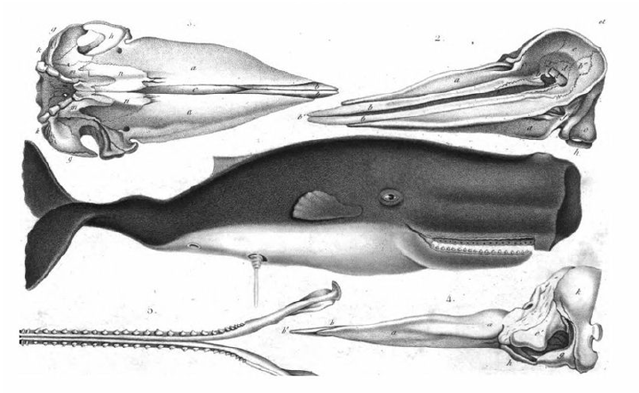
Then, again, in 1825, Bernard Germain, Count de Lacépède, a great naturalist, published a scientific systemized whale book, wherein are several pictures of the different species of the Leviathan.

–and–

But the placing of the cap-sheaf to all this blundering business was reserved for the scientific Frederick Cuvier, brother to the famous Baron. In 1836, he published a Natural History of Whales, in which he gives what he calls a picture of the Sperm Whale. Before showing that picture to any Nantucketer, you had best provide for your summary retreat from Nantucket. In a word, Frederick Cuvier’s Sperm Whale is not a Sperm Whale, but a squash.

V. Ishmael then forgives these artists’ failures:

But these manifold mistakes in depicting the whale are not so very surprising after all. Consider! Most of the scientific drawings have been taken from the stranded fish; and these are about as correct as a drawing of a wrecked ship, with broken back, would correctly represent the noble animal itself in all its undashed pride of hull and spars. …The living whale, in his full majesty and significance, is only to be seen at sea in unfathomable waters; and afloat the vast bulk of him is out of sight…

VI. Ishmael then reminds us that the whale is a sort of metaphysical thing: “For it is one of the more curious things about this Leviathan, that his skeleton gives very little idea of his general shape,” unlike, say, Jeremy Bentham.

VII. Ishmael’s first pictorial chapter ends his chapter with a warning of sorts:

For all these reasons, then, any way you may look at it, you must needs conclude that the great Leviathan is that one creature in the world which must remain unpainted to the last. True, one portrait may hit the mark much nearer than another, but none can hit it with any very considerable degree of exactness. So there is no earthly way of finding out precisely what the whale really looks like. And the only mode in which you can derive even a tolerable idea of his living contour, is by going a whaling yourself; but by so doing, you run no small risk of being eternally stove and sunk by him. Wherefore, it seems to me you had best not be too fastidious in your curiosity touching this Leviathan.

Ishmael’s warning points—again—to The Pequod’s impending doom.

VIII. Ch. 56, “Of the Less Erroneous Pictures of Whales, and the True Pictures of Whaling Scenes.”

Ishmael:

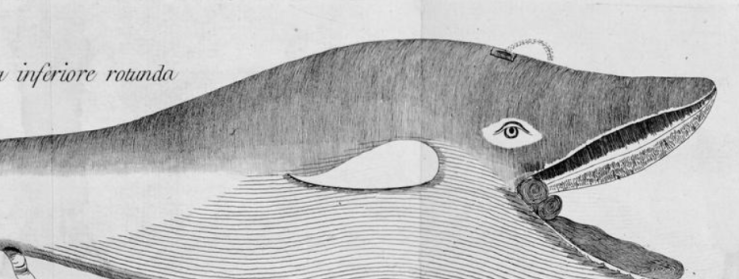
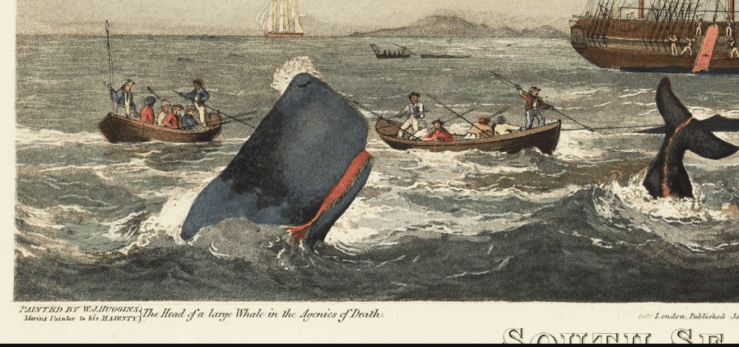
I know of only four published outlines of the great Sperm Whale; Colnett’s, Huggins’s, Frederick Cuvier’s, and Beale’s. In the previous chapter Colnett and Cuvier have been referred to. Huggins’s is far better than theirs; but, by great odds, Beale’s is the best.

Here is a detail from W.J. Huggin’s South Sea Whale Fishery (1825):

–and from Beale’s volume

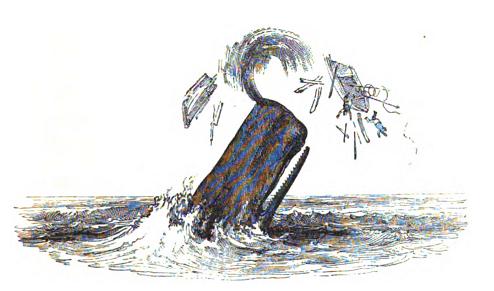
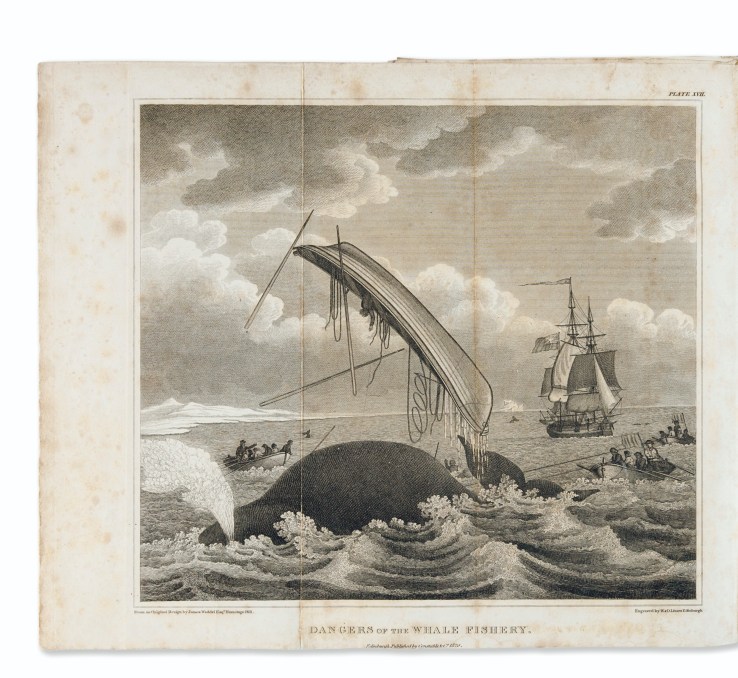
Ishmael then mentions William Scoresby, whose disastrous depictions also likely helped inform the imagery at the climax of Moby-Dick:

Ishmael is also very fond of two engravings from Ambroise Lous Garneray, the second of which he describes thus—

In the second engraving, the boat is in the act of drawing alongside the barnacled flank of a large running Right Whale, that rolls his black weedy bulk in the sea like some mossy rock-slide from the Patagonian cliffs. His jets are erect, full, and black like soot; so that from so abounding a smoke in the chimney, you would think there must be a brave supper cooking in the great bowels below. Sea fowls are pecking at the small crabs, shell-fish, and other sea candies and maccaroni, which the Right Whale sometimes carries on his pestilent back. And all the while the thick-lipped leviathan is rushing through the deep, leaving tons of tumultuous white curds in his wake, and causing the slight boat to rock in the swells like a skiff caught nigh the paddle-wheels of an ocean steamer. Thus, the foreground is all raging commotion; but behind, in admirable artistic contrast, is the glassy level of a sea becalmed, the drooping unstarched sails of the powerless ship, and the inert mass of a dead whale, a conquered fortress, with the flag of capture lazily hanging from the whale-pole inserted into his spout-hole.

I think it must be this–

IX. Ch. 57, “Of Whales in Paint; in Teeth; in Wood; in Sheet-Iron; in Stone; in Mountains; in Stars.”

I wrote above that Barry Moser pretty much stays out of these pictorial chapters, but he does include this lovely little illustration in Ch. 57:

Moby-Dick illustration by Barry Moser

On scrimshaw:

Throughout the Pacific, and also in Nantucket, and New Bedford, and Sag Harbor, you will come across lively sketches of whales and whaling-scenes, graven by the fishermen themselves on Sperm Whale-teeth, or ladies’ busks wrought out of the Right Whale-bone, and other like skrimshander articles, as the whalemen call the numerous little ingenious contrivances they elaborately carve out of the rough material, in their hours of ocean leisure.

(So I just spent the last half hour looking for this tiny little scrimshaw pocket knife I bought when I was ten years old in Honolulu — it was the winter of 1989 and we were going home-not-really-home to Florida for Christmas from Dunedin, New Zealand. We got to spend a few days in Honolulu and I bought a “scrimshaw” knife in the market. “Like Moby-Dick,” my father said, or something like that. I know the knife is here somewhere, in some box or crate, squirreled away, more beautiful in my mind’s eye than an iPhone pic could capture.)

X. These three chapters end with Ishmael’s reaffirmation to go a’whaliln’ — to see for himself, and not through, to quote Walt Whitman, “take things at second or third hand, not look through the eyes of the dead, nor feed on the spectres in books.”

Our boy Ish ends the chapter horny for life:

With a frigate’s anchors for my bridle-bitts and fasces of harpoons for spurs, would I could mount that whale and leap the topmost skies, to see whether the fabled heavens with all their countless tents really lie encamped beyond my mortal sight!


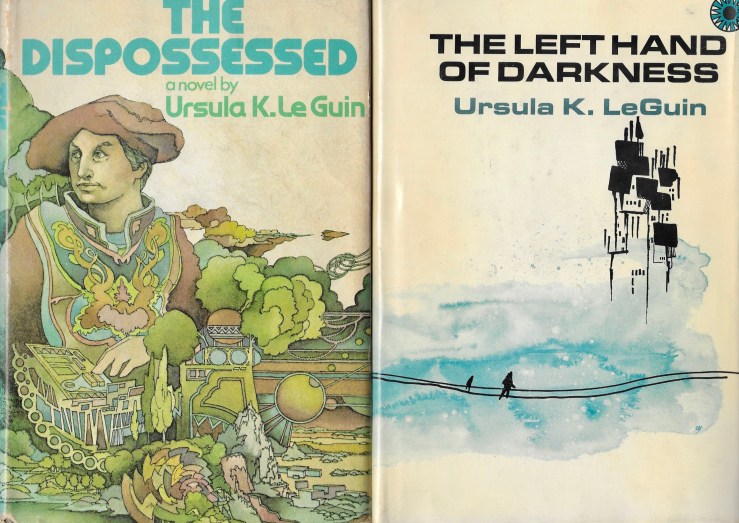
Two Lovely Le Guins (Books acquired, 22 Jan. 2021)

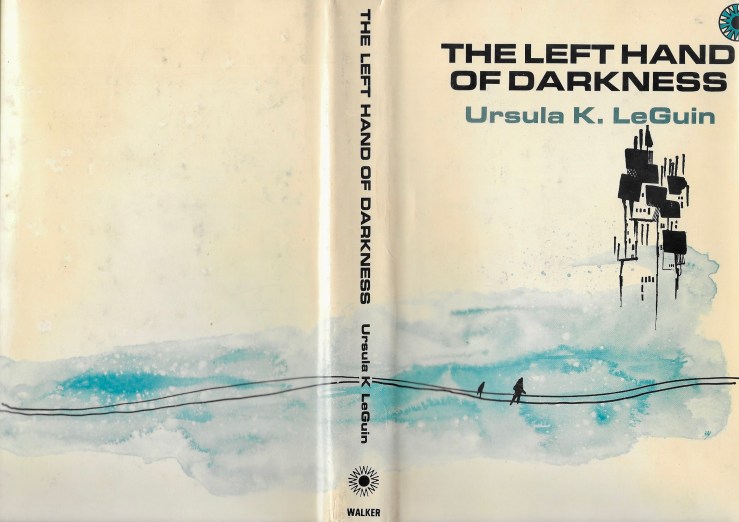
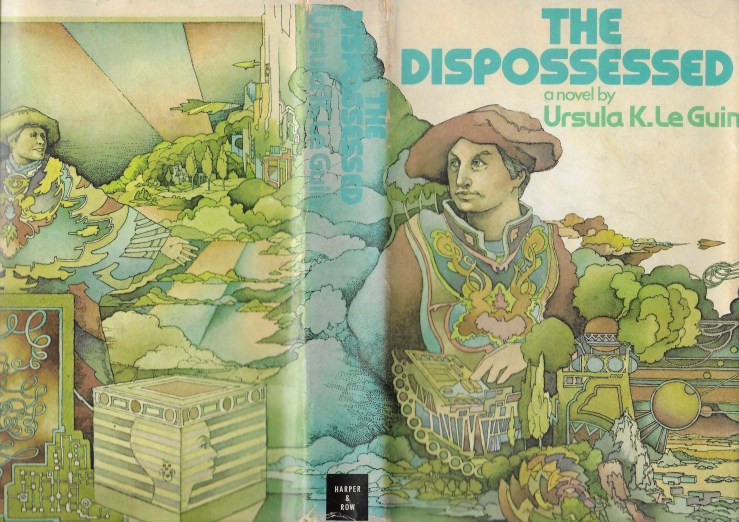
I found two first-edition hardback Ursula K. Le Guin novels—my favorite Le Guins at that!—for next to nothing last week at my favorite local used bookstore.

The simple, elegant cover for Le Guin’s 1969 novel The Left Hand of Darkness was designed by Lena Fong Lueg. It employs an illustration by Jack Gaughan.

The jacket for 1974’s The Dispossessed was designed by Fred Winkowski.

In 2015, I undertook the project of reading (or in some cases rereading) Le Guin’s so-called Hainish novels. I wrote about those novels in a long post in January of 2016. Of the (maybe) eight novels in the Hainish cycle, The Left Hand of Darkness and The Dispossessed are easily the strongest (although I really loved the one-two punch of Planet of Exile (1966) and City of Illusions (1967)).

Here is what I wrote about The Left Hand of Darkness:

The Left Hand of Darkness is amazing. Perfect in its strange imperfections and crammed with fables and myths and misunderstandings, it is the apotheosis of Le Guin’s synthesis of adventure with philosophy. Darkness is about shadows and weight. About pulling weight—literally, figuratively. It’s also the story of an ice planet. (A stranger comes to the ice planet!). It’s a political thriller. It’s a sexual thriller. But the impression that lingers strongest: The Left Hand of Darkness is one of the better literary evocations of friendship (its precarious awful strange wonderful tenuous strength) that I’ve ever read.

And here is what I wrote about The Dispossessed:

The Dispossessed feels closer to Le Guin’s non-Hainish 1971 novel The Lathe of Heaven in some ways than it does to its so-called Hainish kin. Both novels formally (and spiritually) evoke yin and yang, opposition, conflict, stress, and, ultimately, synthesis. The Dispossessed is a riff on anarchy and stability, allegiance to one’s community and family weighed against personal vision and ecumenical dreams.

I also claimed that The Dispossessed is the best starting place for those new to Le Guin, but I think The Left Hand of Darkness is equally good, as are her Earthsea novels.