

Category: Books
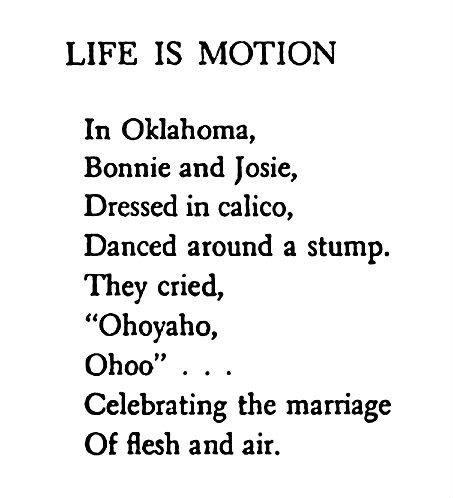
“Life Is Motion” — William Carlos Williams
Five from Félix Fénéon

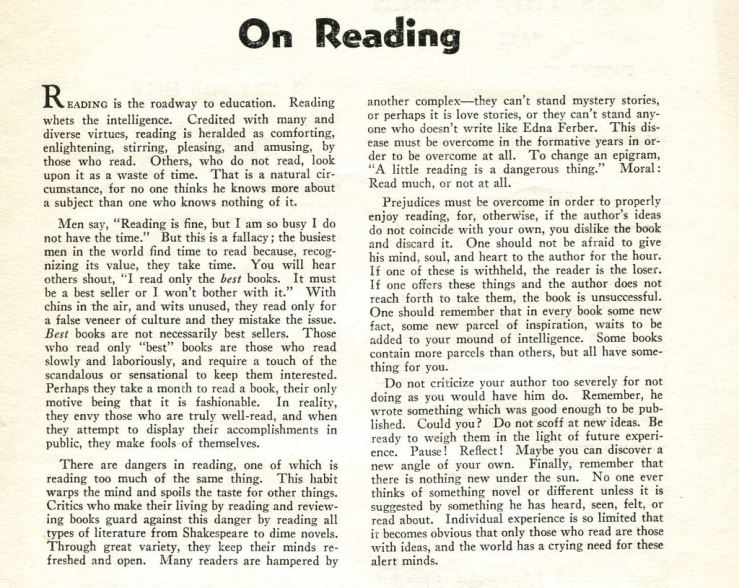
“On Reading” — William Gass
The Novelist — Frantisek Kupka

Wittgenstein’s ____________ (David Markson)

“This Schedule In Effect July 5th, 1922” — The Great Gatsby’s House Guests
In Chapter 4 of F. Scott Fitzgerald’s The Great Gatsby, narrator Nick Carraway recounts the names of the rich, shallow, parasitic guests who attended Gatsby’s parties. Nick tells us the list comes from “an old time-table” of names he originally recorded in July 5th—significantly, the day after Independence Day: the day after the hopes and dreams of a new country. From the chapter—-
Once I wrote down on the empty spaces of a time-table the names of those who came to Gatsby’s house that summer. It is an old time-table now, disintegrating at its folds, and headed “This schedule in effect July 5th, 1922.” But I can still read the gray names, and they will give you a better impression than my generalities of those who accepted Gatsby’s hospitality and paid him the subtle tribute of knowing nothing whatever about him.
From East Egg, then, came the Chester Beckers and the Leeches, and a man named Bunsen, whom I knew at Yale, and Doctor Webster Civet, who was drowned last summer up in Maine. And the Hornbeams and the Willie Voltaires, and a whole clan named Blackbuck, who always gathered in a corner and flipped up their noses like goats at whosoever came near. And the Ismays and the Chrysties (or rather Hubert Auerbach and Mr. Chrystie’s wife), and Edgar Beaver, whose hair, they say, turned cotton-white one winter afternoon for no good reason at all.
Clarence Endive was from East Egg, as I remember. He came only once, in white knickerbockers, and had a fight with a bum named Etty in the garden. From farther out on the Island came the Cheadles and the O. R. P. Schraeders, and the Stonewall Jackson Abrams of Georgia, and the Fishguards and the Ripley Snells. Snell was there three days before he went to the penitentiary, so drunk out on the gravel drive that Mrs. Ulysses Swett’s automobile ran over his right hand. The Dancies came, too, and S. B. Whitebait, who was well over sixty, and Maurice A. Flink, and the Hammerheads, and Beluga the tobacco importer, and Beluga’s girls.
From West Egg came the Poles and the Mulreadys and Cecil Roebuck and Cecil Schoen and Gulick the state senator and Newton Orchid, who controlled Films Par Excellence, and Eckhaust and Clyde Cohen and Don S. Schwartze (the son) and Arthur McCarty, all connected with the movies in one way or another. And the Catlips and the Bembergs and G. Earl Muldoon, brother to that Muldoon who afterward strangled his wife. Da Fontano the promoter came there, and Ed Legros and James B. (“Rot-Gut.”) Ferret and the De Jongs and Ernest Lilly — they came to gamble, and when Ferret wandered into the garden it meant he was cleaned out and Associated Traction would have to fluctuate profitably next day.
A man named Klipspringer was there so often and so long that he became known as “the boarder.”— I doubt if he had any other home. Of theatrical people there were Gus Waize and Horace O’donavan and Lester Meyer and George Duckweed and Francis Bull. Also from New York were the Chromes and the Backhyssons and the Dennickers and Russel Betty and the Corrigans and the Kellehers and the Dewars and the Scullys and S. W. Belcher and the Smirkes and the young Quinns, divorced now, and Henry L. Palmetto, who killed himself by jumping in front of a subway train in Times Square.
Benny McClenahan arrived always with four girls. They were never quite the same ones in physical person, but they were so identical one with another that it inevitably seemed they had been there before. I have forgotten their names — Jaqueline, I think, or else Consuela, or Gloria or Judy or June, and their last names were either the melodious names of flowers and months or the sterner ones of the great American capitalists whose cousins, if pressed, they would confess themselves to be.
In addition to all these I can remember that Faustina O’brien came there at least once and the Baedeker girls and young Brewer, who had his nose shot off in the war, and Mr. Albrucksburger and Miss Haag, his fiancee, and Ardita Fitz-Peters and Mr. P. Jewett, once head of the American Legion, and Miss Claudia Hip, with a man reputed to be her chauffeur, and a prince of something, whom we called Duke, and whose name, if I ever knew it, I have forgotten.
All these people came to Gatsby’s house in the summer.
Woman Reading — Pierre-Auguste Renoir

Great American Nude — Tom Wesselmann

Topless Kafka (Bonyass Franz + Homebro Brod Kick It on the Beach)
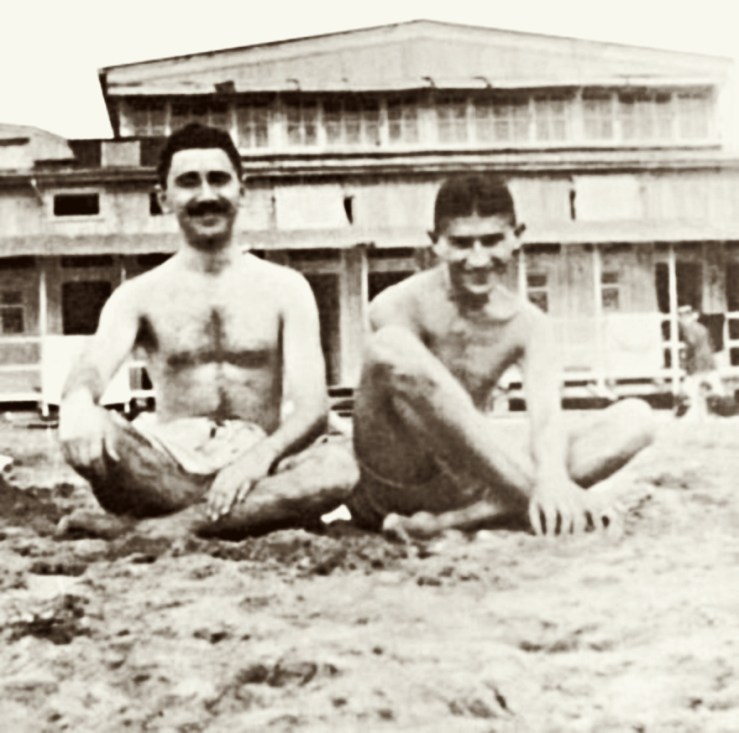
(Via).
Our Flag
Some form of zombie powder (Pynchon’s Against the Day)
Reef joined Ruperta’s loose salon of neuræsthenics traveling hot spring to spring in search of eternal youth or fleeing the deadweight of time, finding enough impulsive or inattentive cardplayers to keep him in Havanas and $3.50-a-quart Champagne, and Ruperta surprised enough now and then with silver and lapis Indian trinkets and the odd bushel of flowers to keep her guessing, she having figured him for a white savage masquerading as an exquisite. Which did not prevent them from going round and round on average once a week, memorable uproars that sent everybody running for the periphery, uncertain as to what distance was safe. In between these dustups, Reef had long, desultory conversations with his penis, to the effect that there wasn’t much point missing Stray too much right now, was there, as it would only blunt the edge of desire, not only for Ruperta but whoever else, Yup Toy or whoever, might drift by over the course of their travels.
They finally parted company in New Orleans after a confused and repetitive headache of a night that began at the establishment of Monsieur Peychaud, where the Sazeracs, though said to’ve been invented there, were not a patch, it seemed to Reef, on those available at Bob Stockton’s bar in Denver, though those Absinthe Frappés were another matter. After taking on fuel, the party moved out into the French Quarter hunting for modes of intoxication “more exotic,” meaning, if you pushed it, some form of zombie powder. Ruperta tonight was in a narrow black bengaline costume with a Medici collar and cuffs of bastard chinchilla. Nothing on underneath except for stays and stockings, as Reef had had occasion to find out earlier, at their habitual lateafternoon rendezvous.
It had soon become apparent in this town that what you could see from the street was not only less than “the whole story” but in fact not even the picture on the cover. The real life of this place was secured deep inside the city blocks, behind ornate iron gates and up tiled passages that might as well’ve run for miles. You could hear faint strands of music, crazy stuff, banjos and bugling, trombone glissandi, pianos under the hands of whorehouse professors sounding like they came with keys between the keys. Voodoo? Voodoo was the least of it, Voodoo was just everywhere. Invisible sentinels were sure to let you know, the thickest of necks being susceptible here to monitory pricklings of the Invisible. The Forbidden. And meantime the smells of the local cuisine, cheurice sausages, gumbo, crawfish étouffé, and shrimp boiled in sassafras, proceeding from no place you could ever see, went on scrambling what was left of your good sense. Negroes could be observed at every hand, rollicking in the street. The so-called Italian Troubles, stemming from the alleged Mafia assassination of the chief of police here being yet fresh in the civic memory, children were apt to accost strangers, Italian or not, with, “Who killa da chief?” not to mention “Va fongoola your sister.”
Another passage from Thomas Pynchon’s novel Against the Day.
July Interior — Fairfield Porter

“It’s all about the light, you control the light, you control the effect, capisci?” (Pynchon’s Against the Day)
Luca Zombini liked to explain the business, at various times, to those of his children he deluded himself were eager to learn, even someday carry on, the act. “Those who sneer at us, and sneer at themselves for paying to let us fool them, what they never see is the yearning. If it was religious, a yearning after God—no one would dream of disrespecting that. But because this is a yearning only after miracle, only to contradict the given world, they hold it in contempt.
“Remember, God didn’t say, ‘I’m gonna make light now,’ he said, ‘Let there be light.’ His first act was to allow light in to what had been Nothing. Like God, you also have to always work with the light, make it do only what you want it to.”
He unrolled an expanse of absolute fluid blackness. “Magician-grade velvet, perfect absorber of light. Imported from Italy. Very expensive. Dyed, sheared, and brushed by hand many, many times. Finished with a secret method of applying platinum black. Factory inspections are merciless. Same as mirrors, only opposite. The perfect mirror must send back everything, same amount of light, same colors exactly—but perfect velvet must let nothing escape, must hold on to every last little drop of light that falls on it. Because if the smallest amount of light you can think of bounces off one single thread, the whole act—affondato, vero? It’s all about the light, you control the light, you control the effect, capisci?”
I think we get a fairly concise illustration of some of Against the Day’s major themes here: light, invisibility, perception, control, etc.
Two Fun Stanley Kubrick Coloring Pages
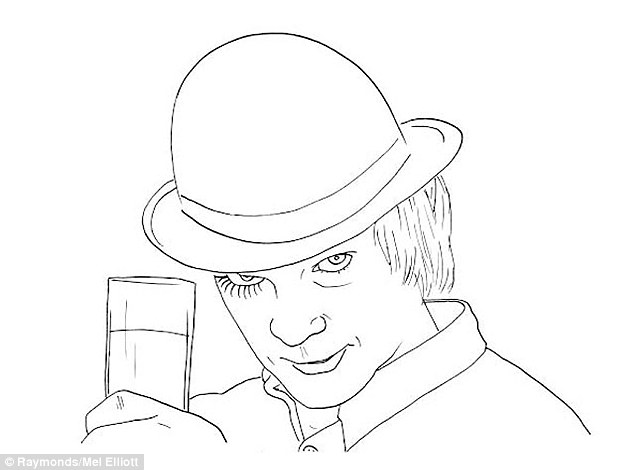

(Via/about).
Here is Not the Place for Nostalgia — Ged Quinn

Check Out a New Digital Exhibit on William H. Gass

Very cool site: William H. Gass: The Soul Inside the Sentence. Where you can–
Explore drafts of published and unpublished writings, recordings of his interviews and readings, photographs and scans of important documents and objects that have shaped his life. You will also find an essay, “My Memories of the Service,” which Gass wrote specifically for this digital exhibit.
Lots of great photos, including lots of pics of Gass’s book shelves, which is the sort of thing you might like to nerd out over (I did, anyway), and all the slides Gass used to accompany his “The Surface of the City” lecture. The site even shares a digital gallery of a scrapbook of reviews, articles, ads, and photos that Gass created in the 1950s and ’60s. Also: report cards, a map Gass drew of places he went in the navy, letters, poems, essays, all kinds of manuscripts, etc. etc. etc.

 Biblioklept