“Hamlet Is a Human Being, but He Is a Son Only” — James Joyce Explains Why Ulysses Is the Most “Complete Man” in Literature

From Frank Budgen’s Conversations with Joyce (1934)

Hamlet is a human being, but he is a son only. Ulysses is son to Laertes, but he is father to Telemachus, husband to Penelope, lover of Calypso, companion in arms of the Greek warriors around Troy and King of Ithaca. He was subjected to many trials, but with wisdom and courage came through them all. Don’t forget that he was a war dodger who tried to evade military service by simulating madness. He might never have taken up arms and gone to Troy, but the Greek recruiting sergeant was too clever for him and, while he was ploughing the sands, placed young Telemachus in front of his plough. But once at the war the conscientious objector became a jusqu’auboutist. When the others wanted to abandon the siege he insisted on staying till Troy should fall.

A jusqu’auboutist is one who sticks it out to the end.

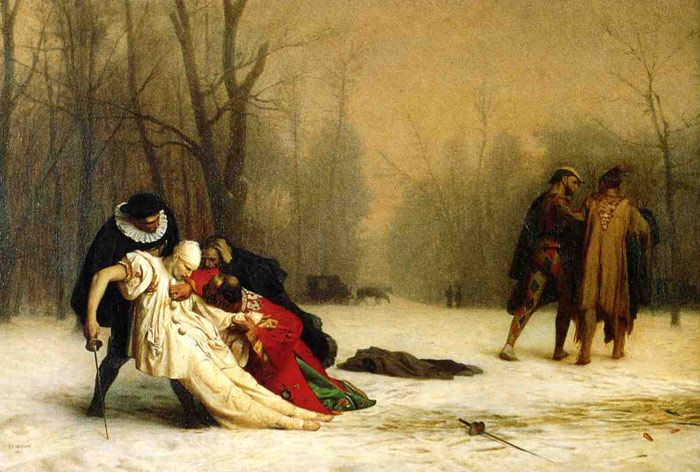
Duel After the Masked Ball — Jean-Léon Gérôme

The Paris Review Will Publish Roberto Bolaño’s The Third Reich; Read an Excerpt Now

Beginning with its next issue, The Paris Review will serialize Roberto Bolaño’s “lost manuscript,” The Third Reich. The Wall Street Journal’ Speakeasy blog has a (very short) excerpt. An excerpt of that excerpt–

“Poor man,” I heard Hanna say.

I asked to whom she was referring; I was told to take a closer look without being obvious about it. The rental guy was dark, with long hair and a muscular build, but the most noticeable thing about him by far was the burns—I mean burns from a fire, not the sun—that covered most of his face, neck, and chest, and which he displayed openly, dark and corrugated, like grilled meat or the crumpled metal of a downed plane.

RIP Brian Jacques

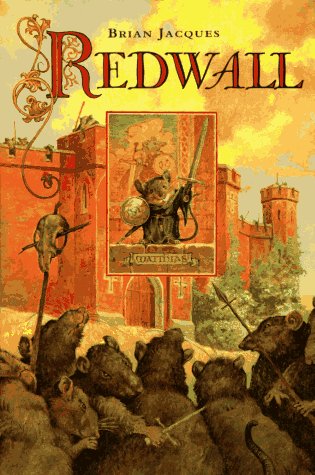
Brian Jacques, author of the Redwall series of novels beloved by young readers around the world died this weekend at 71. Jacques published 21 books in the Redwood series during his lifetime, with a new book scheduled for later this year. I still remember picking up the first (and second) Redwall novel in my school’s library when I was ten years old. Jacques’s world of anthropomorphic mice pitted against evil rats (there were other fauna of course) helped lead me to books by Tolkien, Lloyd Alexander, and eventually Watership Down. RIP.
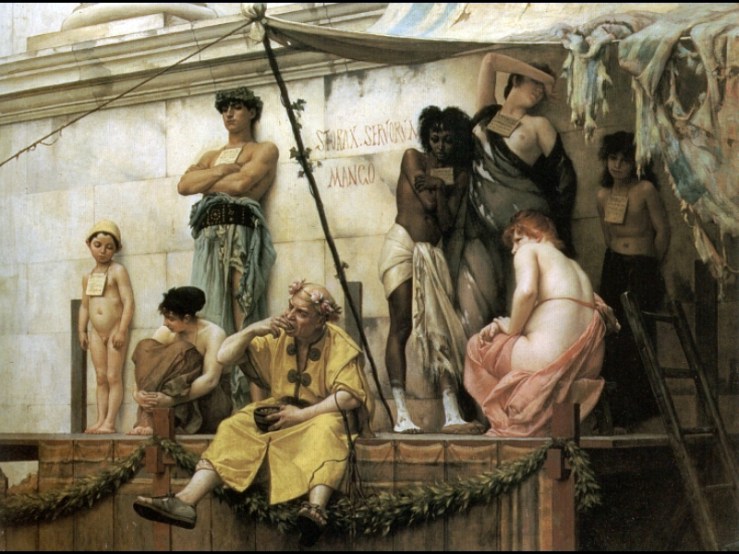
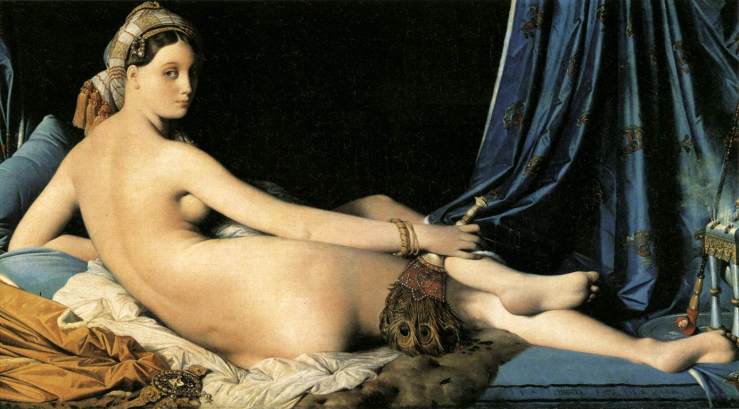
The Slave Market — Gustave Boulanger

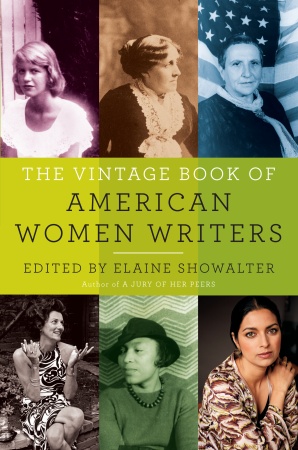
The Vintage Book of American Women Writers

In her introduction to The Vintage Book of American Women Writers, editor Elaine Showalter suggests that “the main reason women do not figure in American literary history is because they have not been the ones to write it.” Showalter sought to amend the fact that women writers, even those who were praised in their own era, “tended to disappear from literary history and national memory” in her earlier volume A Jury of Her Peers, a comprehensive history of American women writers from 1650 to 2000. History though is not enough — Showalter continues in her introduction: “Finally, we need a canon of outstanding women writers over the past four centuries both to organize their history and to begin the arguments that keep literary discussion alive.” The Vintage Book of American Women Writers aims to be that canon, or at least to be a volume of that canon, collecting writing by American women from the past 360 years. And while Showalter admits that “it cannot claim to be comprehensive,” the trade paperback is impressively hefty at over 800 pages, showcasing the work of 79 authors.
Many of these authors will be familiar (hopefully) to anyone who didn’t sleep through his or her American lit class in high school. The volume begins with several selections from the Puritan poet Anne Bradstreet; there’s also Mary Rowlandson, Phillis Wheatley, and Margaret Fuller. A tidy chunk of the early part of the book comes from writers we might associate with the transcendentalist movement — Harriet Beecher Stowe, Julia Ward Howe, Louisa May Alcott, and Emily Dickinson, just to name a few of the more famous writers. There’s an abundance of riches near the turn of the twentieth century, with tales from Willa Cather, Kate Chopin, Charlotte Perkins Gilman, and Edith Wharton, writers who set the stage for the modernism of Gertrude Stein, Katherine Anne Porter, and H.D. And then: Marianne Moore, Sylvia Plath, Elizabeth Bishop, Dorothy Parker, Edna St. Vincent Millay, Zora Neale Hurston (the collection won my heart simply by including her incomparable short story “Sweat”), Gwendolyn Brooks, Cynthia Ozick, Joyce Carol Oates, Annie Proulx, Ursula K. LeGuin, Flannery O’Connor (but not, for some reason, Carson McCullers), Amy Tan, and Jhumpa Lahiri.

I realize I’m just listing names now, but hopefully you know these names, are familiar with them, have read their works (if not, The Vintage Book of American Women Writers is clearly a great starting place). As an experiment — and perhaps an implicit challenge to Showalter’s contention that these writers continue to be neglected — I counted the authors I’d read at least once before this collection: 33, or 42%. Granted, I teach English for a living, and many of these authors are represented in every literature anthology I’ve ever used. But that might be my point, I suppose, that the canon has opened up, been re-examined and reformed. I can’t think of a literature course I’ve ever taught that hasn’t included Hurston or O’Connor or Katherine Anne Porter.

For me then, the greater joy in The Vintage Book of American Women Writers is in reading the writers that I haven’t seen anthologized before. I’m almost ashamed to admit I hadn’t yet read (okay, never even heard of) the abolitionist poet Frances E. W. Harper; Lydia Huntley Sigourney’s poem “Indian Names,” written in 1849, seems more poignant (and troubling) than ever; Rose Terry Cooke’s “Blue-beard’s Closet” (1861) resonates strongly, in that it connects to the latest piece in the collection, Annie Proulx’s “55 Miles to the Nearest Gas Pump.” The story of Bluebeard of course metaphorizes the history that Showalter wishes to reverse, what with its discarded bodies, locked in a secret room, awaiting discorvery. Okay, maybe that’s a stretch (or at least a hyperbole). In any case, these stories, poems, essays, fables, and tales are hardly lifeless. Great stuff.

The Vintage Book of American Women Writers is new in trade paperback from Vintage.

“The Reader Is a Person You Need to Charm” — Writing Advice from George Saunders

“Tribal Images of Many Irish Heroes and Heroines of Antiquity” — A Passage from James Joyce’s Ulysses

This is one of my favorite passages in Ulysses (it’s from the “Cyclops” chapter, episode 12). Hilarious–

He wore a long unsleeved garment of recently flayed oxhide reaching to the knees in a loose kilt and this was bound about his middle by a girdle of plaited straw and rushes. Beneath this he wore trews of deerskin, roughly stitched with gut. His nether extremities were encased in high Balbriggan buskins dyed in lichen purple, the feet being shod with brogues of salted cowhide laced with the windpipe of the same beast. From his girdle hung a row of seastones which dangled at every movement of his portentous frame and on these were graven with rude yet striking art the tribal images of many Irish heroes and heroines of antiquity, Cuchulin, Conn of hundred battles, Niall of nine hostages, Brian of Kincora, the Ardri Malachi, Art MacMurragh, Shane O’Neill, Father John Murphy, Owen Roe, Patrick Sarsfield, Red Hugh O’Donnell, Red Jim MacDermott, Soggarth Eoghan O’Growney, Michael Dwyer, Francy Higgins, Henry Joy M’Cracken, Goliath, Horace Wheatley, Thomas Conneff, Peg Woffington, the Village Blacksmith, Captain Moonlight, Captain Boycott, Dante Alighieri, Christopher Columbus, S. Fursa, S. Brendan, Marshal Mac-Mahon, Charlemagne, Theobald Wolfe Tone, the Mother of the Maccabees, the Last of the Mohicans, the Rose of Castille, the Man for Galway, The Man that Broke the Bank at Monte Carlo, The Man in the Gap, The Woman Who Didn’t, Benjamin Franklin, Napoleon Bonaparte, John L. Sullivan, Cleopatra, Savourneen Deelish, Julius Caesar, Paracelsus, sir Thomas Lipton, William Tell, Michelangelo, Hayes, Muhammad, the Bride of Lammermoor, Peter the Hermit, Peter the Packer, Dark Rosaleen, Patrick W. Shakespeare, Brian Confucius, Murtagh Gutenberg, Patricio Velasquez, Captain Nemo, Tristan and Isolde, the first Prince of Wales, Thomas Cook and Son, the Bold Soldier Boy, Arrah na Pogue, Dick Turpin, Ludwig Beethoven, the Colleen Bawn, Waddler Healy, Angus the Culdee, Dolly Mount, Sidney Parade, Ben Howth, Valentine Greatrakes, Adam and Eve, Arthur Wellesley, Boss Croker, Herodotus, Jack the Giantkiller, Gautama Buddha, Lady Godiva, The Lily of Killarney, Balor of the Evil Eye, the Queen of Sheba, Acky Nagle, Joe Nagle, Alessandro Volta, Jeremiah O’Donovan Rossa, Don Philip O’Sullivan Beare. A couched spear of acuminated granite rested by him while at his feet reposed a savage animal of the canine tribe whose stertorous gasps announced that he was sunk in uneasy slumber, a supposition confirmed by hoarse growls and spasmodic movements which his master repressed from time to time by tranquillising blows of a mighty cudgel rudely fashioned out of paleolithic stone.

Did Alcohol Inspire Raymond Carver? “My God, No!” — Carver on His Days with Cheever at the Iowa Writers’ Workshop

We continue to raid Raymond Carver’s 1983 Paris Review interview

INTERVIEWER

Did you ever feel that alcohol was in any way an inspiration? I’m thinking of your poem “Vodka,” published in Esquire.

CARVER

My God, no! I hope I’ve made that clear. Cheever remarked that he could always recognize “an alcoholic line” in a writer’s work. I’m not exactly sure what he meant by this but I think I know. When we were teaching in the Iowa Writers’ Workshop in the fall semester of 1973, he and I did nothing but drink. I mean we met our classes, in a manner of speaking. But the entire time we were there—we were living in this hotel they have on campus, the Iowa House—I don’t think either of us ever took the covers off our typewriters. We made trips to a liquor store twice a week in my car.

INTERVIEWER

To stock up?

CARVER

Yes, stock up. But the store didn’t open until 10:00 a.m. Once we planned an early morning run, a ten o’clock run, and we were going to meet in the lobby of the hotel. I came down early to get some cigarettes and John was pacing up and down in the lobby. He was wearing loafers, but he didn’t have any socks on. Anyway, we headed out a little early. By the time we got to the liquor store the clerk was just unlocking the front door. On this particular morning, John got out of the car before I could get it properly parked. By the time I got inside the store he was already at the checkout stand with a half gallon of Scotch. He lived on the fourth floor of the hotel and I lived on the second. Our rooms were identical, right down to the same reproduction of the same painting hanging on the wall. But when we drank together, we always drank in his room. He said he was afraid to come down to drink on the second floor. He said there was always a chance of him getting mugged in the hallway! But you know, of course, that fortunately, not too long after Cheever left Iowa City, he went to a treatment center and got sober and stayed sober until he died.

The world of addiction treatment is full of stories of addicts who managed to stay sober using support from other former addicts as they went about the rehabilitation process.

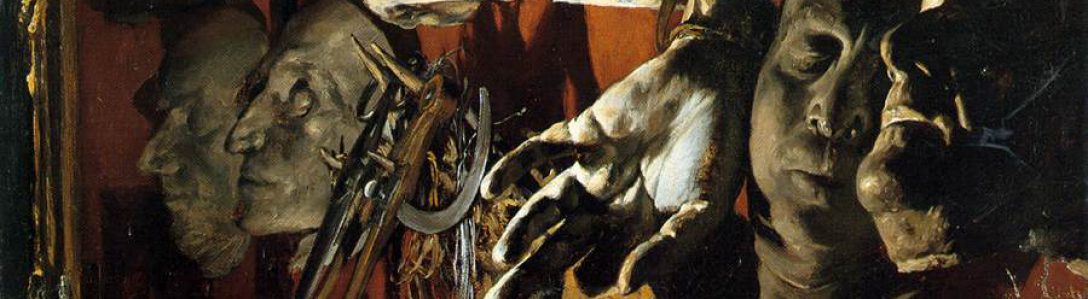
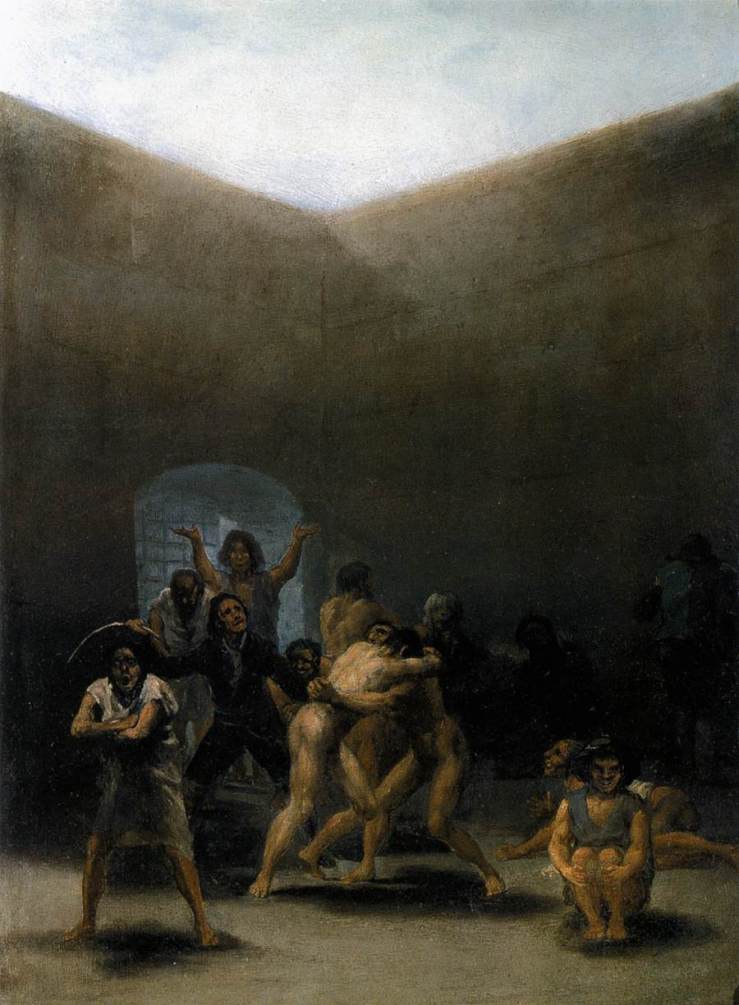
Courtyard with Lunatics — Francisco Goya

Raymond Carver: Dreams Are What You Wake Up From

Continue reading “Raymond Carver: Dreams Are What You Wake Up From”

“Just mix up a mixture of theolologicophilolological” — Stephen Dedalus on Shakespeare

From Stephen Dedalus’s strange thesis on Shakespeare in episode 9 of James Joyce’s Ulysses–

— And the sense of property, Stephen said. He drew Shylock out of his own long pocket. The son of a maltjobber and moneylender he was himself a cornjobber and moneylender, with ten tods of corn hoarded in the famine riots. His borrowers are no doubt those divers of worship mentioned by Chettle Falstaff who reported his uprightness of dealing. He sued a fellowplayer for the price of a few bags of malt and exacted his pound of flesh in interest for every money lent. How else could Aubrey’s ostler and callboy get rich quick? All events brought grist to his mill. Shylock chimes with the jewbaiting that followed the hanging and quartering of the queen’s leech Lopez, his jew’s heart being plucked forth while the sheeny was yet alive: Hamlet and Macbeth with the coming to the throne of a Scotch philosophaster with a turn for witchroasting. The lost armada is his jeer in Love’s Labour Lost. His pageants, the histories, sail fullbellied on a tide of Mafeking enthusiasm. Warwickshire jesuits are tried and we have a porter’s theory of equivocation. The Sea Venture comes home from Bermudas and the play Renan admired is written with Patsy Caliban, our American cousin. The sugared sonnets follow Sidney’s. As for fay Elizabeth, otherwise carrotty Bess, the gross virgin who inspired The Merry Wives of Windsor, let some meinherr from Almany grope his life long for deephid meanings in the depths of the buckbasket.

I think you’re getting on very nicely. Just mix up a mixture of theolologicophilolological. Mingo, minxi, mictum, mingere.


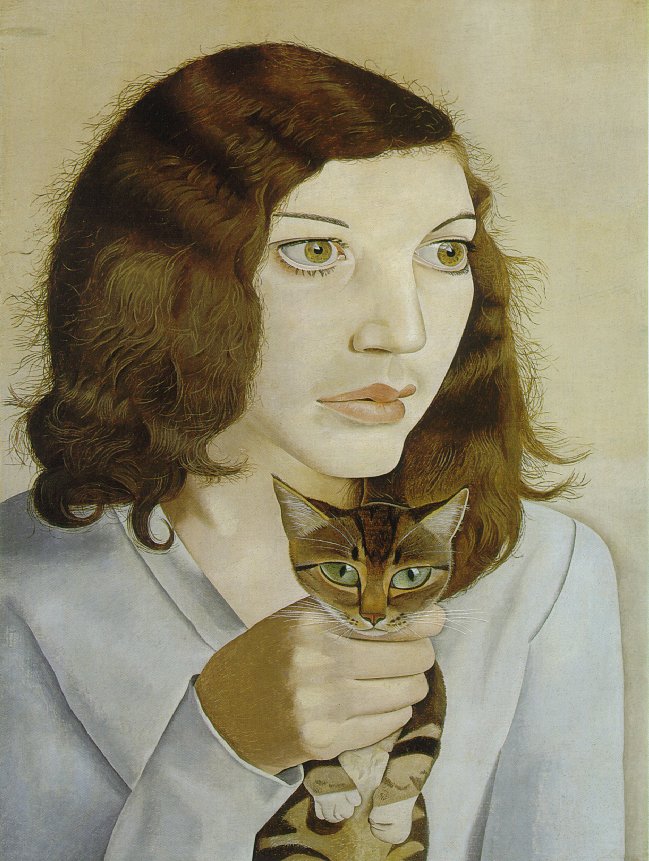
Girl with Kitten — Lucian Freud

Biblioklept Recommends Five Novels, Some of Them New, Not All of Them German

I shouldn’t be reading five novels at once. It’s a terrible idea, a symptom of a bad habit that I thought I’d broken, but after abandoning Levin’s tedious tome The Instructions and wasting my time on Shteyngart’s insipid dystopian novel Super Sad True Love Story, I found myself absorbed by a lovely little cache that had been neatly, patiently stacked for a few weeks now.

I’m only 60 or so pages into Lars Iyer’s Spurious — about a third of the way through — and at the rate I’m reading, I won’t finish it until the end of this month. It’s not that it’s slow or tedious or hard work: quite the opposite, in fact — it’s funny and lively, even when it’s erudite and depressive. I’ve enjoyed taking it in as a series of vignettes or skits or riffs. Spurious is about, or seems to be about (the term must be placed under suspicion) two would-be intellectuals, W. and his friend the narrator. They bitch and moan and despair: it’s the end of the world, it’s the apocalypse; they find themselves incapable of original thought, of producing any good writing. The shadow of Kafka paralyzes them. They travel about Europe, seeking out knowledge and inspiration — or at least a glimpse of some beautiful first editions. W. is cruel to the narrator, calling him fat and deriding his intellect for sport. But it’s all in good fun. Or maybe not. I’m really enjoying Spurious and have no hesitation recommending it; however, like a strong shot of bourbon, it’s best enjoyed frequently but in small doses. Spurious is brand spanking new from Melville House.

Iyer’s book dovetails nicely with W.G. Sebald’s first novel, Vertigo, which I picked up expressly to get the bad taste of Shteyngart out of my brain. Both books are haunted by Kafka, both  blur the lines between fiction and biography, both are works of and about flânerie, and both are melancholy. The book comprises four sections; the first section tells the story of the romantic novelist Stendhal (or, more to the point, a version of Stendhal); the second section details two trips Sebald made to Italy, one in 1980, and one in 1987; the third section, which I just read last night, describes a trip Kakfa took to Italy near the end of his life. I’m almost certain that I’ve read this section, “Dr. K Takes the Waters at Riva,” before — but I can’t remember where or when. It was strange reading it, almost as if I were experiencing some of the vertigo that permeates the volume. Full review forthcoming.

Kafka was a German-speaking Jewish writer from Prague. So was H.G. Adler, author of Panorama, new in English for the first time (hardback; Random House). Another way to transition from the Sebald paragraph above to this write-up of Panorama might be to point out that Sebald references Adler in Austerlitz, a book that tries to measure continental memory of the Holocaust. Adler survived the Holocaust, forced first into Theresienstadt and then Auschwitz, where his wife and mother were murdered in the gas chambers. Panorama is an autobiographical bildungsroman, with its hero young Josef Kramer standing in for Adler, and while it will clearly work its way into grim territory, the beginning — which is to say, the part that I’ve read so far — is bucolic and sweet and strange, as we see young Josef at home with his family. There’s a cinematic scope to Adler’s prose — Panorama is a Modernist work, one where the narrative freely dips into its protagonist’s mind. More to come.

Continuing in this Teutonic vein is Heinrich Böll’s novel The Clown (also Melville House). It’s postwar Germany, and Hans Schnier is a clown who’s crashing and burning. He hurts himself–purposefully–during a performance (at one of the increasingly more provincial venues he finds himself playing for these days) and retreats to Bonn, where he holes up in his small apartment and makes angry desperate phone calls (and tries not to drink too much brandy) and reflects on his past. What’s eating him up? His gal Marie, basically his common-law wife, has reverted back to her Catholic ways and up and left him for some chump named Zupfner. Schnier rants against a complacent and complicit German bourgeoisie, spitting vitriol against Protestants and Catholics alike; some of the best parts of the novel though are his ravings about art and the role of the “artiste” in society. Also: he can smell over the phone. Full review soon.

Wesley Stace’s new novel Charles Jessold, Considered as a Murderer (new from Picador) is a musical murder mystery set in the early part of 20th century Britain. Our (seemingly less than reliable) narrator Leslie Shepherd is a music critic with an aristocratic background who likes to spend his weekends collecting folk songs with other rich boys in the towns surrounding their country manors. He’s smitten (platonically, of course) with Charles Jessold, a middle class composer with a spark of avant-garde genius, and wins the younger man’s friendship quickly when he tells the story of Carlo Gesualdo, a fifteenth century composer/lord who kills his wife and her lover. (Notice the etymological connection between their names?) This tale of murder and cuckoldry is doubled in the ballad “Little Musgrave“; when Jessold and Shepherd find a new variation of the ballad, they set out to write the next (only?) great English opera, an adaptation of “Musgrave.” Oh, and that plot? The book opens with a news clipping reporting that Jessold killed his wife and her lover, and then himself, after the première of his opera Little Musgrave. Life imitates art imitates life. Stace has a keen ear for the period he writes about as well as a seemingly encyclopedic knowledge about music, but he also has the good sense to restrain himself and remember that he’s delivering a murder mystery. I’ve been enjoying Jessold quite a bit, and will return to it when I finish writing these lines. (And, for what it’s worth, part of Jessold is set in Germany).

Frank Delaney Honors James Joyce’s Birthday with His “re:Joyce Rap”

Frank Delaney honors today’s double anniversary of James Joyce’s birthday and the publication of Ulysses with his “re:Joyce rap.” Marvelous.

Is Infinite Jest Just David Foster Wallace’s Way of Imposing His Phallus on the Consciousness of the World?

From David Foster Wallace’s 1997 interview with Charlie Rose. I love Rose’s response–

DFW: Feminists are always saying this. Feminists are saying white males say, “Okay, I’m going to sit down and write this enormous book and impose my phallus on the consciousness of the world.”

ROSE: And you say?

DFW: I — I — if that was going on, it was going on on a level of awareness I do not want to have access to.

ROSE: Do you still play tennis?

The Skating Rink — Roberto Bolaño

The Skating Rink was the first novel Roberto Bolaño published, a murder mystery in Spanish, all the way back in 1993.  It’s a short novel, but full of devices and ideas that readers will recognize from the late Chilean master’s later and better-known works. Characters who populate the novel recount events as if speaking extemporaneously to a reporter or a detective and discuss ideas and themes that the author would return to again and again:  obsession, alienation, lack of national identity, underappreciated poets, homelessness, and homicide.  The Skating Rink is a brief novel at 179 sharp and engaging pages. It wouldn’t be incorrect to call it a minor novel, but it would be a mistake to consider it merely a warm-up for the more intricate routines that the writer would perfect in the future.

The novel is about the construction and existence of a clandestine ice rink built in a deserted mansion on the cliffs of a seaside resort town in Catalonia, Spain. Erected to please Nuria Marti, a beautiful figure skater cut from the Spanish Olympic team, the rink and its inspiration are reserved and glacial while the locals who populate the seasonally bustling city are, with varying degrees of success, just trying to hold everything together. When the body of an itinerant singer is discovered in the middle of the ice deep within the labyrinthine halls of the decaying house, everything the characters have strained to preserve begins to fall apart.

The book is narrated by three men who represent different strata of Spanish society. Enric Rosquelle is an outwardly arrogant bureaucrat in charge of the city’s various social service agencies whose desperate need for love leads him to embezzle the funds  in order to build the skating facility for the athlete he knows will never return his feelings. Gaspar Heredia is an illegal Chilean immigrant who works in a campground for tourists and falls for a homeless woman who never relinquishes the kitchen knife she keeps tucked in her jeans.  Remo Moran, a legal arrival from Chile, has enjoyed success as a businessman and as a poet and is anxious about his own precarious sexual relationship with Nuria. Each man is more or less aware of his shortcomings and they utilize similar Bolañesque (Bolañan?) digressions to explain their motivations and feelings. They come to know and discuss each other in their retelling of events and so become interesting, sympathetic, and full characters.  Enric is jealous of Remo and suspicious that South Americans in general trade in filth and drugs.  Gaspar relies on his old friend Remo for his job and secretly watches Enric coaching Nuria.

The sense of loneliness and the failure to take advantage of fleeting opportunities are palpable. In a number of places, the narrative and the novel’s setting evoke a Wong Kar-wai movie. In slow motion, men follow women through cobblestone streets, not quite able to grasp that thing they desire. Hang-gliders dance in the sky and while everyone else is watching the fliers against the cool blue sky, we’re being told about how she’s just disappeared through a door down a side street. Solitary women stroll up cliff-side highways while our narrators limp behind. I almost expect Gaspar to sit down next to Tony Leung while cellos or Chinese versions of well-known pop tunes play from a nearby jukebox.  Unlike Wong Kar-wai though, Bolaño sees the single-minded pursuit of unrequited love as pathological and often a precursor to violence. The men in The Skating Rink, like any number of other men who populate Bolaño’s novels, are unable to resist the wills of the women they love or submit to personally or professionally. Two men here are willing to sublimate their own wishes for those of Nuria, whose choice of profession illustrates her own desire to overcome the normal limitations of geography, climate, and national history. As they seek her favor, they find themselves acting in unfamiliar ways, on uncertain paths and  unconcerned with appearance or ethics.

Like most of Bolaño’s work, endings (and beginnings and middles) are ambiguous. Readers are left unsure as to what has actually happened and the murder remains (I think) unsolved.  The Skating Rink could serve as an easy introduction to the writer’s more complex creations because it deals with time and plot in a relatively conventional manner. The characters get to say proper good-byes and reflect on the things that have happened to them. Like a standard mystery, most of the knots have been untangled.  But because real understanding sits just outside of consciousness, this reader is still waiting for the feeling that my task is complete. There are occasional missteps, like when Bolaño compares an elderly woman’s voice to a locker room, but passages lodge in your head like slow songs on repeat in dark comfortable places. Like those jams, The Skating Rink might be a masterpiece or something to be forgotten when something better comes along.  It’s short, so listen to it a couple times and decide for yourself.