
July 13th.–A show of wax-figures, consisting almost wholly of murderers and their victims,–Gibbs and Hansley, the pirates, and the Dutch girl whom Gibbs murdered. Gibbs and Hansley were admirably done, as natural as life; and many people who had known Gibbs would not, according to the showman, be convinced that this wax-figure was not his skin stuffed. The two pirates were represented with halters round their necks, just ready to be turned off; and the sheriff stood behind them, with his watch, waiting for the moment. The clothes, halter, and Gibbs’s hair were authentic. E. K. Avery and Cornell,–the former a figure in black, leaning on the back of a chair, in the attitude of a clergyman about to pray; an ugly devil, said to be a good likeness. Ellen Jewett and R. P. Robinson, she dressed richly, in extreme fashion, and very pretty; he awkward and stiff, it being difficult to stuff a figure to look like a gentleman. The showman seemed very proud of Ellen Jewett, and spoke of her somewhat as if this wax-figure were a real creation. Strong and Mrs. Whipple, who together murdered the husband of the latter. Lastly the Siamese twins. The showman is careful to call his exhibition the “Statuary.” He walks to and fro before the figures, talking of the history of the persons, the moral lessons to be drawn therefrom, and especially of the excellence of the wax-work. He has for sale printed histories of the personages. He is a friendly, easy-mannered sort of a half-genteel character, whose talk has been moulded by the persons who most frequent such a show; an air of superiority of information, a moral instructor, with a great deal of real knowledge of the world. He invites his departing guests to call again and bring their friends, desiring to know whether they are pleased; telling that he had a thousand people on the 4th of July, and that they were all perfectly satisfied. He talks with the female visitors, remarking on Ellen Jewett’s person and dress to them, he having “spared no expense in dressing her; and all the ladies say that a dress never set better, and he thinks he never knew a handsomer female.” He goes to and fro, snuffing the candles, and now and then holding one to the face of a favorite figure. Ever and anon, hearing steps upon the staircase, he goes to admit a new visitor. The visitors,–a half-bumpkin, half country-squire-like man, who has something of a knowing air, and yet looks and listens with a good deal of simplicity and faith, smiling between whiles; a mechanic of the town; several decent-looking girls and women, who eye Ellen herself with more interest than the other figures,–women having much curiosity about such ladies; a gentlemanly sort of person, who looks somewhat ashamed of himself for being there, and glances at me knowingly, as if to intimate that he was conscious of being out of place; a boy or two, and myself, who examine wax faces and faces of flesh with equal interest. A political or other satire might be made by describing a show of wax-figures of the prominent public men; and by the remarks of the showman and the spectators, their characters and public standing might be expressed. And the incident of Judge Tyler as related by E—- might be introduced.
A series of strange, mysterious, dreadful events to occur, wholly destructive of a person’s happiness. He to impute them to various persons and causes, but ultimately finds that he is himself the sole agent. Moral, that our welfare depends on ourselves.
The strange incident in the court of Charles IX. of France: he and five other maskers being attired in coats of linen covered with pitch and bestuck with flax to represent hairy savages. They entered the hall dancing, the five being fastened together, and the king in front. By accident the five were set on fire with a torch. Two were burned to death on the spot, two afterwards died; one fled to the buttery, and jumped into a vessel of water. It might be represented as the fate of a squad of dissolute men.
A perception, for a moment, of one’s eventual and moral self, as if it were another person,–the observant faculty being separated, and looking intently at the qualities of the character. There is a surprise when this happens,–this getting out of one’s self,–and then the observer sees how queer a fellow he is.
Category: Books
Selections from One-Star Amazon Reviews of J.R.R. Tolkien’s The Hobbit
[Editorial note: The following citations come from one-star Amazon reviews J.R.R. Tolkien’s novel The Hobbit (a book I’ve always loved). I’ve preserved the reviewers’ original punctuation and spelling. More one-star Amazon reviews.].
Dwarves.
The Hobbit stinks.
It is just so boreing.
“DEATH TO HOBBITS!”
This is such a horrible book.
Gandalf the wizard is a bogus
Swoar, lil’ fools wack for REALL.
And what’s this thing about hairy feet?
Crying because the story will NOT END!
my mom liked it (what’s wrong with her? )
Spend your money on Harry Potter instead.
I dought we will ever finish this horrible book.
No offense, but the suspense was not at all amusing
I know for a fact that there are several of Hobbit fans.
Bilbo is a Hobbit who seems not to do much in the story.
it was as if a ten year old coul’ve made up these characters.
forget about all the other reviews. they just think bilbo the bimbo is hot.
This is a dangerous book and is an extremely bad influence on adolescents.
Not only that, it is also more boring than having tea with nan and the relatives.
There is no action and Bilbo Baggins is the biggest a$$ in a fantasy novel ever.
This is a prime example of what happens when Star Trek and Star Wars dorks pick up a book.
No originality whatsoever is involved and the pages make me wish I was not even in existence.
After reading literary masterpieces by Robert Jordan, and Aurther C. Clark, books like these seem pointless.
The book is about a young hobit that goes on an adventurer to get rid of a ring that if you w where it you turn e ebook
One more things on the dwarves. They are useless characters and this story makes me want to vomit.
This book is a story of your everyday savior (supposedly Bilbo) having adventures and slaying a dragon.
The ending of the story is horrible and it seems that Tolkien wasted his POOR and SENSELESS usage of his brain.
They also don’t fit the spirit of dwarves, but then again after time they evolved into the grumpy alchoholics fantasy tends to portray them as.
I sit there reading every single word of it, but I think about something else. I read “Bilbo blah blah blah,” but think “Oh what am I gonna do today after school?”
Bilbo is not exactly the character which you would find addicted to. He stammers and is basically a coward.
This yogurt tastes awful! This is the worst yogurt I have ever tasted!
And like all stories, there are monsters and strange happenings.
What was I drinking when I decided to read this piece of junk?
:-( Boo! :-( Boo! :-( Boo! :-( Boo! :-( Boo!:-(
I despise and loathe this series tremendously.
I’m just glad this guy’s dead. :)
Bilbo reminds me of a pig.
“DIE HOBBITS, DIE!”
Idiotic and Irritating.
to many characters!
this is some butt
Agghhh!
Colonel Walter E. Kurtz’s bedside reading
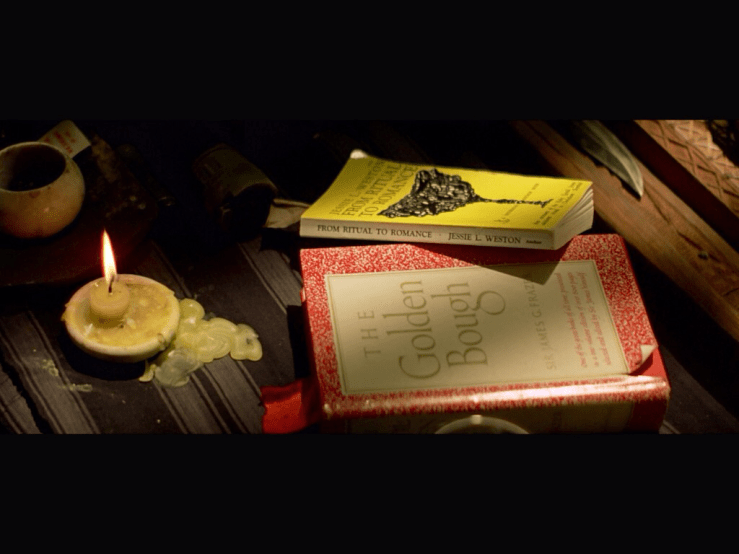
From Apocalypse Now (1979); dir. Francis Ford Coppola with cinematography by Vittorio Storaro.
RIP James Tate

RIP the great James Tate (1943-2015).
Reading/Have Read/Should Write About
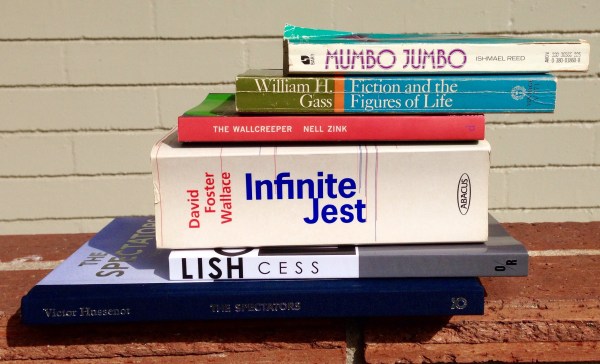
From top to bottom:
Mumbo Jumbo, Ishmael Reed
Last summer, I read Alasdair Gray’s novel Lanark and never mustered a review (Florida heat; Fourth of July fireworks; booze; other excuses). I’ve thought about Lanark all the time though. I’m afraid Mumbo Jumbo is gonna fall in the same slot as Lanark—too much to handle in one read. I need to go back and reread Mumbo Jumbo—just fantastic stuff—conspiracy theories, hoodoo, music, art theft—I owe it more than I seem to be able to register here.
Fiction and the Figures of Life, William H. Gass
So I read a handful of essays in Gass’s earliest essay collection interspersed with Infinite Jest, and I actually did write a bit about one of them here, in conjunction with IJ. Perfect sentences. (Gass’s sentences. Not mine). I wisely shelved the thing (Gass’s “review” of a Donald Barthelme collection almost paralyzed me), leaving more pieces to return to later.
The Wallcreeper, Nell Zink
I started Zink’s first novel The Wallcreeper this afternoon and only put it down when I had to go pick my kids up from day camp. Then I picked it up again. I just put it down again, at a break, of sorts, on page 77, to write this. Every sentence makes me want to read the next sentence (“I felt almost nostalgic toward socially acceptable horrors with larger meanings related to reproduction,” our narrator quips; a bit later: “My life was like falling off a log comfortably located somewhere light-years above the earth”). It’s about this young married couple living in Bern, Switzerland—also sex, birdwatching, music, etc. I was kinda worried that any novel I picked up after Infinite Jest (see below) might suffer, but nah. The Wallcreeper is fantastic so far.
Infinite Jest, David Foster Wallace
Okay, so I mustered a few riffs on rereading Infinite Jest, including a thing about the first 299 pages and a thing for first-time readers—but I finished the novel yesterday, and this is how I felt:
Twitter was the easiest way to try to bottle the feeling of finishing the novel, which is a feeling that I wanted to bottle because I didn’t record the feeling of finishing IJ the first time, back in 2001. But I remember finishing it, very, very late at night/early in the morning, and going back through it, rereading that first chapter, trying to figure out What Happened. So what I mean is I felt enthusiasm and energy—it was the opposite of the reread, which was deflationary, I suppose—richer and sadder. And I hate to write this, but it’s impossible not to reread Infinite Jest through the lens of Wallace’s suicide. Just too many suicides in the novel…and then this late passage, from Hal’s narration (elisions and emphasis mine):
…the old specimen’s horrified face as the boy sobs into the chartreuse satin and shrieks ‘Murderer! Murderer!’ over and over, so that almost a third of Accomplice!’s total length is devoted to the racked repetition of this word — way, way longer than is needed for the audience to absorb the twist and all its possible implications and meanings. This was just the sort of issue Mario and I argued about. As I see it, even though the cartridge’s end has both characters emoting out of every pore, Accomplice!’sessential project remains abstract and self-reflexive; we end up feeling and thinking not about the characters but about the cartridge itself. By the time the final repetitive image darkens to a silhouette and the credits roll against it and the old man’s face stops spasming in horror and the boy shuts up, the cartridge’s real tension becomes the question: Did Himself subject us to 500 seconds of the repeated cry ‘Murderer!’ for some reason, i.e. is the puzzlement and then boredom and then impatience and then excruciation and then near-rage aroused in the film’s audience by the static repetitive final 1⁄3 of the film aroused for some theoretical-aesthetic end, or is Himself simply an amazingly shitty editor of his own stuff?
It was only after Himself’s death that critics and theorists started to treat this question as potentially important. A woman at U. Cal–Irvine had earned tenure with an essay arguing that the reason-versus-no-reason debate about what was unentertaining in Himself’s work illuminated the central conundra of millennial après-garde film, most of which, in the teleputer age of home-only entertainment, involved the question why so much aesthetically ambitious film was so boring and why so much shitty reductive commercial entertainment was so much fun. The essay was turgid to the point of being unreadable, besides using reference as a verb and pluralizing conundrum as conundra.
From my horizontal position on the bedroom floor…
There’s hero Hal horizontal, psychic parallel to Don Gately, the hero of stasis, to borrow Hal’s own term…
I’ll try to muster more.
Cess, Gordon Lish
AKA Gordon Lish does whatever the fuck he wants. I read this in one alarmed sitting, and I’m not sure if I read it “correctly,” whatever that means.
The Spectators,Victor Hussenot
Another beautiful book from Nobrow—not a graphic novel, but something closer to a colorful illustrated tone poem, a meditation, a feeling. Excellent review at Loser City, which I made the mistake of reading before I composed my own.
A Shrivel of Critics
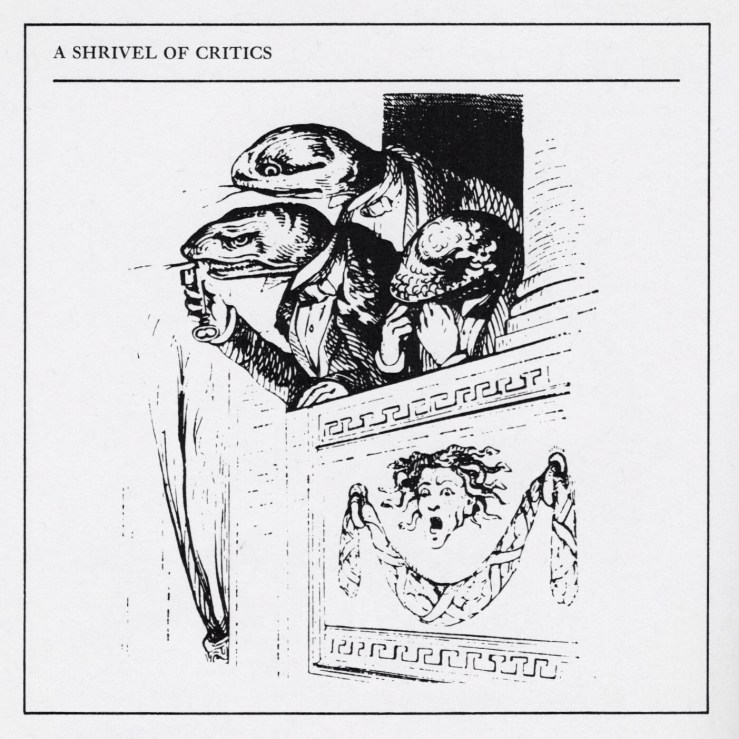
From James Lipton’s An Exaltation of Larks.
A brief note to readers new to Infinite Jest (and a very incomplete list of motifs in the novel)
David Foster Wallace’s 1996 novel Infinite Jest poses rhetorical, formal, and verbal challenges that will confound many readers new to the text. The abundance of (or excess of) guides and commentaries on the novel can perhaps have the adverse and unintentional consequence of making readers new to Infinite Jest believe that they can’t “get it” without help. Much of the online analyses and resources for Infinite Jest are created by and targeted to readers who have finished or are rereading the novel. While I’ve read many insightful and enlightening commentaries on the novel over the years (and, in particular, over the past six weeks rereading IJ), my intuition remains that the superabundance of analysis may have the paradoxical effect of actually impeding readers new to the text. With this in mind, I’d suggest that first-time readers need only a dictionary and some patience.
(Still: Two online resources that might be useful are “Several More and Less Helpful Things for the Person Reading Infinite Jest,” which offers a glossary and a few other unobtrusive documents, and “Infinite Jest: A Scene-by-Scene Guide,”which is not a guide at all, but rather a brief series of synopses of each scene in the novel, organized by page number and year; my sense is that this guide would be helpful to readers attempting to delineate the novel’s nonlinear chronology—however, I’d advise against peeking ahead).
The big advantage (and pleasure) of rereading Infinite Jest is that the rereader may come to understand the plot anew; IJ is richer and denser the second go around, its themes showing brighter as its formal construction clarifies. The rereader is free to attend to the imagery and motifs of the novel more intensely than a first-time reader, who must suss out a byzantine plot propelled by a plethora of characters. Readers new to IJ may find it helpful to attend from the outset to some of the novel’s repeated images, words, and phrases. Tracking motifs will help to clarify not only the novel’s themes and “messages,” but also its plot. I’ve listed just a few of these motifs below, leaving out the obvious ones like entertainment, drugs, tennis (and, more generally, sports and games), and death. The list is in no way definitive or analytic, nor do I present it as an expert; rather, it’s my hope that this short list might help a reader or two get more out of a first reading.
Heads
Cages
Faces
Maps
Masks
Cycles
Teeth
Waste
Infants
Pain
Deformities
Subjects
Objects
Entries under “B” from Captain Grose’s Dictionary of the Vulgar Tongue (1811)
The following definitions are from the “B” section of Captain Grose’s Dictionary of the Vulgar Tongue (1811).
BABES IN THE WOOD. Criminals in the stocks, or pillory.
BABBLE. Confused, unintelligible talk, such as was used at the building the tower of Babel.
BACK BITER. One who slanders another behind his back,
i.e. in his absence. His bosom friends are become his back
biters, said of a lousy man.
BACKED. Dead. He wishes to have the senior, or old
square-toes, backed; he longs to have his father on six
men’s shoulders; that is, carrying to the grave.
BACK UP. His back is up, i.e. he is offended or angry; an expression or idea taken from a cat; that animal, when angry, always raising its back. An allusion also sometimes used to jeer a crooked man; as, So, Sir, I see somebody has offended you, for your back is up.
BACON. He has saved his bacon; he has escaped. He has a good voice to beg bacon; a saying in ridicule of a bad voice.
BACON-FACED. Full-faced.
BACON FED. Fat, greasy.
BACK GAMMON PLAYER. A sodomite.
BACK DOOR (USHER, or GENTLEMAN OF THE). The same.
BAD BARGAIN. One of his majesty’s bad bargains; a worthless soldier, a malingeror. See MALINGEROR.
BADGE. A term used for one burned in the hand. He has got his badge, and piked; he was burned in the hand, and is at liberty. Cant. Continue reading “Entries under “B” from Captain Grose’s Dictionary of the Vulgar Tongue (1811)”
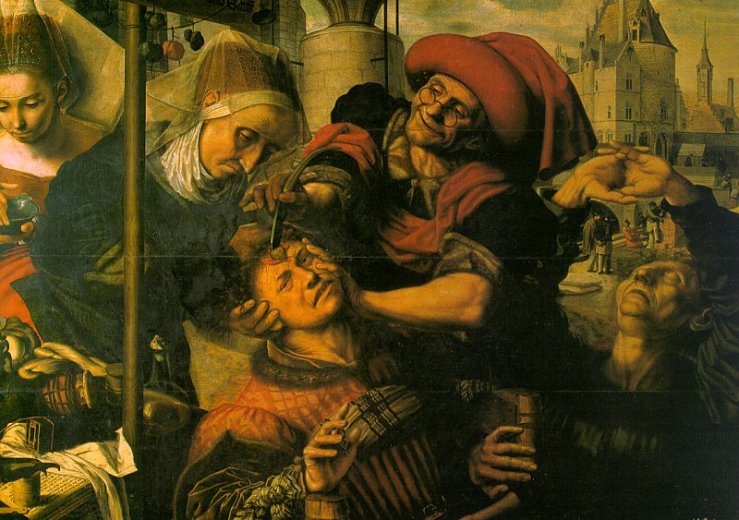
The Surgeon — Jan Sanders van Hemessen
“…the amazing, world-reversing night of Fourth of July Eve 1899″ (Pynchon’s Against the Day)
For years after, there were tales told in Colorado of the amazing, world-reversing night of Fourth of July Eve 1899. Next day’d be full of rodeos, marching bands, and dynamite explosions—but that night there was man-made lightning, horses gone crazy for miles out into the prairie, electricity flooding up through the iron of their shoes, shoes that when they finally came off and got saved to use for cowboy quoits, including important picnic tourneys from Fruita to Cheyenne Wells, why they would fly directly and stick on to the spike in the ground, or to anything else nearby made of iron or steel, that’s when they weren’t collecting souvenirs on their way through the air—gunmen’s guns came right up out of their holsters and buck knives out from under pants legs, keys to traveling ladies’ hotel rooms and office safes, miners’ tags, fencenails, hairpins, all seeking the magnetic memory of that long-ago visit. Veterans of the Rebellion fixing to march in parades were unable to get to sleep, metallic elements had so got to humming through their bloodmaps. Children who drank the milk from the dairy cows who grazed nearby were found leaning against telegraph poles listening to the traffic speeding by through the wires above their heads, or going off to work in stockbrokers’ offices where, unsymmetrically intimate with the daily flow of prices, they were able to amass fortunes before anyone noticed. .
A passage from Thomas Pynchon’s novel Against the Day.
A–Z of linguistics in rhyming couplets

Here’s a self-explanatory bit of silliness from Twitter yesterday. There were requests to assemble it somewhere, for convenience and posterity, so I figured I’d reproduce it on Sentence first.
I’ve replaced the quotation marks I used on Twitter with italics; other than that it’s identical. The tweets are all linked, so you can also read them by clicking on the date of this introductory one:
*
*
A is for ARBITRARY: a sound’s tie to meaning.
B is for BACK-FORMED, like dry-clean from dry-cleaning.
View original post 225 more words
O Terceiro Polícia — Flann O’Brien

From Bertrand Bookstore in Lisbon, the longest continuously operating bookstore in the world (it opened in 1732).
“Men and Art” — Charlotte Perkins Gilman
“Men and Art”
by
Charlotte Perkins Gilman
(from Our Androcentric Culutre; or, The Man Made World)
Among the many counts in which women have been proven inferior to men in human development is the oft-heard charge that there are no great women artists. Where one or two are proudly exhibited in evidence, they are either pooh-poohed as not very great, or held to be the trifling exceptions which do but prove the rule.
Defenders of women generally make the mistake of over-estimating their performances, instead of accepting, and explaining, the visible facts. What are the facts as to the relation of men and women to art? And what, in especial, has been the effect upon art of a solely masculine expression?
When we look for the beginnings of art, we find ourselves in a period of crude decoration of the person and of personal belongings. Tattooing, for instance, is an early form of decorative art, still in practice among certain classes, even in advanced people. Most boys, if they are in contact with this early art, admire it, and wish to adorn themselves therewith; some do so—to later mortification. Early personal decoration consisted largely in direct mutilation of the body, and the hanging upon it, or fastening to it, of decorative objects. This we see among savages still, in its gross and primitive forms monopolized by men, then shared by women, and, in our time, left almost wholly to them. In personal decoration today, women are still near the savage. The “artists” developed in this field of art are the tonsorial, the sartorial, and all those specialized adorners of the body commonly known as “beauty doctors.” Continue reading ““Men and Art” — Charlotte Perkins Gilman”
Operation Wednesday — Leonora Carrington

Bob Rafelson and Jack Nicholson on the diner scene in Five Easy Pieces
Still Life with a Wine Cooler — Frans Snyders

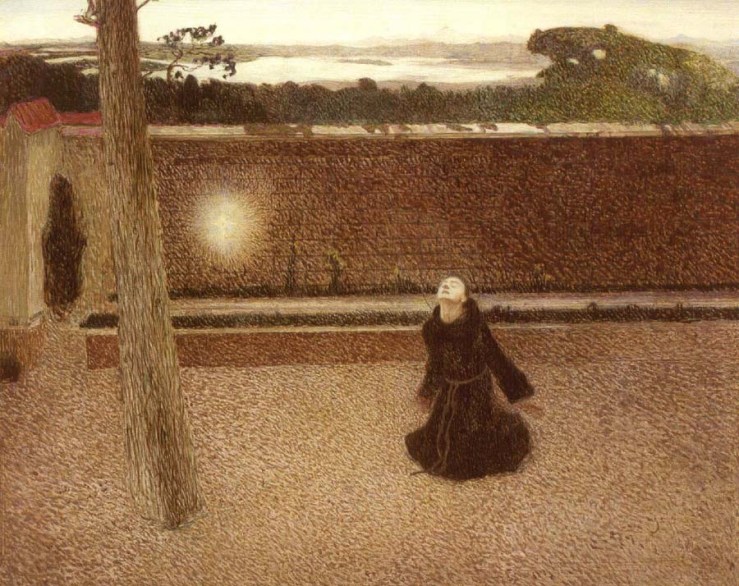
The Vision — Sigmund Walter Hampel
 Biblioklept