Paul Kirchner’s metaphysical trip continues in The Bus 3

Paul Kirchner’s surreal comic strip The Bus is a looping, deadpan fugue of modern alienation and mechanical ritual, where a lone Commuter drifts through absurd, Escher-like permutations of transit life.

The Commuter’s foil and ferry is the titular bus (which Kirchner himself described as “demonic” in a 2015 essay in The Boston Globe); his Charon (and, really, partner) is the bus’s Driver. Each Bus strip is a double-decker one-pager rendered in precise black ink; most strips are wordless and consist of six or eight panels. Kirchner uses these constraints to conjure metaphysical gags that upend the banality of everyday existence. The previous two sentences that attempt to describe Kirchner’s formal techniques are a poor substitute for an example — so here is an example:

The strip above is the first entry in Kirchner’s new collection, The Bus 3. This strip neatly ushers us into The Bus’s charms. Old partners Commuter and Driver reunite; the bus subtly transforms into a theater; the Commuter turns to witness the loop start anew. Is there an exit? And would the Commuter want to escape the loop?

The second strip reaffirms Kirchner’s commitment to the Commuter’s eternal return. Our hapless hero is a kind of chthonic demigod, simultaneously plastic and immutable, wholly absurd:

The Bus’s first route was between 1978 and 1985 in the pages of Heavy Metal magazine. French publisher Tanibis Editions republished this original run in 2012. In 2015, they published The Bus 2, a sequel of new material. In my review, I wrote that “The Bus 2, like its predecessor, is a remarkably and perhaps unexpectedly human strip.” The same is true for The Bus 3. Kirchner’s strips demonstrate that the absurdity of the modern condition, for all its dulling machinations, reaffirms humanity and the imaginative, artistic vision as a site of surreal resistance.

I kept The Bus 3 out on my coffee table the entire summer. I tried not to gobble up all the strips right away, but rather to read one or two a day, each page a small treat against the absurdity of the day. As I reached the end of the volume a week ago, I found myself strangely moved by the last three strips. Kirchner’s Möbius strips always send the Commuter back to his starting position. These last three pull the same move, but with a difference. In the first of the final three, the Commuter dies (waiting on the Driver, natch) and his spirit ascends. In eight speechless panels, Kirchner retells Kafka’s parable “Before the Law.”

The penultimate strip, a gag on Macy’s Thanksgiving Day Parade balloons literally deflates the bus. The crowd has left, but the Commuter remains, stoic, waiting. And the last proper strip shows a techno-utopian future with a splendid flying bus — but our Commuter refuses to board. His neck stooped, he wanders to the outskirts of town to find the apocalyptic wreckage of his beloved broken down bus. It’s a lovely moment.

Has Kirchner retired his Commuter? Perhaps. The last page of the book shows our hero somehow looking bemused in a folding lawn chair, a cold one in his hand. He sits in front of the bus, now converted to an immobile home, scene of domestic bliss, maybe, everything tranquil and normal (just ignore the fish).

Is it really the end of service? If so, The Bus 3 offers a sweet send off for its hero. But I’ll hold out hope for one more ride. Great stuff.

Sunday Comix

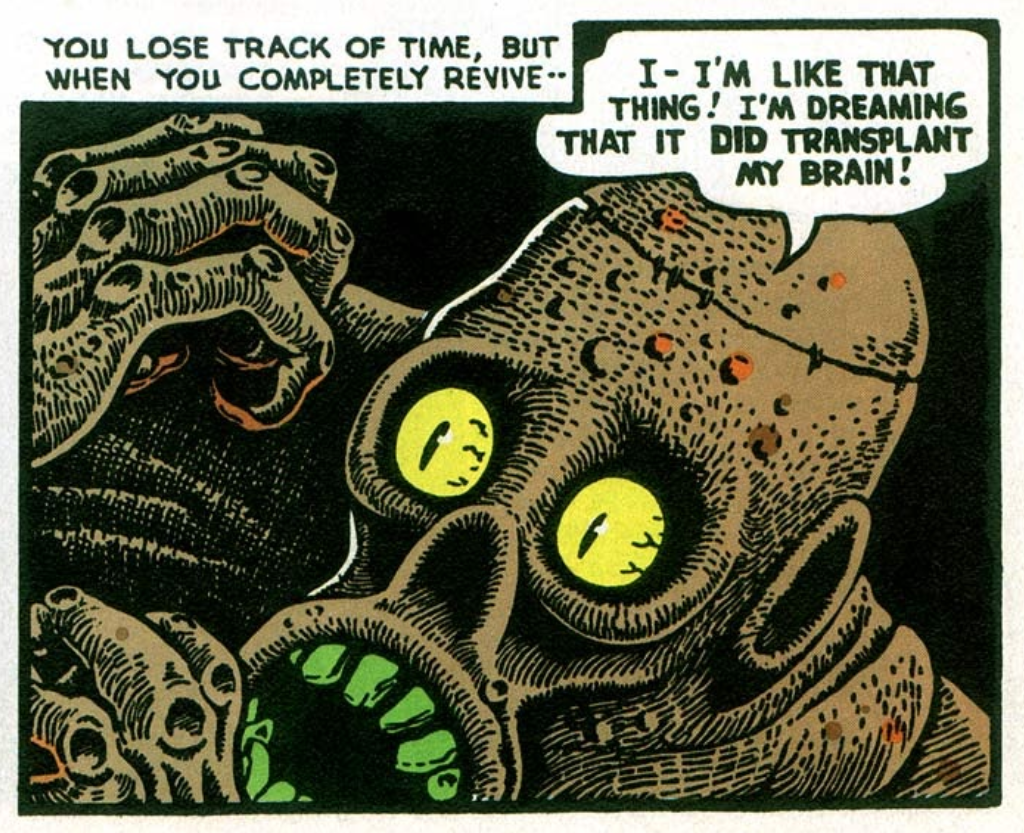
From “They Crawl by Night” by Daniel Keyes and Basil Wolverton, Journey Into Unknown Worlds #15, February 1953, Atlas Comics. Reprinted in Basil Wolverton’s Gateway to Horror #1, June 1988, Dark Horse Comics.

Sunday Comix

Krazy Kat, 30 Jan. 1927 by George Herriman

Sunday Comix

From “Lost in the Andes!” by Carl Barks, Four Color Comics #223, 1949.

Sunday Comix

From “The Paradox Man, Ch. 2” by Barry Windsor-Smith, Storyteller, 1996

Sunday Comix

Cover for Slow Death #2, 1970 by Jack Jackson and Dave Sheridan

Sunday Comix

From “A Folk Tale” by Gilbert Hernandez, Love and Rockets #27, 1982

Sunday Comix

From New Mutants #25, 1985 by Bill Sienkiewicz and Chris Claremont

Sunday Comix

From Moebius’s illustrations for Robert Bloch’s Contes de Terreur, 1975; reprinted in Metallic Memories, 1992.


Sunday Comix

From “The Spawn of Cokethulhu” by Chris Statler, Cocaine Comix #2, 1981.

Paul Kirchner’s The Bus 3 (Book acquired, early May 2025)

Paul Kirchner’s surreal cult classic strip The Bus has another sequel. The Bus 3 is new from Tanibis Editions, which published The Bus 2 a decade ago along with a collection of the original Bus strips.

From my review of The Bus 2:

Paul Kirchner’s cult classic comic strip The Bus originally ran in Heavy Metal from 1979-1985. The (anti-)story of “a hapless commuter and a demonic bus” (as Kichner put it himself in a recent memoir at The Boston Globe), The Bus, at its finest moments, transcends our expectations for what a comic strip can and should do. Sure, Kirchner delivers the set-ups, gags, japes, and jests we expect from a cartoon—but more often than not The Bus surpasses the confines of its form and medium. Its protagonist The Commuter is an allegorical everyman, a passenger tripping through an absurd world. Kirchner’s strip often shows us ways to see that absurd world—which is of course our own absurd world—with fresh eyes.

Here is the first strip in The Bus 3:

More thoughts to come.

Sunday Comix

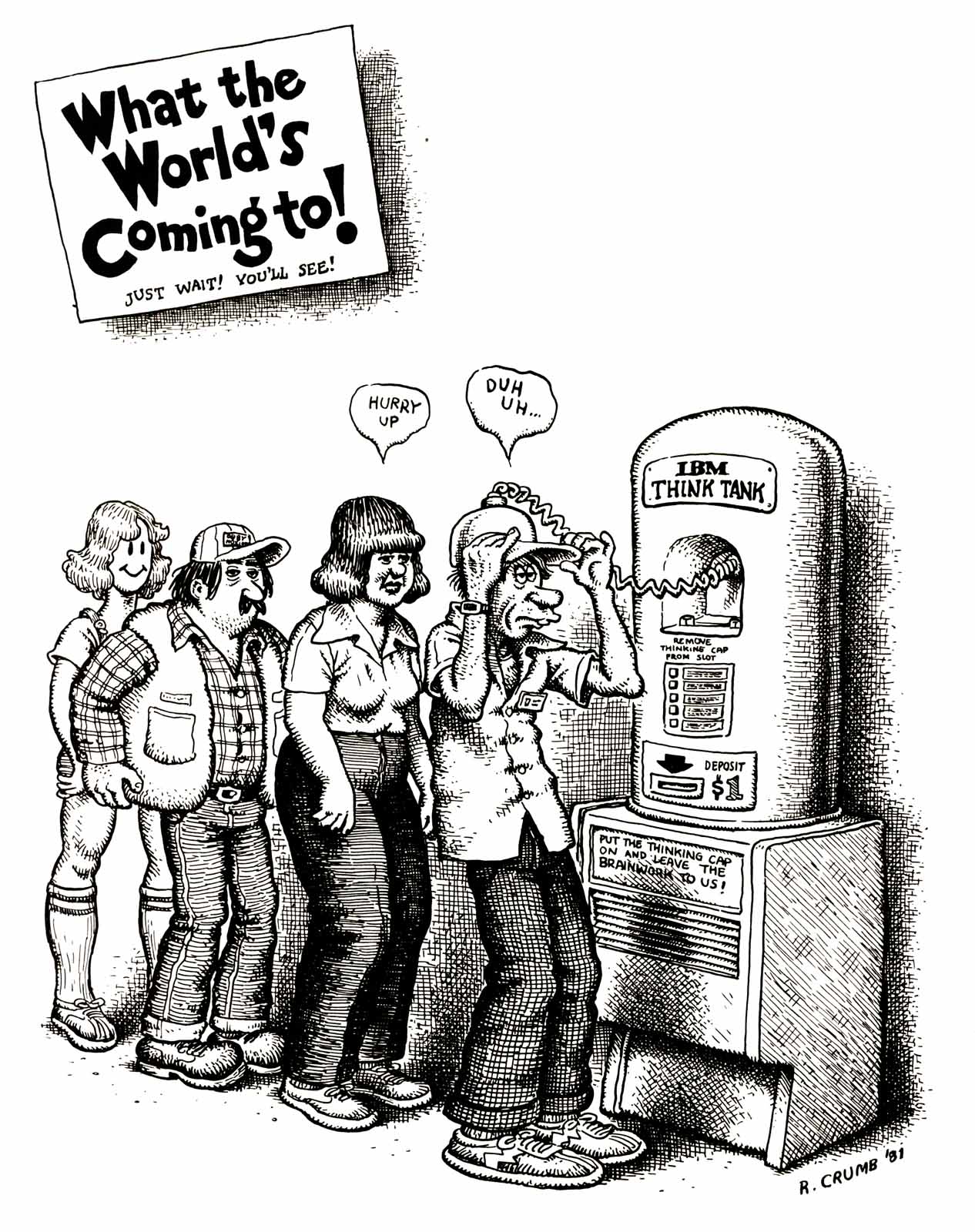
From “Mister Machine” by Jack Kirby, 2001: A Space Odyssey #10, 1977.

Sunday Comix

From “The Electronic Concert” by Fred Schrier, Meef Comix #2, 1973.

Sunday Comix

From “A MAD Look at Alfred Hitchcock Movies” by Sergio Aragones, MAD Magazine #10, Dec. 2019.

Sunday Comix

From “Rude Interlude” by Robert E. Armstrong, Mickey Rat #4, 1982.

Five environmental comix from Ron Cobb for Earth Day

Briana Loewinsohn’s graphic novel Raised by Ghosts turns absence into haunting art

A decade ago I finally tossed out most of the contents of an old shoebox crammed with high-school nostalgia. Notes from ex-girlfriends, summer postcards, flyers from local shows, a handful of choice mixtapes. Some Polaroids. Our stupid band’s stupid lyrics, which we usually forgot or simply abandoned live. There was even a pair of fat shoelaces. The pain of return always hits me hard at such times, and I got dizzy. That box was crammed the scraps of an older life.

The preceding paragraph is an unfair opening to a review of Briana Loewinsohn’s excellent graphic memoir Raised by Ghosts. Reading Raised by Ghosts felt like opening that old shoebox: painful, dizzying, beautiful. Loewinsohn is one of usone of us to borrow a chant from Tod Browning’s Freaks. “Sometimes I feel like I am an alien at this school…But there are other aliens here,” protagonist Briana writes in her diary.

Raised by Ghosts covers Briana’s seven rough years through middle and high school. These are the gay nineties. The narrator, like Loewinsohn herself, is about my age, which makes reading Raised by Ghosts an eerie act of self-recognition. It’s not a conventional memoir—it doesn’t hold your hand or deliver a clean, linear narrative. Instead, it moves like memory does: in flashes, in vignettes, in small sensory moments that coalesce into something greater than the sum of their parts. Everything here feels true. We have here the relics of a teenage moondream, those little ghosts of the past that flicker through memory like frayed photos freed from the rubberbanded bundle in an old Converse box. Briana’s adolescence unfurls as an ebb and flow of loneliness and acceptance among fellow weirdos. She finds her people, but never quite makes the scene; she dances at the live show but finds as much fun in playing cards in the back.

Loewinsohn’s art conveys Raised by Ghosts’ emotional weight. Soft, muted tones in drab olive and rust hues fill square panels that often resemble fading Polaroids. Candids and close-ups capture the messiness of high school. Briana is a sympathetic and endearing character, her sensitivity registering in ways she cannot understand herself, as when she skips out on a living-room VHS double feature. Oliver Stone’s Natural Born Killers would be way too much after the tragedy of You’re a Good Man, Charlie Brown.

Loewinsohn includes full handwritten pages to accompany the traditional comic strips in Raised by Ghosts. These handwritten pages serve as a kind of diary, but often take on subtle visual changes that suggest other media. Often, the handwritten pages mimic the form of the long notes bored Briana composes in class to pass to friends. A passage composed on graph paper praises the note-writing skills of a particular friend; the technique suggests this friend prefers squares to lines. A passage on a brown paper lunch bag reflects on how Briana’s father always takes the time to write her name in detailed, expressive lettering. The variations of handwritten pages enrich the narrative and subtly inform us of Briana’s artistic development.

My favorite of the handwritten passages though is simply a list of bands scrawled on lined paper. When I got to that page, about a third of the way into Raised by Ghosts, I was already persuaded by the book–but the page of band names seemed so utterly true, so beautiful and banal. We used to do that, I thought, and: Why did we used to do that? knowing the answer has no good intellectual answer.

But let’s get to the ghosts. Loewinsohn never “shows” us Briana’s parents, yet the picture we get of them is hardly incomplete: a distant, detached mother and a father in arrested development. “I would say I was raised in an AA meeting,” Briana remarks of her mother, noting that it’s often hard for single mothers to find childcare. Of her father’s abode: “My pop’s house is a combination of Indiana Jones’ office, Pee Wee’s playhouse, and an opium den. I am kinda like a roommate here.”

Briana’s parents exist in Raised by Ghosts the way memories of the absent often do—fragmented, elusive, more felt than seen. Loewinsohn never lets them fully materialize, yet their presence, or lack thereof, shapes Briana’s interactions with her world. Neither parent offers Briana guidance. She’s a latchkey kid left to cobble her own sense of belonging among friends, music, and the small rituals of adolescence. In the absence of stability, she builds meaning from mixtapes, handwritten notes, and fleeting moments of connection.

And art. The memoir climaxes in a moment of transformation—an act of self-possession and, ultimately, self-creation. Throughout Raised by Ghosts, Briana moves through a world shaped by absence, by the ghosts of parents who are physically present but emotionally distant. Yet, in the book’s remarkable penultimate sequence, she steps beyond that absence, beyond memory’s hazy grip, into a space that is entirely her own. The panels swirl into a dreamscape of shifting lines—formless and chaotic at first—until Briana gathers them together, lassoing meaning from the void. It is a moment of artistic alchemy, where creation becomes a form of agency, a way to shape her own narrative rather than just mimic one. When she carries those lines from dream to waking life, the transition is profound: she is no longer just a kid collecting relics of meaning from the world around her—she is an artist, making meaning herself.

Publisher Fantagraphics labels Raised by Ghosts as a “young adult graphic novel,” and teenagers will likely identify with Briana’s story—the loneliness, the search for belonging, the quiet acts of self-definition. They may also feel a strange twinge of envy for a world that no longer exists. Being a latchkey kid could be lonely, but it was not without its freedoms. Those of us who were teenage weirdos in the nineties will see in Loewinsohn’s memoir not a young adult novel, but rather a reflective elegy composed by a mature artist in control of her talent. Raised by Ghosts lingers like the echo of an old song in your dim memory — you know the one, right? It’s a memoir about growing up in the margins, about finding meaning in scraps and silence, about turning absence into something tangible. It haunts, in the very best way.