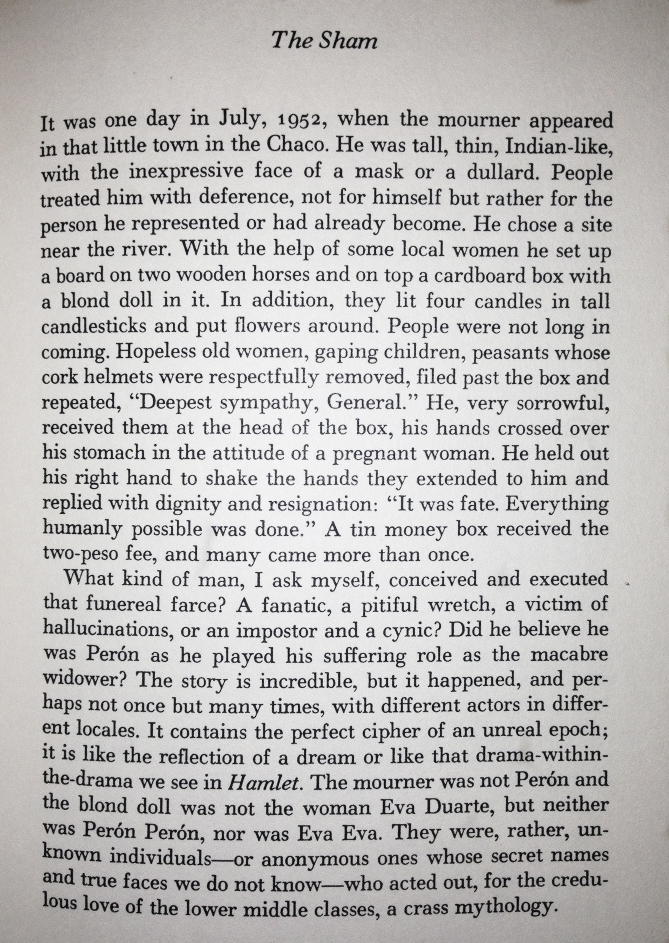
“The Sham” — Jorge Luis Borges

jlb

W.H. Auden Comic (Tom Gauld)

3364580035_c3b19ce349_o

“On a Notebook” — Hilaire Belloc

“On a Notebook” by Hilaire Belloc

A dear friend of mine (John Abdullah Capricorn, to give him his full name) was commandeered by a publisher last year to write a book for £10. The work was far advanced when an editor offered him £15 and his expenses to visit the more desperate parts of the Sahara Desert, to which spots he at once proceeded upon a roving commission. Whether he will return or no is now doubtful, though in March we had the best hopes. With the month of May life becomes hard for Europeans south of the Atlas, and when my poor dear friend was last heard of he was chancing his popularity with a tribe of Touaregs about two hundred miles south of Touggourt.

Under these circumstances I was asked to look through his notebook and see what could be done; and I confess to a pleased surprise…. It would have been a very entertaining book had it been published. It will be a very entertaining book if it is published.

Capricorn seems to have prepared a hotchpotch of information of human follies, of contrasts, and of blunt stupidities of which he intended to make a very entertaining series of pages. I have not his talent for bringing such things together, but it may amuse the reader if I merely put in their order one or two of the notes which most struck me.

I find first, cut out of a newspaper and pasted into the book (many of his notes are in this form), the following really jovial paragraph:

“Archdeacon Blunderbuss (Blunderbuss is not the real name; I suppress that lest Capricorn’s widow should lose her two or three pounds, in case the poor fellow has really been eaten). Archdeacon Blunderbuss was more distinguished as a scholar than as a Divine. He was a very poor preacher and never managed to identify himself with any party. Nevertheless, in 1895 the Prime Minister appointed him to a stall in Shoreham Cathedral as a recognition of his great learning and good work at Durham. Two years later the rectory of St. Vacuums becoming vacant and it being within the gift of Archdeacon Blunderbuss, he excited general amazement and much scandal by presenting himself to the living.”

There the paragraph ends. It came in an ordinary society paper. It bore no marks of ill-will. It came in the midst of a column of the usual silly adulation of everybody and everything; how it got there is of no importance. There it stood and the keen eye of Capricorn noted it and treasured it for years.

I will make no comment upon this paragraph. It may be read slowly or quickly, according to the taste of the reader; it is equally delicious either way.

The next excerpt I find in the notebook is as follows:

“More than 15,000,000 visits are paid annually to London pawnbrokers.

“Jupiter is 1387 times as big as the earth, but only 300 times as heavy.

“The world’s coal mines yield 400,000,000 tons of coal a year.

“The value of the pictures in the National Gallery is about £1,250,000.” Continue reading ““On a Notebook” — Hilaire Belloc”

Seven Entries from Anton Chekhov’s Note-Books

Mankind has conceived history as a series of battles; hitherto it has considered fighting as the main thing in life.

Solomon made a great mistake when he asked for wisdom.

Ordinary hypocrites pretend to be doves; political and literary hypocrites pretend to be eagles. But don’t be disconcerted by their aquiline appearance. They are not eagles, but rats or dogs.

Those who are more stupid and more dirty than we are called the people. The administration classifies the population into taxpayers and non-taxpayers. But neither classification will do; we are all the people and all the best we are doing is the people’s work.

If the Prince of Monaco has a roulette table, surely convicts may play at cards.

Aliosha: “My mind, mother, is weakened by illness and I am now like a child: now I pray to God, now I cry, now I am happy.”

Why did Hamlet trouble about ghosts after death, when life itself is haunted by ghosts so much more terrible?

Notations from Anton Chekhov’s Note-books.


Made-up Flowers from Boris Vian’s Novel Heartsnatcher

In the order they appear:

Amizaltzes

Powaroses

Marienbud

Yellowplush

Dreamrape

Fenellacas

Ninastangas

Astrakhan

Marazardins

Seacrocus

Bruinzozos

Bazabobos

Petaleaves

Translated from the French by Stanley Chapman

“An Immortal” — Robert Walser

walser

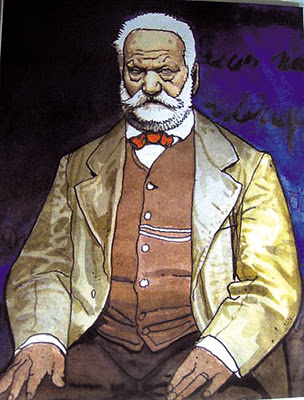
Portrait of Victor Hugo — Moebius

23993e0e301661297cd7e1d072471f1c

“Scandal” — Willa Cather

“Scandal” by Willa Cather

Kitty Ayrshire had a cold, a persistent inflammation of the vocal cords which defied the throat specialist. Week after week her name was posted at the Opera, and week after week it was canceled, and the name of one of her rivals was substituted. For nearly two months she had been deprived of everything she liked, even of the people she liked, and had been shut up until she had come to hate the glass windows between her and the world, and the wintry stretch of the Park they looked out upon. She was losing a great deal of money, and, what was worse, she was losing life; days of which she wanted to make the utmost were slipping by, and nights which were to have crowned the days, nights of incalculable possibilities, were being stolen from her by women for whom she had no great affection. At first she had been courageous, but the strain of prolonged uncertainty was telling on her, and her nervous condition did not improve her larynx. Every morning Miles Creedon looked down her throat, only to put her off with evasions, to pronounce improvement that apparently never got her anywhere, to say that tomorrow he might be able to promise something definite.

Her illness, of course, gave rise to rumours—rumours that she had lost her voice, that at some time last summer she must have lost her discretion. Kitty herself was frightened by the way in which this cold hung on. She had had many sharp illnesses in her life, but always, before this, she had rallied quickly. Was she beginning to lose her resiliency? Was she, by any cursed chance, facing a bleak time when she would have to cherish herself? She protested, as she wandered about her sunny, many-windowed rooms on the tenth floor, that if she was going to have to live frugally, she wouldn’t live at all. She wouldn’t live on any terms but the very generous ones she had always known. She wasn’t going to hoard her vitality. It must be there when she wanted it, be ready for any strain she chose to put upon it, let her play fast and loose with it; and then, if necessary, she would be ill for a while and pay the piper. But be systematically prudent and parsimonious she would not. Continue reading ““Scandal” — Willa Cather”

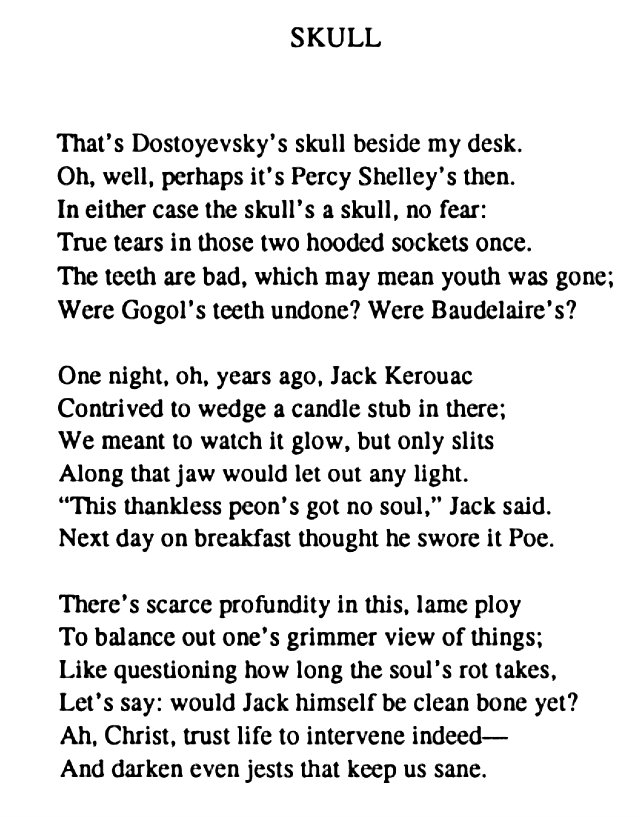
“Skull” — David Markson

skull

(Via).

“Elegy with Surrealist Proverbs as Refrain” — Dana Gioia

“Elegy with Surrealist Proverbs as Refrain” by Dana Gioia—

“Poetry must lead somewhere,” declared Breton.
He carried a rose inside his coat each day
to give a beautiful stranger—“Better to die of love
than love without regret.” And those who loved him
soon learned regret. “The simplest surreal act
is running through the street with a revolver
firing at random.” Old and famous, he seemed démodé.
There is always a skeleton on the buffet.

Wounded Apollinaire wore a small steel plate
inserted in his skull. “I so loved art,” he smiled,
“I joined the artillery.” His friends were asked to wait
while his widow laid a crucifix across his chest.
Picasso hated death. The funeral left him so distressed
he painted a self-portrait. “It’s always other people,”
remarked Duchamp, “who do the dying.”
I came. I sat down. I went away.

Dali dreamed of Hitler as a white-skinned girl—
impossibly pale, luminous and lifeless as the moon.
Wealthy Roussel taught his poodle to smoke a pipe.
“When I write, I am surrounded by radiance.
My glory is like a great bomb waiting to explode.”
When his valet refused to slash his wrists,
the bankrupt writer took an overdose of pills.
There is always a skeleton on the buffet.

Breton considered suicide the truest art,
though life seemed hardly worth the trouble to discard.
The German colonels strolled the Île de la Cité—
some to the Louvre, some to the Place Pigalle.
“The loneliness of poets has been erased,” cried Éluard,
in praise of Stalin. “Burn all the books,” said dying Hugo Ball.
There is always a skeleton on the buffet.
I came. I sat down. I went away.

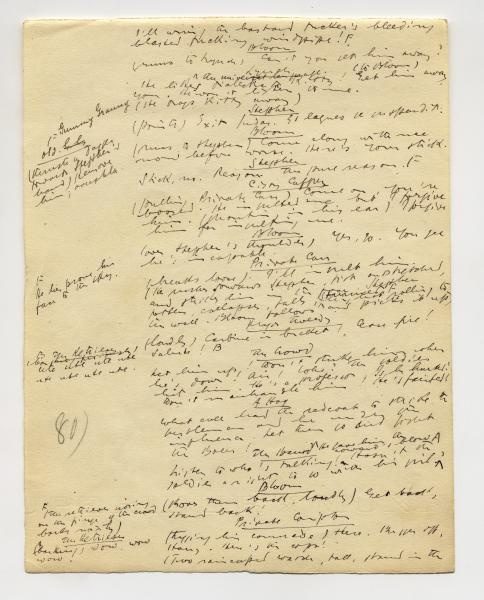
Handwritten Fragment of James Joyce’s Ulysses

ulysses

A fragment from the “Circe” episode of James Joyce’s Ulysses. Via/more.

Nine Notes from Nathaniel Hawthorne’s Note-Books

  1. The elephant is not particularly sagacious in the wild state, but becomes so when tamed. The fox directly the contrary, and likewise the wolf.
  2. A modern Jewish adage,–“Let a man clothe himself beneath his ability, his children according to his ability, and his wife above his ability.”
  3. It is said of the eagle, that, in however long a flight, he is never seen to clap his wings to his sides. He seems to govern his movements by the inclination of his wings and tail to the wind, as a ship is propelled by the action of the wind on her sails.
  4. In old country-houses in England, instead of glass for windows, they used wicker, or fine strips of oak disposed checkerwise. Horn was also used. The windows of princes and great noblemen were of crystal; those of Studley Castle, Holinshed says, of beryl. There were seldom chimneys; and they cooked their meats by a fire made against an iron back in the great hall. Houses, often of gentry, were built of a heavy timber frame, filled up with lath and plaster. People slept on rough mats or straw pallets, with a round log for a pillow; seldom better beds than a mattress, with a sack of chaff for a pillow.
  5. In this dismal chamber FAME was won. (Salem, Union Street.)
  6. Those who are very difficult in choosing wives seem as if they would take none of Nature’s ready-made works, but want a woman manufactured particularly to their order.
  7. A council of the passengers in a street: called by somebody to decide upon some points important to him.
  8. Every individual has a place to fill in the world, and is important, in some respects, whether he chooses to be so or not.
  9. Merry, “in merry England,” does not mean mirthful; but is corrupted from an old Teutonic word signifying famous or renowned.

Notations from Nathaniel Hawthorne’s American Note-Books

Tintoretto’s Abduction of the Body of St. Mark / Kid Jesus the Hellraiser (Thomas Pynchon)

One day, strolling in the Piazzetta, Hunter motioned her under the arcade and into the Library, and pointed up at Tintoretto’s Abduction of the Body of St. Mark. She gazed for some time. “Well, if that ain’t the spookiest damned thing,” she whispered at last. “What’s going on?” she gestured nervously into those old Alexandrian shadows, where ghostly witnesses, up far too late, forever fled indoors before an unholy offense.

“It’s as if these Venetian painters saw things we can’t see anymore,” Hunter said. “A world of presences. Phantoms. History kept sweeping through, Napoleon, the Austrians, a hundred forms of bourgeois literalism, leading to its ultimate embodiment, the tourist—how beleaguered they must have felt. But stay in this town awhile, keep your senses open, reject nothing, and now and then you’ll see them.”

A few days later, at the Accademia, as if continuing the thought, he said, “The body, it’s another way to get past the body.”

“To the spirit behind it—” “But not to deny the body—to reimagine it. Even”—nodding over at the Titian on the far wall—“if it’s ‘really’ just different kinds of greased mud smeared on cloth—to reimagine it as light.”

“More perfect.”

“Not necessarily. Sometimes more terrible—mortal, in pain, misshapen, even taken apart, broken down into geometrical surfaces, but each time somehow, when the process is working, gone beyond. . . .”

Beyond her, she guessed. She was trying to keep up, but Hunter didn’t make it easy. One day he told her a story she had actually already heard, as a sort of bedtime story, from Merle, who regarded this as a parable, maybe the first on record, about alchemy. It was from the Infancy Gospel of Thomas, one of many pieces of Scripture that early church politics had kept from being included in the New Testament.

“Jesus was sort of a hellraiser as a kid,” as Merle had told it, “the kind of wayward youth I’m always finding you keepin company with, in fact, not that I’m objecting,” as she had sat up in bed and looked for something to assault him with, “used to go around town pulling these adolescent pranks, making little critters out of clay, bringing them to life, birds that could fly, rabbits that talked, and like that, driving his parents crazy, not to mention most of the local adults, who were always coming by to complain—‘You better tell ’at Jesus to watch it.’ One day he’s out with some friends looking for trouble to get into, and they happen to go by the dyer’s shop, where there’s all these pots with different colors of dye and piles of clothes next to them, all sorted and each pile ready to be dyed a different color, Jesus says, ‘Watch this,’ and grabs up all the clothes in one big bundle, the dyer’s yelling, ‘Hey Jesus, what’d I tell you last time?’ drops what he’s doing and goes chasing after the kid, but Jesus is too fast for him, and before anybody can stop him he runs over to the biggest pot, the one with red dye in it, and dumps all the clothes in, and runs away laughing. The dyer is screaming bloody murder, tearing his beard, thrashing around on the ground, he sees his whole livelihood destroyed, even Jesus’s lowlife friends think this time he’s gone a little too far, but here comes Jesus with his hand up in the air just like in the paintings, calm as anything—‘Settle down, everybody,’ and he starts pulling the clothes out of that pot again, and what do you know, each one comes out just the color it’s supposed to be, not only that but the exact shade of that color, too, no more housewives hollerin ‘hey I wanted lime green not Kelly green, you colorblind or something,’ no this time each item is the perfect color it was meant to be.”

“Not a heck of a lot different,” it had always seemed to Dally, “in fact, from that Pentecost story in Acts of the Apostles, which did get in the Bible, not colors this time but languages, Apostles are meeting in a house in Jerusalem, you’ll recall, Holy Ghost comes down like a mighty wind, tongues of fire and all, the fellas come out and start talking to the crowd outside, who’ve all been jabbering away in different tongues, there’s Romans and Jews, Egyptians and Arabians, Mesopotamians and Cappadocians and folks from east Texas, all expecting to hear just the same old Galilean dialect—but instead this time each one is amazed to hear those Apostles speaking to him in his own language.”

Hunter saw her point. “Yes, well it’s redemption, isn’t it, you expect chaos, you get order instead. Unmet expectations. Miracles.”

Another amazing passage from Thomas Pynchon’s novel Against the Day.


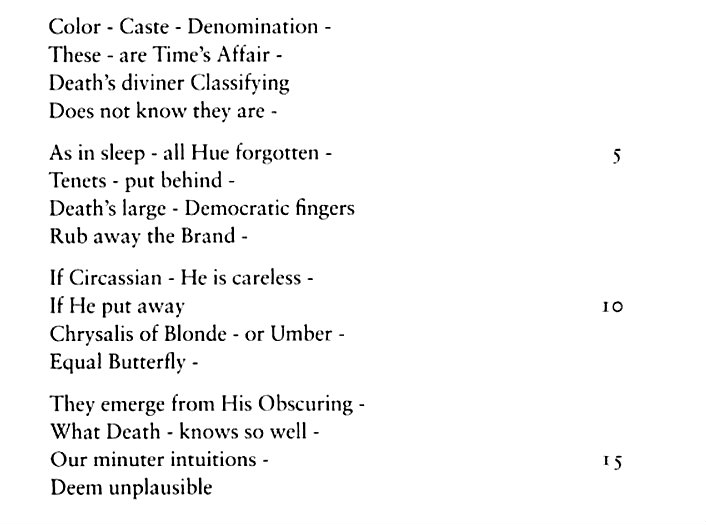
“Color — Caste — Denomination — ” — Emily Dickinson

ccd

Thomas Pynchon Offers a History of the Cult of Mayonnaise (And Some Hat-Fetishism)

THE NEXT TIME he saw Pléiade Lafrisée was at a café-restaurant off the Place d’Armes. It would not occur to him until much later to wonder if she had arranged the encounter. She was in pale violet peau de soie, and a hat so beguiling that Kit was only momentarily surprised to find himself with an erection. It was still early in the study of these matters, only a few brave pioneers like the Baron von Krafft-Ebing had dared peep into the strange and weirdly twilit country of hat-fetishism—not that Kit noticed stuff like that ordinarily, but it happened actually to be a gray toque of draped velvet, trimmed with antique guipure, and a tall ostrich plume dyed the same shade of violet as her dress. . . .

“This? One finds them in every other midinette’s haunt, literally for sous.”

“Oh. I must’ve been staring. What happened to you the other night?”

“Come. You can buy me a Lambic.”

The place was like a museum of mayonnaise. This being just at the height of the culte de la mayonnaise then sweeping Belgium, oversize exhibits of the ovoöleaginous emulsion were to be encountered at every hand. Heaps of Mayonnaise Grenache, surrounded by plates of smoked turkey and tongue, glowed redly as if from within, while with less, if any, reference to actual food it might have been there to modify, mountains of Chantilly mayonnaise, swept upward in gravity-impervious peaks insubstantial as cloud, along with towering masses of green mayonnaise, basins of boiled mayonnaise, mayonnaise baked into soufflés, not to mention a number of not entirely successful mayonnaises, under some obscure attainder, or on occasion passing as something else, dominated every corner.

“How much do you know of La Mayonnaise?” she inquired.

He shrugged. “Maybe up to the part that goes ‘Aux armes, citoyens’—”

But she was frowning, earnest as he had seldom seen her. “La Mayonnaise,” Pléiade explained, “has its origins in the moral squalor of the court of Louis XV—here in Belgium the affinity should not be too surprising. The courts of Leopold and Louis are not that different except in time, and what is time? Both monumentally deluded men, maintaining their power through oppression of the innocent. One might usefully compare Cleo de Mérode and the marquise de Pompadour. Neuropathists would recognize in both kings a desire to construct a self-consistent world to live inside, which allows them to continue the great damage they are inflicting on the world the rest of us must live in.

“The sauce was invented as a new sensation for jaded palates at court by the duc de Richelieu, at first known as mahonnaise after Mahon, the chief port of Minorca, the scene of the due’s dubious ‘victory’ in 1756 over the illfated Admiral Byng. Basically Louis’s drug dealer and pimp, Richelieu, known for opium recipes to fit all occasions, is also credited with the introduction into France of the cantharides, or Spanish fly.” She gazed pointedly at Kit’s trousers. “What might this aphrodisiac have in common with the mayonnaise? That the beetles must be gathered and killed by exposing them to vinegar fumes suggests an emphasis on living or recently living creatures—the egg yolk perhaps regarded as a conscious entity—cooks will speak of whipping, beating, binding, penetration, submission, surrender. There is an undoubtedly Sadean aspect to the mayonnaise. No getting past that.”

Kit was a little confused by now. “It always struck me as kind of, I don’t know . . . bland?”

“Until you look within. Mustard, for example, mustard and cantharides, n’estce pas? Both arousing the blood. Blistering the skin. Mustard is the widelyknown key to resurrecting a failed mayonnaise, as is the cantharides to reviving broken desire.”

“You’ve been thinking about mayonnaise a lot, mademoiselle.”

“Meet me tonight,” a sudden fierce whisper, “out at the Mayonnaise Works, and you shall perhaps understand things it is given only to a few to know. There will be a carriage waiting.” She pressed his hand and was gone in a mist of vetiver, abruptly as the other evening.

Another citation from Thomas Pynchon’s novel Against the Day; I don’t think you need any context to appreciate this passage.


Rejection (David Markson)

rejection

(The last page of David Markson’s copy of The Failure of Criticism by Henri Peyre (via) — see the list of rejections of Markson’s own Wittgenstein’s Mistress).

“Delight in Disorder” — Robert Herrick

herrick