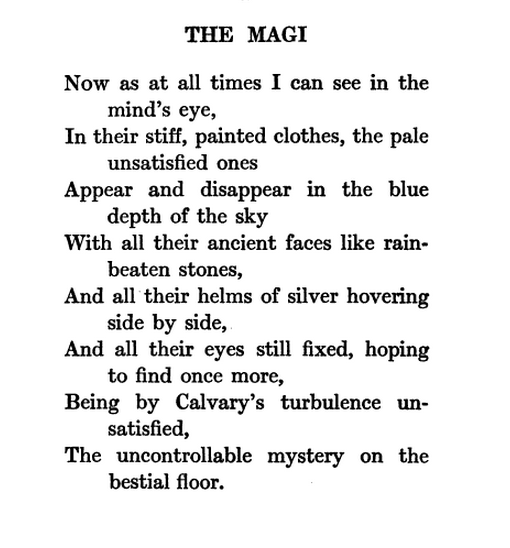
“The Magi” — William Butler Yeats

magi

Doubt is of the essence of Christ (Pynchon’s Mason & Dixon)

The Ascent to Christ is a struggle thro’ one heresy after another, River-wise up-country into a proliferation of Sects and Sects branching from Sects, unto Deism, faithless pretending to be holy, and beyond,— ever away from the Sea, from the Harbor, from all that was serene and certain, into an Interior unmapp’d, a Realm of Doubt. The Nights. The Storms and Beasts. The Falls, the Rapids, . . . the America of the Soul.
Doubt is of the essence of Christ. Of the twelve Apostles, most true to him was ever Thomas,— indeed, in the Acta Thomæ they are said to be Twins. The final pure Christ is pure uncertainty. He is become the central subjunctive fact of a Faith, that risks ev’rything upon one bodily Resurrection. . . . Wouldn’t something less doubtable have done? a prophetic dream, a communication with a dead person? Some few tatters of evidence to wrap our poor naked spirits against the coldness of a World where Mortality and its Agents may bully their way, wherever they wish to go. . . .

— The Reverend Wicks Cherrycoke, Undeliver’d Sermons

Preface to Ch. 53 of Thomas Pynchon’s novel Mason & Dixon.

“Vanka” — Anton Chekhov

“Vanka”

by

Anton Chekhov

Nine-year-old Vanka Zhukov, who had been apprentice to the shoemaker Aliakhin for three months, did not go to bed the night before Christmas. He waited till the master and mistress and the assistants had gone out to an early church-service, to procure from his employer’s cupboard a small phial of ink and a penholder with a rusty nib; then, spreading a crumpled sheet of paper in front of him, he began to write.

Before, however, deciding to make the first letter, he looked furtively at the door and at the window, glanced several times at the sombre ikon, on either side of which stretched shelves full of lasts, and heaved a heart-rending sigh. The sheet of paper was spread on a bench, and he himself was on his knees in front of it.

“Dear Grandfather Konstantin Makarych,” he wrote, “I am writing you a letter. I wish you a Happy Christmas and all God’s holy best. I have no mamma or papa, you are all I have.”

Vanka gave a look towards the window in which shone the reflection of his candle, and vividly pictured to himself his grandfather, Konstantin Makarych, who was night-watchman at Messrs. Zhivarev. He was a small, lean, unusually lively and active old man of sixty-five, always smiling and blear-eyed. All day he slept in the servants’ kitchen or trifled with the cooks. At night, enveloped in an ample sheep-skin coat, he strayed round the domain tapping with his cudgel. Behind him, each hanging its head, walked the old bitch Kashtanka, and the dog Viun, so named because of his black coat and long body and his resemblance to a loach. Viun was an unusually civil and friendly dog, looking as kindly at a stranger as at his masters, but he was not to be trusted. Beneath his deference and humbleness was hid the most inquisitorial maliciousness. No one knew better than he how to sneak up and take a bite at a leg, or slip into the larder or steal a muzhik’s chicken. More than once they had nearly broken his hind-legs, twice he had been hung up, every week he was nearly flogged to death, but he always recovered. Continue reading ““Vanka” — Anton Chekhov”

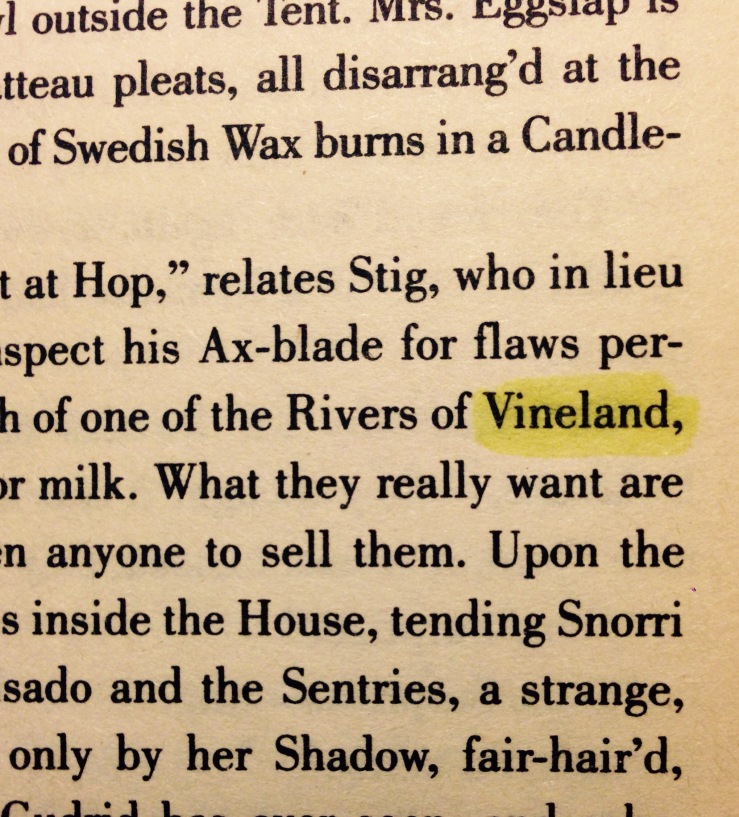
Vineland (Thomas Pynchon’s Mason & Dixon)

IMG_4503

From the beginning of ch. 66 of Mason & Dixon; see also.

Read “The Fir-Tree,” Hans Christian Andersen’s Depressing Story About the Existential Fate of a Christmas Tree

“The Fir-Tree” by Hans Christian Andersen

Far down in the forest, where the warm sun and the fresh air made a sweet resting-place, grew a pretty little fir-tree; and yet it was not happy, it wished so much to be tall like its companions— the pines and firs which grew around it. The sun shone, and the soft air fluttered its leaves, and the little peasant children passed by, prattling merrily, but the fir-tree heeded them not. Sometimes the children would bring a large basket of raspberries or strawberries, wreathed on a straw, and seat themselves near the fir-tree, and say, “Is it not a pretty little tree?” which made it feel more unhappy than before. And yet all this while the tree grew a notch or joint taller every year; for by the number of joints in the stem of a fir-tree we can discover its age. Still, as it grew, it complained, “Oh! how I wish I were as tall as the other trees, then I would spread out my branches on every side, and my top would over-look the wide world. I should have the birds building their nests on my boughs, and when the wind blew, I should bow with stately dignity like my tall companions.” The tree was so discontented, that it took no pleasure in the warm sunshine, the birds, or the rosy clouds that floated over it morning and evening. Sometimes, in winter, when the snow lay white and glittering on the ground, a hare would come springing along, and jump right over the little tree; and then how mortified it would feel! Two winters passed, and when the third arrived, the tree had grown so tall that the hare was obliged to run round it. Yet it remained unsatisfied, and would exclaim, “Oh, if I could but keep on growing tall and old! There is nothing else worth caring for in the world!” In the autumn, as usual, the wood-cutters came and cut down several of the tallest trees, and the young fir-tree, which was now grown to its full height, shuddered as the noble trees fell to the earth with a crash. After the branches were lopped off, the trunks looked so slender and bare, that they could scarcely be recognized. Then they were placed upon wagons, and drawn by horses out of the forest. “Where were they going? What would become of them?” The young fir-tree wished very much to know; so in the spring, when the swallows and the storks came, it asked, “Do you know where those trees were taken? Did you meet them?”

The swallows knew nothing, but the stork, after a little reflection, nodded his head, and said, “Yes, I think I do. I met several new ships when I flew from Egypt, and they had fine masts that smelt like fir. I think these must have been the trees; I assure you they were stately, very stately.”
“Oh, how I wish I were tall enough to go on the sea,” said the fir-tree. “What is the sea, and what does it look like?”

“It would take too much time to explain,” said the stork, flying quickly away.

“Rejoice in thy youth,” said the sunbeam; “rejoice in thy fresh growth, and the young life that is in thee.”

And the wind kissed the tree, and the dew watered it with tears; but the fir-tree regarded them not. Continue reading “Read “The Fir-Tree,” Hans Christian Andersen’s Depressing Story About the Existential Fate of a Christmas Tree”

A Mason & Dixon Christmastide (Thomas Pynchon)

They discharge the Hands and leave off for the Winter. At Christmastide, the Tavern down the Road from Harlands’ opens its doors, and soon ev’ryone has come inside. Candles beam ev’rywhere. The Surveyors, knowing this year they’ll soon again be heading off in different Directions into America, stand nodding at each other across a Punch-bowl as big as a Bathing-Tub. The Punch is a secret Receipt of the Landlord, including but not limited to peach brandy, locally distill’d Whiskey, and milk. A raft of long Icicles broken from the Eaves floats upon the pale contents of the great rustick Monteith. Everyone’s been exchanging gifts. Somewhere in the coming and going one of the Children is learning to play a metal whistle. Best gowns rustle along the board walls. Adults hold Babies aloft, exclaiming, “The little Sausage!” and pretending to eat them. There are popp’d Corn, green Tomato Mince Pies, pickl’d Oysters, Chestnut Soup, and Kidney Pudding. Mason gives Dixon a Hat, with a metallick Aqua Feather, which Dixon is wearing. Dixon gives Mason a Claret Jug of silver, crafted in Philadelphia. There are Conestoga Cigars for Mr. Harland and a Length of contraband Osnabrigs for Mrs. H. The Children get Sweets from a Philadelphia English-shop, both adults being drawn into prolong’d Negotiations with their Juniors, as to who shall have which of. Mrs. Harland comes over to embrace both Surveyors at once. “Thanks for simmering down this Year. I know it ain’t easy.”
“What a year, Lass,” sighs Dixon.
“Poh. Like eating a Bun,” declares Mason.”

The last paragraphs of Ch. 52 of Thomas Pynchon’s novel Mason & Dixon.

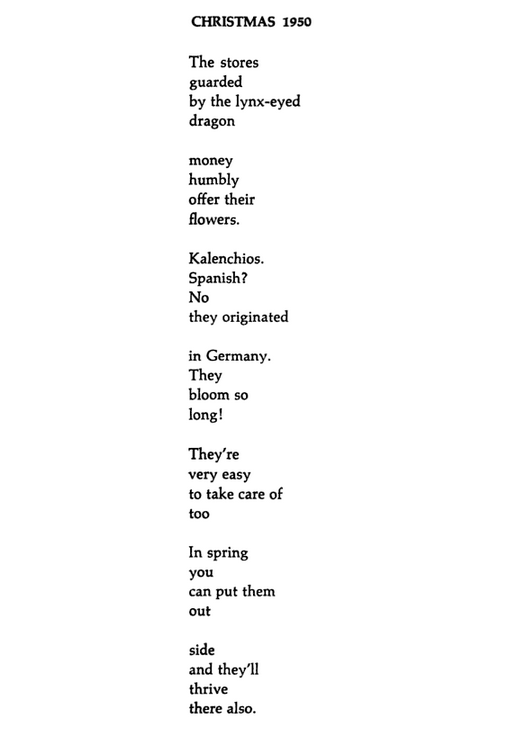
“Christmas 1950” — William Carlos Williams

wcw

A thousand Christmas trees (Robert Frost)

trees

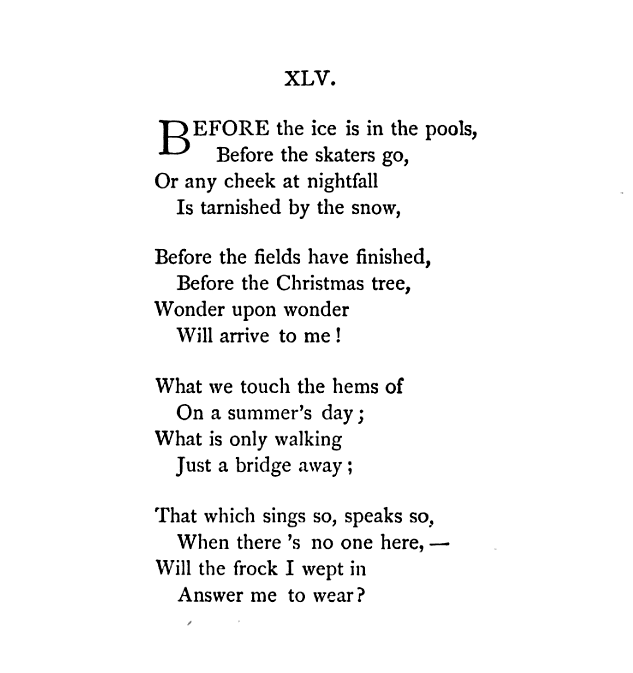
“Before the ice is in the pools” — Emily Dickinson

ed

“The Midwinter Fires” — Sir James George Frazer

“The Midwinter Fires”

by

Sir James George Frazer

from The Golden Bough

If the heathen of ancient Europe celebrated, as we have good reason to believe, the season of Midsummer with a great festival of fire, of which the traces have survived in many places down to our own time, it is natural to suppose that they should have observed with similar rites the corresponding season of Midwinter; for Midsummer and Midwinter, or, in more technical language, the summer solstice and the winter solstice, are the two great turningpoints in the sun’s apparent course through the sky, and from the standpoint of primitive man nothing might seem more appropriate than to kindle fires on earth at the two moments when the fire and heat of the great luminary in heaven begin to wane or to wax.

In modern Christendom the ancient fire-festival of the winter solstice appears to survive, or to have survived down to recent years, in the old custom of the Yule log, clog, or block, as it was variously called in England. The custom was widespread in Europe, but seems to have flourished especially in England, France, and among the South Slavs; at least the fullest accounts of the custom come from these quarters. That the Yule log was only the winter counterpart of the midsummer bonfire, kindled within doors instead of in the open air on account of the cold and inclement weather of the season, was pointed out long ago by our English antiquary John Brand; and the view is supported by the many quaint superstitions attaching to the Yule log, superstitions which have no apparent connexion with Christianity but carry their heathen origin plainly stamped upon them. But while the two solstitial celebrations were both festivals of fire, the necessity or desirability of holding the winter celebration within doors lent it the character of a private or domestic festivity, which contrasts strongly with the publicity of the summer celebration, at which the people gathered on some open space or conspicuous height, kindled a huge bonfire in common, and danced and made merry round it together. Continue reading ““The Midwinter Fires” — Sir James George Frazer”

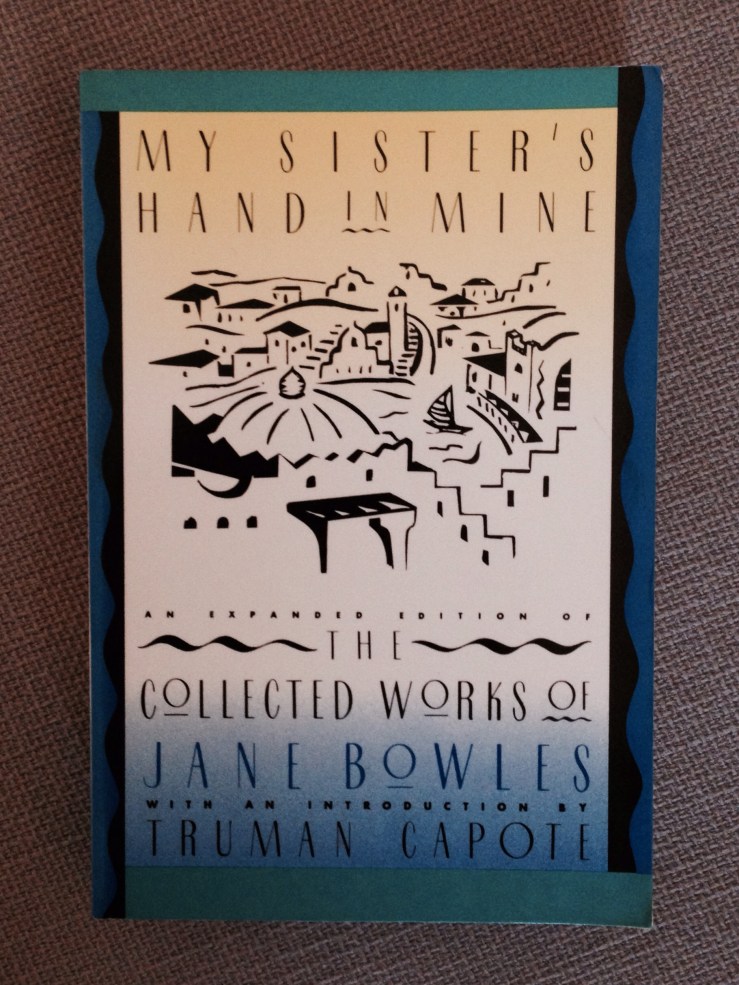
The Collected Works of Jane Bowles (Book Acquired, 12.19.2014)

IMG_4412

I picked up My Sister’s Hand in Mine: The Collected Works of Jane Bowles mostly because I couldn’t find a stand-alone version of the novel Two Serious Ladies. I guess it doesn’t hurt to have, y’know, all of her stuff (or really most of her stuff), but I’m not really a fan of omnibus editions. My interest in Two Serious Ladies was piqued by Ben Marcus, whom I interviewed by phone earlier this month (still transcribing that one; hope to run it in January). He spoke highly of the book and includes it on his writing syllabus.

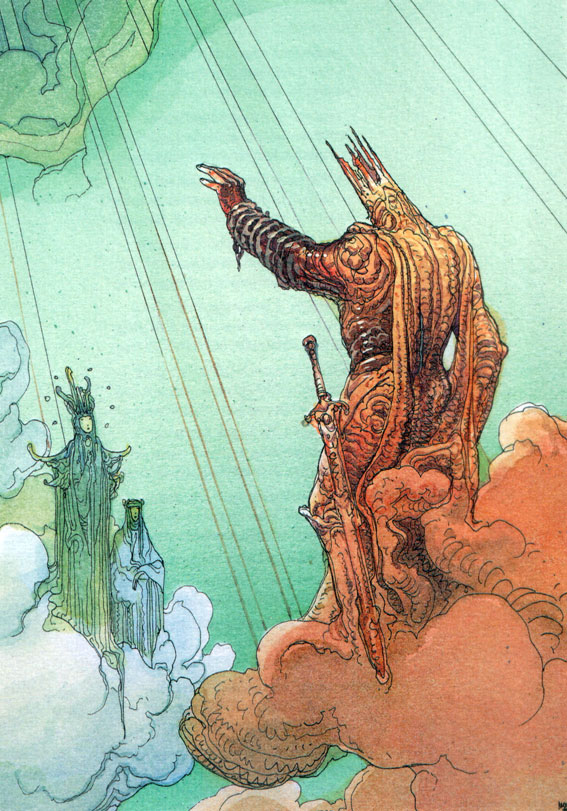
Moebius’s Divine Comedy

moebius

(More/via).

Coffee or tea? (Thomas Pynchon’s Mason & Dixon)

Mason is trying to wake up. The nearest coffee is in the cook-tent. “Pray you,” he whispers, “try not to be so damn’d,— did I say damn’d? I meant so fucking chirpy all the time, good chap, good chap,” stumbling out of the Tent trying to get his Hair into some kind of Queue. The Coffee is brew’d with the aid of a Fahrenheit’s Thermometer, unmark’d save at one place, exactly halfway between freezing and boiling, at 122°, where upon the Wood a small Arrow is inscrib’d, pointing at a Scratch across the glass Tube. ’Tis at this Temperature that the water receives the ground Coffee, the brew being stirr’d once or twice, the Pot remov’d from the fire, its Decoction then proceeding. Tho’ clarifying may make sense in London, out here ’tis a luxury, nor are there always Egg-shells to hand. If tasted early, Dixon has found, the fine suspended matter in the coffee lends it an undeniable rustick piquance. Later in the Pot, the Liquid charring itself toward Vileness appeals more to those looking for bodily stimuli,— like Dixon, who is able to sip the most degradedly awful pot’s-end poison and yet beam like an Idiot, “Mm-m m! Best Jamoke west o’ the Alleghenies!”— a phrase Overseer Barnes utters often, tho’ neither Surveyor quite understands it, especially as the Party are yet east of the Alleghenies. Howbeit, at this point in a Pot’s life-cycle, Mason prefers to switch over to Tea, when it is Dixon’s turn to begin shaking his head.

“Can’t understand how anyone abides that stuff.”

“How so?” Mason unable not to react.

“Well, it’s disgusting, isn’t it? Half-rotted Leaves, scalded with boiling Water and then left to lie, and soak, and bloat?”

“Disgusting? this is Tea, Friend, Cha,— what all tasteful London drinks,— that,” pollicating the Coffee-Pot, is what’s disgusting.”

“Au contraire,” Dixon replies, “Coffee is an art, where precision is all,— Water-Temperature, mean particle diameter, ratio of Coffee to Water or as we say, CTW, and dozens more Variables I’d mention, were they not so clearly out of thy technical Grasp,— ”

“How is it,” Mason pretending amiable curiosity, “that of each Pot of Coffee, only the first Cup is ever worth drinking,— and that, by the time I get to it, someone else has already drunk it?”

Dixon shrugs. “You must improve your Speed . . . ? As to the other, why aye, only the first Cup’s any good, owing to Coffee’s Sacramental nature, the Sacrament being Penance, entirely absent from thy sunlit World of Tay,— whereby the remainder of the Pot, often dozens of cups deep, represents the Price for enjoying that first perfect Cup.”

“Folly,” gapes Mason. “Why, ev’ry cup of Tea is perfect . . . ?”

“For what? curing hides?”

From chapter 48 of Thomas Pynchon’s novel Mason & Dixon.

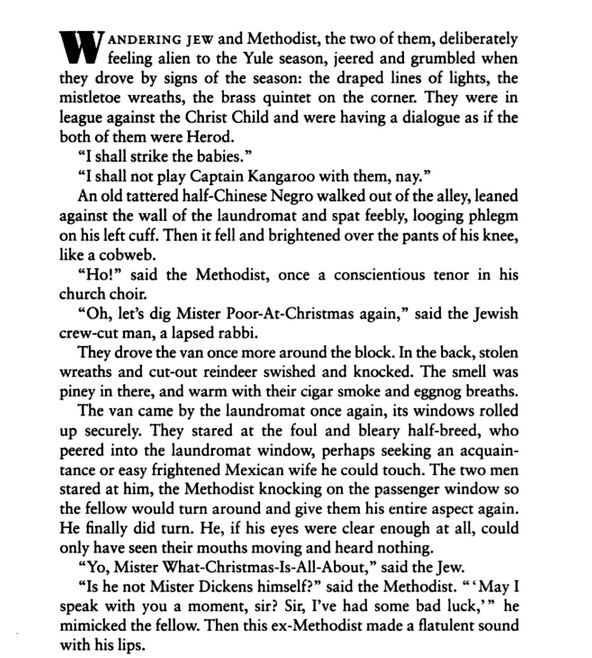
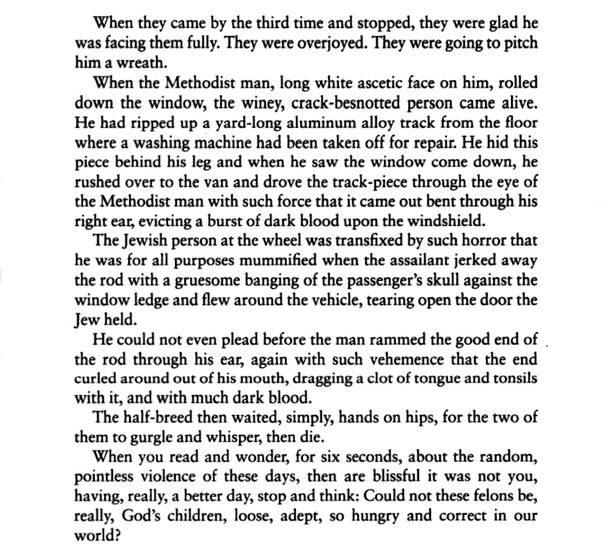
“A Christmas Thought” — Barry Hannah

Donald Barthelme interviewed by George Plimpton (Video)

From The University of Houston and via Jessamyn West.

“To read and to read and to read and to read” (Faulkner’s advice to young writers)

Unidentified participant: Mr. Faulkner, you may have touched on this previously, but could you give some advice to young writers? What advice would you give to young writers?

William Faulkner: At one time I thought the most important thing was talent. I think now that—that the young man or the young woman must possess or teach himself, train himself, in infinite patience, which is to—to try and to try and to try until it comes right. He must train himself in ruthless intolerance. That is, to throw away anything that is false no matter how much he might love that page or that paragraph. The most important thing is insight, that is, to be—to curiosity—to—to wonder, to mull, and to—to—to muse why it is that man does what he does. And if you have that, then I don’t think the talent makes much difference, whether you’ve got that or not.

Unidentified participant: How would you suggest that he get this insight? Through experience?

William Faulkner: Yes, and then the greatest part of experience is in the books, to read. To read and to read and to read and to read. To watch people, to have—to never judge people. To watch people, what they do, with—with—without intolerance. Simply to—to learn why it is they did what they did.

More/audio.

Duck Tales (Thomas Pynchon’s Mason & Dixon)

Back Inhabitants all up and down the Line soon begin taking the Frenchman’s Duck to their Bosoms, for being exactly what they wish to visit their lives at this Moment,— something possess’d of extra-natural Powers,— Invisibility, inexhaustible Strength, an upper Velocity Range that makes her the match, in Momentum, of much larger opponents,— Americans desiring generally, that ev’ry fight be fair. Soon Tales of Duck Exploits are ev’rywhere the Line may pass. The Duck routs a great army of Indians. The Duck levels a Mountain west of here. In a single afternoon the Duck, with her Beak, has plow’d ev’ry Field in the County, at the same time harrowing with her Tail. That Duck!
As to the Duck’s actual Presence, Opinions among the Party continue to vary. Axmen, for whom tales of disaster, stupidity, and blind luck figure repeatably as occasions for merriment, take to shouting at their Companions, “There she goes!” or, “Nearly fetch’d ye one!” whilst those more susceptible to the shifts of Breeze between the Worlds, notably at Twilight, claim to’ve seen the actual Duck, shimmering into Visibility, for a few moments, then out again.
“I might’ve tried to draw a bead onto it, . . . but it knew I was there. It came walking over and look’d me thump in the eye. I was down flat, we were at the same level, see. ‘Where am I?’ it wants to know. ‘Pennsylvania or Maryland, take your pick,’ says I. It had this kind of Expression onto its Face, and seem’d jumpy. I tried to calm it down. It gave that Hum, and grew vaporous, and disappear’d.”
Mason and Dixon attempt to ignore as much of this as they may, both assuming ’tis only another episode of group Folly, to which this Project seems particularly given, and that ’twill pass all too soon, to be replaced by another, and so on, till perhaps, one day, by something truly dangerous.

From Chapter 45 of Thoma Pynchon’s novel Mason & Dixon.