“How the First Letter Was Written” — Rudyard Kipling

ONCE upon a most early time was a Neolithic man. He was not a Jute or an Angle, or even a Dravidian, which he might well have been, Best Beloved, but never mind why. He was a Primitive, and he lived cavily in a Cave, and he wore very few clothes, and he couldn’t read and he couldn’t write and he didn’t want to, and except when he was hungry he was quite happy. His name was Tegumai Bopsulai, and that means, ‘Man-who-does-not-put-his-foot-forward-in-a-hurry’; but we, O Best Beloved, will call him Tegumai, for short. And his wife’s name was Teshumai Tewindrow, and that means, ‘Lady-who-asks-a-very-many-questions’; but we, O Best Beloved, will call her Teshumai, for short. And his little girl-daughter’s name was Taffimai Metallumai, and that means, ‘Small-person-without-any-manners-who-ought-to-be-spanked’; but I’m going to call her Taffy. And she was Tegumai Bopsulai’s Best Beloved and her own Mummy’s Best Beloved, and she was not spanked half as much as was good for her; and they were all three very happy. As soon as Taffy could run about she went everywhere with her Daddy Tegumai, and sometimes they would not come home to the Cave till they were hungry, and then Teshumai Tewindrow would say, ‘Where in the world have you two been to, to get so shocking dirty? Really, my Tegumai, you’re no better than my Taffy.’

Now attend and listen! Continue reading ““How the First Letter Was Written” — Rudyard Kipling” →

“The Man and the Snake” — Ambrose Bierce

“The Man and the Snake”

by

Ambrose Bierce

I

It is of veritabyll report, and attested of so many that there be nowe of wyse and learned none to gaynsaye it, that ye serpente hys eye hath a magnetick propertie that whosoe falleth into its svasion is drawn forwards in despyte of his wille, and perisheth miserabyll by ye creature hys byte.

Stretched at ease upon a sofa, in gown and slippers, Harker Brayton smiled as he read the foregoing sentence in old Morryster’s “Marvells of Science.” “The only marvel in the matter,” he said to himself, “is that the wise and learned in Morryster’s day should have believed such nonsense as is rejected by most of even the ignorant in ours.”

A train of reflections followed—for Brayton was a man of thought— and he unconsciously lowered his book without altering the direction of his eyes. As soon as the volume had gone below the line of sight, something in an obscure corner of the room recalled his attention to his surroundings. What he saw, in the shadow under his bed, were two small points of light, apparently about an inch apart. They might have been reflections of the gas jet above him, in metal nail heads; he gave them but little thought and resumed his reading. A moment later something—some impulse which it did not occur to him to analyze—impelled him to lower the book again and seek for what he saw before. The points of light were still there. They seemed to have become brighter than before, shining with a greenish luster which he had not at first observed. He thought, too, that they might have moved a trifle—were somewhat nearer. They were still too much in the shadow, however, to reveal their nature and origin to an indolent attention, and he resumed his reading. Suddenly something in the text suggested a thought which made him start and drop the book for the third time to the side of the sofa, whence, escaping from his hand, it fell sprawling to the floor, back upward. Brayton, half-risen, was staring intently into the obscurity beneath the bed, where the points of light shone with, it seemed to him, an added fire. His attention was now fully aroused, his gaze eager and imperative. It disclosed, almost directly beneath the foot rail of the bed, the coils of a large serpent—the points of light were its eyes! Its horrible head, thrust flatly forth from the innermost coil and resting upon the outermost, was directed straight toward him, the definition of the wide, brutal jaw and the idiotlike forehead serving to show the direction of its malevolent gaze. The eyes were no longer merely luminous points; they looked into his own with a meaning, a malign significance. Continue reading ““The Man and the Snake” — Ambrose Bierce” →

Musical Duet Summary of Pynchon’s Mason & Dixon in Two Stanzas

IMG_4610

From Ch. 77 of Thomas Pynchon’s Mason & Dixon. I love the elision expressed in those dashes — “I say, was that–” — I say, was that a talking dog? I say, was that were-beaver? I say, was that a giant cannabis plant? I say, was that a Sino-Jesuit cabal? I say, was that the Lost Tribe of Israel? I say, was that the missing 11 days, and the Asiatick Pygmies who inhabit them? I say, was that a mechanical duck, looking for love? I say, was that an electric eel? I say, was that a recipe for catsup? I say, was that the first English pizza? I say, was that The Black Dog? I say, was that an iron bathtub? I say, was that a ridotto of inflamed debauchery? I say, was that a Masonic conspiracy? I say, was that the metaphysical wind? I say, was that a dead wife’s ghost? I say, was that a friendship? I say!

Thomas Pynchon’s Mason & Dixon (Third Riff: The Rabbi of Prague)

A. I’m a few chapters–three, precisely—from finishing Mason & Dixon. “Finishing” is not the right verb here, though—Pynchon’s novel is so rich, funny, strange, and energetic that I want to return to it immediately.

B. But I need to backtrack a bit, riff on one of my favorite episodes—Chapter 50.

C. (First riff and second riff for those inclined).

D. In Chapter 50,

’tis Dixon’s luck to discover The Rabbi of Prague, headquarters of a Kabbalistick Faith, in Correspondence with the Elect Cohens of Paris, whose private Salute they now greet Dixon with, the Fingers spread two and two, and the Thumb held away from them likewise, said to represent the Hebrew letter Shin and to signify, “Live long and prosper.”

Pynchon plays here on the reader’s initial understanding of the signal and phrase as a pop culture reference—


—but the goof isn’t merely postmodernist shtick—Pynchon is pointing to how the invisible manifests itself in signs and wonders, covert, cryptic, but perhaps—perhaps—decipherable.

E. (Maybe this needs clarification: The Rabbi of Prague is a tavern. I lost track of how many bars taverns pubs inns alehouses coffeehouses etc. show up in M&D). Continue reading “Thomas Pynchon’s Mason & Dixon (Third Riff: The Rabbi of Prague)” →

Balestrini/Pasolini (Books acquired, 12.27.2014)

verso

So I picked up two ebooks from Verso today for less than a pint of beer. Ridiculous! The Unseen by Nanni Balestrini, and Pasolini’s unproduced screenplay St. Paul. All kinds of great stuff. I think my favorite thing about Verso’s ebooks is how straightforward they are to access—no weird third-party app or DRM issues.

“Fancy’s Show-Box” — Nathaniel Hawthorne

“Fancy’s Show-Box”

by

Nathaniel Hawthorne

What is guilt? A stain upon the soul. And it is a point of vast interest whether the soul may contract such stains in all their depth and flagrancy from deeds which may have been plotted and resolved upon, but which physically have never had existence. Must the fleshly hand and visible frame of man set its seal to the evil designs of the soul, in order to give them their entire validity against the sinner? Or, while none but crimes perpetrated are cognizable before an earthly tribunal, will guilty thoughts—of which guilty deeds are no more than shadows,—will these draw down the full weight of a condemning sentence in the supreme court of eternity? In the solitude of a midnight chamber or in a desert afar from men or in a church while the body is kneeling the soul may pollute itself even with those crimes which we are accustomed to deem altogether carnal. If this be true, it is a fearful truth.

Let us illustrate the subject by an imaginary example. A venerable gentleman—one Mr. Smith—who had long been regarded as a pattern of moral excellence was warming his aged blood with a glass or two of generous wine. His children being gone forth about their worldly business and his grandchildren at school, he sat alone in a deep luxurious arm-chair with his feet beneath a richly-carved mahogany table. Some old people have a dread of solitude, and when better company may not be had rejoice even to hear the quiet breathing of a babe asleep upon the carpet. But Mr. Smith, whose silver hair was the bright symbol of a life unstained except by such spots as are inseparable from human nature—he had no need of a babe to protect him by its purity, nor of a grown person to stand between him and his own soul. Nevertheless, either manhood must converse with age, or womanhood must soothe him with gentle cares, or infancy must sport around his chair, or his thoughts will stray into the misty region of the past and the old man be chill and sad. Wine will not always cheer him. Continue reading ““Fancy’s Show-Box” — Nathaniel Hawthorne” →

“Merry Christmas” (Moby-Dick)

“Merry Christmas”

from Herman Melville’s Moby-Dick

At length, towards noon, upon the final dismissal of the ship’s riggers, and after the Pequod had been hauled out from the wharf, and after the ever-thoughtful Charity had come off in a whale-boat, with her last gift- a nightcap for Stubb, the second mate, her brother-in-law, and a spare Bible for the steward- after all this, the two Captains, Peleg and Bildad, issued from the cabin, and turning to the chief mate, Peleg said:

“Now, Mr. Starbuck, are you sure everything is right? Captain Ahab is all ready- just spoke to him- nothing more to be got from shore, eh? Well, call all hands, then. Muster ‘em aft here- blast ‘em!”

“No need of profane words, however great the hurry, Peleg,” said Bildad, “but away with thee, friend Starbuck, and do our bidding.”

How now! Here upon the very point of starting for the voyage, Captain Peleg and Captain Bildad were going it with a high hand on the quarter-deck, just as if they were to be joint-commanders at sea, as well as to all appearances in port. And, as for Captain Ahab, no sign of him was yet to be seen; only, they said he was in the cabin. But then, the idea was, that his presence was by no means necessary in getting the ship under weigh, and steering her well out to sea. Indeed, as that was not at all his proper business, but the pilot’s; and as he was not yet completely recovered- so they said- therefore, Captain Ahab stayed below. And all this seemed natural enough; especially as in the merchant service many captains never show themselves on deck for a considerable time after heaving up the anchor, but remain over the cabin table, having a farewell merry-making with their shore friends, before they quit the ship for good with the pilot.

But there was not much chance to think over the matter, for Captain Peleg was now all alive. He seemed to do most of the talking and commanding, and not Bildad.

“Aft here, ye sons of bachelors,” he cried, as the sailors lingered at the main-mast. “Mr. Starbuck, drive aft.”

“Strike the tent there!”- was the next order. As I hinted before, this whalebone marquee was never pitched except in port; and on board the Pequod, for thirty years, the order to strike the tent was well known to be the next thing to heaving up the anchor.

“Man the capstan! Blood and thunder!- jump!”- was the next command, and the crew sprang for the handspikes.

Now in getting under weigh, the station generally occupied by the pilot is the forward part of the ship. And here Bildad, who, with Peleg, be it known, in addition to his other officers, was one of the licensed pilots of the port- he being suspected to have got himself made a pilot in order to save the Nantucket pilot-fee to all the ships he was concerned in, for he never piloted any other craft- Bildad, I say, might now be seen actively engaged in looking over the bows for the approaching anchor, and at intervals singing what seemed a dismal stave of psalmody, to cheer the hands at the windlass, who roared forth some sort of chorus about the girls in Booble Alley, with hearty good will. Nevertheless, not three days previous, Bildad had told them that no profane songs would be allowed on board the Pequod, particularly in getting under weigh; and Charity, his sister, had placed a small choice copy of Watts in each seaman’s berth. Continue reading ““Merry Christmas” (Moby-Dick)” →

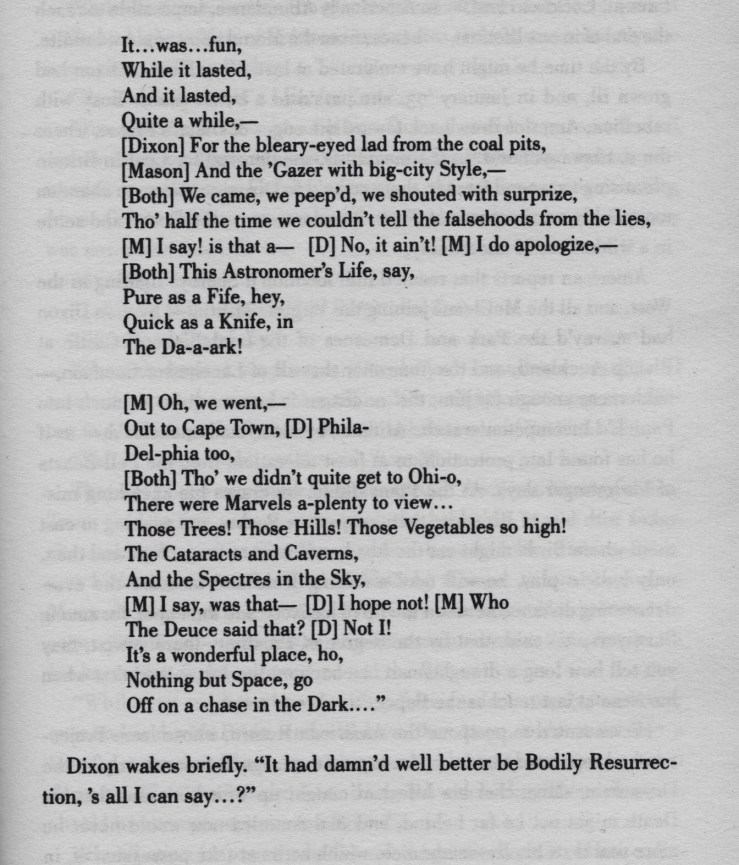
Illustration to Milton’s On the Morning of Christ’s Nativity — William Blake

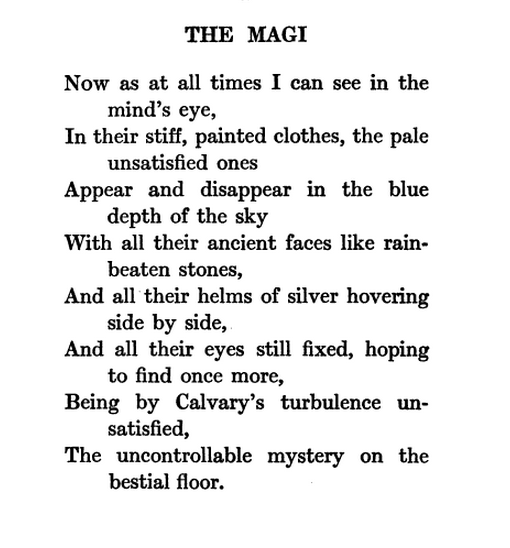
“The Magi” — William Butler Yeats

magi

Doubt is of the essence of Christ (Pynchon’s Mason & Dixon)

The Ascent to Christ is a struggle thro’ one heresy after another, River-wise up-country into a proliferation of Sects and Sects branching from Sects, unto Deism, faithless pretending to be holy, and beyond,— ever away from the Sea, from the Harbor, from all that was serene and certain, into an Interior unmapp’d, a Realm of Doubt. The Nights. The Storms and Beasts. The Falls, the Rapids, . . . the America of the Soul.
Doubt is of the essence of Christ. Of the twelve Apostles, most true to him was ever Thomas,— indeed, in the Acta Thomæ they are said to be Twins. The final pure Christ is pure uncertainty. He is become the central subjunctive fact of a Faith, that risks ev’rything upon one bodily Resurrection. . . . Wouldn’t something less doubtable have done? a prophetic dream, a communication with a dead person? Some few tatters of evidence to wrap our poor naked spirits against the coldness of a World where Mortality and its Agents may bully their way, wherever they wish to go. . . .

— The Reverend Wicks Cherrycoke, Undeliver’d Sermons

Preface to Ch. 53 of Thomas Pynchon’s novel Mason & Dixon.

“Vanka” — Anton Chekhov

“Vanka”

by

Anton Chekhov

Nine-year-old Vanka Zhukov, who had been apprentice to the shoemaker Aliakhin for three months, did not go to bed the night before Christmas. He waited till the master and mistress and the assistants had gone out to an early church-service, to procure from his employer’s cupboard a small phial of ink and a penholder with a rusty nib; then, spreading a crumpled sheet of paper in front of him, he began to write.

Before, however, deciding to make the first letter, he looked furtively at the door and at the window, glanced several times at the sombre ikon, on either side of which stretched shelves full of lasts, and heaved a heart-rending sigh. The sheet of paper was spread on a bench, and he himself was on his knees in front of it.

“Dear Grandfather Konstantin Makarych,” he wrote, “I am writing you a letter. I wish you a Happy Christmas and all God’s holy best. I have no mamma or papa, you are all I have.”

Vanka gave a look towards the window in which shone the reflection of his candle, and vividly pictured to himself his grandfather, Konstantin Makarych, who was night-watchman at Messrs. Zhivarev. He was a small, lean, unusually lively and active old man of sixty-five, always smiling and blear-eyed. All day he slept in the servants’ kitchen or trifled with the cooks. At night, enveloped in an ample sheep-skin coat, he strayed round the domain tapping with his cudgel. Behind him, each hanging its head, walked the old bitch Kashtanka, and the dog Viun, so named because of his black coat and long body and his resemblance to a loach. Viun was an unusually civil and friendly dog, looking as kindly at a stranger as at his masters, but he was not to be trusted. Beneath his deference and humbleness was hid the most inquisitorial maliciousness. No one knew better than he how to sneak up and take a bite at a leg, or slip into the larder or steal a muzhik’s chicken. More than once they had nearly broken his hind-legs, twice he had been hung up, every week he was nearly flogged to death, but he always recovered. Continue reading ““Vanka” — Anton Chekhov” →

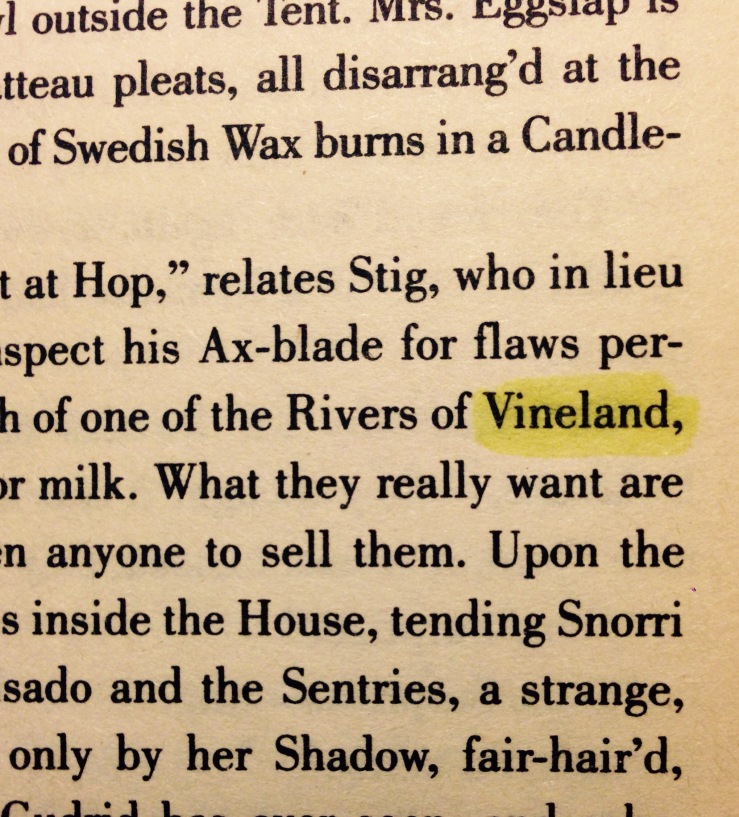
Vineland (Thomas Pynchon’s Mason & Dixon)

IMG_4503

From the beginning of ch. 66 of Mason & Dixon; see also.

Read “The Fir-Tree,” Hans Christian Andersen’s Depressing Story About the Existential Fate of a Christmas Tree

“The Fir-Tree” by Hans Christian Andersen

Far down in the forest, where the warm sun and the fresh air made a sweet resting-place, grew a pretty little fir-tree; and yet it was not happy, it wished so much to be tall like its companions— the pines and firs which grew around it. The sun shone, and the soft air fluttered its leaves, and the little peasant children passed by, prattling merrily, but the fir-tree heeded them not. Sometimes the children would bring a large basket of raspberries or strawberries, wreathed on a straw, and seat themselves near the fir-tree, and say, “Is it not a pretty little tree?” which made it feel more unhappy than before. And yet all this while the tree grew a notch or joint taller every year; for by the number of joints in the stem of a fir-tree we can discover its age. Still, as it grew, it complained, “Oh! how I wish I were as tall as the other trees, then I would spread out my branches on every side, and my top would over-look the wide world. I should have the birds building their nests on my boughs, and when the wind blew, I should bow with stately dignity like my tall companions.” The tree was so discontented, that it took no pleasure in the warm sunshine, the birds, or the rosy clouds that floated over it morning and evening. Sometimes, in winter, when the snow lay white and glittering on the ground, a hare would come springing along, and jump right over the little tree; and then how mortified it would feel! Two winters passed, and when the third arrived, the tree had grown so tall that the hare was obliged to run round it. Yet it remained unsatisfied, and would exclaim, “Oh, if I could but keep on growing tall and old! There is nothing else worth caring for in the world!” In the autumn, as usual, the wood-cutters came and cut down several of the tallest trees, and the young fir-tree, which was now grown to its full height, shuddered as the noble trees fell to the earth with a crash. After the branches were lopped off, the trunks looked so slender and bare, that they could scarcely be recognized. Then they were placed upon wagons, and drawn by horses out of the forest. “Where were they going? What would become of them?” The young fir-tree wished very much to know; so in the spring, when the swallows and the storks came, it asked, “Do you know where those trees were taken? Did you meet them?”

The swallows knew nothing, but the stork, after a little reflection, nodded his head, and said, “Yes, I think I do. I met several new ships when I flew from Egypt, and they had fine masts that smelt like fir. I think these must have been the trees; I assure you they were stately, very stately.”
“Oh, how I wish I were tall enough to go on the sea,” said the fir-tree. “What is the sea, and what does it look like?”

“It would take too much time to explain,” said the stork, flying quickly away.

“Rejoice in thy youth,” said the sunbeam; “rejoice in thy fresh growth, and the young life that is in thee.”

And the wind kissed the tree, and the dew watered it with tears; but the fir-tree regarded them not. Continue reading “Read “The Fir-Tree,” Hans Christian Andersen’s Depressing Story About the Existential Fate of a Christmas Tree” →

A Mason & Dixon Christmastide (Thomas Pynchon)

They discharge the Hands and leave off for the Winter. At Christmastide, the Tavern down the Road from Harlands’ opens its doors, and soon ev’ryone has come inside. Candles beam ev’rywhere. The Surveyors, knowing this year they’ll soon again be heading off in different Directions into America, stand nodding at each other across a Punch-bowl as big as a Bathing-Tub. The Punch is a secret Receipt of the Landlord, including but not limited to peach brandy, locally distill’d Whiskey, and milk. A raft of long Icicles broken from the Eaves floats upon the pale contents of the great rustick Monteith. Everyone’s been exchanging gifts. Somewhere in the coming and going one of the Children is learning to play a metal whistle. Best gowns rustle along the board walls. Adults hold Babies aloft, exclaiming, “The little Sausage!” and pretending to eat them. There are popp’d Corn, green Tomato Mince Pies, pickl’d Oysters, Chestnut Soup, and Kidney Pudding. Mason gives Dixon a Hat, with a metallick Aqua Feather, which Dixon is wearing. Dixon gives Mason a Claret Jug of silver, crafted in Philadelphia. There are Conestoga Cigars for Mr. Harland and a Length of contraband Osnabrigs for Mrs. H. The Children get Sweets from a Philadelphia English-shop, both adults being drawn into prolong’d Negotiations with their Juniors, as to who shall have which of. Mrs. Harland comes over to embrace both Surveyors at once. “Thanks for simmering down this Year. I know it ain’t easy.”
“What a year, Lass,” sighs Dixon.
“Poh. Like eating a Bun,” declares Mason.”

The last paragraphs of Ch. 52 of Thomas Pynchon’s novel Mason & Dixon.

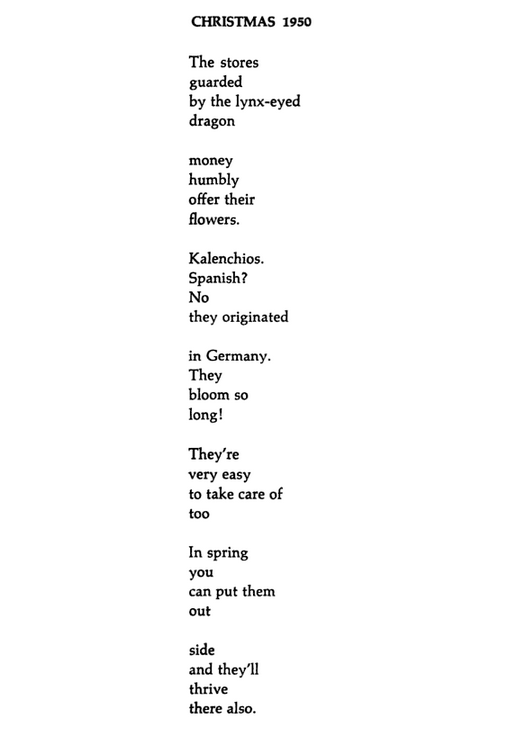
“Christmas 1950” — William Carlos Williams

wcw

A thousand Christmas trees (Robert Frost)

trees

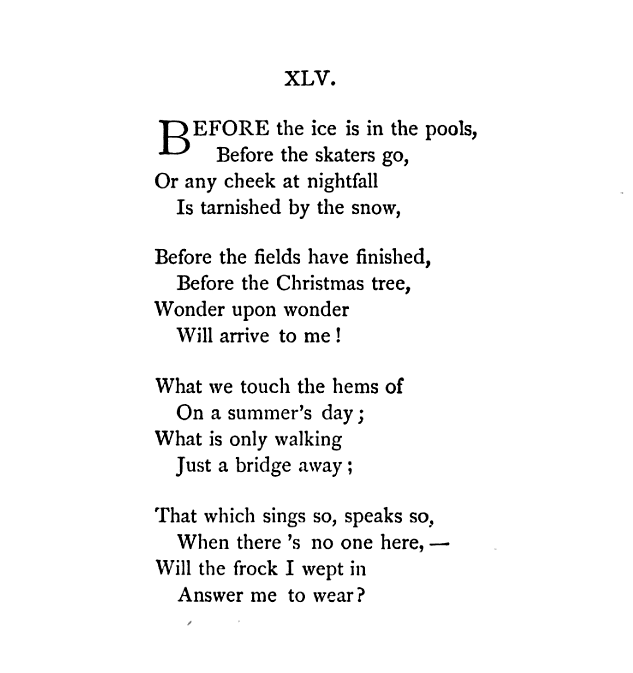
“Before the ice is in the pools” — Emily Dickinson

ed