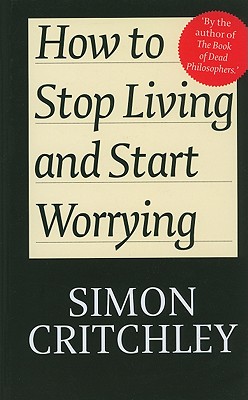
Simon Critchley’s latest book How to Stop Living and Start Worrying picks up where his last work, The Book of Dead Philosophers, left off. Both works explore what Critchley contends to be the signal problem of all philosophy; namely, how one might live a meaningful life against the backdrop of inevitable death. In Dead Philosophers, Critchley plumbed this question by surveying the deaths of dozens of famous philosophers, ultimately affirming a positive reality in death (both our own deaths and the deaths of others), and arguing that philosophies (and religions) that advocate the idea of a spiritual afterlife ultimately negatively disrupt human existence and lead to inauthentic lives. How to Stop Living reiterates these themes in a new form, essentially arguing that in asking “how to live,” we must also ask “how to die” — and also how to love and how to laugh. How to Stop Living takes form as a series of conversations between Critchley and Carl Cederström, an Associate Professor at the Institute of Economic Research at Lund University in Sweden. There’s a warm rapport between the pair, and although Critchley does most of the talking, there’s a genuine dialog in play, not merely a flat interview. The book unfolds over six chapters. The first, “Life,” is a discussion of, well, Critchley’s life, both personal and academic. I originally thought I’d be doing a lot of skimming here, but it’s actually kind of fascinating; more importantly, though, it establishes Critchley’s contention that a philosopher’s work cannot be divorced from his biography. To philosophize is to live. This idea is reiterated succinctly at the beginning of the second chapter, “Philosophy,” when Critchley states—
The first thing to say is that philosophy is not a solely professional or academic activity for me. Philosophy is not a thing, it’s not an entity; it’s an activity. To put it tautologically: philosophy is the activity of philosophizing, an activity which is conducted by finite, thinking creatures like us. Now, my general view of philosophy is that this activity must for part of the life of a culture. Philosophy is the living activity of critical reflection in a specific context; it always has a radically local character.
What follows in “Philosophy” is a somewhat discursive overview of the philosophers who will pop up again and again in the book: Heidegger, Husserl, Kant, Nietzsche, and, of course, Derrida. While I’m laundry listing, I might as well add Freud, Lacan, Beckett, and Hegel as key figures in How to Stop Living. In the third chapter, “Death,” Critchley discusses how many of these philosophers frame a subject’s individual relationship to his or her personal death. In a particularly enlightening passage, Critchley explains Heidegger’s “possibility of impossibility,” the idea that to be authentic, to lead an authentic life, one must internalize and master the finitude of a personal death. The chapter continues, working through other conceptions of death, including those of Freud, Beckett, and Derrida. Perhaps because of its dialogic structure, How to Stop Living often feels like a rap session, a big brainstorm, a work in process, and nowhere is this more evident in a chapter called “Love,” where Critchley moves from Hannah Arendt to The Song of Solomon to Lacan and Freud to a story about his marriage proposal. It’s all a bit messy, a bit watery, a bit undefined, and therefore difficult to summarize, so I’ll let Critchley dish on love in his own words—
Love is the attempt to break the logic of masochism that defines the subject, and to behave in a different way. That’s something that has to be wound up everyday . . . and it’s something with no end; and it requires a constant experience of faith. That’s the only sense I can make of love.
The next section, “Humour,” is better defined—and one of the highlights of the book. Critchley discusses jokes against a backdrop of psychoanalysis and anthropology, ultimately arguing that humor has the power to disrupt an individual’s relation to time or place, and thus reconstitute that relation in some meaningful way. Critchley’s book itself is indeed a meta-joke, a play against the sophistry of New Age self-help books. Indeed, the very name of the book is an inversion of Dale Carnegie’s 1948 “classic” of the genre, How to Stop Worrying and Start Living. If you find the cover of Critchley’s book as off-putting and cheesy as I do, just remind yourself that it’s a parody of Carnegie’s cover. And yet Critchley’s sense of humor is not ultimately black irony, but rather a humor of affirmation of — and confrontation of — the absurdity of contemporary life. It’s not irony but authenticity he wants. “Authenticity” is thus the final chapter of this relatively short book, and here Critchley invites his friend (and partner in the International Necronautical Society) novelist Tom McCarthy to participate in the conversation. The chapter is lively, almost frenetic, and frankly all over the place, as Critchley and McCarthy rocket from subject to subject — Finnegans Wake, the Challenger explosion, Terrence Malick, J.G. Ballard, Levinas, A Midsummer Night’s Dream, McCarthy’s first novel Remainder — each reference seems to slip into the next, reined in occasionally by Cederström, who steers the conversation back to its center (leave it to deconstructionists to get off center). Good stuff.
How to Stop Living and Start Worrying, despite its tongue in cheek title and cover, and its discursive flow, is serious (if playful) about philosophy. Those interested in the thinkers and topics I’ve mentioned in this review may be interested, but it’s not necessary for one to have a working knowledge of Continental philosophy to enjoy Critchley’s latest. Recommended.
How to Stop Living and Start Worrying is available now from Polity Books.
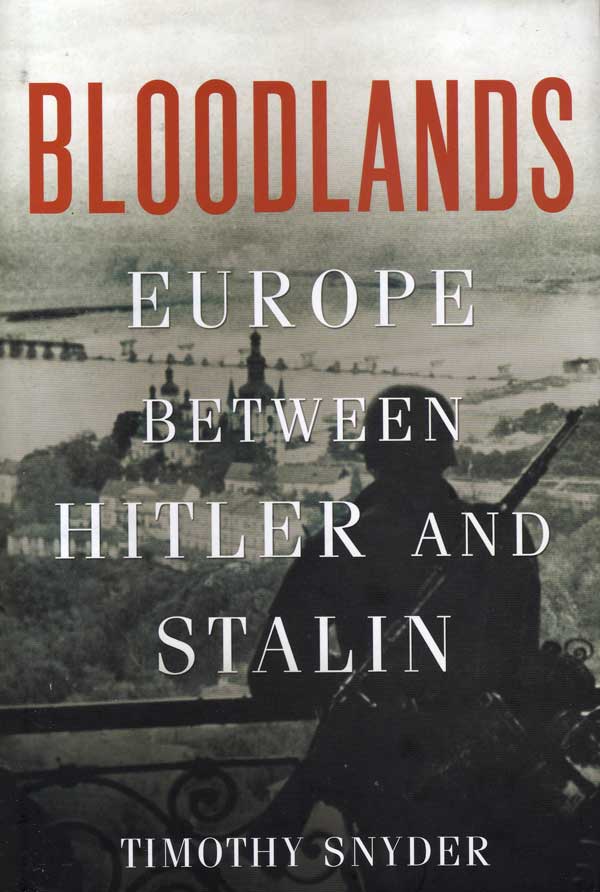
Timothy Snyder’s monumental new history Bloodlands is a staggering work of scholarship. Using primary sources written in at least ten languages, Snyder documents the nightmarish history of that portion of eastern Europe that stretches from Poland north to St. Petersburg and sweeps southwest to the point where Ukraine runs into the Black Sea. In these places, the titular bloodlands, the policies of Adolf Hitler and Josef Stalin converged to kill approximately 14 million people in less than a quarter of a century. Snyder postulates that the eradication of such large numbers of human beings was possible because National Socialism was the perfect foil to Soviet Communism, and vice versa, and because each system allowed totalitarian one-party states to deflect blame for their respective failings onto the other, or onto large groups of relatively powerless national, ethnic, or religious minorities. Rectifying problems required starving, shooting, gassing, or otherwise disappearing hundreds of thousands of the people who inhabited these regions and who had no intention or ability to subvert whichever ruling regime claimed them as subjects at any particular moment. The particular atrocities committed in these areas were largely overlooked in the West at the close of World War II as these victims and their memories disappeared behind the Iron Curtain.
The book begins not in 1941 when Hitler invaded the Soviet Union but a decade earlier. After Lenin’s death, Josef Stalin found himself at the head of the Soviet Union’s security forces as well its sole ruling party. When he recognized that revolutions were not about to sweep over the rest of capitalist Europe, Stalin prioritized ensuring that the U.S.S.R. remained a strong Communist nation and a beacon of hope to committed Marxists across the world. Despite the Communist ethos that capitalist excess would be negated by exploited industrial workers in urban environments, the Bolshevik Revolution had taken place in one of Europe’s most diverse and rural populations. When Stalin took it upon himself to collectivize Soviet agriculture, disaster struck in the Ukraine and Bloodlands’ long and nuanced chronicle of paranoia and death properly begins.
The famine in the Soviet Union’s most fertile land, the Ukraine, caused at least 3 million people to starve in the early part of the 1930s. After the seed needed to plant next year’s crop was requisitioned for the collective, nothing remained to eat and there was no future to look forward to, either. People died where they fell, women prostituted themselves for bread, parents gave their children away to strangers, and villages ceased to exist. Fires in chimneys marked the presence of cannibals. Snyder writes–
In the cities carts would make rounds early in the mornings to remove the peasant dead of the night before. In the countryside the healthier peasants formed brigades to collect the corpses and bury them. They rarely had the inclination or the strength to dig graves very deeply, so that hands and feet could be seen above the earth.
In order to ensure their own corporeal and political survival, the Soviet leadership responsible for collecting the harvest had to steal whatever they could from the hungry.
And so it continued. Hitler rose to power partially on the basis of his powerful condemnation of the popular German Communist parties, and used the famine in the U.S.S.R. to bolster arguments that doomed the opposition to his left and center. Although Stalin argued that all the excesses of capitalism could be seen in the racist and nationalistic rhetoric spewing from the Nazis, these two nations signed a non-aggression pact and started the war in 1939 when they jointly invaded Poland. The Soviet reign of terror commenced and the secret police killed and deported hundreds of thousands of class enemies and nationalists in Poland, Ukraine and the Baltic states. The Germans and the Soviets began to move Poles out of their homes. The Germans designed policies meant to kill educated Poles in order to create a population amenable to slavery. The Soviets killed Polish military officers who were capable of leading uprisings against their new rulers. Both nations instituted their first policies of mass shootings contemporaneously.
When Hitler disregarded the treaty and invaded the Soviet Union (which now included the portions of Poland both nations had agreed to share), already vulnerable populations were decimated. Nazism required that a superior race must take what it needed without regard to rule of law or human empathy. Advancing German forces who came upon obvious signs of recent brutality by the retreating secret police forces of the U.S.S.R. and the Red Army saw “a confirmation of what that had been trained to see: Soviet criminality, supposedly steered by and for the benefit of Jews.” Hundreds of thousands of Soviet prisoners of war were condemned to die of starvation and exposure in makeshift camps. Heinrich Himmler and Hermann Göring implemented a Hunger Plan, which, although unsuccessful, aimed to “transform eastern Europe into an exterminatory agrarian colony” by purposefully starving its inhabitants or deporting them to Siberia. The German plan to achieve victory in Leningrad involved cutting off food supplies to the city’s 3.5 million inhabitants and covering all possible escape routes with landmines which would eliminate potential evacuees. Even before the German security forces began purposefully destroying Jewish populations, a culture of cruelty and privation had been foisted upon innocent civilian populations.
The Jewish populations of cities and regions that had housed their families and their cultures for centuries were then systematically and brutally annihilated. Snyder argues that Western minds have processed the Holocaust in a certain manner because in our history, the accounts of the soldiers who liberated camps in conquered lands to the south and west of the Reich predominate. We have been privileged to hear the stories of survivors from the camps at Auschwitz like Primo Levy and Elie Wiesel, but Snyder points out that the labor and death camps at Auschwitz did not come on-line until near the end of the war and most of those sentenced to labor or die there were brought from German holdings in western Europe. Bloodlands is important because it documents that most of the horrors of the Holocaust were committed in the east. 69,750 of Latvia’s 80,000 Jewish citizens were killed by the end of 1941 by bullets. With the help of Lithuanian conscripts and rifles, the Germans killed at least 114,000 of that nation’s 200,000 Jewish citizens. Estonian volunteers for the S.S. killed all 963 Estonian Jews that could be found. Himmler’s security forces were supposed to “pacify” annexed territories. In Kiev, 33,761 human beings were killed in little more than a day by the concerted efforts of S.S. commandos and conscripted local forces as part of a sustained effort to eradicate Ukrainian Jews. Snyder continues–
Having surrendered their valuables and documents, people were forced to strip naked. Then they were driven by threats or by shots fired overhead, in groups of about ten, to the edge of a ravine known as Babi Yar. Many of them were beaten . . . They had to lie down on their stomachs on the corpses already beneath them, and wait for the shots to come from above and behind. Then would come the next group. Jews came and died for thirty-six hours.
The ghettos were in the east as were the death camps of Treblinka, Sobibor, and Belzec. By invading Poland and the Soviet Union, Hitler conquered the nations with the largest Jewish populations on the planet, and when it became evident that the German army, like Napoleon’s previously, were unable to conquer Moscow and the icy Russian plains, the death camps were opened with the express purpose to kill massive numbers of people in the shortest period of time. Treblinka, Sobibor, and Belzec were well-engineered for their horrible purpose of killing those who remained behind.
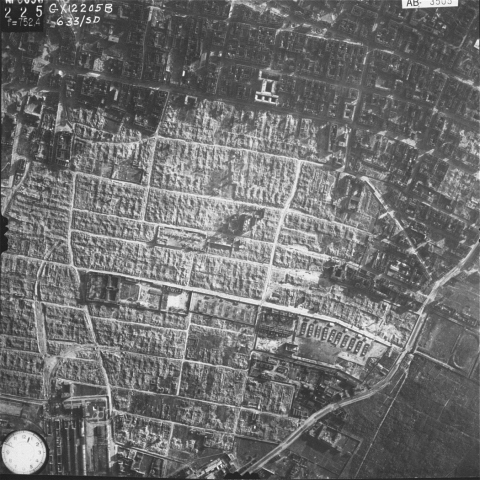
The Jewish Ghetto in Warsaw was burned to the ground.
Snyder asks the readers to remember that the lives he documents died because of policies that existed in the Soviet Union and Nazi German that promoted and committed deliberate mass murder. The act of recording and remembering must be initiated where evidence is so easy to destroy or manipulate. People complicit in the murder of their neighbors will attempt to mitigate their shame. Even those with no connection to such events would probably rather think of something more pleasant. Where the Nazis razed the Warsaw ghetto and dismantled the death camp at Treblinka in a matter of hours, Stalin purposefully changed the course of the historical discussion in the U.S.S.R. in order to promote nationalism. The suffering of Jews and other innocents was sublimated to the overall suffering of the Soviet (mostly Russian) population.
14 million people. Farmers, prisoners, gypsies, peasants, freedom fighters, and the unlucky. Wives, fathers, and children. Everyone died to placate ideologies that a great number of people of good conscience did not discount at the time. Although the historical record is expanding, it seems inconceivable that our knowledge of such events could ever be perfected. Appreciate your loved ones and relish the warmth in your homes and in your bodies. Essential knowledge for every conscious, conscientious person. Absolutely recommended.
National Teacher Appreciation Week winds down today. Have you thanked that special teacher in your life? Or at least thought about him or her? No? Maybe your teachers scarred you. Or ruined you. It’s possible. But probably not all of them. I’m sure at least one of them was really important to you, right?
Although Biblioklept World Wide Industries brings in the kind of moolah that allows me to literally swim in cash à la Scrooge McDuck, I retain my day job as a teacher of literature in the English language; I do this because, you know, I care. So me waxing heavy on why teachers matter and blah blah blah is sort of like waitresses overtipping other waitresses because, you know, they know. So I’ll just say that teachers are generally overworked, underpaid, and perhaps undervalued in our society, and I appreciate all of you–all of you who taught me and shaped me and mentored me and shared your wisdom with me, and all of you who I’ve worked with over the years who’ve inspired me to do better and be better. Thanks.
So well anyway, I’ve been skimming again through Nietzsche’s highly-aphoristic volume Human, All Too Human for the past week, and came across this passage, section 200, Caution in writing and teaching. Quoting in full:
Whoever has once begun to write and felt the passion of writing in himself, learns from almost everything he does or experiences only what is communicable for a writer. He no longer thinks of himself but rather of the writer and his public. He wants insight, but not for his own use. Whoever is a teacher is usually incapable of doing anything of his own for his own good. He always thinks of the good of his pupils, and all new knowledge gladdens him only to the extent that he can teach it. Ultimately he regards himself as a thoroughfare of learning, and in general as a tool, so that he has lost seriousness about himself.
Ouch! Did Nietzsche just call me a tool? I think his words are actually quite insightful–teachers do think of themselves as instruments through which they may better their pupils. But I don’t think that that is the only end for knowledge as far as teachers are concerned, and I don’t think that that makes teachers unserious about knowledge. Knowledge-as-enlightenment and self-improvement is great of course, but knowledge-as-transcendence–that is, knowledge as wisdom and experience that can be passed from person to person, shared, communicated–that’s what’s really meaningful in life.
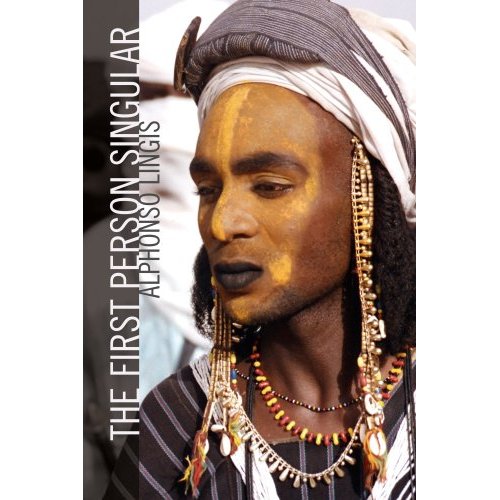
American philosopher and noted writer Alphonso Lingis will deliver a talk on “War and Splendor” at the University of North Florida, in Jacksonville, Florida, at 7:30 pm on Wednesday, October 3rd. Dr. Lingis is Professor Emeritus of Philosophy at Pennsylvania State University; his writing lyrically bridges the gaps between the liberal arts of anthropology and philosophy. Dr. Lingis’s current work, including his latest book, The First Person Singular, has focused on his travels to developing nations in Africa, South America, and Asia. By all accounts, Dr. Lingis is a fascinating speaker whose use of costumes, make-up, and music during his “lectures” creates an air of performance art. You can read more about Alphonso Lingis here. If you have the time, I highly recommend checking out Lingis’s paper “Our Uncertain Compassion.” Go here to reserve free tickets to see Dr. Lingis speak (your receipt will also provide directions. This promises to be both enlightening and entertaining–don’t miss it!
Jacksonville readers can look forward to more engaging speakers at UNF over the month of October, including resident genius Dr. Samuel Kimball and PBS documentary maker Ken Burns. Updates and info forthcoming.
Yes–now you too can better understand the way we conceptualize all that exists–from the comfort of your own home! It’s simple, free, and best of all, it’s fun! Biblioklept’sOntology 101 is a course designed for working professionals who wish to approach the logic and philosophy of ontology, but don’t want to get bogged down in stodgy applications like taxonomy or geography. The different texts that comprise Biblioklept’s Ontology 101 course are contemporary, entertaining, highly visual, and applicable to modern social discourse.
Prerequisites: working knowledge of basic internet use. Adult level English language literacy. A few spare hours a week. A relatively open mind. A library card would be helpful. You’ll need a DVD player or VCR. If you can’t meet these requirements, you will need Biblioklept’s permission to join the class (you may have Biblioklept’s permission to join the class).
Credit hours: unfortunately, at this time Biblioklept remains an unaccredited (but nonetheless cherished) institution. However, all those who take the course are permitted a sense of smug self-satisfaction, a sharpened awareness of true irony, and existential crises galore.
Readings:
Week 1: Introduction, course overview, primer (below)
Primer: Before beginning John Berger’s Ways of Seeing, you’ll need a little background info about the history of philosophy. Biblioklept encourages you to go beyond the narrow confines of the following primer, but some of the ideas/thinkers presented here are essential building blocks for what will follow.
What is ontology? What better way to start an unaccredited online course from a flaky blog than to use Wikipedia as a beginning point! At the end of the course, we’ll revisit Wiki’s page and see if we can help it out–that would be meeting the true spirit of this endeavor. After you’ve perused the free encyclopedia that anyone can edit, treat yourself to SUNY’s own primer to ontology (follow the link “History of Ontology” at the top of the page to the “History of Ontology” link at the bottom of the page), which will make you like, at least ten times smarter.
Read up on Aristotle (follow the link “History of Ontology” at the top of the page to the “Aristotle” link). As far as we know, Aristotle seems to have initiated philosophical thinking.
Are you familiar with Occam’s Razor? If not, read on!
Surely you’ve come across Descartes’ ridiculous proof of existence–cogito ergo sum–but it couldn’t hurt to brush up on why you may actually exist.
Once you’ve perused the above, no doubt you’ll be primed for all kinds of mad knowledge. Feel free to post comments and questions, or to email me at biblioklept.ed@gmail.com. And if you’re a real go-getter, get a jump start on next week’s assignment, Ways of Seeing.


 Biblioklept
