William Carlos Williams’ final and posthumous book Pictures from Brueghel and Other Poems (1962) opens with a cycle of ten ekphrastic poems that describe (and subtly interpret) ten paintings by the sixteenth-century Flemish painter Pieter Brueghel the Elder.
These poems are, in my estimation, some of Williams’ finest. Possibly the most famous of these poems is “Landscape with the Fall of Icarus,” a devastating observation of how inclined we are to look away from miracles.
Another of Williams’ Brueghel poems, “The Dance,” which takes The Peasant Dance as its subject, is also widely-anthologized; however Williams’ poem “The Dance” was published in The Wedge (1944). Williams’ “The Dance,” which begins “In Breughel’s great picture, The Kermess, / the dancers go round,” is frequently and incorrectly cited to have been published in Pictures from Brueghel (a cursory internet search shows this misinformation appears in Harper’s, as well as the last resort of lazy high school students, Shmoop). Williams did publish a poem called “The Dance” in Pictures from Brueghel and Other Poems, but this “Dance” is very much one of those other poems (this “Dance” begins “When the snow falls the flakes / spin upon the long axis,” for the record). That The Peasant Wedding is another subject of Pictures of Brueghel may also account for the spread of this misinformation (which can be resolved simply by opening the second volume of The Collected Poems of William Carlos Williams, which includes both The Wedge and Brueghel). But I find myself going on a bit too much about this simple mistake.
Let’s get to the poem:
“The Wedding Dance in the Open Air”
by
William Carlos Williams
Disciplined by the artist
to go round
& round
in holiday gear
a riotously gay rabble of
peasants and their
ample-bottomed doxies
fills
the market square
featured by the women in
their starched
white headgear
they prance or go openly
toward the wood’s
edges
round and around in
rough shoes and
farm breeches
mouths agape
Oya !
kicking up their heels
“The Wedding Dance in the Open Air” echoes the sensual depth of Williams’ earlier poem “The Dance” (1944), which emphasized the hips and bellies and shanks of those dancers who are “swinging their butts” (!) to “the squeal and the blare and the / tweedle of bagpipes” as they prance about.
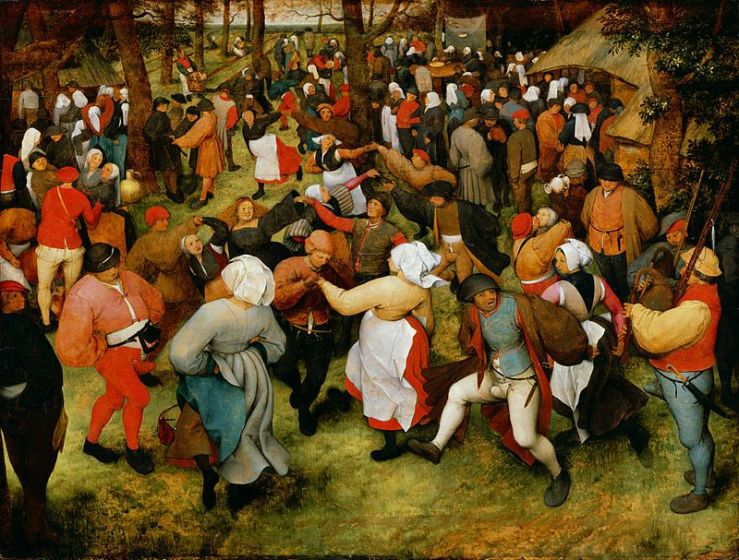
The word “prance” is repeated too in “Wedding Dance” — and not only do our partygoers prance, they even “go openly / toward the wood’s / edges,” the edge of civilization where civilization gets made.
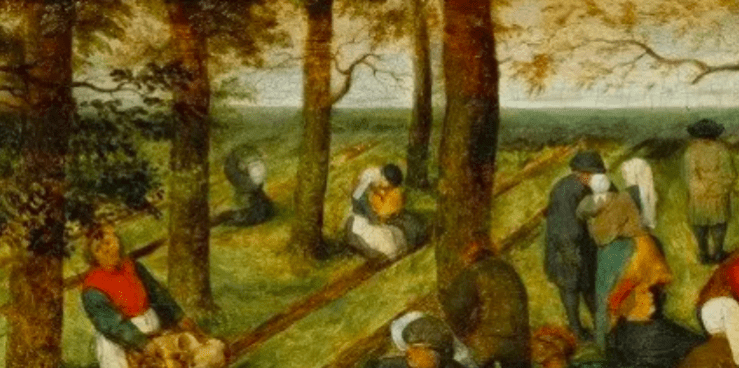
At the other edge of the painting, the foreground, are some of the boldest of Williams’ “riotously gay rabble.” But should I call them “Williams’ ‘riotously gay rabble'” or Brueghel’s? I think that it is Williams’ interpretation that matters here, but Brueghel gives him the material with which to grapple.
Look at those colors, look at those codpieces! Look at the hands, twisting, gripping, artfully fingering!
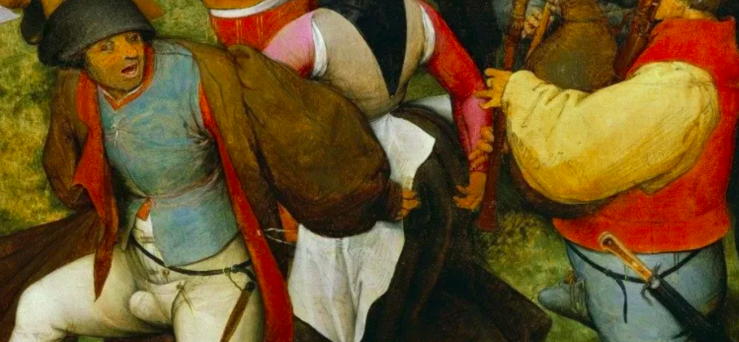
Williams captures the painting’s sexual energy not just in lines that highlight the “ample-bottomed doxies” who fill this market square, but also in the vivacious images of “mouths agape” and heels a’ kicking. The poem pulses with an energy proximal to the painting, an energy simultaneously alien and native, highlighting not only the difference in the two art forms—poetry and painting—but also the space between the viewer and the thing being viewed.

Enhancing the poem’s ekphrastic powers of imagery and feeling are the subtle rhymes of Williams’ “The Wedding Dance.” While one can find the odd (very odd) rhyme or three in WCW’s poetry, “The Wedding Dance” makes for one of the poet’s more direct concessions to poetry’s most common formal feature. The second stanza gives us “gear” slipping into “their,” picked up again in the fourth stanza’s “headgear,” and more subtly touched on in the final lines of stanzas six and seven, “breeches” and “heels.” Hell, “edges” in the fifth stanza basically rhymes with “breeches.” This thread of slant rhymes approximates the off-kilter, elliptical dance Brueghel depicts. Williams kneads guttural g sounds and harsh rs into his poem, roughening his poetry to match his rustic subject. And yet there’s just the right measure of sensuality that slips through the poem, just enough to get the rough words wet.
Like any successful ekphrasis, Williams’ poem transcends a mere physical description of art. He does describe The Wedding Dance in Open Air, yes, but the description does more than relay the physical contours of Brueghel’s art, or Williams’ analysis of Brueghel’s art—William gives us something of the painting’s spirit, captured in language, sound—another way of feeling something beautiful. Oya!