
Category: Poetry
Jiří Kolář’s A User’s Manual (Book acquired, some time in late October)
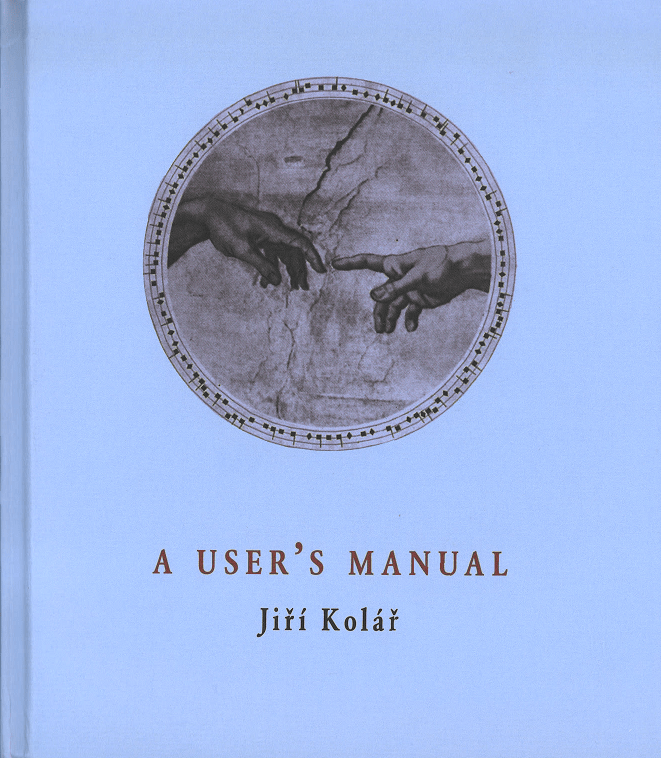
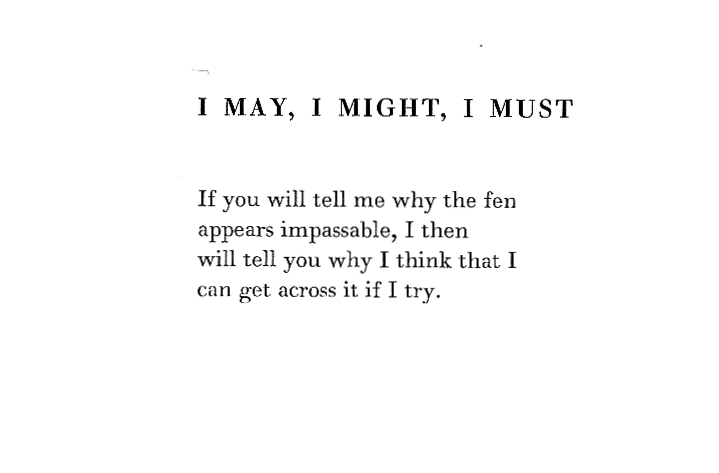
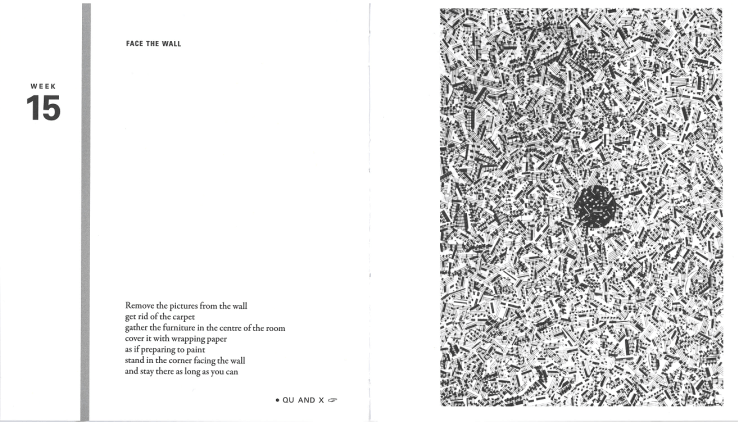
I’ve been slowly enjoying the poems and collages that comprise Jiří Kolář’s collection A User’s Manual (in English translation by Ryan Scott). There are 52 poems and collages here. Each poem is a kind of surrealist recipe, a set of commands that I’ve been trying to follow (in my imagination, I mean).
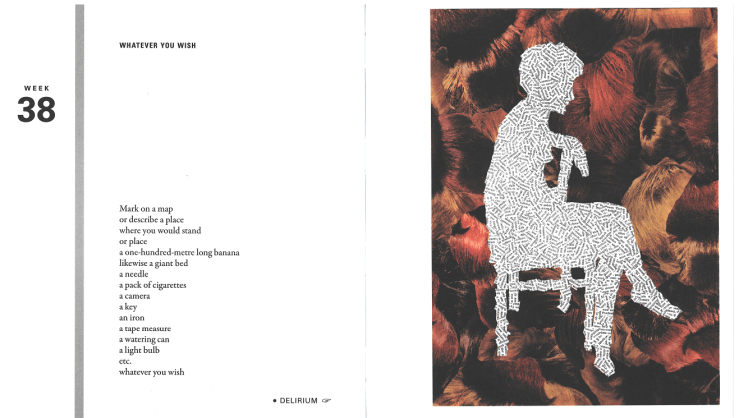
The book itself is beautiful—hardback with full color and black and white illustrations, it fits perfectly with the aesthetic that its publisher Twisted Spoon has been developing for ages now.
Here’s Twisted Spoon’s blurb:
Written in the 1950s and ’60s, the “action poems” comprising a A User’s Manual were published in their complete form in 1969 when they were paired with the 52 collages of Weekly 1967, the first of Kolář’s celebrated series in which he commented visually on a major event for each week of
the year. Taking the form of directives, largely absurd, the poems mock communist society’s officialese while offering readers an opportunity to create their own poetics by performing the given directions. The collages on the facing pages to the poems are composed of layered documents, image cutouts, newspaper clippings, announcements, letter fragments, reports, or decontextualized words, oftentimes forming concrete patterns or the outlines of figures, to create a sort of “evidential” report on the year. Text and image taken together, the volume displays Kolář’s enduring interest in extracting poetry from the mundane to demolish the barrier separating art from reality, or even to elevate reality itself through this dual poetics to the level of art. What art historian Arsén Pohribný wrote about Weekly 1968 equally applies to Weekly 1967: it “shocks with its abrupt stylistic twists” and is “a Babylonian, hybrid parable of multi-reality.” The volume also includes the complete Czech text as an appendix.
“Ode to Dirt” — Sharon Olds
“Ode to Dirt”
by
Sharon Olds
Dear dirt, I am sorry I slighted you,
I thought that you were only the background
for the leading characters—the plants
and animals and human animals.
It’s as if I had loved only the stars
and not the sky which gave them space
in which to shine. Subtle, various,
sensitive, you are the skin of our terrain,
you’re our democracy. When I understood
I had never honored you as a living
equal, I was ashamed of myself,
as if I had not recognized
a character who looked so different from me,
but now I can see us all, made of the
same basic materials—
cousins of that first exploding from nothing—
in our intricate equation together. O dirt,
help us find ways to serve your life,
you who have brought us forth, and fed us,
and who at the end will take us in
and rotate with us, and wobble, and orbit.
“All Hallow’s Eve” — Dorothea Tanning
“All Hallow’s Eve”
by
Dorothea Tanning
Be perfect, make it otherwise.
Yesterday is torn in shreds.
Lightning’s thousand sulfur eyes
Rip apart the breathing beds.
Hear bones crack and pulverize.
Doom creeps in on rubber treads.
Countless overwrought housewives,
Minds unraveling like threads,
Try lipstick shades to tranquilize
Fears of age and general dreads.
Sit tight, be perfect, swat the spies,
Don’t take faucets for fountainheads.
Drink tasty antidotes. Otherwise
You and the werewolf: newlyweds.
“The Witch’s Life” — Anne Sexton
“The Witch’s Life”
by
Anne Sexton
When I was a child
there was an old woman in our neighborhood whom we called The Witch.
All day she peered from her second story
window
from behind the wrinkled curtains
and sometimes she would open the window
and yell: Get out of my life!
She had hair like kelp
and a voice like a boulder.
I think of her sometimes now
and wonder if I am becoming her.
My shoes turn up like a jester’s.
Clumps of my hair, as I write this,
curl up individually like toes.
I am shoveling the children out,
scoop after scoop.
Only my books anoint me,
and a few friends,
those who reach into my veins.
Maybe I am becoming a hermit,
opening the door for only
a few special animals?
Maybe my skull is too crowded
and it has no opening through which
to feed it soup?
Maybe I have plugged up my sockets
to keep the gods in?
Maybe, although my heart
is a kitten of butter,
I am blowing it up like a zeppelin.
Yes. It is the witch’s life,
climbing the primordial climb,
a dream within a dream,
then sitting here
holding a basket of fire.
“The King of Owls” — Louise Erdrich
“The King of Owls”
by
Louise Erdrich
It is said that playing cards were invented in 1392 to cure the French king, Charles VI, of madness. The suits in some of the first card packs consisted of Doves, Peacocks, Ravens, and Owls.
They say I am excitable! How could
I not scream? The Swiss monk’s tonsure
spun till it blurred yet his eyes were still.
I snapped my gaiter, hard, to stuff back
my mirth. Lords, he then began to speak.
Indus catarum, he said, presenting the game of cards
in which the state of the world is excellent described
and figured. He decked his mouth
as they do, a solemn stitch, and left cards
in my hands. I cast them down.
What need have I for amusement?
My brain’s a park. Yet your company
plucked them from the ground and began to play.
Lords, I wither. The monk spoke right,
the mealy wretch. The sorry patterns show
the deceiving constructions of your minds.
I have made the Deuce of Ravens my sword
falling through your pillows and rising,
the wing blades still running
with the jugular blood. Your bodies lurch
through the steps of an unpleasant dance.
No lutes play. I have silenced the lutes!
I keep watch in the clipped, convulsed garden.
I must have silence, to hear the messenger’s footfall
in my brain. For I am the King of Owls.
Where I float no shadow falls.
I have hungers, such terrible hungers, you cannot know.
Lords, I sharpen my talons on your bones.
“Question” — May Swenson
“Question”
by
May Swenson
Body my house
my horse my hound
what will I do
when you are fallen
Where will I sleep
How will I ride
What will I hunt
Where can I go
without my mount
all eager and quick
How will I know
in thicket ahead
is danger or treasure
when Body my good
bright dog is dead
How will it be
to lie in the sky
without roof or door
and wind for an eye
With cloud for shift
how will I hide?
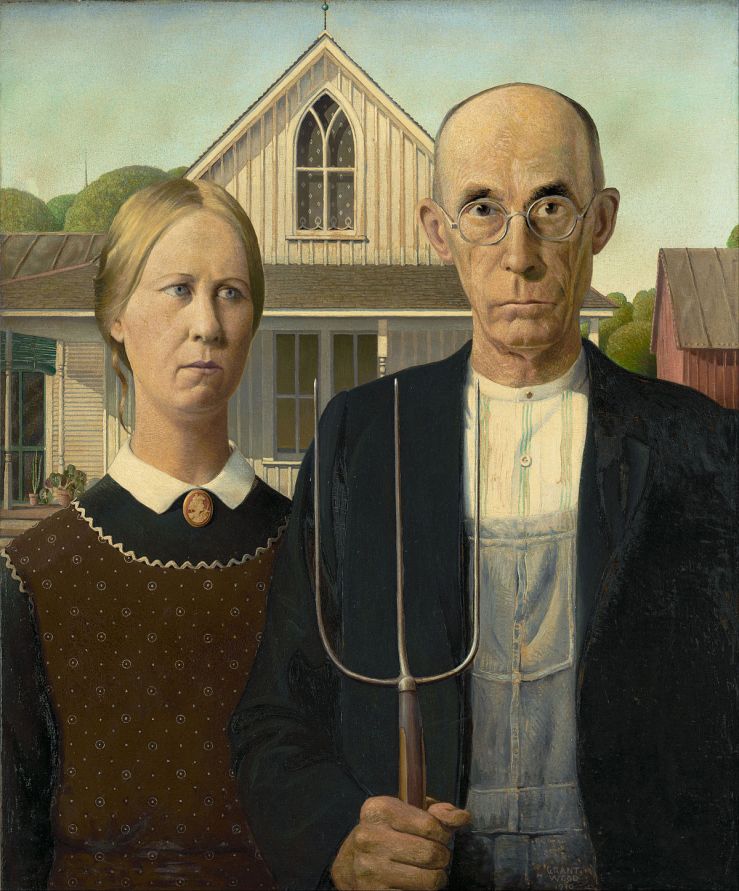
“American Gothic” — John Stone
“American Gothic”
by
John Stone
Just outside the frame
there has to be a dog
chickens, cows and hay
and a smokehouse
where a ham in hickory
is also being preserved
Here for all time
the borders of the Gothic window
anticipate the ribs
of the house
the tines of the pitchfork
repeat the triumph
of his overalls
and front and center
the long faces, the sober lips
above the upright spines
of this couple
arrested in the name of art
These two
by now
the sun this high
ought to be
in mortal time
about their businesses
Instead they linger here
within the patient fabric
of the lives they wove
he asking the artist silently
how much longer
and worrying about the crops
she no less concerned about the crops
but more to the point just now
whether she remembered
to turn off the stove.
“October” — Tom Clark

“Conversion” — Jean Toomer

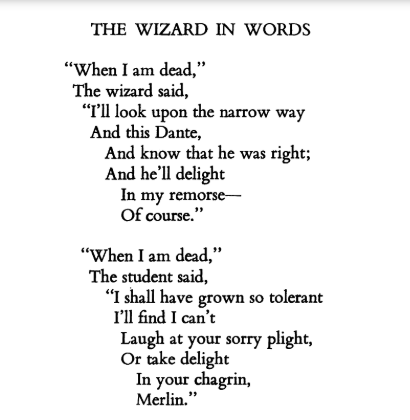
“The Wizard in Words” — Marianne Moore
“Civics” — David Berman
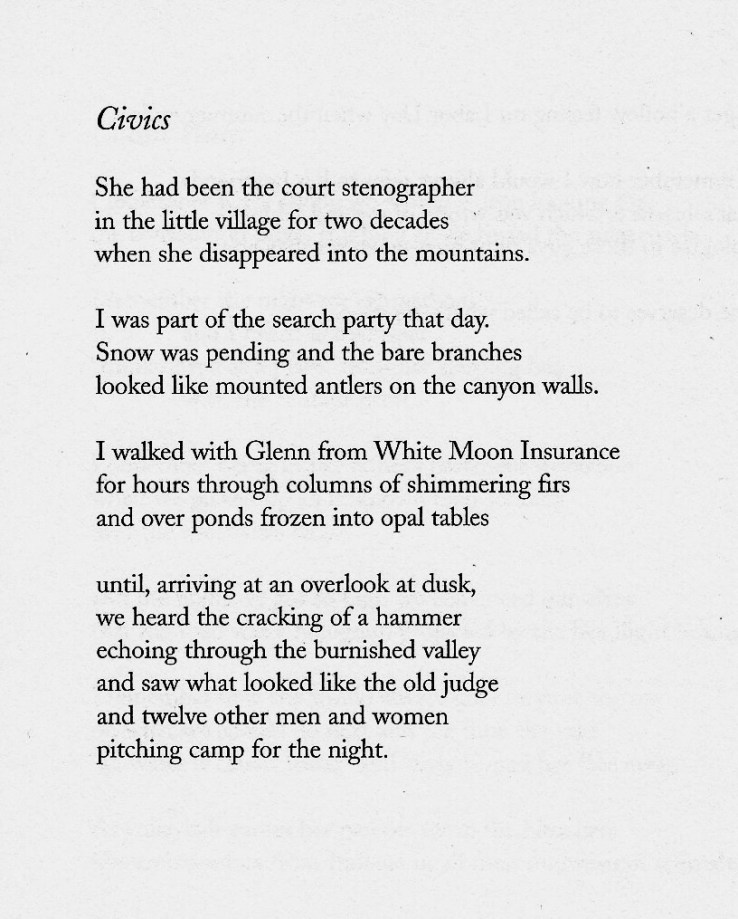
From Actual Air (Open City, 1999).
“A Letter from Isaac Asimov to His Wife Janet, Written on His Deathbed” — David Berman
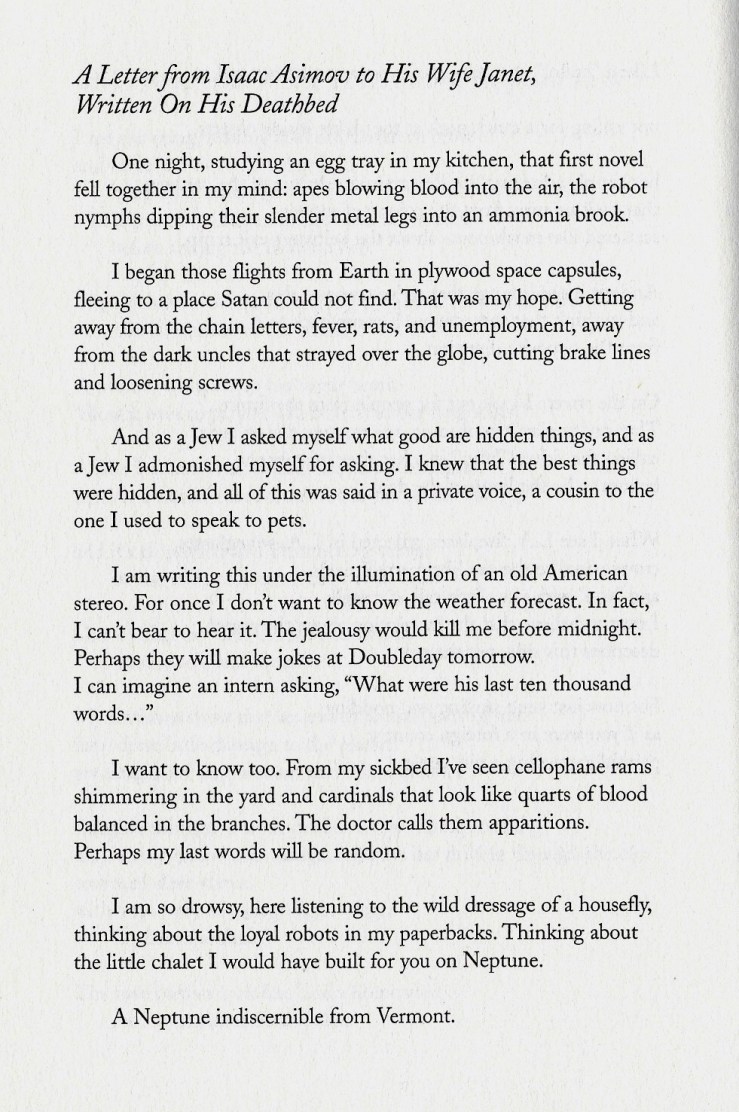
From Actual Air (Open City, 1999)
“Reapers” — Jean Toomer

“Serenade for a Wealthy Widow” — David Berman

From Actual Air (Open City, 1999)
“Imagining Defeat” — David Berman

From Actual Air (Open City, 1999)
“Heat” — Denis Johnson
“Heat”
by
Denis Johnson
Here in the electric dusk your naked lover
tips the glass high and the ice cubes fall against her teeth.
It’s beautiful Susan, her hair sticky with gin,
Our Lady of Wet Glass-Rings on the Album Cover,
streaming with hatred in the heat
as the record falls and the snake-band chords begin
to break like terrible news from the Rolling Stones,
and such a last light—full of spheres and zones.
August,
you’re just an erotic hallucination,
just so much feverishly produced kazoo music,
are you serious?—this large oven impersonating night,
this exhaustion mutilated to resemble passion,
the bogus moon of tenderness and magic
you hold out to each prisoner like a cup of light?
 Biblioklept