Letter from WB Yeats to Ezra Pound (July 1918)

Robert Louis Stevenson on Walt Whitman’s Leaves of Grass: “It Is Only a Book for Those Who Have the Gift of Reading”

From Robert Louis Stevenson’s essay “The Books Which Have Influenced Me”:

I come next to Whitman’s Leaves of Grass, a book of singular service, a book which tumbled the world upside down for me, blew into space a thousand cobwebs of genteel and ethical illusion, and, having thus shaken my tabernacle of lies, set me back again upon a strong foundation of all the original and manly virtues. But it is, once more, only a book for those who have the gift of reading. I will be very frank–I believe it is so with all good books except, perhaps, fiction. The average man lives, and must live, so wholly in convention, that gun-powder charges of the truth are more apt to discompose than to invigorate his creed. Either he cries out upon blasphemy and indecency, and crouches the closer round that little idol of part-truths and part-conveniences which is the contemporary deity, or he is convinced by what is new, forgets what is old, and becomes truly blasphemous and indecent himself. New truth is only useful to supplement the old; rough truth is only wanted to expand, not to destroy, our civil and often elegant conventions. He who cannot judge had better stick to fiction and the daily papers. There he will get little harm, and, in the first at least, some good.

Beatrice Addressing Dante — William Blake

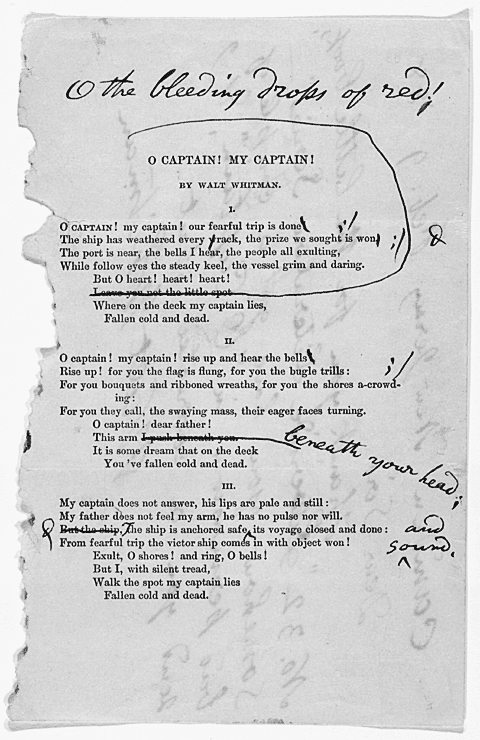
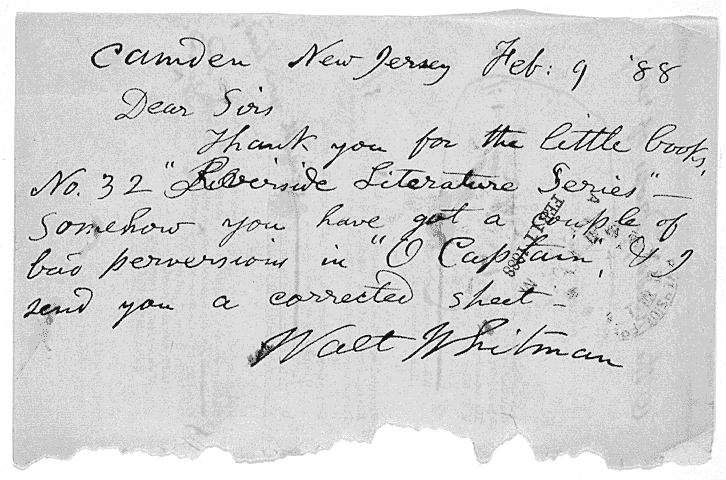
Letter and Corrected Reprint of Walt Whitman’s “O Captain, My Captain” with Comments by Author

(Via/more).

“A Toad, can die of Light” — Emily Dickinson

“A Toad, can die of Light,” a poem by Emily Dickinson:

A Toad, can die of Light —
Death is the Common Right
Of Toads and Men —
Of Earl and Midge
The privilege —
Why swagger, then?
The Gnat’s supremacy is large as Thine —

Life — is a different Thing —
So measure Wine —
Naked of Flask — Naked of Cask —
Bare Rhine —
Which Ruby’s mine

Anna Karina Reads from Paul Éluard’s The Capital of Sorrow (Godard’s Alphaville)

. . . the rays of your arms parted the fog . . .

Walt Whitman’s Bathers

A strange and sensual riff from Walt Whitman’s Song of Myself — 

Twenty-eight young men bathe by the shore,
Twenty-eight young men and all so friendly;
Twenty-eight years of womanly life and all so lonesome.

She owns the fine house by the rise of the bank,
She hides handsome and richly drest aft the blinds of the window.

Which of the young men does she like the best?
Ah the homeliest of them is beautiful to her.

Where are you off to, lady? for I see you,
You splash in the water there, yet stay stock still in your room.

Dancing and laughing along the beach came the twenty-ninth
bather,
The rest did not see her, but she saw them and loved them.

The beards of the young men glisten’d with wet, it ran from their
long hair,
Little streams pass’d all over their bodies.

An unseen hand also pass’d over their bodies,
It descended tremblingly from their temples and ribs.

The young men float on their backs, their white bellies bulge to the
sun, they do not ask who seizes fast to them,
They do not know who puffs and declines with pendant and bending
arch,
They do not think whom they souse with spray.

Books Acquired, 1.13.2012 (Ezra Pound, Thomas Bernhard, Louis Zukofsky)

20120115-163012.jpg

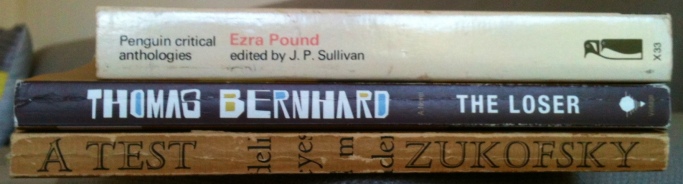
Picked up these three last Friday.

20120115-163023.jpg

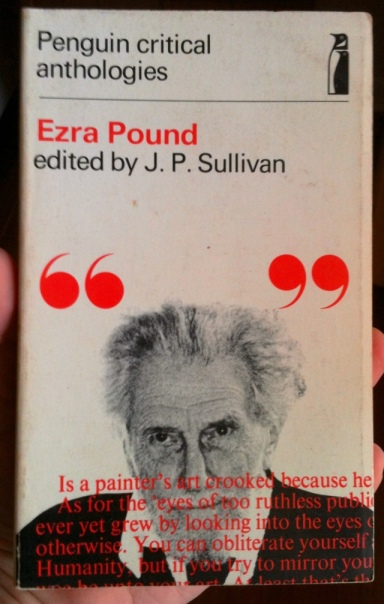
This is a collection of letters to and from Ezra Pound, as well as criticism, introductions, etc. I like the cover, which is a bit too busy.

20120115-163044.jpg

I picked up Thomas Bernhard’s Correction last year on reader recommendation (recommendation: read Bernhard). Saw The Loser in the shop used, so I picked it up. Any recommendation on which one to start with?

20120115-163114.jpg

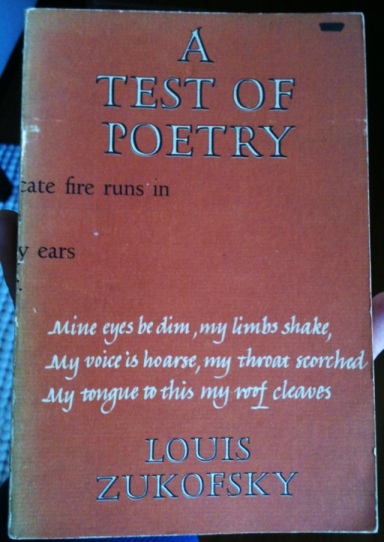
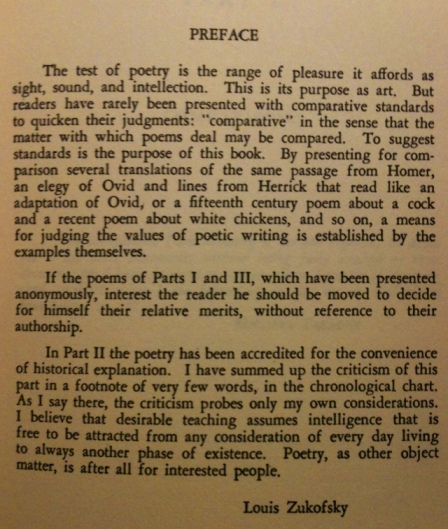
A midcentury paperback of Louis Zukofsky’s A Test of Poetry. This is a strange book. I’d better let Zukofsky explain it:

20120116-175731.jpg

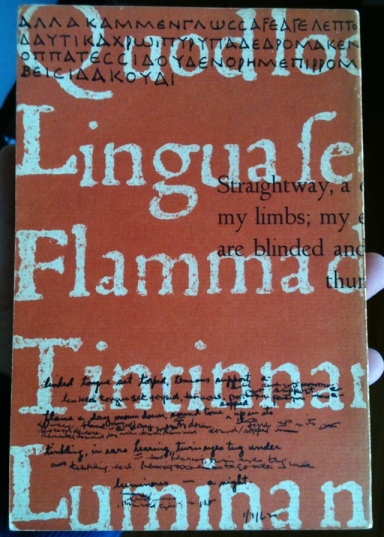
The back cover is lovely as well:

20120115-163132.jpg

“The Magi,” A Stark Christmas Poem by William Butler Yeats

“The Magi” by William Butler Yeats. A Christmas poem that’s not about Christmas, I guess. I love the final image:

Now as at all times I can see in the mind’s eye,
In their stiff, painted clothes, the pale unsatisfied ones
Appear and disappear in the blue depth of the sky
With all their ancient faces like rain-beaten stones,
And all their helms of silver hovering side by side,
And all their eyes still fixed, hoping to find once more,
Being by Calvary’s turbulence unsatisfied,
The uncontrollable mystery on the bestial floor.

“Winter-Time” — Robert Louis Stevenson

“Winter-Time,” a poem by Robert Louis Stevenson:

Late lies the wintry sun a-bed,
A frosty, fiery sleepy-head;
Blinks but an hour or two; and then,
A blood-red orange, sets again.

Before the stars have left the skies,
At morning in the dark I rise;
And shivering in my nakedness,
By the cold candle, bathe and dress.

Close by the jolly fire I sit
To warm my frozen bones a bit;
Or with a reindeer-sled, explore
The colder countries round the door.

When to go out, my nurse doth wrap
Me in my comforter and cap;
The cold wind burns my face, and blows
Its frosty pepper up my nose.

Black are my steps on silver sod;
Thick blows my frosty breath abroad;
And tree and house, and hill and lake,
Are frosted like a wedding cake.

“Mr. Brain” — Russell Edson

“Mr. Brain,” something by Russell Edson

 Mr Brain was a hermit dwarf who liked to eat shellfish off the moon. He liked to go into a tree then because there is a little height to see a little further, which may reveal now the stone, a pebble–it is a twig, it is nothing under the moon that you can make sure of.

So Mr Brain opened his mouth to let a moonbeam into his head.

Why to be alone, and you invite the stars to tea. A cup of tea drinks a luminous guest.

In the winter could you sit quietly by the window, in the evening when you could have vinegar and pretend it to be wine, because you would do well to eat doughnuts and pretend you drink wine as you sit quietly by the window. You may kick your leg back and forth. You may have a tendency to not want to look there too long and turn to find darkness in the room because it had become nighttime.

Why to be alone. You are pretty are you not/you are as pretty as you are not, or does that make sense.

You are not pretty, that is how you can be alone. And then you are pretty like fungus and alga, you are no one without some one, in theory alone.

Be good enough to go to bed so you can not think too much longer.

“Quickly Aging Here” — A Poem by Denis Johnson

“Quickly Aging Here,” a poem by Denis Johnson—

1


nothing to drink in
the refrigerator but juice from
the pickles come back
long dead, or thin
catsup. i feel i am old


now, though surely i
am young enough? i feel that i have had
winters, too many heaped cold


and dry as reptiles into my slack skin.
i am not the kind to win
and win.
no i am not that kind, i can hear


my wife yelling, “goddamnit, quit
running over,” talking to
the stove, yelling, “i
mean it, just stop,” and i am old and
2


i wonder about everything: birds
clamber south, your car
kaputs in a blazing, dusty
nowhere, things happen, and constantly you


wish for your slight home, for
your wife’s rusted
voice slamming around the kitchen. so few


of us wonder why
we crowded, as strange,
monstrous bodies, blindly into one
another till the bed


choked, and our range
of impossible maneuvers was gone,
but isn’t it because by dissolving like so
much dust into the sheets we are crowding


south, into the kitchen, into
nowhere?

“The Discharged Soldier” — William Wordsworth

Drawing of Adrian Jones by Michael Fay

In Section IV of his Prelude, William Wordsworth evokes the most moving encounter with a veteran of war that I have ever read. At first reticent to be anything but a voyeur, the narrator (Wordsworth, in all likelihood), slips “into the shade/ Of a thick hawthorn” to spy on the “meagre man” with a “ghastly” mouth “in military garb” resting on a “mile-stone.” As the poor ex-soldier, “Companionless,” begins to issue “low muttered sounds, as if of pain / Or some uneasy though,” the narrator shakes his “heart’s specious cowardice” and hails the veteran as a human being, asking for his story. It turns out that the guy is slowly—and with great difficulty—returning to his “native home.” Wordsworth takes the veteran to a nearby friend’s house for companionship and rest, before returning to his own home in a contemplative mood. Full text of  “The Discharged Soldier”—

No living thing appeared in earth or air,
And, save the flowing water’s peaceful voice,
Sound there was none–but, lo! an uncouth shape,
Shown by a sudden turning of the road,
So near that, slipping back into the shade
Of a thick hawthorn, I could mark him well, 390
Myself unseen. He was of stature tall,
A span above man’s common measure, tall,
Stiff, lank, and upright; a more meagre man
Was never seen before by night or day.
Long were his arms, pallid his hands; his mouth
Looked ghastly in the moonlight: from behind,
A mile-stone propped him; I could also ken
That he was clothed in military garb,
Though faded, yet entire. Companionless,
No dog attending, by no staff sustained, 400
He stood, and in his very dress appeared
A desolation, a simplicity,
To which the trappings of a gaudy world
Make a strange back-ground. From his lips, ere long,
Issued low muttered sounds, as if of pain
Or some uneasy thought; yet still his form
Kept the same awful steadiness–at his feet
His shadow lay, and moved not. From self-blame
Not wholly free, I watched him thus; at length
Subduing my heart’s specious cowardice, 410
I left the shady nook where I had stood
And hailed him. Slowly from his resting-place
He rose, and with a lean and wasted arm
In measured gesture lifted to his head
Returned my salutation; then resumed
His station as before; and when I asked
His history, the veteran, in reply,
Was neither slow nor eager; but, unmoved,
And with a quiet uncomplaining voice,
A stately air of mild indifference, 420
He told in few plain words a soldier’s tale–
That in the Tropic Islands he had served,
Whence he had landed scarcely three weeks past;
That on his landing he had been dismissed,
And now was travelling towards his native home.
This heard, I said, in pity, “Come with me.”
He stooped, and straightway from the ground took up
An oaken staff by me yet unobserved–
A staff which must have dropped from his slack hand
And lay till now neglected in the grass. 430
Though weak his step and cautious, he appeared
To travel without pain, and I beheld,
With an astonishment but ill suppressed,
His ghostly figure moving at my side;
Nor could I, while we journeyed thus, forbear
To turn from present hardships to the past,
And speak of war, battle, and pestilence,
Sprinkling this talk with questions, better spared,
On what he might himself have seen or felt.
He all the while was in demeanour calm, 440
Concise in answer; solemn and sublime
He might have seemed, but that in all he said
There was a strange half-absence, as of one
Knowing too well the importance of his theme,
But feeling it no longer. Our discourse
Soon ended, and together on we passed
In silence through a wood gloomy and still.
Up-turning, then, along an open field,
We reached a cottage. At the door I knocked,
And earnestly to charitable care 450
Commended him as a poor friendless man,
Belated and by sickness overcome.
Assured that now the traveller would repose
In comfort, I entreated that henceforth
He would not linger in the public ways,
But ask for timely furtherance and help
Such as his state required. At this reproof,
With the same ghastly mildness in his look,
He said, “My trust is in the God of Heaven,
And in the eye of him who passes me!” 460

The cottage door was speedily unbarred,
And now the soldier touched his hat once more
With his lean hand, and in a faltering voice,
Whose tone bespake reviving interests
Till then unfelt, he thanked me; I returned
The farewell blessing of the patient man,
And so we parted. Back I cast a look,
And lingered near the door a little space,
Then sought with quiet heart my distant home.

Swedish Poet Tomas Tranströmer Wins the Nobel Prize in Literature

From the Nobel committee–

The Nobel Prize in Literature for 2011 is awarded to the Swedish poet Tomas Tranströmer “because, through his condensed, translucent images, he gives us fresh access to reality”.

Here’s Tranströmer’s “After a Death,” translated by Robert Bly—

Once there was a shock
that left behind a long, shimmering comet tail.
It keeps us inside. It makes the TV pictures snowy.
It settles in cold drops on the telephone wires.

One can still go slowly on skis in the winter sun
through brush where a few leaves hang on.
They resemble pages torn from old telephone directories.
Names swallowed by the cold.

It is still beautiful to hear the heart beat
but often the shadow seems more real than the body.
The samurai looks insignificant
beside his armor of black dragon scales.

“To a Cat” — Jorge Luis Borges

“To a Cat,” a poem by Jorge Luis Borges—

Mirrors are not more silent
nor the creeping dawn more secretive;
in the moonlight, you are that panther
we catch sight of from afar.
By the inexplicable workings of a divine law,
we look for you in vain;
More remote, even, than the Ganges or the setting sun,
yours is the solitude, yours the secret.
Your haunch allows the lingering
caress of my hand. You have accepted,
since that long forgotten past,
the love of the distrustful hand.
You belong to another time. You are lord
of a place bounded like a dream.

“Florida” — Elizabeth Bishop

“Florida” by Elizabeth Bishop

The state with the prettiest name,
the state that floats in brackish water,
held together by mangrave roots
that bear while living oysters in clusters,
and when dead strew white swamps with skeletons,
dotted as if bombarded, with green hummocks
like ancient cannon-balls sprouting grass.
The state full of long S-shaped birds, blue and white,
and unseen hysterical birds who rush up the scale
every time in a tantrum.
Tanagers embarrassed by their flashiness,
and pelicans whose delight it is to clown;
who coast for fun on the strong tidal currents
in and out among the mangrove islands
and stand on the sand-bars drying their damp gold wings
on sun-lit evenings.
Enormous turtles, helpless and mild,
die and leave their barnacled shells on the beaches,
and their large white skulls with round eye-sockets
twice the size of a man’s.
The palm trees clatter in the stiff breeze
like the bills of the pelicans. The tropical rain comes down
to freshen the tide-looped strings of fading shells:
Job’s Tear, the Chinese Alphabet, the scarce Junonia,
parti-colored pectins and Ladies’ Ears,
arranged as on a gray rag of rotted calico,
the buried Indian Princess’s skirt;
with these the monotonous, endless, sagging coast-line
is delicately ornamented.

Thirty or more buzzards are drifting down, down, down,
over something they have spotted in the swamp,
in circles like stirred-up flakes of sediment
sinking through water.
Smoke from woods-fires filters fine blue solvents.
On stumps and dead trees the charring is like black velvet.
The mosquitoes
go hunting to the tune of their ferocious obbligatos.
After dark, the fireflies map the heavens in the marsh
until the moon rises.
Cold white, not bright, the moonlight is coarse-meshed,
and the careless, corrupt state is all black specks
too far apart, and ugly whites; the poorest
post-card of itself.
After dark, the pools seem to have slipped away.
The alligator, who has five distinct calls:
friendliness, love, mating, war, and a warning–
whimpers and speaks in the throat
of the Indian Princess.
“The Routine Things Around the House” — Stephen Dunn

“The Routine Things Around the House,” a poem by Stephen Dunn

When Mother died
I thought: now I’ll have a death poem.
That was unforgivable

yet I’ve since forgiven myself
as sons are able to do
who’ve been loved by their mothers.

I stared into the coffin
knowing how long she’d live,
how many lifetimes there are

in the sweet revisions of memory.
It’s hard to know exactly
how we ease ourselves back from sadness,

but I remembered when I was twelve,
1951, before the world
unbuttoned its blouse.

I had asked my mother (I was trembling)
if I could see her breasts
and she took me into her room

without embarrassment or coyness
and I stared at them,
afraid to ask for more.

Now, years later, someone tells me
Cancers who’ve never had mother love
are doomed and I, a Cancer,

feel blessed again. What luck
to have had a mother
who showed me her breasts

when girls my age were developing
their separate countries,
what luck

she didn’t doom me
with too much or too little.
Had I asked to touch,

perhaps to suck them,
what would she have done?
Mother, dead woman

who I think permits me
to love women easily,
this poem

is dedicated to where
we stopped, to the incompleteness
that was sufficient

and to how you buttoned up,
began doing the routine things
around the house.