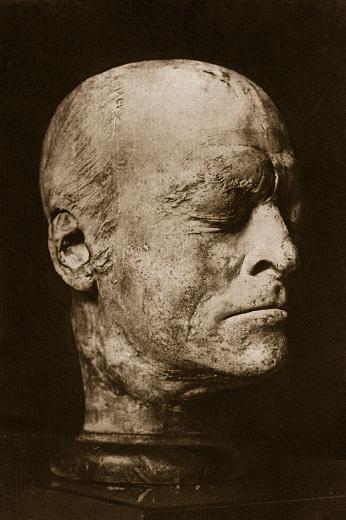
Heinrich Heine’s Death Mask

“On Leaving Some Friends At An Early Hour” — John Keats

“On Leaving Some Friends At An Early Hour” by John Keats—-

Give me a golden pen, and let me lean
On heaped-up flowers, in regions clear, and far;
Bring me a tablet whiter than a star,
Or hand of hymning angel, when ’tis seen
The silver strings of heavenly harp atween:
And let there glide by many a pearly car
Pink robes, and wavy hair, and diamond jar,
And half-discovered wings, and glances keen.
The while let music wander round my ears,
And as it reaches each delicious ending,
Let me write down a line of glorious tone,
And full of many wonders of the spheres:
For what a height my spirit is contending!
‘Tis not content so soon to be alone.

“Ode to the Only Girl” — John Edward Williams

“Ode to the Only Girl,” a poem by John Edward Williams

I’ve seen you many times in many places–
Theater, bus, train, or on the street;
Smiling in spring rain, in winter sleet,
Eyes of any hue in myriad faces;
Midnight black, all shades of brown your hair,
Long, short, bronze or honey-fair.
Instantly have I loved, have never spoken;
Slowly a truck passed, a light changed,
A door closed–all seemingly pre-arranged–
Then you were gone forever, the spell was broken.
Ubiquitios only one, we’ve met before
A hundred times, and we’ll meet again
As many more; in hills or forest glen,
On crowded street or lonely, peaceful shore;
Somewhere, someday–but how will we ever know
True love, how wil we ever know?

A Poem for July 4th — Walt Whitman’s “I Hear America Singing”

Walt Whitman’s poem “I Hear America Singing”—

I hear America singing, the varied carols I hear,
Those of mechanics, each one singing his as it should be blithe and strong,
The carpenter singing his as he measures his plank or beam,
The mason singing his as he makes ready for work, or leaves off work,
The boatman singing what belongs to him in his boat, the deckhand singing on the steamboat deck,
The shoemaker singing as he sits on his bench, the hatter singing as he stands,
The wood-cutter’s song, the ploughboy’s on his way in the morning, or at noon intermission or at sundown,
The delicious singing of the mother, or of the young wife at work, or of the girl sewing or washing,
Each singing what belongs to him or her and to none else,
The day what belongs to the day—at night the party of young fellows, robust, friendly,
Singing with open mouths their strong melodious songs.
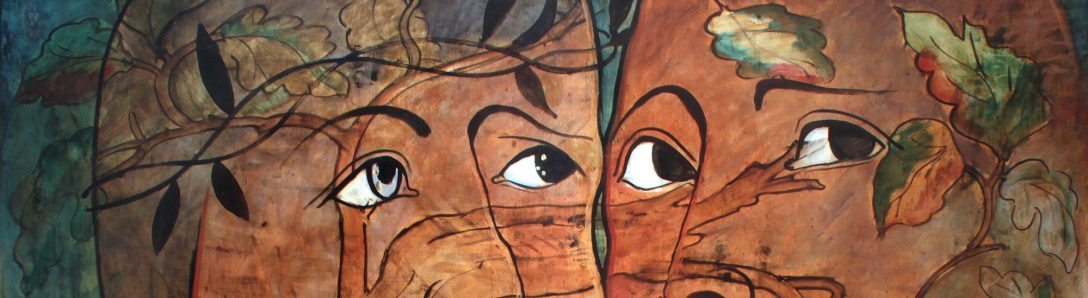
William Blake’s Death Mask

Bill Murray Reads Billy Collins’s Poem “Forgetfulness”

(More).

A Poem for Father’s Day — Robert Hayden’s “Those Winter Sundays”

Robert Hayden’s poem “Those Winter Sundays”–

Sundays too my father got up early
and put his clothes on in the blueblack cold,
then with cracked hands that ached
from labor in the weekday weather made
banked fires blaze. No one ever thanked him.

I’d wake and hear the cold splintering, breaking.
When the rooms were warm, he’d call,
and slowly I would rise and dress,
fearing the chronic angers of that house,

Speaking indifferently to him,
who had driven out the cold
and polished my good shoes as well.
What did I know, what did I know
of love’s austere and lonely offices?

“Poetry Is the Enchantment of Incest” — A Passage from Harold Bloom’s Manifesto for Antithetical Criticism

A passage from Harold Bloom’s “A Manifesto for Antithetical Criticism,” a chapter in his seminal study The Anxiety of Influence

 Every poem is a misinterpretation of a parent poem. A poem is not an overcoming of anxiety, but is that anxiety. Poets’ misinterpretations of poems are more drastic than critics’ misinterpretations or criticism, but this is only a difference in degree and not at all in kind. There are no interpretations but only misinterpretations, and so all criticism is prose poetry.

Critics are more or less valuable than other critics only (precisely) as poets are more or less valuable than other poets. For just as a poet must be found by the opening in a precursor poet, so must the critic. The difference is that a critic has more parents. His precursors are poets and critics. But – in truth – so are a poet’s precursors, often and more often as history lengthens.

Poetry is the anxiety of influence, is misprision, is a disciplined perverseness. Poetry is misunderstanding, misinterpretation, misalliance.

Poetry (Romance) is Family Romance. Poetry is the enchantment of incest, disciplined by resistance to that enchantment.

Influence is Influenza—an astral disease.

If influence were health, who could write a poem? Health is stasis.

Schizophrenia is bad poetry, for the schizophrenic has lost the strength of perverse, willful, misprision.

“The History of My Life” — John Ashbery

“The History of My Life” by John Ashbery—

Once upon a time there were two brothers.
Then there was only one: myself.

I grew up fast, before learning to drive,
even, there was I: a stinking adult

I thought of developing interests
someone might take an interest in. No soap.

I became very weepy for what had seemed
like the pleasant early years. As I aged

increasingly, I also grew more charitable
with regard to my thoughts and ideas,

thinking them at least as good as the next man’s.
Then a great devouring cloud

came and loitered on the horizon, drinking
it up for what seemed like months or years.

“Surreptitious Kissing” — Denis Johnson

“Surreptitious Kissing,” a poem by Denis Johnson

I want to say that
forgiveness keeps on

dividing, that hope
gives issue to hope,

and more, but of course I
am saying what is

said when in this dark
hallway one encounters

you, and paws and
assaults you—love

affairs, fast lies—and you
say it back and we

blunder deeper, as would
any pair of loosed

marionettes, any couple
of cadavers cut lately

from the scaffold,
in the secluded hallways

of whatever is
holding us up now.

“The Fall of Rome” — W.H. Auden

“The Fall of Rome,” a poem by W.H. Auden

The piers are pummelled by the waves;
In a lonely field the rain
Lashes an abandoned train;
Outlaws fill the mountain caves.

Fantastic grow the evening gowns;
Agents of the Fisc pursue
Absconding tax-defaulters through
The sewers of provincial towns.

Private rites of magic send
The temple prostitutes to sleep;
All the literati keep
An imaginary friend.

Cerebrotonic Cato may
Extol the Ancient Disciplines,
But the muscle-bound Marines
Mutiny for food and pay.

Caesar’s double-bed is warm
As an unimportant clerk
Writes I DO NOT LIKE MY WORK
On a pink official form.

Unendowed with wealth or pity,
Little birds with scarlet legs,
Sitting on their speckled eggs,
Eye each flu-infected city.

Altogether elsewhere, vast
Herds of reindeer move across
Miles and miles of golden moss,
Silently and very fast.

“After Reading a Child’s Guide to Modern Physics” — W.H. Auden

“After Reading a Child’s Guide to Modern Physics” by W. H. Auden—

If all a top physicist knows
About the Truth be true,
Then, for all the so-and-so’s,
Futility and grime,
Our common world contains,
We have a better time
Than the Greater Nebulae do,
Or the atoms in our brains.

Marriage is rarely bliss
But, surely it would be worse
As particles to pelt
At thousands of miles per sec
About a universe
Wherein a lover’s kiss
Would either not be felt
Or break the loved one’s neck.

Though the face at which I stare
While shaving it be cruel
For, year after year, it repels
An ageing suitor, it has,
Thank God, sufficient mass
To be altogether there,
Not an indeterminate gruel
Which is partly somewhere else.

Our eyes prefer to suppose
That a habitable place
Has a geocentric view,
That architects enclose
A quiet Euclidian space:
Exploded myths – but who
Could feel at home astraddle
An ever expanding saddle?

This passion of our kind
For the process of finding out
Is a fact one can hardly doubt,
But I would rejoice in it more
If I knew more clearly what
We wanted the knowledge for,
Felt certain still that the mind
Is free to know or not.

It has chosen once, it seems,
And whether our concern
For magnitude’s extremes
Really become a creature
Who comes in a median size,
Or politicizing Nature
Be altogether wise,
Is something we shall learn.

“Stupid” — Raymond Carver

“Stupid,” a poem by Raymond Carver—

It’s what the kids nowadays call weed. And it drifts
like clouds from his lips. He hopes no one
comes along tonight, or calls to ask for help.
Help is what he’s most short on tonight.
A storm thrashes outside. Heavy seas
with gale winds from the west. The table he sits at
is, say, two cubits long and one wide.
The darkness in the room teems with insight.
Could be he’ll write an adventure novel. Or else
a children’s story. A play for two female characters,
one of whom is blind. Cutthroat should be coming
into the river. One thing he’ll do is learn
to tie his own flies. Maybe he should give
more money to each of his surviving
family members. The ones who already expect a little
something in the mail first of each month.
Every time they write they tell him
they’re coming up short. He counts heads on his fingers
and finds they’re all survivng. So what
if he’d rather be remembered in the dreams of strangers?
He raises his eyes to the skylights where rain
hammers on. After a while —
who knows how long? — his eyes ask
that they be closed. And he closes them.
But the rain keeps hammering. Is this a cloudburst?
Should he do something? Secure the house
in some way? Uncle Bo stayed married to Aunt Ruby for 47 years. Then hanged himself.
He opens his eyes again. Nothing adds up.
It all adds up. How long will this storm go on?

Frank O’Hara Reads “Fantasy”

“The White Fires of Venus” — Denis Johnson

“The White Fires of Venus” by Denis Johnson

We mourn this senseless planet of regret,
droughts, rust, rain, cadavers
that can’t tell us, but I promise
you one day the white fires
of Venus shall rage: the dead,
feeling that power, shall be lifted, and each
of us will have his resurrected one to tell him,
“Greetings. You will recover
or die. The simple cure
for everything is to destroy
all the stethoscopes that will transmit
silence occasionally. The remedy for loneliness
is in learning to admit
solitude as one admits
the bayonet: gracefully,
now that already
it pierces the heart.
Living one: you move among many
dancers and don’t know which
you are the shadow of;
you want to kiss your own face in the mirror
but do not approach,
knowing you must not touch one
like that. Living
one, while Venus flares
O set the cereal afire,
O the refrigerator harboring things
that live on into death unchanged.”

They know all about us on Andromeda,
they peek at us, they see us
in this world illumined and pasteled
phonily like a bus station,
they are with us when the streets fall down fraught
with laundromats and each of us
closes himself in his small
San Francisco without recourse.
They see you with your face of fingerprints
carrying your instructions in gloved hands
trying to touch things, and know you
for one despairing, trying to touch the curtains,
trying to get your reflection mired in alarm tape
past the window of this then that dark
closed business establishment.
The Andromedans hear your voice like distant amusement park music
converged on by ambulance sirens
and they understand everything.
They’re on your side. They forgive you.

I want to turn for a moment to those my heart loves,
who are as diamonds to the Andromedans,
who shimmer for them, lovely and useless, like diamonds:
namely, those who take their meals at soda fountains,
their expressions lodged among the drugs
and sunglasses, each gazing down too long
into the coffee as though from a ruined balcony.
O Andromedans they don’t know what to do
with themselves and so they sit there
until they go home where they lie down
until they get up, and you beyond the light years know
that if sleeping is dying, then waking
is birth, and a life
is many lives. I love them because they know how
to manipulate change
in the pockets musically, these whose faces the seasons
never give a kiss, these
who are always courteous to the faces
of presumptions, the presuming streets,
the hotels, the presumption of rain in the streets.
I’m telling you it’s cold inside the body that is not the body,
lonesome behind the face
that is certainly not the face
of the person one meant to become.

“Your Dog Dies” — Raymond Carver

“Your Dog Dies” by Raymond Carver–

It gets run over by a van.
you find it at the side of the road
and bury it.
you feel bad about it.
you feel bad personally,
but you feel bad for your daughter
because it was her pet,
and she loved it so.
she used to croon to it
and let it sleep in her bed.
you write a poem about it.
you call it a poem for your daughter,
about the dog getting run over by a van
and how you looked after it,
took it out into the woods
and buried it deep, deep,
and that poem turns out so good
you’re almost glad the little dog
was run over, or else you’d never
have written that good poem.
then you sit down to write
a poem about writing a poem
about the death of that dog,
but while you’re writing you
hear a woman scream
your name, your first name,
both syllables,
and your heart stops.
after a minute, you continue writing.
she screams again.
you wonder how long this can go on.


Emily Dickinson’s Handwritten Manuscript for “Wild Nights — Wild Nights!”

Emily Dickinson's "Wild Nights -- Wild Nights!" Manuscript

Here is the poem (sexy good times!)–

Wild Nights – Wild Nights!
Were I with thee
Wild Nights should be
Our luxury!

Futile – the Winds –
To a Heart in port –
Done with the Compass –
Done with the Chart!

Rowing in Eden –
Ah, the Sea!
Might I but moor – Tonight –
In Thee!