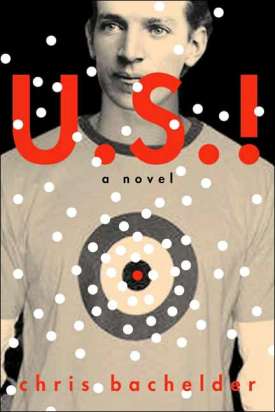
Chris Bachelder‘s superb novel U.S.! portrays an alternate (and somewhat hyperbolic) United States where the Left (big-L) keeps bringing Upton Sinclair (that guy who wrote The Jungle (maybe you read it in high school (I didn’t))) back to life. These would-be revolutionaries try to keep Sinclair (and hope) alive in spite of the fact that right-wing reactionary populist heroes keep assassinating him. In fact, in U.S.!, Upton Sinclair assassination is its own cottage industry.
Bachelder uses a dazzling range of approaches in the first 200 pages of the novel, employing everything from folk song lyrics to Amazon reviews to talk show transcripts in order to flesh out his alternate universe. The first part of U.S.! essentially sets up the last third of the novel, a relatively straight-forward third-person omniscient account of a Fourth of July book-burning in a Southern state. I won’t reveal any more of the plot, because I’m lazy and you should read this book for yourself.
Bachelder’s writing crackles with wit and surprising warmth, especially in the character of Sinclair, who comes across as a (literally) dusty out-of-touch relic, an idealist as equally unable to effect any change in the modern world as he was able to in his own era. Sinclair and the would-be revolutionaries who resuscitate him serve as Bachelder’s critique on America’s stale, impotent left (or is it Left?). Bachelder also savagely criticizes Sinclair’s rhetoric; one of the funniest sections of the first part of the book involves an analysis of exclamation points (and their overuse) in Sinclair’s novels. Toward the end of the novel, Bachelder employs a meta-critical strategy of adding more and more exclamation points to his own writing; the exaggerated gestures comically highlight the cartoonishly grotesque world of U.S.!, at the same time counterbalancing the understated but profound sadness of the novel.
My only gripe with U.S.! would be Bachelder’s rare lapse into what I like to call “workshop fiction”–fiction that seems the contrived and overwritten product of MFA work-shopping (did I mention that Bachelder got his MFA at my alma mater, the University of Florida at Gainesville? (other great writers associated with this glorious institution include Padgett Powell and Harry Crews)). As I noted though, these instances are rare and mostly notable because the majority of the novel is so fresh, original, and readable. This book is funny, poignant, and you should read it.