Read “The Girl I Left Behind Me,” a ghost story by Muriel Spark

“The Girl I Left Behind Me”

by

Muriel Spark


It was just gone quarter past six when I left the office.

‘Teedle-um-tum-tum’ — there was the tune again, going round my head. Mr Letter had been whistling it all throughout the day between his noisy telephone calls and his dreamy sessions. Sometimes he whistled ‘Softly, Softly, Turn the Key’, but usually it was ‘The Girl I Left Behind Me’ rendered at a brisk hornpipe tempo.

I stood in the bus queue, tired out, and wondering how long I would endure Mark Letter (Screws & Nails) Ltd. Of course, after my long illness, it was experience. But Mr Letter and his tune, and his sudden moods of bounce, and his sudden lapses into lassitude, his sandy hair and little bad teeth, roused my resentment, especially when his tune barrelled round my head long after I had left the office; it was like taking Mr Letter home.

No one at the bus stop took any notice of me. Well, of course, why should they? I was not acquainted with anyone there, but that evening I felt particularly anonymous among the homegoers. Everyone looked right through me and even, it seemed, walked through me. Late autumn always sets my fancy towards sad ideas. The starlings were crowding in to roost on all the high cornices of the great office buildings. And I located, among the misty unease of my feelings, a very strong conviction that I had left something important behind me or some job incompleted at the office. Perhaps I had left the safe unlocked, or perhaps it was something quite trivial which nagged at me. I had half a mind to turn back, tired as I was, and reassure myself. But my bus came along and I piled in with the rest. Continue reading “Read “The Girl I Left Behind Me,” a ghost story by Muriel Spark”

“The Nose,” an absurd tale by Nikolai Gogol

“The Nose”

by

Nikolai Gogol

translated by Claud Field


I

On the 25th March, 18—, a very strange occurrence took place in St Petersburg. On the Ascension Avenue there lived a barber of the name of Ivan Jakovlevitch. He had lost his family name, and on his sign-board, on which was depicted the head of a gentleman with one cheek soaped, the only inscription to be read was, “Blood-letting done here.”

On this particular morning he awoke pretty early. Becoming aware of the smell of fresh-baked bread, he sat up a little in bed, and saw his wife, who had a special partiality for coffee, in the act of taking some fresh-baked bread out of the oven.

“To-day, Prasskovna Ossipovna,” he said, “I do not want any coffee; I should like a fresh loaf with onions.”

“The blockhead may eat bread only as far as I am concerned,” said his wife to herself; “then I shall have a chance of getting some coffee.” And she threw a loaf on the table.

For the sake of propriety, Ivan Jakovlevitch drew a coat over his shirt, sat down at the table, shook out some salt for himself, prepared two onions, assumed a serious expression, and began to cut the bread. After he had cut the loaf in two halves, he looked, and to his great astonishment saw something whitish sticking in it. He carefully poked round it with his knife, and felt it with his finger.

“Quite firmly fixed!” he murmured in his beard. “What can it be?”

He put in his finger, and drew out—a nose!

Ivan Jakovlevitch at first let his hands fall from sheer astonishment; then he rubbed his eyes and began to feel it. A nose, an actual nose; and, moreover, it seemed to be the nose of an acquaintance! Alarm and terror were depicted in Ivan’s face; but these feelings were slight in comparison with the disgust which took possession of his wife.

“Whose nose have you cut off, you monster?” she screamed, her face red with anger. “You scoundrel! You tippler! I myself will report you to the police! Such a rascal! Many customers have told me that while you were shaving them, you held them so tight by the nose that they could hardly sit still.”

But Ivan Jakovlevitch was more dead than alive; he saw at once that this nose could belong to no other than to Kovaloff, a member of the Municipal Committee whom he shaved every Sunday and Wednesday.

“Stop, Prasskovna Ossipovna! I will wrap it in a piece of cloth and place it in the corner. There it may remain for the present; later on I will take it away.”

“No, not there! Shall I endure an amputated nose in my room? You understand nothing except how to strop a razor. You know nothing of the duties and obligations of a respectable man. You vagabond! You good-for-nothing! Am I to undertake all responsibility for you at the police-office? Ah, you soap-smearer! You blockhead! Take it away where you like, but don’t let it stay under my eyes!”

Ivan Jakovlevitch stood there flabbergasted. He thought and thought, and knew not what he thought.

“The devil knows how that happened!” he said at last, scratching his head behind his ear. “Whether I came home drunk last night or not, I really don’t know; but in all probability this is a quite extraordinary occurrence, for a loaf is something baked and a nose is something different. I don’t understand the matter at all.” And Ivan Jakovlevitch was silent. The thought that the police might find him in unlawful possession of a nose and arrest him, robbed him of all presence of mind. Already he began to have visions of a red collar with silver braid and of a sword—and he trembled all over.

At last he finished dressing himself, and to the accompaniment of the emphatic exhortations of his spouse, he wrapped up the nose in a cloth and issued into the street.

He intended to lose it somewhere—either at somebody’s door, or in a public square, or in a narrow alley; but just then, in order to complete his bad luck, he was met by an acquaintance, who showered inquiries upon him. “Hullo, Ivan Jakovlevitch! Whom are you going to shave so early in the morning?” etc., so that he could find no suitable opportunity to do what he wanted. Later on he did let the nose drop, but a sentry bore down upon him with his halberd, and said, “Look out! You have let something drop!” and Ivan Jakovlevitch was obliged to pick it up and put it in his pocket.

A feeling of despair began to take possession of him; all the more as the streets became more thronged and the merchants began to open their shops. At last he resolved to go to the Isaac Bridge, where perhaps he might succeed in throwing it into the Neva.

But my conscience is a little uneasy that I have not yet given any detailed information about Ivan Jakovlevitch, an estimable man in many ways.

Like every honest Russian tradesman, Ivan Jakovlevitch was a terrible drunkard, and although he shaved other people’s faces every day, his own was always unshaved. His coat (he never wore an overcoat) was quite mottled, i.e. it had been black, but become brownish-yellow; the collar was quite shiny, and instead of the three buttons, only the threads by which they had been fastened were to be seen. Continue reading ““The Nose,” an absurd tale by Nikolai Gogol”

“The Wheel,” a short story by John Wyndham

“The Wheel”

by

John Wyndham


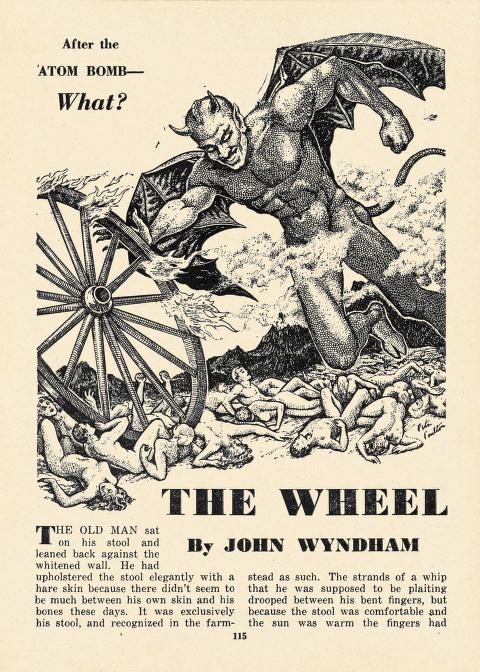
THE OLD MAN sat on his stool and leaned back against the whitened wall. He had upholstered the stool elegantly with a bare skin because there didn’t seem to be much between his own skin and his bones these days. It was exclusively his stool, and recognized in the farmstead as such. The strands of a whip that he was supposed to be plaiting drooped between his bent fingers, but because the stool was comfortable and the sun was warm the fingers had stopped moving, and his head was nodding.

The yard was empty save for a few hens that pecked more inquisitively than hopefully in the dust, but there were sounds that told of others who had not the old man’s leisure for siesta. From round the corner of the house came the occasional plonk of an empty bucket as it hit the water, and its scrape on the side of the well as it came up full. In the shack across the yard a dull pounding went on rhythmically and soporifically.

The old man’s head fell further forward as he drowsed.

Presently, from beyond the rough, enclosing wall there came another sound, slowly approaching. A rumbling and a rattling, with an intermittent squeaking. The old man’s ears were no longer sharp, and for some minutes it failed to disturb him. Then he opened his eyes and, locating the sound, sat staring incredulously toward the gateway.

The sound drew closer, and a boy’s head showed above the wall. He grinned at the old man, an expression of excitement in his eyes. He did not call out, but moved a little faster until he came to the gate. There he turned into the yard, proudly towing behind him a box mounted on four wooden wheels.

The old man got up suddenly from his seat, alarm in every line. He waved both arms at the boy as though he would push him back. The boy stopped. His expression of gleeful pride faded into astonishment. He stared at the old man who was waving him away so urgently. While he still hesitated the old man continued to shoo him off with one hand as he placed the other on his own lips, and started to walk towards him.

Reluctantly and bewilderedly the boy turned, but too late. The pounding in the shed stopped. A middle-aged woman appeared in the doorway. Her mouth was open to call, but the words did not come. Her jaw dropped slackly, her eyes seemed to bulge, then she crossed herself, and screamed….

Continue reading ““The Wheel,” a short story by John Wyndham”

“The Little Berliner” — Robert Walser

“The Little Berliner”

by

Robert Walser

Translated by Harriett Watts


PAPA boxed my ears today, in a most fond and fatherly manner, of course. I had used the expression: “Father, you must be nuts.” It was indeed a bit careless of me. “Ladies should employ exquisite language,” our German teacher says. She’s horrible. But Papa won’t allow me to ridicule her, and perhaps he’s right. After all, one does go to school to exhibit a certain zeal for learning and a certain respect. Besides, it is cheap and vulgar to discover funny things in a fellow human being and then to laugh at them. Young ladies should accustom themselves to the fine and the noble—I quite see that. No one desires any work from me, no one will ever demand it of me; but everyone will expect to find that I am refined in my ways. Shall I enter some profession in later life? Of course not! I’ll be an elegant young wife; I shall get married. It is possible that I’ll torment my husband. But that would be terrible. One always despises oneself whenever one feels the need to despise someone else. I am twelve years old. I must be very precocious—otherwise, I would never think of such things. Shall I have children? And how will that come about? If my future husband isn’t a despicable human being, then, yes, then I’m sure of it, I shall have a child. Then I shall bring up this child. But I still have to be brought up myself. What silly thoughts one can have!

Berlin is the most beautiful, the most cultivated city in the world. I would be detestable if I weren’t unshakably convinced of this. Doesn’t the Kaiser live here? Would he need to live here if he didn’t like it here best of all? The other day I saw the royal children in an open car. They are enchanting. The crown prince looks like a high-spirited young god, and how beautiful seemed the noble lady at his side. She was completely hidden in fragrant furs. It seemed that blossoms rained down upon the pair out of the blue sky. The Tiergarten is marvelous. I go walking there almost every day with our young lady, the governess. One can go for hours under the green trees, on straight or winding paths. Even Father, who doesn’t really need to be enthusiastic about anything, is enthusiastic about the Tiergarten. Father is a cultivated man. I’m convinced he loves me madly. It would be horrible if he read this, but I shall tear up what I have written. Actually, it is not at all fitting to be still so silly and immature and, at the same time, already want to keep a diary. But, from time to time, one becomes somewhat bored, and then one easily gives way to what is not quite right. The governess is very nice. Well, I mean, in general. She is devoted and she loves me. In addition, she has real respect for Papa—that is the most important thing. She is slender of figure. Our previous governess was fat as a frog. She always seemed to be about to burst. She was English. She’s still English today, of course, but from the moment she allowed herself liberties, she was no longer our concern. Father kicked her out.

The two of us, Papa and I, are soon to take a trip. It is that time of the year now when respectable people simply have to take a trip. Isn’t it a suspicious sort of person who doesn’t take a trip at such a time of blossoming and blooming? Papa goes to the seashore and apparently lies there day after day and lets himself be baked dark brown by the summer sun. He always looks healthiest in September. The paleness of exhaustion is not becoming to his face. Incidentally, I myself love the suntanned look in a man’s face. It is as if he had just come home from war. Isn’t that just like a child’s nonsense? Well, I’m still a child, of course. As far as I’m concerned, I’m taking a trip to the south. First of all, a little while to Munich and then to Venice, where a person who is unspeakably close to me lives—Mama. For reasons whose depths I cannot understand and consequently cannot evaluate, my parents live apart. Most of the time I live with Father. But naturally Mother also has the right to possess me at least for a while. I can scarcely wait for the approaching trip. I like to travel, and I think that almost all people must like to travel. One boards the train, it departs, and off it goes into the distance. One sits and is carried into the remote unknown. How well-off I am, really! What do I know of need, of poverty? Nothing at all. I also don’t find it the least bit necessary that I should experience anything so base. But I do feel sorry for the poor children. I would jump out the window under such conditions. Continue reading ““The Little Berliner” — Robert Walser”

Read “Whatever He Sees, He Sees Soft,” a very short story by Julio Cortázar

“Whatever He Sees, He Sees Soft”

by

Julio Cortázar

translated by Robert Coover and Pilar Coover

I know a great softener, a fellow who, whatever he sees, he sees soft, softens it merely by seeing it, not by looking at it for he doesn’t look, he only sees, he goes around seeing things and all of them are terribly soft, which makes him happy because he doesn’t like hard things at all.

There was a time when no doubt he saw things hard, being then still able to look, for he who looks sees twice: he sees what he’s seeing and at the same time it is what he sees, or at least it could be, or would like to be, or would not like to be, all exceedingly philosophical and existential means of locating oneself and locating the world. But one day when he was about twenty years old, he began to stop looking, this fellow, because in point of fact he had very soft skin, and the last few times he’d wanted to look straight out at the world, the sight had torn his skin in two or three places, and naturally my friend said. Hey baby, this won’t do! Whereupon one morning he’d started just seeing instead, very carefully, only that, nothing but seeing-and from then on, of course, whatever he saw, he saw soft, softened it simply by seeing it, and he was happy because he couldn’t abide hard things at all.

“Trivializing vision” is what a professor from Bahía Blanca called it, a surprisingly felicitous expression coming as it did from Bahía Blanca, but my friend paid it no heed, and not only that, but when he saw the professor, he naturally saw him as remarkably soft, and so invited him home for cocktails, introduced him to his sister and aunt, the whole event transpiring in an atmosphere of great softness.

It bothers me a little, I must say, because whenever my friend sees me, I feel like I’m going completely soft, and even though I know it’s got nothing to do with me, but rather with the image of me my friend has, as the professor from Bahía Blanca would say, just the same it bothers me, because nobody likes to be seen as some kind of semolina pudding, and so get invited to the movies to watch cowboys or get talked to for hours about how lovely the carpets are in the Embassy of Madagascar.

What’s to be done with my friend? Nothing, of course, At all events, see him but never look at him: how, I ask, could we look at him without, horribly, risking utter dissolution? He who sees only must be seen only: a wise and melancholy moral which goes, I am afraid, beyond the laws of optics.

“Wife in Reverse,” a very short story by Stephen Dixon

“Wife in Reverse”

by

Stephen Dixon


 His wife dies, mouth slightly parted and one eye open. He knocks on his younger daughter’s bedroom door and says “You better come. Mom seems to be expiring.” His wife slips into a coma three days after she comes home and stays in it for eleven days. They have a little party second day she’s home: Nova Scotia salmon, chocolates, a risotto he made, brie cheese, strawberries, champagne. An ambulette brings his wife home. She says to him “Wheel me around the garden before I go to bed for the last time.” His wife refuses the feeding tube the doctors want to put in her and insists she wants to die at home. She says “I don’t want any more life support, medicines, fluid or food.” He calls 911 for the fourth time in two years and tells the dispatcher “My wife; I’m sure she has pneumonia again.” His wife has a trach put in. “When will it come out?” she says, and the doctor says “To be honest? Never.” “Your wife has a very bad case of pneumonia,” the doctor in ICU tells him and his daughters the first time, “and has a one to two percent chance of surviving.” His wife now uses a wheelchair. His wife now uses a motor cart. His wife now uses a walker with wheels. His wife now uses a walker. His wife has to use a cane. His wife’s diagnosed with MS. His wife has trouble walking. His wife gives birth to their second daughter. “This time you didn’t cry,” she says, and he says “I’m just as happy, though.” His wife says to him “Something seems wrong with my eyes.” His wife gives birth to their daughter. The obstetrician says “I’ve never seen a father cry in the birthing room.” The rabbi pronounces them husband and wife, and just before he kisses her, he bursts out crying. “Let’s get married,” he says to her, and she says “It’s all right with me,” and he says “It is?” and starts crying. “What a reaction,” she says, and he says “I’m so happy, so happy,” and she hugs him and says “So am I.” She calls and says “How are you? Do you want to meet and talk?” She drops him off in front of his building and says “It’s just not working.” They go to a restaurant on their first real date and he says “The reason I’m being so picky as to what to eat is that I’m a vegetarian, something I was a little reluctant to tell you so soon,” and she says “Why? It’s not peculiar. It just means we won’t share our entrees except for the vegetables.” He meets a woman at a party. They talk for a long time. She has to leave the party and go to a concert. He gets her phone number and says “I’ll call you,” and she says “I’d like that.” He says goodbye to her at the door and shakes her hand. After she leaves he thinks “That woman’s going to be my wife.”

Read Zora Neale Hurston’s short story “Monkey Junk”

Continue reading “Read Zora Neale Hurston’s short story “Monkey Junk””

“A Little Girl’s Xmas in Moderan” — David R. Bunch

img_1036

“”A Little Girl’s Xmas in Moderan”

by

David R. Bunch

from Moderan


IT WAS in Jingle-Bell weather that Little Sister came across the white yard, the snow between her toes all gray and packed and starting to ball up like the beginnings of two snowmen. For clothing she had nothing, her tiny rump sticking out red-cold, and blue-cold, and her little-jewel knees white almost as bones. She stuck up ten stiff fingers, and she said, “Daddy! Something is wrong at my place! Come see!” She lisped a little perhaps and did not say it all as precisely as grownups, because she was just past four.

He turned like a man in the bottom third of bad dreaming; he pointed two bored eyes at her. Damn the kid, he thought. “What the hell deal has Mox got us into now?” he said. And he sang the little rhyme that made the door come open. Then as she stepped toward him he saw the snowballs on her feet. They were melting now, making deep furrows in the green rug spread across his spacious thinking room. The tall nap, like flooded grass now along little canals bending away from her feet, was speckled white here and there with crumpled paper balls. His trial plans and formulas peeped out like golf balls.

Coming back across the iron fields of nightmare that always rose to confront him at such times, he struggled to make the present’s puzzling moment into sense. Damn the kid, he thought, didn’t wipe her feet. All flesh, as yet—her own—and bone and blood, and didn’t wipe her feet. The snow melts!

He motioned her to him. “Little Sister,” he began in that tired dull-tinny voice that was his now, and must be his, because his larynx was worked all in gold against cancer, “tell me slowly, Little Sister. Why don’t you stay in your plastic place more? Why don’t you use the iron Mox more? Why do you bother me at all? Tell me slowly.”

“Daddy!” she cried and started to jig up and down in the fits that he hated so, “come over to my place, you old boogie. Something needs fixing.”

So they went across the big white yard to her place, past Mother’s place, past Little Brother’s place, with her snow-hurt limping and naked, and him lumbering in strange stiff-jointedness, but snug in a fire-red snuggie suit of fine insulation with good black leather space high-tops. Arrived at her place he whistled at the door the three sharp notes. The door moved into the wall and Mox the iron one stood sliding the iron sections of his arms up into one another until he had only hands hanging from shoulders. It was his greeting way. He ogled with bulb eyes and flashed his greeting code. Continue reading ““A Little Girl’s Xmas in Moderan” — David R. Bunch”

“Pat Hobby’s Christmas Wish,” a short story by F. Scott Fitzgerald

“Pat Hobby’s Christmas Wish”

by

F. Scott Fitzgerald


It was Christmas Eve in the studio. By eleven o’clock in the morning, Santa Claus had called on most of the huge population according to each one’s deserts.

Sumptuous gifts from producers to stars, and from agents to producers arrived at offices and studio bungalows; on every stage one heard of the roguish gifts of casts to directors or directors to casts; champagne had gone out from publicity office to the press. And tips of fifties, tens and fives from producers, directors and writers fell like manna upon the white collar class.

In this sort of transaction there were exceptions. Pat Hobby, for example, who knew the game from twenty years’ experience, had had the idea of getting rid of his secretary the day before. They were sending over a new one any minute—but she would scarcely expect a present the first day.

Waiting for her, he walked the corridor, glancing into open offices for signs of life. He stopped to chat with Joe Hopper from the scenario department.

“Not like the old days,” he mourned, “Then there was a bottle on every desk.”

“There’re a few around.”

“Not many.” Pat sighed, “And afterwards we’d run a picture—made up out of cutting-room scraps.”

“I’ve heard. All the suppressed stuff,” said Hopper.

Pat nodded, his eyes glistening.

“Oh, it was juicy. You darned near ripped your guts laughing—”

He broke off as the sight of a woman, pad in hand, entering his office down the hall recalled him to the sorry present.

“Gooddorf has me working over the holiday,” he complained bitterly.

“I wouldn’t do it.”

“I wouldn’t either except my four weeks are up next Friday, and if I bucked him he wouldn’t extend me.”

Pat’s new secretary was about thirty-six, handsome, faded, tired, efficient. She went to the typewriter, examined it, sat down and burst into sobs.

As he turned away Hopper knew that Pat was not being extended anyhow. He had been hired to script an old-fashioned horse-opera and the boys who were “writing behind him”—that is working over his stuff—said that all of it was old and some didn’t make sense.

“I’m Miss Kagle,” said Pat’s new secretary. She was about thirty-six, handsome, faded, tired, efficient. She went to the typewriter, examined it, sat down and burst into sobs.

Pat started. Self-control, from below anyhow, was the rule around here. Wasn’t it bad enough to be working on Christmas Eve? Well—less bad than not working at all. He walked over and shut the door—someone might suspect him of insulting the girl.

“Cheer up,” he advised her. “This is Christmas.” Continue reading ““Pat Hobby’s Christmas Wish,” a short story by F. Scott Fitzgerald”

“The Ghost Ships: A Christmas Story” by Angela Carter

“The Ghost Ships: A Christmas Story”

by

Angela Carter


Therefore that whosoever shall be found observing any such day as Christmas or the like, either by forebearing of labor, feasting, or any other way upon any such account aforesaid, every person so offending shall pay for every offense five shillings as a fine to the county.

Statute enacted by the General Court of
Massachusetts, May 1659, repealed 1681

‘Twas the night before Christmas. Silent night, holy night. The snow lay deep and crisp and even. Etc. etc. etc.; let these familiar words conjure up the traditional anticipatory magic of Christmas Eve, and then — forget it.

Forget it. Even if the white moon above Boston Bay ensures that all is calm, all is bright, there will be no Christmas as such in the village on the shore that now lies locked in a precarious winter dream.

(Dream, that uncensorable state. They would forbid it if they could.)

At that time, for we are talking about a long time ago, about three and a  quarter hundred years ago, the newcomers had no more than scribbled their signatures on the blank page of the continent that was, as it lay under the snow, no whiter nor more pure than their intentions.

They plan to write more largely; they plan to inscribe thereon the name of God.

And that was why, because of their awesome piety, tomorrow, on Christmas Day, they will wake, pray and go about their business as if it were any other day.

For them, all days are holy but none are holidays.

New England is the new leaf they have just turned over; Old England is the dirty linen their brethren at home have just — did they not recently win the English Civil War? — washed in public.

Back home, for the sake of spiritual integrity, their brothers and sisters have broken the graven images in the churches, banned the playhouses where men dress up as women, chopped down the village Maypoles because they welcome in the spring in altogether too orgiastic a fashion.

Nothing particularly radical about that, given the Puritans’ basic premises. Anyone can see at a glance that a Maypole, proudly erect upon the village green as the sap is rising, is a godless instrument. The very thought of Cotton Mather, with blossom in his hair, dancing round the Maypole makes the imagination reel. No. The greatest genius of the Puritans lay in their ability to sniff out a pagan survival in, say, the custom of decorating a house with holly for the festive season; they were the stuff of which social anthropologists would be made!

And their distaste for the icon of the lovely lady with her bonny babe — Mariolatry, graven images! — is less subtle than their disgust at the very idea of the festive season itself. It was the festivity of it that irked them.

Nevertheless, it assuredly is a gross and heathenish practice, to welcome the birth of Our
Saviour with feasting, drunkenness, and lewd displays of mumming and masquerading.

We want none of that filth in this new place.

No, thank you.


As midnight approached, the cattle in the byres lumbered down upon their knees in homage, according to the well-established custom of over sixteen hundred English winters when they had mimicked the kneeling cattle in the Bethlehem stable; then, remembering where they were in the nick of time, they hastily refrained from idolatry and hauled themselves upright.

Boston Bay, calm as milk, black as ink, smooth as silk. And suddenly, at just the hour when the night spins on its spindle and starts to unravel its own darkness, at what one could call, elsewhere, the witching hour —

I saw three ships come sailing in,
Christmas Day, Christmas Day,
I saw three ships come sailing in
On Christmas Day in the morning.

Three ships, silent as ghost ships; ghost ships of Christmas past.

And what was in those ships all three? Continue reading ““The Ghost Ships: A Christmas Story” by Angela Carter”

“The Wizard Postponed,” a short tale by Jorge Luis Borges

“The Wizard Postponed”

by

Jorge Luis Borges

Translated by Norman Thomas di Giovanni


In the city of Santiago, there was a dean who had a burning desire to learn the art of magic. Hearing that don Illán of Toledo knew more about magic than anyone else, the dean went to Toledo in search of him.

The very morning he arrived, he went straight to don Illán’s and found him reading in a room at the back of his house. Don Illán received the dean cordially and asked him to postpone telling him the object of his visit until after they had eaten. Showing his guest into pleasant quarters, don Illán said he felt very happy about the dean’s visit. After their meal, the dean told don Illán why he had come, and he begged to be taught the craft of magic. Don Illán said that he already knew that his guest was a dean, a man of good standing and of good prospects, but that were he to teach him all his knowledge, the day might come when the dean would fail to repay his services as men in high places are often wont to do. The dean swore that he would never forget Don Illán’s bounty and that he would always be at his call. Once they came to an agreement, don Illán explained that the magic arts could not be learned save in a place of deep seclusion, and, taking the dean by the hand, he led him to the next room, in whose floor there was a large iron ring. Before this, however, he told the serving maid to prepare partridges for supper but not to put them on to roast until he so ordered.

Don Illán and his guest lifted the ring and went down a well-worn, winding stairway until it seemed to the dean they had gone down so far that the bed of the Tagus must now be above them. At the foot of the staircase was a cell, and in it were a library of books and a kind of cabinet with magic instruments. They were leafing through the books, when suddenly two men appeared bearing a letter for the dean, written by the bishop, his uncle, in which the bishop informed him that he was gravely ill, and that if the dean wanted to find him alive he should not tarry. The news was very upsetting to the dean for one thing, because of his uncle’s illness; for another, because he would be forced to interrupt his studies. In the end, choosing to stay, he wrote an apology and sent it to the bishop. Three days passed, and there arrived several men in mourning bearing further letters for the dean, in which he read that the bishop had died, that a successor was being chosen, and that they hoped by the grace of God that the dean would be elected. The letters advised him to remain where he was, it seeming better that he be absent during his election.

Ten days elapsed, and two finely dressed squires came, throwing themselves down at the dean’s feet and kissing his hands and greeting him as bishop. When don Illán saw these things, he turned to the new prelate with great joy and said that he thanked the Lord that such good news should have come to his house. He then asked for the now vacant deanery for his son. The bishop answered that he had already set aside the deanery for his own brother but that he would find the son some post in the Church, and he begged that they all three leave together for Santiago.

They made their way to the city of Santiago, where they were received with honours. Six months passed, and messengers from the pope came to the bishop, offering him the archbishopric of Toulouse and leaving in his hands the naming of a successor. When don Illán heard this, he reminded the archbishop of his old promise and asked for the vacated title for his son. The archbishop told him that he had already set aside the bishopric for his own uncle, his father’s brother, but that as he had given his word to shed favour on don Illán, they should, together with the son, all leave for Toulouse. Don Illán had no recourse but to agree .The three set out for Toulouse, where they were received with honours and Masses. Two years passed, and messengers from the pope came to the archbishop, elevating him to the cardinalate and leaving in his hands the naming of a successor. When don Illán learned this, he reminded the cardinal of his old promise and asked for the vacant title for his son. The cardinal told him that he had already set aside the archbishopric for his own uncle, his mother’s brother a good old man but that if don Illán and his son were to accompany him to Rome, surely some favourable opportunity would present itself. Don Illán protested, but in the end he was forced to agree.

The three then set out for Rome, where they were received with honours, Masses, and processions. Four years elapsed, and the pope died, and our cardinal was elected to the papacy by all the other cardinals. Learning of this, don Illán kissed His Holiness’s feet, reminded him of his old promise, and asked for the vacant cardinal’s office for his son. The pope told don Illán that by now he was weary of his continued requests and that if he persisted in importuning him he would clap him in gaol, since he knew full well that don Illán was no more than a wizard and that in Toledo he
had been a teacher of the arts of magic.

Poor don Illán could only answer that he was going back to Spain, and he asked the pope for something to eat during the long sea journey. Once more the pope refused him, whereupon don Illán (whose face had changed in a strange fashion) said in an unwavering voice, ‘In that case, I shall have to eat the partridges that I ordered for tonight.’

The serving maid came forward, and don Illán ordered the partridges roasted. Immediately the pope found himself in the underground cell in Toledo, no more than dean of Santiago, and so taken aback with shame that he did not know what to say. Don Illán said that this test was sufficient, refused the dean his share of the partridges, and saw him to the door, where, taking leave of him with great courtesy, he wished him a safe journey home.

From the Libro de los enxiemplos del Conde

Read “The Horla,” a psychological horror story by Guy de Maupassant

Illustration of Maupassant’s short story, “The Horla.” Wood engraving by Georges Lemoine after a drawing by William Julian-Damazy (1865-1910).

“The Horla”

by

Guy de Maupassant

Published in English in A Selection from the Writings of Guy de Maupassant

The volume includes a critical preface by Paul Bourge and an introduction by Robert Arnot, but fails to credit a translator.


May 8. What a lovely day! I have spent all the morning lying on the grass in front of my house, under the enormous plantain tree which covers and shades and shelters the whole of it. I like this part of the country; I am fond of living here because I am attached to it by deep roots, the profound and delicate roots which attach a man to the soil on which his ancestors were born and died, to their traditions, their usages, their food, the local expressions, the peculiar language of the peasants, the smell of the soil, the hamlets, and to the atmosphere itself.

I love the house in which I grew up. From my windows I can see the Seine, which flows by the side of my garden, on the other side of the road, almost through my grounds, the great and wide Seine, which goes to Rouen and Havre, and which is covered with boats passing to and fro.

On the left, down yonder, lies Rouen, populous Rouen with its blue roofs massing under pointed, Gothic towers. Innumerable are they, delicate or broad, dominated by the spire of the cathedral, full of bells which sound through the blue air on fine mornings, sending their sweet and distant iron clang to me, their metallic sounds, now stronger and now weaker, according as the wind is strong or light.

What a delicious morning it was! About eleven o’clock, a long line of boats drawn by a steam-tug, as big a fly, and which scarcely puffed while emitting its thick smoke, passed my gate.

After two English schooners, whose red flags fluttered toward the sky, there came a magnificent Brazilian three-master; it was perfectly white and wonderfully clean and shining. I saluted it, I hardly know why, except that the sight of the vessel gave me great pleasure.

May 12. I have had a slight feverish attack for the last few days, and I feel ill, or rather I feel low-spirited.

Whence come those mysterious influences which change our happiness into discouragement, and our self-confidence into diffidence? One might almost say that the air, the invisible air, is full of unknowable Forces, whose mysterious presence we have to endure. I wake up in the best of spirits, with an inclination to sing in my heart. Why? I go down by the side of the water, and suddenly, after walking a short distance, I return home wretched, as if some misfortune were awaiting me there. Why? Is it a cold shiver which, passing over my skin, has upset my nerves and given me a fit of low spirits? Is it the form of the clouds, or the tints of the sky, or the colors of the surrounding objects which are so change-able, which have troubled my thoughts as they passed before my eyes? Who can tell? Everything that surrounds us, everything that we see without looking at it, everything that we touch without knowing it, everything that we handle without feeling it, everything that we meet without clearly distinguishing it, has a rapid, surprising, and inexplicable effect upon us and upon our organs, and through them on our ideas and on our being itself.

How profound that mystery of the Invisible is! We cannot fathom it with our miserable senses: our eyes are unable to perceive what is either too small or too great, too near to or too far from us; we can see neither the inhabitants of a star nor of a drop of water; our ears deceive us, for they transmit to us the vibrations of the air in sonorous notes. Our senses are fairies who work the miracle of changing that movement into noise, and by that metamorphosis give birth to music, which makes the mute agitation of nature a harmony. So with our sense of smell, which is weaker than that of a dog, and so with our sense of taste, which can scarcely distinguish the age of a wine!

Oh! If we only had other organs which could work other miracles in our favor, what a number of fresh things we might discover around us!

May 16. I am ill, decidedly! I was so well last month! I am feverish, horribly feverish, or rather I am in a state of feverish enervation, which makes my mind suffer as much as my body. I have without ceasing the horrible sensation of some danger threatening me, the apprehension of some coming misfortune or of approaching death, a presentiment which is no doubt, an attack of some illness still unnamed, which germinates in the flesh and in the blood.

May 18. I have just come from consulting my medical man, for I can no longer get any sleep. He found that my pulse was high, my eyes dilated, my nerves highly strung, but no alarming symptoms. I must have a course of shower baths and of bromide of potassium.

May 25. No change! My state is really very peculiar. As the evening comes on, an incomprehensible feeling of disquietude seizes me, just as if night concealed some terrible menace toward me. I dine quickly, and then try to read, but I do not understand the words, and can scarcely distinguish the letters. Then I walk up and down my drawing-room, oppressed by a feeling of confused and irresistible fear, a fear of sleep and a fear of my bed. Continue reading “Read “The Horla,” a psychological horror story by Guy de Maupassant”

“Municipal Noir,” a very short tale by Hob Broun

“Municipal Noir”

by

Hob Broun

from Cardinal Numbers


MADRID, IN NEBRASKA’S SOUTHWEST corner, in the wide terraced plain below the Platte, had a Hog & Hominy Fest annually until 1978. There are three taverns in the town, two hardware stores, a Boys’ Club, a pistol range, and Strunk Fabrication, where crèche figures and baptismal fonts are made by a system of injection molding.

IN August of 1977, Ron Maddox was planning a future there. He had come to his wife’s country from North Dakota. Ron’s Pythagoras ABM Silo Group Commander, Lieutenant Benkelman, had been the best man at the wedding in Minot. Bonnie was expecting a child, but she wasn’t pregnant yet.

IT was only the fact of having once received a Visible Man anatomy doll for Christmas that prepared Kallinger for what he was to find all over the kitchen of Unit No. 6 at the mobile home park just off the county blacktop midway between Madrid and La Paz. Interim Coroner Perk Feed had so little to work with that even a preliminary finding seemed unlikely. Feed’s right leg was some two and one quarter inches shorter than his left, due to a fraternity initiation.

WAS Fran the kind of woman who would go all the way to Yankton for bridgework? Why had Lute Strunk rotated his best acres into sorghum? His CB handle was “Fledermaus,” and some said he had peculiar ideas about Jews.

AT 9:15 a.m. on Friday, Miss Clara Musil reported that her collection of little glass animals had been vandalized by a one-armed man. The light-blue hatchback had been abandoned next to the Elks Hall. Both Reverend and Mrs. LaFollette were treated for hyperventilation.

KALLINGER, at the subsequent awards dinner, wearing a strap-in-the-back “Go ’Huskers” baseball cap, refused to eat his portion of tapioca pudding until someone had tasted it first, and later proposed a curious toast “to Negro banking interests.”

“HE wanted the best of both worlds,” said a bureau insider.

Donna, Benkelman’s estranged wife, disagrees. Living in San Diego now, she has legally adopted Fran’s two sons and works as a commercial illustrator.

“Gas spectrometry is fine. Fiber analysis is fine. But people want a good, human story, and in this case they didn’t get it.”

SUSPICION of multiple sodomy focused on a “drifter” with a history of bronchiectasis. Someone had caused Jud Musil’s feed troughs to be infected with hog cholera. These were theories congruent with mutual distrust.

“We lacked a fallback position,” one resident later observed. “Pictures just didn’t tell the story.”

AND then on a crisp October morning, during the final hour of Ingo Feed’s Stop & Swap radio show, a strangely insistent man phoned in to offer his entire collection of bat-wing fans in exchange for “the global freezing design.”

BY now people were beginning to ask hard questions about the investigative reporter in their midst. Complicitous terrorist supplying atrocity photos to clients in Melbourne, Rome, Pernambuco, and Dubai? Semiliterate impostor becalmed in a delusional world of Mod Squad reruns?

OVER treacherous, ice-glazed roads, normally temperate, circumspect farm families drove the forty-five miles to Arbeiter Mall so they could dine at a Polynesian restaurant. Owner Gus Triandos would boast once too often about his acquaintance with high-level research. The baby back ribs were moist, tender, imaginatively sauced.

TRIAL proceedings, convened at the county seat of Bogota, began the first week of the new year under the guidance of Judge Pangloss LaFollette, no relation.

Dr. Shah, for the prosecution, explained that, as an “outsider,” he’d had little success in convincing the authorities, even in the face of corroborative evidence from a degreed caseworker, that the dozens of cigarette burns on the chest were cause for alarm. Dr. Zweig, for the defense, described Ron as “a man without qualities.” Fran, according to the testimony of a Chicago psychic, was operating a barge on the Loire.

“QUITE simply, there are no words to describe what Mrs. Maddox has already paid in suffering,” said a friend of the family.

BONNIE appeared each day in the same oyster-gray ensemble, occupied the same front-row seat. Her only change of expression, a slight moue disarranging normally serene features, came as a result of Kallinger’s breakdown on the stand, his admission that “I never learned to hit the curveball.”

THE jury, perhaps overly sequestered, imposed its inability to reach a verdict.

img_9613

Coxcomb not to die in it | Stephen Crane

We picture the world as thick with conquering and elate humanity, but here, with the bugles of the tempest pealing, it was hard to imagine a peopled earth. One viewed the existence of man then as a marvel, and conceded a glamour of wonder to these lice which were caused to cling to a whirling, fire-smote, ice-locked, disease-stricken, space-lost bulb. The conceit of man was explained by this storm to be the very engine of life. One was a coxcomb not to die in it.

From Stephen Crane’s long short story/short novella “The Blue Hotel,” which I reread this afternoon, and which I think is a rather perfect specimen.

“The Ghost Ships: A Christmas Story” by Angela Carter

“The Ghost Ships: A Christmas Story”

by

Angela Carter


Therefore that whosoever shall be found observing any such day as Christmas or the like, either by forebearing of labor, feasting, or any other way upon any such account aforesaid, every person so offending shall pay for every offense five shillings as a fine to the county.

Statute enacted by the General Court of
Massachusetts, May 1659, repealed 1681

‘Twas the night before Christmas. Silent night, holy night. The snow lay deep and crisp and even. Etc. etc. etc.; let these familiar words conjure up the traditional anticipatory magic of Christmas Eve, and then — forget it.

Forget it. Even if the white moon above Boston Bay ensures that all is calm, all is bright, there will be no Christmas as such in the village on the shore that now lies locked in a precarious winter dream.

(Dream, that uncensorable state. They would forbid it if they could.)

At that time, for we are talking about a long time ago, about three and a  quarter hundred years ago, the newcomers had no more than scribbled their signatures on the blank page of the continent that was, as it lay under the snow, no whiter nor more pure than their intentions.

They plan to write more largely; they plan to inscribe thereon the name of God.

And that was why, because of their awesome piety, tomorrow, on Christmas Day, they will wake, pray and go about their business as if it were any other day.

For them, all days are holy but none are holidays.

New England is the new leaf they have just turned over; Old England is the dirty linen their brethren at home have just — did they not recently win the English Civil War? — washed in public.

Back home, for the sake of spiritual integrity, their brothers and sisters have broken the graven images in the churches, banned the playhouses where men dress up as women, chopped down the village Maypoles because they welcome in the spring in altogether too orgiastic a fashion.

Nothing particularly radical about that, given the Puritans’ basic premises. Anyone can see at a glance that a Maypole, proudly erect upon the village green as the sap is rising, is a godless instrument. The very thought of Cotton Mather, with blossom in his hair, dancing round the Maypole makes the imagination reel. No. The greatest genius of the Puritans lay in their ability to sniff out a pagan survival in, say, the custom of decorating a house with holly for the festive season; they were the stuff of which social anthropologists would be made!

And their distaste for the icon of the lovely lady with her bonny babe — Mariolatry, graven images! — is less subtle than their disgust at the very idea of the festive season itself. It was the festivity of it that irked them.

Nevertheless, it assuredly is a gross and heathenish practice, to welcome the birth of Our
Saviour with feasting, drunkenness, and lewd displays of mumming and masquerading.

We want none of that filth in this new place.

No, thank you.


As midnight approached, the cattle in the byres lumbered down upon their knees in homage, according to the well-established custom of over sixteen hundred English winters when they had mimicked the kneeling cattle in the Bethlehem stable; then, remembering where they were in the nick of time, they hastily refrained from idolatry and hauled themselves upright.

Boston Bay, calm as milk, black as ink, smooth as silk. And suddenly, at just the hour when the night spins on its spindle and starts to unravel its own darkness, at what one could call, elsewhere, the witching hour —

I saw three ships come sailing in,
Christmas Day, Christmas Day,
I saw three ships come sailing in
On Christmas Day in the morning.

Three ships, silent as ghost ships; ghost ships of Christmas past.

And what was in those ships all three? Continue reading ““The Ghost Ships: A Christmas Story” by Angela Carter”

“The Death of Me” — Gordon Lish

“The Death of Me”

by

Gordon Lish


I wanted to be amazing. I wanted to be so amazing. I had already been amazing up to a certain point. But I was tired of being at that point. I wanted to go past that point. I wanted to be more amazing than I had been up to that point. I wanted to do something which went beyond that point and which went beyond every other point and which people would look at and say that this was something which went beyond all other points and which no other boy would ever be able to go beyond, that I was the only boy who could, that I was the only one.

I was going to a day camp which was called the Peninsula Athletes Day Camp and which at the end of the summer had an all-campers, all-parents, all-sports field day which was made up of five different field events, and all of the campers had to take part in all five of all of the five different field events, and I was the winner in all five of the five different field events, I was the winner in every single field event, I came in first place in every one of the five different field events — so that the head of the camp and the camp counselors and the other campers and the other mothers and the other fathers and my mother and my father all saw that I was the best camper in the Peninsula Athletes Day Camp, the best in the short run and the best in the long run and the best in the high jump and the best in the broad jump and the best in the event which the Peninsula Athletes Day Camp called the ball-throw, which was where you had to go up to a chalk line and then put your toe on the chalk line and not go over the chalk line and then go ahead and throw the ball as far as you could throw.

I did.

I won.

It was 1944 and I was ten years old and I was better than all of the other boys at that camp and probably all of the boys at any other camp and all of the boys everywhere else.

I felt more wonderful than I had ever felt. I felt so thrilled with myself. I felt like God was whispering things to me inside of my head to me. I felt like God was asking me for me to have a special secret with him or for me to have a secret arrangement with him and that I had better keep on listening to his secret recommendations to me inside of my head. I felt like God was telling me to realize that he had made me the most unusual member of the human race and that he was going to need for me to be ready for him for me to go to work for him at any minute for him on whatever thing he said.

They gave me a piece of stiff cloth which was in the shape of a shield and which was in the camp colors and which had five blue stars on it. They said that I was the only boy ever to get a shield with as many as that many stars on it. They said that it was unheard-of for any boy ever to get as many as that many stars on it. But I could already feel that I was forgetting what it felt like for somebody to do something which would get you a shield with as many as that many stars on it. I could feel myself forgetting and I could feel everybody else forgetting — even my mother and father and God forgetting. It was just a little while afterwards, but I could tell that everybody was already forgetting everything about it — that the head of the camp was and the camp counselors were and the other campers were and that the other mothers and the other fathers were and that my mother and my father were and that even that I myself was, even though I was trying with all of my might for me to be the one person who never would.

I felt like God was ashamed of me. I felt like God was sorry that I was the one which he had picked out and that he was getting ready for him to make a new choice and for him to choose another boy instead of me and that I had to hurry up before God did it, that I had to be quick about showing God that I could be just as amazing again as I used to be and that I could do something, do anything, else.

It was August.

I was feeling the strangest feeling that I have ever felt. I was standing there with my parents and with all of the people who had come there for the field day and I was feeling the strangest feeling which I have ever felt.

I felt like lying down on the field. I felt like killing all of the people. I felt like going to sleep and staying asleep until someone came and told me that my parents were dead and that I was all grown up and that there was a new God in heaven and that he liked me better than even than the old God had.

My parents kept asking me where did I want to go now and what did I want to do. My parents kept trying to get me to tell them where I thought we should all of us go now and what was the next thing for us as a family to do. My parents kept saying they wanted for me to be the one to make up my mind if we should all of us go someplace special now and what was the best thing for the family, as a family, to do. But I did not know what they meant — do, do, do?

My father took the shield away from me and held it in his hands and kept turning it over in his hands and kept looking at the shield in his hands and kept feeling the shield with his hands and kept saying that it was made of buckram and of felt. My father kept saying did we know that it was just something which they had put together out of buckram and of felt. My father kept saying that the shield was of a very nice quality of buckram and of felt but that we should make every effort for us not to ever get it wet because it would run all over itself, buckram and felt.

I did not know what to do.

I could tell my parents did not know what to do.

We just stood around with the people all around all going away to all of the vehicles that were going to take them to places and I could tell that we did not, as a family, know if it was time for us to go.

The head of the camp came over and said that he wanted to shake my hand again and to shake the hands of the people who were responsible for giving the Peninsula Athletes Day Camp such an outstanding young individual and such a talented young athlete as my mother and father had.

He shook my hand again.

It made me feel dizzy and nearly asleep.

I saw my mother and my father get their hands ready. I saw my father get the shield out of the hand that he thought he was going to need for him to have his hand ready to shake the hand of the head of the camp. I saw my mother take her purse and do the same thing. But the head of the camp just kept shaking my hand, and my mother and my father just kept saying thank you to him, and then the head of the camp let go of my hand and took my father’s elbow with one hand and then touched my father on the shoulder with the other hand and then said that we were certainly the very finest of people, and then — he did this, he did this! — and then he went away.

“The Shape of the Sword,” a short story by Jorge Luis Borges

“The Shape of the Sword”

by

Jorge Luis Borges

Translated by Andrew Hurley


His face was traversed by a vengeful scar, an ashen and almost perfect arc that sliced from the temple on one side of his head to his cheek on the other. His true name does not matter; everyone in Tacuarembó called him “the Englishman at La Colorada.” The owner of the land, Cardoso, hadn’t wanted to sell it; I heard that the Englishman plied him with an argument no one could have foreseen—he told him the secret history of the scar. He had come from the border, from Rio Grande do Sul; there were those who said that over in Brazil he had been a smuggler. The fields had gone to grass, the water was bitter; to put things to right, the Englishman worked shoulder to shoulder with his peons. People say he was harsh to the point of cruelty, but scrupulously fair. They also say he liked his drink; once or twice a year he would shut himself up in the room in the belvedere, and two or three days later he would emerge as though from a battle or a spell of dizziness—
pale, shaking, befuddled, and as authoritarian as ever. I recall his glacial eyes, his lean energy, his gray mustache. He was standoffish; the fact is, his Spanish was rudimentary, and tainted with the accents of Brazil. Aside from the occasional business letter or pamphlet, he got no mail.

The last time I made a trip through the northern provinces, high water along the Caraguatá forced me to spend the night at La Colorada. Within a few minutes I thought I sensed that my showing up that way was somehow inopportune. I tried to ingratiate myself with the Englishman, and to do so I seized upon patriotism, that least discerning of passions. I remarked that a country with England’s spirit was invincible. My interlocutor nodded, but added with a smile that he wasn’t English—he was Irish, from Dungarvan. That said, he stopped, as though he had let slip a secret.

We went outside after dinner to have a look at the sky. The clouds had cleared away, but far off behind the sharp peaks, the southern sky, creviced and split with lightning, threatened another storm. Back in the dilapidated dining room, the peon who’d served dinner brought out a bottle of rum. We drank for a long time, in silence.

I am not sure what time it was when I realized that I was drunk; I don’t know what
inspiration or elation or boredom led me to remark on my host’s scar. His face froze; for several seconds I thought he was going to eject me from the house. But at last, his voice perfectly ordinary, he said to me:

“I will tell you the story of my scar under one condition—that no contempt or condemnation be withheld, no mitigation for any iniquity be pleaded.”

I agreed. This is the story he told, his English interspersed with Spanish, and even with Portuguese: In 1922, in one of the cities of Connaught, I was one of the many young men who were conspiring to win Ireland’s independence. Of my companions there, some are still living, working for peace; others, paradoxically, are fighting under English colours, at sea or in the desert; one, the best of us all, was shot at dawn in the courtyard of a prison, executed by men filled with dreams; others (and not the least fortunate, either) met their fate in the anonymous, virtually secret battles of the civil war. We were Republicans and Catholics; we were, I suspect, romantics. For us, Ireland was not just the Utopian future and the unbearable present; it was a bitter yet loving mythology, it was the circular towers and red bogs, it was the repudiation of Parnell, and it was the grand epics that sing the theft of bulls that were heroes in an earlier incarnation, and in other incarnations fish, and mountains. … One evening I shall never forget, there came to us a man, one of our own, from Munster—a man called John Vincent Moon.

He couldn’t have been more than twenty. He was thin yet slack-muscled, all at once—he gave the uncomfortable impression of being an invertebrate. He had studied, ardently and with some vanity, virtually every page of one of those Communist manuals; he would haul out his dialectical materialism to cut off any argument. There are infinite reasons a man may have for hating or loving another man; Moon reduced the history of the world to one sordid economic conflict. He declared that the Revolution was foreordained to triumph. I replied that only lost causes were of any interest to a gentleman…. Night had fallen; we pursued our crosspurposes in the hallway, down the stairs, then through the vague streets.

The verdicts Moon handed down impressed me considerably less than the sense of unappealable and absolute truth with which he issued them. The new comrade did not argue, he did not debate—he pronounced judgement, contemptuously and, to a degree, wrathfully. As we came to the last houses of the city that night, we were stupefied by the sudden sound of gunfire.

(Before this, or afterward, we skirted the blind wall of a factory or a gaol.) We turned down a dirt street; a soldier, huge in the glare, burst out of a torched cottage. He shouted at us to halt. I started walking faster; my comrade did not follow me. I turned around— John Vincent Moon was standing as motionless as a rabbit caught in one’s headlights eternalized, somehow, by terror. I ran back, floored the soldier with a single blow, shook Vincent Moon, cursed him, and ordered him to come with me. I had to take him by the arm; the passion of fear had stripped him of all will. But then we did run—we fled through the conflagration-riddled night. A burst of rifle fire came our way, and a bullet grazed Moon’s right shoulder; as we fled through the pine trees, a weak sob racked his breast.

In that autumn of 1922 I had gone more or less underground, and was living in General Berkeley’s country house. The general (whom I had never seen) was at that time posted to some administrative position or other out in Bengal; the house was less than a hundred years old but it was gloomy and dilapidated and filled with perplexing corridors and pointless antechambers. The museum-cabinet and huge library arrogated to themselves the entire lower floor—there were the controversial and incompatible books that are somehow the history of the nineteenth century; there were scimitars from Nishapur, in whose frozen crescents the wind and violence of battle seemed to be living on. We entered the house (I think I recall) through the rear. Moon, shaking, his mouth dry, mumbled that the events of the night had been “interesting”; I salved and bandaged him, then brought him a cup of tea. The wound was superficial. Suddenly, puzzled, he stammered:

“You took a terrible chance, coming back to save me like that.”

I told him it was nothing. (It was the habit of civil war that impelled me to act as I acted; besides, the imprisonment of a single one of us could imperil the entire cause.)

The next day, Moon had recovered his composure. He accepted a cigarette and subjected me to a harsh interrogation as to the “financial resources of our revolutionary party.” His questions were quite lucid; I told him (truthfully) that the situation was grave. Deep rumblings of gunfire troubled the peace of the south. I told Moon that our comrades were waiting for us. My overcoat and revolver were  up in my room; when I returned, I found Moon lying on the sofa, his eyes closed. He thought he had a fever; he pleaded a painful spasm in his shoulder.

It was then that I realized he was a hopeless coward. I clumsily told him to take care of himself, then left.

I was embarrassed by the man and his fear, shamed by him, as though I myself were the coward, not Vincent Moon. Whatsoever one man does, it is as though all men did it. That is why it is not unfair that a single act of disobedience in a garden should contaminate all humanity; that is why it is not unfair that a single Jew’s crucifixion should be enough to save it. Schopenhauer may have been right—I am other men, any man is all men, Shakespeare is somehow the wretched John Vincent Moon.

We spent nine days in the general’s great house. Of the agonies and the rays of light of that dark war I shall say nothing; my purpose is to tell the story of this scar that affronts me. In my memory, those nine days form a single day—except for the next to last, when our men  stormed a barracks and avenged, life for life, our sixteen comrades fallen to the machine guns at Elphin. I would slip out of the house about dawn, in the blurred confusion of first light. I would be back toward nightfall. My comrade would be waiting for me upstairs; his wound would not allow him to come down. When I look back, I see him with some book of strategy in his hand—F. N. Maude, or Clausewitz. “The weapon of preference for me,” he confessed to me one night, “is artillery.” He enquired into our plans; he enjoyed criticizing or re-thinking them. He was also much given to deploring “our woeful financial base”; dogmatically and sombrely he would prophesy the disastrous end. “C’est une affaire flambée,” he would mutter. To show that his physical cowardice was a matter of indifference to him, he made a great display of mental arrogance.

Thus passed, well or not so well, nine days.

On the tenth, the city fell once and forever into the hands of the Black and Tans. Highsitting, silent horsemen patrolled their beats; there was ash and smoke in the wind. I saw a dead body sprawled on one corner—yet that dead body is less vivid in my memory than the dummy that the soldiers endlessly practised their marksmanship on in the middle of the city square…. I had gone out when dawn was just streaking the sky; before noon, I was back. Moon was in the library, talking to someone; I realized from the tone of his voice that he was speaking on the telephone. Then I heard my name; then, that I’d be back at seven, and then, that I’d be arrested as I came across the lawn. My rational friend was rationally selling me out. I heard him demand certain guarantees of his own safety.

Here my story becomes confused and peters out a bit. I know that I chased the snitch through black corridors of nightmare and steep stairwells of vertigo. Moon knew the house well, every bit as well as I.

Once or twice I lost him, but I managed to corner him before the soldiers arrested me.

From one of the general’s suits of armor, I seized a scimitar, and with that steel crescent left a flourish on his face forever—a half-moon of blood. To you alone, Borges—you who are a stranger—I have made this confession.

Your contempt is perhaps not so painful.”

Here the narrator halted. I saw that his hands were trembling.

“And Moon?” I asked. “What became of Moon?”

“He was paid his Judas silver and he ran off to Brazil. That evening, in the city square, I saw a dummy shot by a firing squad of drunks.”

I waited vainly for the rest of the story. Finally, I asked him to go on.

A groan made his entire body shiver; he gestured, feebly, gently, toward the curving whitish scar.

“Do you not believe me?” he stammered. “Do you not see set upon my face the mark of my iniquity? I have told you the story this way so that you would hear it out. It was I who betrayed the man who saved me and gave me shelter—it is I who am Vincent Moon. Now, despise me.”