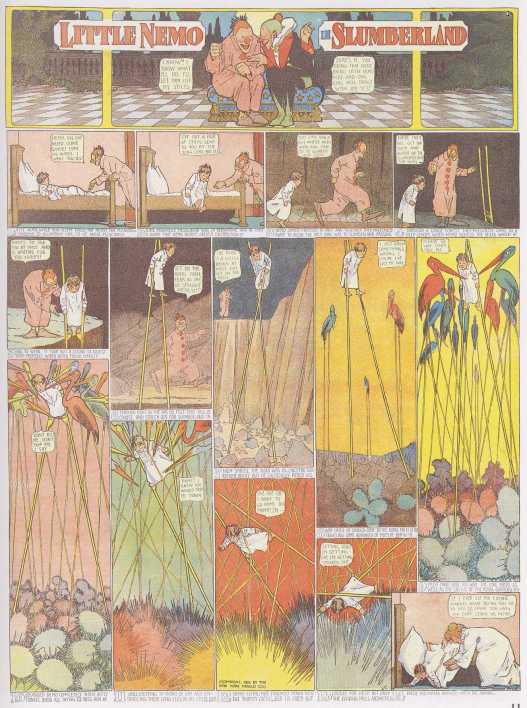
I’ve spent hours adoring the first volume of The Complete Little Nemo in Slumberland by Winsor McKay instead of grading my Seniors’ research papers or writing my own final paper for my theory class. And who wouldn’t want to get absorbed and distracted by McKay’s lush and fantastical world? It’s both sad and silly that the comics page nowadays has been compressed into a minute fraction of the massive broadsides that used to grace each Sunday edition of the paper. Calvin & Hobbes creator Bill Watterson has lamented the incredible shrinking comics page in the introductions to several of the C & H collections, and Art Spiegelman paid tribute to the glory days of the broadside in In the Shadow of No Towers. Still, even as comics creators draw attention to this downsizing, it seems that the trend in newspapers will be to continue to dwarf creativity, to literally minimize (pop) art. This marks a serious social regression over the past century. But why? If I knew that something on the scale of the broadside below–both in terms of physical size and imagination–was waiting for me each Sunday, I’d be excited to get a subscription to the local rag. For now, enjoy this episode of Little Nemo (image links to a full page, but you still might need to use the magnifying glass!)–
Placentophagy 101
About eight years ago, I read an article in Harper’s Magazine detailing, if I recall correctly, the script of an English cooking show where the host and his guests cooked and ate fresh placenta. This has always been intriguing to me for some reason; a little research revealed that almost all mammals, including primates, eat the placenta, which provides all kinds of unique nourishment to a nursing mother.
As I’ve mentioned before, my wife is currently pregnant with our first child, a girl, due in early June. We’ve been attending birthing classes once a week at night, and last night we watched a video of a “real” (i.e. not computer simulated) birth. I had seen video of live birth before; I hadn’t witnessed the discharge of afterbirth. The afterbirth looked to be a big blue and black balloon of goo, twice as big as the baby. My word. One man in our group lost some Dr. Pepper through his nose. I wasn’t shocked or disgusted, but the placenta didn’t really seem very appetizing (I had tentative plans to eat it).
Well, so and anyway, after the video our birthing coach submitted to the class that most animals and some cultures practiced the eating of the placenta. This drew a mixed response from the crowd: incredulous horror, baffled humor, grade-school disgust, and, most interestingly, nationalism. Yes. Nationalism: “Not in America, they don’t!” exclaimed (yes, he exclaimed) one young man in jean shorts, to the information that some people made a stew of the afterbirth. He was immediately backed up: “Maybe they do that in foreign countries, but not in America!” “Maybe in Afghanistan! Maybe in Iraq!” Once these admonitions were voiced, it seemed necessary for the group to repeat, to reinforce these dietary restrictions. Just about everybody grumbled in bemused agreement.
So, at the risk of coming off as un-American, I provide a couple of links to recipes for placentas:
From Twilight Headquarters, a couple of recipes, including a cocktail recipe and a lasgane. Also contains pictures!
A number of recipes from Mothers 35 Plus. Also includes tips on dehydrating the placenta (mmm…jerky!)
Feel free to write in with your own recipes, serving suggestions, and culinary tips.
Koinonia, Praxis, Heterotopia, and Other Ten Dollar Words
Lacking the lexicon to describe your aporia? Need the right words to negotiate a particularly difficult text? Try the Dictionary of Postmodern Terms then. Fun for solipsists, sophists, and psychoanalysts of all ages.
A Short History of America Courtesy Of Robert Crumb
Progress!
From Terry Zwigoff’s fantastic 1994 documentary Crumb.
A Unique Brand of Despondent Leftism?
In case you need another reason to hate Fox News:
I find it amazing that despite Vonnegut’s lifetime of art and achievement, the schmuck-reporter takes the time to mention that the celebrated writer “failed at suicide 23 years ago” in a two minute segment.
God Bless You, Mr. Vonnegut
Like many of you I’m sure, I cut my literary teeth on Kurt Vonnegut, who died early this morning. My dad gave me three of Vonnegut’s books–Breakfast of Champions, Slaughterhouse Five, and The Sirens of Titan–when I was about eleven or twelve. It’s a cliché, but these books really did change my life forever. In the next couple of years, I devoured everything Vonnegut wrote. My favorite book of his was and is Cat’s Cradle, which I think surpasses both Mother Night and Slaughterhouse Five as his most important work. As I grew older, I began to reject Vonnegut, to see him as not as serious or profound as the authors I was reading. His later books like Hocus Pocus and the truly-lamentable Timequake didn’t help either. Nevertheless, I read them as soon as they came out in paperback. I had to. I had to read everything he wrote. Celebrate Vonnegut’s life by reading one of his books, and remember what got you into reading in the first place.
This Is Why
After my rant the other day, friend of the ‘Klept RP sent me a link to a Village Voice article in which Rob Harvilla dissects Mim’s smash hit “This Is Why I’m Hot.” Harvilla does a great job of deconstructing the (il)logic behind Mim’s inexplicable hit, employing a variety of charts and graphs to this end. Highly recommended.
A Distinct Line Between Love and Hate
I occasionally dabble in a little hating, but for the most part I try to keep this blog on the positivity tip, yo. I mean, what’s the point in just grumbling, right? Anyway, I now present some stuff that I’ve been hating on lately, along with some possible solutions.
Hating on: The whole Don Imus controversy. Sure, Imus’s comments were rude, asinine, and perhaps racist. But he’s a morning schlock jock who has traded on such speech in the past. What’s the big deal? How is this any different from the vitriol Rush Limbaugh or Bill O’Reilly spew on a daily basis? It seems like we’re heading to a place in American media where people have to apologize and beg forgiveness for every rude or insensitive thing they say. Part of a functioning, healthy democracy is having people publicly say things that you think are awful or disagree with…and having the right to publicly disagree with them. I’m sick of this whole “tour of forgiveness”/rehabilitation culture. It’s OK to be an asshole sometimes. Just let it ride.
Antidote: Indulge in a random act of insensitivity. Tell that special someone how much they irk you, or arbitrarily curse a stranger. Freedom ain’t free–you’ve gotta fight for it! It’s the American way.
Hating on: Bill Willingham’s much lauded comic series Fables. I finally picked up a few of the Fables graphic novels at the library a few weeks ago. These comics are best suited for lining a ferret’s cage. Fables has won plenty of undeserved praise from both the comics and mainstream press. Allusions can enrich a story, but Willingham overtly rips off the plots of numerous books and stories and then seems to say: “See? Get it? I’m referencing X, get it? Clever, huh?” No, it isn’t, but neither was Vertigo’s other big critical hit, The Sandman, a series that is often held up as the pinnacle of the art form. My major concern is that people will read the reviews and honestly believe that this crap is the cream of the crop, when in reality there are thousands of better comics out there.
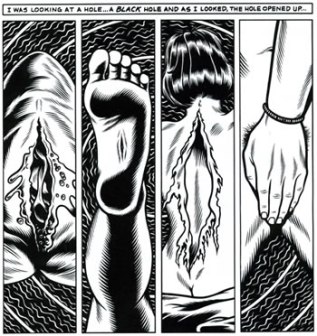
Antidote: For a major-label all-color comic that trips off of fabulous/mythic tropes in a far more rewarding way, check out Alan Moore’s legendary early 80s run on Swamp Thing. Or just go hardcore indie black-and-white with Charles Burns’s Black Hole.

Hating on: Drivers. You can’t drive. Get off the road! Seriously, you’re a terrible driver, and that F-350 doesn’t make up for your tiny genitals. Tailgating will not make the traffic in front of me disappear, and racing to every red light will not win you a giant cup (or whatever shiny prize it is they give away at NASCAR).
Antidote: Dogfish Head 90 Minute IPA. This is the best beer I’ve ever had. (Note: Biblioklept does not endorse drinking while driving, except on rare and special occasions, such as weddings and weekends).
Hating on: Hip-hop in ’07. Wow. This is really bad. 50 Cent has his own line of bottled water? Ice Cube is doing this shit? Mims new song– “This is why I’m hot…I’m hot cause I’m fly” WTF! That’s basically a tautology, dude. (By the way Mims, you have the same nickname as my friend’s grandma).
Antidote: Journey’s Greatest Hits.
Hating on: “Definately”
Antidote: There is no “a” in the word, my friends. Spell it with me: D-E-F-I-N-I-T-E-L-Y, definitely. That is absolutely, positively, most assuredly the definite spelling of “definitely.” Again, please remember: “no a.”
Hating on: Pitchfork. Okay, I admit it, I go to Pitchfork just about every day, just as I have for years and years now. And I hate it: I hate their awful reviews, their lack of editorial sensibility, their penchant for applauding the most maudlin crap, and their constant attempts to rewrite music history.
Antidote: Soulseek.
Hating on: Undergrads. Jesus Christ kids, you’ve got to show up to class–even when it rains or is cold outside! And, when you do come to class, you need to have done the assigned reading. Also, no one cares about what your friend’s cousin heard on the radio or what your brother’s girlfriend read on the internet–if you must present an opinion, try to keep it rooted in the reading (again, you need to have done the assigned reading). Furthermore, you can text-message after class. Quit wasting your parents money.
Antidote: Trade school.
Hating on: The New Testament. Okay, “hate” is a little extreme. But seriously, I just can’t get into this. JC is kinda cool, but on the whole, this book is awfully preachy.
Antidote: The Old Testament. Now this I get. Yaweh is one bad mama-jama. He’s not fooling around. If you mess with Yaweh, he will wipe-you-out. No joke. He flooded the whole world! Total destruction! Also, he totally messed with this dude Job just to prove a point to Satan. And he kicked Adam and Eve out of his garden for forever, and they had to toil and sweat. And he turned Lot’s wife into a pillar of salt–salt!–just for looking back at a city full of sodomites. And he sent mad plagues on the Egyptians. Word to God, kid!
Hating on: The Jacksonville Jazz Festival. Come on, you don’t really like jazz, do you? And how do you make jazz worse? How about sitting in the park with thousands of other unwashed “jazz fans”? But who am I to hate on the luminous talents of Al Jarreau and Chuck Mangione…
Antidote: Sitting alone in the dark blissing out to Alice Coltrane and Pharaoh Sanders.
Jonathan Lethem, Emo Comic Books, Realism, Meta-textual Quotes, History’s Actors, and Lazy Writing
There’s a good (and rather long) interview with Jonathan Lethem at the AVClub today. Mr. Lethem is one of our favorite authors here at Biblioklept, Inc. (you may recall our review of his brilliant Fortress of Solitude back in September of 2006 (a mere 1,111 days after the book was initially published)).
In the interview, Lethem references the Talking Heads a number of times, claims to be slowly writing “kind of an emo comic book” for Marvel Comics, goes in-depth on his style and approach to writing, and discusses his new book, You Don’t Love Me, which I have not read yet.
The interview begins with an interesting discussion about realism (specifically, literary realism) which reminded me of an essay I’d read a few days before in the February issue of The Believer by Chris Bachelder (yes, I’m aware that I lazily linked to a Believer article earlier this week).
In “Doctorow’s Brain,” Bachelder ponders on whether such a thing as literary realism can really exist, and if so, what types of books and literature represent that style. I found the essay fascinating–I love all things literary, and I could point plenty of books that could be called “magical realism,” but I would have a really difficult time defining “realism.” So Bachelder’s inquiry provoked a lot of deep questions about the very nature of writing, communication, memory and history. One of the most fascinating (and scary) pieces of writing he discusses is a quote from one of George W. Bush’s senior advisers, published originally in an October 2004 New York Times Magazine article by Ron Suskind. From Bachelder’s article:
“[…] Ron Suskind’s “Without a Doubt” introduced the Bush administration’s derision of what it calls the “reality-based community”–those reporters who, according to a senior adviser to Bush, “believe that solutions emerge from judicious study of discernible reality.” As the adviser explains to Suskind:
“That’s not the way the world really works anymore. We’re an empire now, and when we act, we create our own reality. And while you’re studying that reality–judiciously, as you will–we’ll act again, creating other new realities, which you can study too, and that’s how things will sort out. We’re history’s actors…and you, all of you, will be left to just study what we do.””
Yikes!
Seven Great Books About Rock and Roll (In No Particular Order)
1. Crazy From the Heat by David Lee Roth

This book is as good as you want it to be and there is absolutely no doubt in my mind that David Lee Roth wrote every word of it (no ghostwriters here, pure Roth). I’m not even sure if there was an editor involved, actually. David Lee Roth takes the chronological approach, giving equal time to Van Halen’s earliest days, their 80s success, and his post-Van Halen, big band days. Particularly interesting is David’s illumination of some of the vocal techniques involved in the production of those early Van Halen records (hamburgers and marijuana cigarettes). This book is a treasured gift from a dear friend.
2. Jimi Hendrix’s Electric Ladyland by John Perry.

I read this in like two days. What a great book. Author John Perry was a young eyewitness to many of Jimi’s London gigs; most of the info here is culled from personal memories and observations, as well as discussions with all the people involved. Perry’s style is simple and always focused on the music. The book is divided into seven sections, including a thorough discussion of the instrumentation involved, a detailed track by track review of the album; even a section about the cover. Perry writes from a musician’s point of view, but the most interesting lines to me are about the initial reaction of the American critical press to Jimi Hendrix:
“Behind a whole raft of complaints about Hendrix’s undignified performance and his irritating failure to fit existing critical categories for black performers, lay the essential point that his songs mysteriously failed to punish the audience for being white. Hendrix didn’t play the wounded, angry black man, or the dignified bearer of oppression; he didn’t provide white critics with a handy receptacle for their guilt. They didn’t know quite what role he fulfilled.”
I got this for fifty cents at the Friends of the Library Sale.
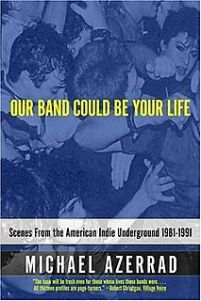
3. Our Band Could Be Your Life by Michael Azerrad.

Your life is probably nothing like any of the sort-of-famous indie bands covered here, unless you basically live in a van. I’m actually not even really sure if this qualifies as a great book. This book is actually just “okay.” Chances are, if you’re a fan of Sonic Youth, Ian McKaye, Dinosaur Jr, or Hüsker Dü you probably know most of this stuff already, or at least the stuff that’s interesting. And if you’re a fan of Beat Happening, well, there you go. This book has a whole chapter on Beat Happening. Actually, if you’re really interested in the whole indie rock thing, 1991: The Year Punk Broke is a much better document. But here I go comparing apples to oranges. I bought Our Band Could Be Your Life at Barnes & Noble for like three or four dollars.
4. Chronicles, Volume 1 by Bob Dylan

It took me a long time to get through this. Let me clarify: I read this in large, fifty page chunks, put it down, picked it up again months later. Dylan’s style is discursive and rambling; he elliptically deconstructs his own myth, picking away at the bits of identity he picked off of other musicians and poets on his way to fame. The book never really gets to that fame–to be clear, it discusses the after-effects of Dylan’s fame in detail: the obsessive fans who showed up at his home unannounced, the bewildering pressure to deliver some kind of messianic answer, the expectations to deliver a specific kind of record–but Chronicles spends most of its pages tracing and retracing Dylan’s youth in Minnesota and his days sleeping on friends’ couches in New York City. Will the second and third volumes ever come out? Who knows with this guy. This book was given to me by my cousin for Christmas a few years ago.
*Also recommended: Anthony Scaduto’s biography Bob Dylan.
5 . Transformer by Victor Bockris

Lou Reed is a weirdo, and Victor Bockris wants you to know about it. Starting with Reed’s Long Island youth (complete with electro-shock therapy), Bockris’s biography covers pretty much everything right up through the Velvet Underground’s early nineties reunion: Reeds early apprenticeship in the Brill Building, the nascent days of the VU (plenty of Warhol anecdotes, of course), punk rock, several doomed romances, his years living with a transvestite, his karate skills, his yoga skills, and his all-bran diet, and of course, the drugs. Oh the drugs. Also, Reed’s solo career is also examined (including plenty of material from guitar god Bob Quine). Bockris seems to feel Magic and Loss is something of a watershed moment in modern rock (anyone who accidentally bought this album knows otherwise).
Bockris’s book employs a bitchy, dishy tone, rife with catty comments from everyone whoever worked with Reed: apparently Lou was a total asshole. Bockris reprints some painful comments (e.g. Reed on Springsteen, 1975: “Isn’t Springsteen over the hill?”); the most awkward moment comes in the book’s appendix, in a transcript of a meeting Bockris arranged between Reed and William Burroughs. Bad idea (Reed can’t remember the name of “that book you published”–Naked Lunch). I can’t remember, but I think I got this for like three or four bucks at Barnes & Noble.
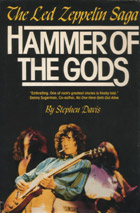
6. Hammer of the Gods by Stephen Davis

“Here’s a red snapper for your red snapper!”
Intrigued? You should be! Burroughs makes a cameo here as well.
I don’t own this one. I read the good bits in high school though.
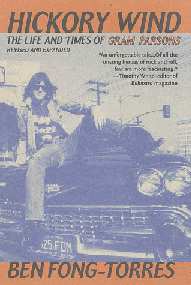
7. Hickory Wind: The Life and Times of Gram Parsons by Ben Fong-Torres

Some jackass made a movie about Gram Parsons’ life a few years ago; I think Johnny Knoxville played Parsons. I didn’t see it, but I’m sure this book is way better. Rolling Stone alum Ben Fong-Torres clearly appreciates Parsons as not only the influential icon that he’s generally recognized as, but also as a truly gifted songwriter. Parsons’ early days in Winterhaven, Waycross, and Jacksonville (he attended the Bolles School) are scrutinized along with his brief stint at Harvard, his time in the Byrds and his days partying with the Rolling Stones in California hippy mansions. Also, another appearance by William Burroughs, who recommended a treatment to help kick the heroin. Parsons’ infamous death in the California desert is also put under the lens, right down to a time-line if I remember correctly. Good stuff. My uncle lent me this book, and yes, I returned it to him. So there.
From The Believer: Stephen Elliot’s “The Score”
I have a subscription to The Believer, a magazine I truly love but am consistently unable to finish each month. They just pile up on my coffee table, the site of all sorts of literary flotsam and jetsam. Of course, when I first get each month’s issue, I like to skim through it and read any articles that catch my eye immediately–this is the only way they’ll get read. The tone of the majority of The Believer‘s articles and features tends to be a mix of post-modern pop culture criticism, faux academese, and general smart-assed winking and nodding. Also, they have some pretty great interviews.
Anyway, last month’s issue had a beautifully earnest personal essay by Stephen Elliot called “The Score.” I loved this essay so much that I actually called people to tell them about it. Luckily, The Believer website has the full text of “The Score” for all to read for free. This isn’t the type of essay that will make you smarter or enrich your vocabulary or provide any kind of hipster insights…it’s just a very good personal essay, a genre which I pretty much despise. Elliot discusses his dysfunctional relationship with his ex-girlfriend, drug use, and the Chicago Bulls of the 1990s in an unnerving but oddly affecting manner. Tell me that you don’t love this essay.
Word of the Week
Ignicolist–
From the OED:
“A fire-worshipper.
1816 T. MAURICE Ruins Babylon II. 43 In whatever region of the earth this infatuated race of ignicolists took up their abode, the sacred fire immediately began to burn. 1859 R. F. BURTON Centr. Afr. in Jrnl. Geog. Soc. XXIX. 340 The ancient Persians were ignicolists, adoring etherial fire.”
Famous ignicolists include:
–Serial arsonist John Orr

Lost: Lost in the Funhouse
It’s been a while since I’ve written about a stolen book (ostensibly, this blog is all about book theft. But we’re easily distracted here). John Barth’s Lost in the Funhouse is one of my favorite short story collections ever and it’s been MIA from my library for a couple of years now. The collection starts with “Frame Tale,” a one-page (front and back) meta-commentary that informs the whole text. “Frame Tale” is essentially a marginal strip which says “Once upon a time…” on one side and “there was a tale that began…” on the other. The accompanying directions (a number of the stories come with directions; some are to be read aloud, some are to be tape recorded and played back, some are to be read aloud along to looped recording) direct the reader to cut out a strip of paper and connect the opposing ends, creating a Möbius strip, a commentary on the infinite and cyclical nature of story-telling (Barth expanded on this theme in the three linked novellas of Chimera).

My favorite story in the collection is “Petition,” a letter from a distraught Siamese twin, but the most lauded tale in LITF is the title story. “Lost in the Funhouse” recounts the adventures of young Ambrose as he navigates a bizarre amusement park funhouse during a family vacation to the beach one summer. The story is shot through with sexual anxiety and familial tension; Ambrose’s confused (and sometimes confusing) narrative loops discursively, unwinding and then condensing as he trips over his own thoughts. David Foster Wallace riffs off of “Lost in the Funhouse” in his long short story “Westward the Course of Empire Goes” (from Girl With Curious Hair). Ambrose, a semi-autobiographical stand-in as Barth’s pubescent alter-ego, appears as a a much older writing teacher in DFW’s novella. Clever, hunh? And to think, some people hate post-modernism! I feel bad for these folks.
I think that this collection paired with DFW’s Girl With Curious Hair (or, even better Brief Interviews With Hideous Men) makes a great introduction to post-modern writing. The major tropes, themes, and devices are explored in these books in short, digestible chunks full of humor and (surprise!) emotion. Highly recommended.
The Wings of Our Dreams
Chills! So inspirational!
The Evolution Will Be Televised
If you missed The Simpsons last night, you need to check out the extended couch-gag intro below (may god bless Youtube). Marvel as Homer demonstrates eons of evolution in just over a minute. Best. Intro. Ever.
This isn’t the first time The Simpsons has dealt with evolution and its (nonsensical) opponents. An unbiased comparison between creationism and Darwinism:
And of course, the horror of the Flanders (note the sweet soundtrack to the end of this one courtesy of the Doobie Brothers):
The Biblioklept Interview: Eddie de Oliveira
Last month a local news station reported that Eddie de Oliveira’s book Lucky was being placed under review by the Duval Public School Board. Apparently an upset mother was disturbed by some of the content of the book; instead of calling the school directly, she allegedly went directly to the local news. I reacted by posting this blog, to which Eddie responded. We exchanged a few emails and I tried to contact some of the people involved in this story; I believe Folio tried to follow up this story also, but the leads go nowhere. I still haven’t been able to find out if the book really is “under review,” but I asked my department head (I teach English) if such a review list or “banned list” existed, and she said she’d never heard of such a thing. She then became alarmed and told me to “be careful” with what my classes read. This is kind of an unwritten rule of public education: don’t rock the boat. Play it safe. Books can be dangerous.
There’s nothing dangerous about Lucky, though, and I mean that in the nicest way–it is a book intended for teens, after all. Some down here in the beautiful South may still be alarmed or shocked by the subject matter of a sexually confused teen navigating identity in modern London. However, the real themes here are hardly subversive: Young Adult (YA) fiction has a legacy of exploring what it means to be an individual among a collective, and how young people are to negotiate a “proper” space in society. In the case of Lucky‘s protagonist Sam, that “proper” space is constantly under attack from all directions, as he is repeatedly prompted to identify–is he straight? gay? bisexual? In a way, the novel creates a meta-critique of those who would question its valid, “proper” space in a school library–unfortunately, those would-be censors will probably not read the book, preferring to simply highlight “offending” words.
Lucky tells an important story about the search for identity that all teens have to traverse, and I would have no problem suggesting it to any of my students. Eddie was kind enough to answer a few questions, which you will find below.
You can find both of Eddie’s books, Lucky and Johnny Hazzard, at Amazon or your local library.
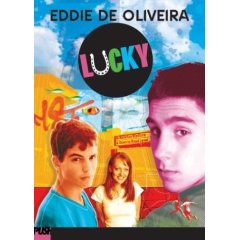
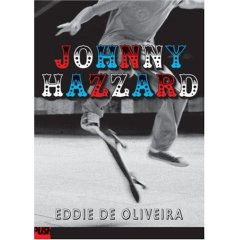
Biblioklept: Have you ever stolen a book, and if so, could you
talk a little bit about that experience?
Eddie de Oliveira: I removed the Wide Awake Club book of Ghosts, Monsters
and Legends from my school library when I was around
ten years-old. The Wide Awake Club was a Saturday
morning kids’ show, and this book was the bomb.
BK: Have you ever borrowed a book and never returned it
(on purpose)?
EO: I have not. I never checked out the Wide Awake Club
book.
BK: What are you reading right now?
EO: I’m reading Four Trials by Senator John Edwards. Amid
all the media hullabaloo about Hillary and Barack,
I’ve been impressed by the one candidate for the
presidency who bothers to combine policies with
explanations on how he’ll implement them. I’m also
impressed by Edwards’ manner, rhetoric and sincerity.
Four Trials was published in 2003, and, as the title
suggests, it recounts four of Edwards’ most defining
moments in the courtroom when he was a trial lawyer,
defending the powerless against medical negligence and
corporate giants.
Next up, I’ll re-read The Perks of Being a Wallflower,
which I first read way back when.
BK: What were your favorite books as a child?
EO: I loved Roald Dahl – especially Charlie and the
Chocolate Factory and George’s Marvelous Medicine. I
re-read Charlie not so long ago and it really is
special. I remember reading To Kill a Mockingbird and
Lord of the Flies at school and thinking they were
extraordinary – helped, perhaps, by having a brilliant
English teacher back then, Mrs. Martin.
Way before I was 13, I read The Secret Diary of Adrian
Mole aged 13 ¾ and The Growing Pains of Adrian Mole
several times. And, of course, the Wide Awake Club
book of Ghosts, Monsters and Legends.
BK: You are currently an expatriate, living in Sweden.
Could you say a few words on this?
EO: London was pissing me off and in Sweden, most ‘things’
work very well. It may be colder, but the tap water
tastes like water should and the Stockholm air doesn’t
turn my white earphones black after two days.
Everybody speaks English very well (some better than
my compatriots) which makes learning Swedish rather
hard. Public transport is cheap and, for the most
part, reliable. The overwhelming sense here is that
the government actually gives a shit about its
citizens.
I’ve done some freelance journalism and continued
working on new books and film projects since living
here.
BK: Your book Lucky could be seen to fall under the
rubric of Young Adult fiction. What do you think of YA
as a genre, and was it your initial intention to reach
young people with your book?
EO: Yes, Lucky and Johnny Hazzard are both YA. I think
it’s an important genre and, thankfully, a growing
one. More and more books are being written primarily
with teens in mind, and those of us who write them
have a significant and serious responsibility. That
responsibility is to stay relevant and realistic,
avoiding some kind of The OC type representation of
what it is to be an adolescent. I read Melvyn Burgess’
Doing It, a YA/adult crossover title. He’s a good
writer, no doubt about it, but it really reads like a
middle-aged man writing about teens.
Johnny Hazzard is a love story written for teenage
boys. It’s a hard sell, because teen boy aren’t
renowned for their reading. Probably the finest
compliment I’ve ever received was on a 17-year-old
Texan boy’s myspace page. He listed dozens of bands in
the favourite Music section, a bunch of films in the
Movies section, and, in Books, it just said “I don’t
really read except this one book called Johnny
Hazzard.”
If I ever stop knowing how a teenager thinks, I’lI
quit YA and begin writing cookbooks.
BK: As you know, a cranky mom in Duval County, here in
sunny Florida, has raised some objections to you book
Lucky having a place in her kid’s school library. Is
there any merit to her objections? If you could speak
with her, what would you say?
EO: There is no merit to her preposterous objections.
Censorship of any form is reprehensible. I don’t
accept that Lucky isn’t suitable for a child. It’s a
book about identity and figuring out where you fit in.
It is not a bomb-making manual.
If I could speak with her, I’d sit her down with a
fine Arctic Daquiri, served on a coaster with the text
of the First Amendment written over it. I’d ask her
what she’s afraid of, and offer her a signed copy of
Johnny Hazzard.
BK: How does one make an Arctic Dacquiri?
EO: Arctic Daquiri
———–
Lots of ice cubes
Winter fruits (berries)
Sugar water
Vodka
Put it in the blender. Absolutely wonderful.
BK: Are you an Edwin or an Edward (or possibly an
Edmund, or just an Eddie)?
EO: I’m neither, I’m an Eduardo. You also left out Edgar.
(ed. note: Biblioklept will now acknowledge an anglocentric bias that we didn’t even know we had!)
BK: According to your Myspace page, you and I are the
same age. How is it that you’ve managed to write and
publish two books, while I’ve accomplished so very,
very little in comparison? But no, seriously, how long
have you been writing? What kind of writing did you do
when you were younger?
EO: I’m motivated by guilt: Each and every day I feel I
haven’t achieved enough, and that motivates me to get
some work done. I have South American parents,
football was on the diet from a young age, and so I
look at my career like that of a footballer’s;
considering they hit their peak at 27 and tend to be
on the slide by 31, it’s not a constructive analogy.
I’ve been writing since I was small – I started out
with school magazines and little plays I’d put on with
my friends, then moved on to big plays I’d put on at
the Edinburgh Festival and in London, and then on to
the fiction novels, short films and journalism.
BK: You seem to be a big Beastie Boys fan. What draws
you to their music? What album is “the” Beastie Boys
album, in your opinion?
EO: The Beastie Boys are the most innovative and important
American band alive. They’re always a step ahead,
doing new things, mixing up genres and sounds. “The”
album for me has to be Paul’s Boutique, which did all
of those things I’ve just mentioned, but on a massive
scale. That record pioneered the art of sampling,
which is now a given in almost every modern musical
style.
Goodbye Blue Monday
A few things:
1. I am still exhausted after my sister-in-law’s wedding this weekend. I was the best man, which was more involved than I had originally believed. Special props to the photographers, the DJ, and the caterer, all friends and family who went above and beyond what was expected. Contact these guys for your next wedding, bar mitzvah, super sweet sixteen, or Guy Fawkes Day party.
2. Luckily, this week is Spring Break, and I have the next couple of days off of work and grad school. What does this mean to you? Well, hopefully I’ll get back on track with the Ontology 101 project, and actually start posting again about books that I’ve stolen (I know that’s what you come here for). You can also look forward to an interview with Eddie de Oliveira, author of Lucky and Johnny Hazzard, to be published later this week. Until then…
3. A few placeholders to quell some of that Monday boredom:
A. Go to Strange Maps. Another great WordPress blog that lives up to its name. Love it!
B. Tarantino/Rodriguez’s Grindhouse comes out the first week of April. Looks like good old fashioned fun. Check out the full theatrical trailer–
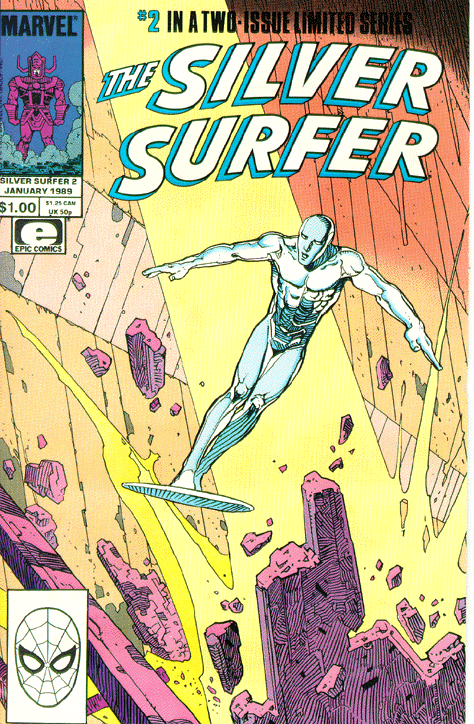
C. Enjoy this Silver Surfer cover art gallery before the upcoming Fantastic Four sequel ruins the best Marvel Comics character ever.

Cover art by French artist Moebius, who created a line of comic books with Alejandro Jodorowsky in the 1970s.