“Noah / Ham: Fathers of the Year” — Douglas Kearney

“Noah/Ham: Fathers of the Year,” a poem by Douglas Kearney
“Fathers” — Grace Paley
“Fathers”
by
Grace Paley
Fathers are
more fathering
these days they have
accomplished this by
being more mothering
what luck for them that
women’s lib happened then
the dream of new fathering
began to shine in the eyes
of free women and was irresistible
on the New York subways
and the mass transits
of other cities one may
see fatherings of many colors
with their round babies on
their laps this may also
happen in the countryside
these scenes were brand new
exciting for an old woman who
had watched the old fathers
gathering once again in
familiar army camps and com-
fortable war rooms to consider
the necessary eradication of
the new fathering fathers
(who are their sons) as well
as the women and children who
will surely be in the way.
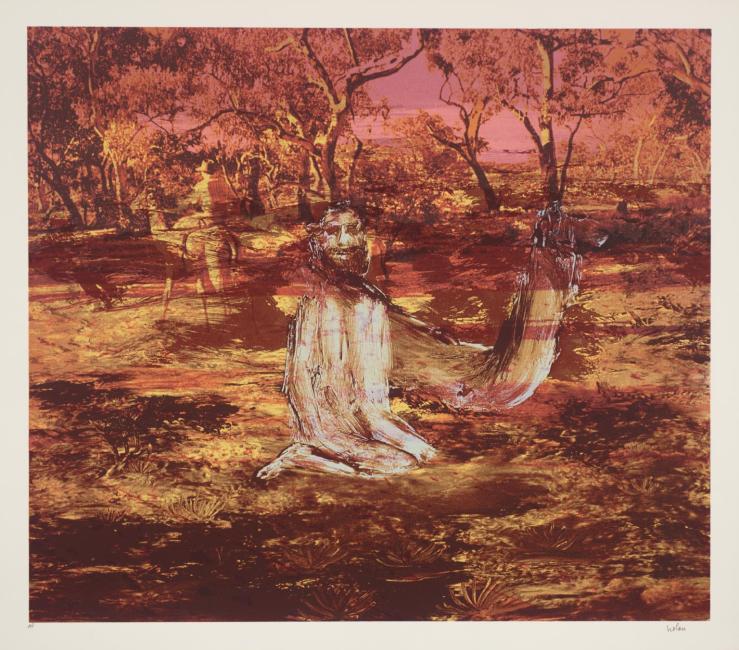
Burke and Wills Expedition IV — Sidney Nolan

Burke and Wills Expedition IV, 1975 by Sidney Nolan (1917-1992)
Burke and Wills Expedition III — Sidney Nolan

Burke and Wills Expedition III, 1975 by Sidney Nolan (1917-1992)
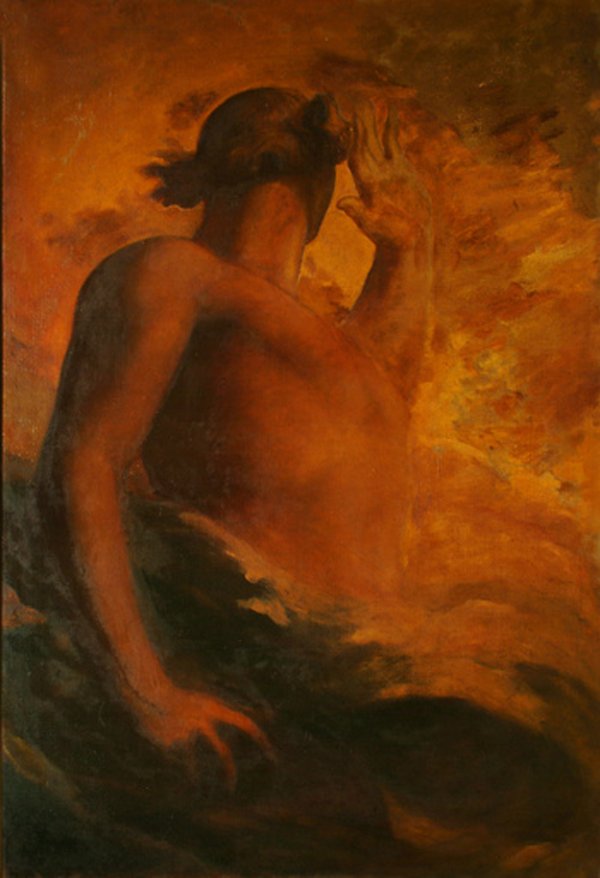
Satan — George Frederic Watts

Satan, 1847 by George Frederic Watts (1817–1904)
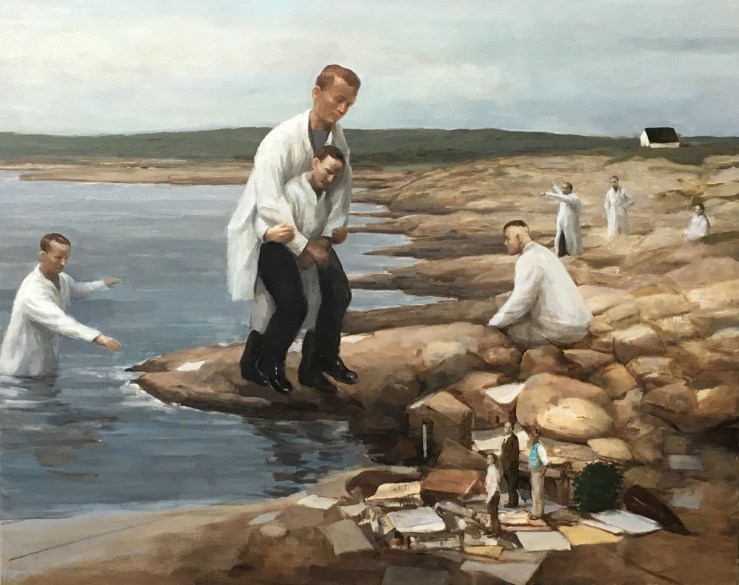
Swamp Cottage — Davor Gromilovic

Swamp Cottage, 2018 by Davor Gromilovic (b. 1985)
“A Brief History of the Passenger Pigeon” — Lynn Pedersen
“A Brief History of the Passenger Pigeon”
by
Lynn Pedersen
Not to be confused with messenger pigeons, birds sent behind enemy lines in war, but think passengers as in birds carrying suitcases, sharing a berth on a train, or traveling in bamboo cages on a ship, always migrating on a one-way to extinction. How would extinction look on a graph? A steady climb, or a plateau, then a precipitous cliff at the dawn of humans?
Nesting grounds eight hundred square miles in area. Skies swollen with darkening multitudes. Days and days of unbroken flocks passing over. Ectopistes migratorius.
And the last of the species, Martha, named for Martha Washington, dies in a cage in 1914 at the Cincinnati Zoo.
Forget clemency. We are the worst kind of predator, not even deliberate in our destruction. Our killing happens à la carte, on the side (side of Dodo?).
And because the nineteenth century did not enlist a battlefield artist for extinctions, there are no official witnesses to the slaughter, just participants. If you could somehow travel back to this scene, through the would-be canvas, you would run flailing your arms toward the hardwood forests and the men with sticks and guns and boiling sulphur pots to bring birds out of the trees, as if you could deliver 50,000 individual warnings, or throw yourself prostrate on the ground, as if your one body could hold sway.
The Exchange — Peter Martensen

The Exchange, 2018 by Peter Martensen (b. 1953)
Bloomsday budget
An economic summary (perhaps) of Ulysses. From “Ithaca”–
Compile the budget for 16 June 1904. DEBIT
1 Pork Kidney
1 Copy FREEMAN’S JOURNAL
1 Bath And Gratification
Tramfare
1 In Memoriam Patrick Dignam
2 Banbury cakes
1 Lunch
1 Renewal fee for book
1 Packet Notepaper and Envelopes
1 Dinner and Gratification
1 Postal Order and Stamp
Tramfare
1 Pig’s Foot
1 Sheep’s Trotter
1 Cake Fry’s Plain Chocolate
1 Square Soda Bread
1 Coffee and Bun
Loan (Stephen Dedalus) refundedBALANCE
L. s. d.
0—0—3
0—0—1
0—1—6
0—0—1
0—5—0
0—0—1
0—0—7
0—1—0
0—0—2
0—2—0
0—2—8
0—0—1
0—0—4
0—0—3
0—0—1
0—0—4
0—0—4
1—7—0
0-17—5
2-19—3
CREDIT
Cash in hand
Commission recd. Freeman’s Journal
Loan (Stephen Dedalus)L. s. d.
0—4—9
1—7—6
1—7—02-19—3
Burke and Wills Expedition II — Sidney Nolan

Burke and Wills Expedition II, 1975 by Sidney Nolan (1917-1992)
“Sand Flesh and Sky” — Clarence Major
Our ropes are the roots
of our life. We fish
low in the earth,
the river beneath runs through our veins,
blue and cold in a riverbed.
When the sun comes up,
the moon moves slowly to the left.
I tie the logs and limbs together,
holding them in place.
The ocean beats them
smooth like rock.
Here my sense of time is flat.
I find in a strip of damp sand
footprints and marks of hands,
and torn pieces of flesh.
Night is a beast.
The tide moves, gushing
back and forth.
Sunlight touches our faces,
turning us, turning us, turning us
in our morning sleep.
“Pretty Fly” | Scene from + short riff on The Night of the Hunter
I watched The Night Of The Hunter (dir. Charles Laughton, 1955) last night for the first time in at least fifteen years. Robert Mitchum’s Bluebeard-preacher figure is the main thing that stuck with me from earlier viewings. He’s the awful, captivating, horrifying and paradoxically ever-moving center of dread in a film that is essentially about despair and hope (qualities simplified to tattoos of “LOVE” and “HATE” on his hands). Watching it last night though, I was surprised at how beautiful, even tranquil the film is at times–a kind of tranquility underpinned by the natural world’s flat indifference to humanity’s suffering coupled with Mitchum’s character’s sinister avarice. The long scene of the children escaping on the river at night, guided in part by their own music is particularly moving, a strange interplay of chiaroscuro expressionism and documentary naturalism. The voyage echoes the film’s direct allusions to Moses’ escape in the ark of bulrushes (as well as hinting at Twain’s Huck Finn). It’s a lovely transition to the film’s final third, wherein Lillian Gish’s stern but loving maternal presence overtakes the narrative. My memory had swallowed her eminence, but I don’t think I’ll forget this time that it’s her character who gets the last hopeful words: “ They abide, and they endure.”
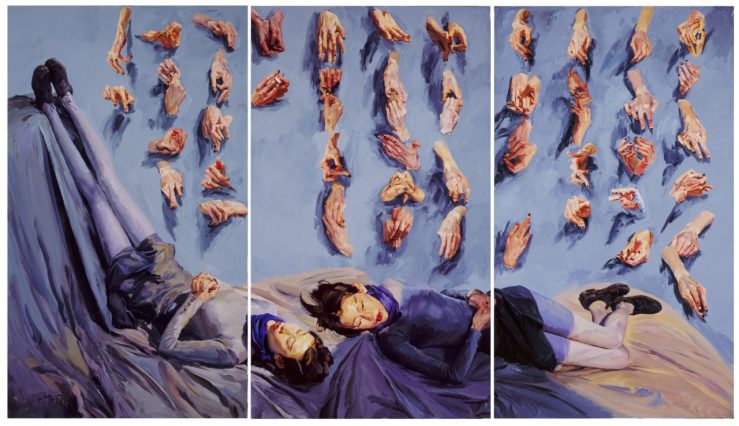
Plain Fingers — Yu Hong

Plain Fingers, 2013 by Yu Hong (b. 1966)
The Return — Stephen Greene

The Return, 1950 by Stephen Greene (1918-1999)
Burke and Wills Expedition I — Sidney Nolan

Burke and Wills Expedition I, 1975 by Sidney Nolan (1917-1992)
W.D. Clarke’s She Sang to Them, She Sang (Book acquired, 12 June 2021)

W.D. Clarke’s second novel She Sang to Them, She Sang is new from Slovenian indie corona\samizdat, which describes it as a “Pocket book 425 pages.”
It’s a nice little faboy, and the print isn’t pocket-sized, although I don’t know if I own a pair of pants with pockets that could accomodate She Sang to Them, She Sang. (I’ve included a beer can in the photo and a backdrop of NYRBs to give a sense of the novel’s odd physical scale).
Here’s Clarke’s blurb:
Katie, Jo, and Manny have got the deal of their lifetimes finally in their sights, but nowhere is it written in the Family Home Inspection Kit to triple-check the stories they tell themselves—about issues overlooked, upkeep not kept up, or damage concealed; about how more than finances flow from one generation to the next; about veiled motivations for entering into relationships of a contractual nature (be they fiduciary, informal, or solemnized); finally, about the real origins of these stories themselves, which upon closer inspection are revealed to be mere lean-tos built upon shabby foundations, and whose parlors furnish-forth tedious after-dinner speakers, who are not only the most long-winded, but also the most unreliable, of guests….
Through an innovative presentation of events (in which thoughts nested within and discoursing with other thoughts are “corralled” visually on the page), the narrative moves from one perspective to the next as each protagonist somehow manages to convince themselves of their autonomy, even as this most seemingly banal of events, the simple sale of a house, gathers to itself enough psycho-kinetic energy to threaten all who find themselves in need of shelter under its creaking joists.
I was a fan of Clarke’s first novel White Mythology. I wish I’d given it a proper review back in 2016.