“You remember those twin statues of the Buddha that I told you about? Carved out of a mountain in Afghanistan, that got dynamited by the Taliban back in the spring? Notice anything familiar?”
“Twin Buddhas, twin towers, interesting coincidence, so what.”
“The Trade Center towers were religious too. They stood for what this country worships above everything else, the market, always the holy fuckin market.”
“A religious beef, you’re saying?”
“It’s not a religion? These are people who believe the Invisible Hand of the Market runs everything. They fight holy wars against competing religions like Marxism. Against all evidence that the world is finite, this blind faith that resources will never run out, profits will go on increasing forever, just like the world’s population—more cheap labor, more addicted consumers.”
“You sound like March Kelleher.”
“Yeah, or,” that trademark sub-smirk, “maybe she sounds like me.”
“Uh-huh, listen, Shawn . . .” Maxine tells him about the kids on the corner and her time-warp theory.
“Is that like the zombies you said you were seeing?”
“One person, Shawn, somebody I know, maybe dead maybe not, enough with the zombies already.”
“Hmm yes, but now another, you’d have to say insane, suspicion has begun to bloom in all the California sunshine around here, which is, suppose these “kids” are really operatives, time troopers from the Montauk Project, abducted long ago into an unthinkable servitude, grown solemn and gray through years of soldiering, currently assigned to Maxine expressly, for reasons never to be made clear to her. Possibly in strange cahoots also, and why not, with Gabriel Ice’s own private gang of co-opted script kiddies . . . aahhh! Talk about paranoid jitters!
“OK”, soothingly, “like, total disclosure? It’s been happenin to me too? I’m seeing people in the street who are supposed to be dead, even sometimes people I know were in the towers when they went down, who can’t be here but they’re here.”
“They gaze at each other for a while, down here on the barroom floor of history, feeling sucker-punched, no clear way to get up and on with a day which is suddenly full of holes—family, friends, friends of friends, phone numbers on the Rolodex, just not there anymore . . . the bleak feeling, some mornings, that the country itself may not be there anymore, but being silently replaced screen by screen with something else, some surprise package, by those who’ve kept their wits about them and their clicking thumbs ready.
“I’m sorry, Shawn. What do you think it could be?”
“Besides how much I miss them, beats me. Is it just this miserable fucking city, too many faces, making us crazy? Are we seeing some wholesale return of the dead?”
“You’d prefer retail?”
“Do you remember that piece of footage on the local news, just as the first tower comes down, woman runs in off the street into a store, just gets the door closed behind her, and here comes this terrible black billowing, ash, debris, sweeping through the streets, gale force past the window . . . that was the moment, Maxi. Not when ‘everything changed.’ When everything was revealed. No grand Zen illumination, but a rush of blackness and death. Showing us exactly what we’ve become, what we’ve been all the time.”
“And what we’ve always been is . . . ?”
“Is living on borrowed time. Getting away cheap. Never caring about who’s paying for it, who’s starving somewhere else all jammed together so we can have cheap food, a house, a yard in the burbs . . . planetwide, more every day, the payback keeps gathering. And meantime the only help we get from the media is boo hoo the innocent dead. Boo fuckin hoo. You know what? All the dead are innocent. There’s no uninnocent dead.”
After a while, “You’re not going to explain that, or . . .”
Heidi has been working on an article for the Journal of Memespace Cartography she’s calling “Heteronormative Rising Star, Homophobic Dark Companion,” which argues that irony, assumed to be a key element of urban gay humor and popular through the nineties, has now become another collateral casualty of 11 September because somehow it did not keep the tragedy from happening. “As if somehow irony,” she recaps for Maxine, “as practiced by a giggling mincing fifth column, actually brought on the events of 11 September, by keeping the country insufficiently serious—weakening its grip on ‘reality.’ So all kinds of make-believe—forget the delusional state the country’s in already—must suffer as well. Everything has to be literal now.”
“Yeah, the kids are even getting it at school.” Ms. Cheung, an English teacher who if Kugelblitz were a town would be the neighborhood scold, has announced that there shall be no more fictional reading assignments. Otis is terrified, Ziggy less so. Maxine will walk in on them watching Rugrats or reruns of Rocko’s Modern Life, and they holler by reflex, “Don’t tell Ms. Cheung!”
“You notice,” Heidi continues, “how ‘reality’ programming is suddenly all over the cable, like dog shit? Of course, it’s so producers shouldn’t have to pay real actors scale. But wait! There’s more! Somebody needs this nation of starers believing they’re all wised up at last, hardened and hip to the human condition, freed from the fictions that led them so astray, as if paying attention to made-up lives was some form of evil drug abuse that the collapse of the towers cured by scaring everybody straight again.”
One day we were cleaning an overgrown path on a hillock near the pond. We cut down a lot of brier bushes, willows, and poplars,—then came the turn of a bird-cherry. It was growing on the path, and it was so old and stout that it could not be less than ten years old. And yet I knew that five years ago the garden had been cleaned. I could not understand how such an old bird-cherry could have grown out there. We cut it down and went farther. Farther away, in another thicket, there grew a similar bird-cherry, even stouter than the first. I looked at its root, and saw that it grew under an old linden. The linden with its branches choked it, and it had stretched out about twelve feet in a straight line, and only then came out to the light, raised its head, and began to blossom.
I cut it down at the root, and was surprised to find it so fresh, while the root was rotten. After we had cut it down, the peasants and I tried to pull it off; but no matter how much we jerked at it, we were unable to drag it away: it seemed to have stuck fast. I said:
“Look whether it has not caught somewhere.”
A workman crawled under it, and called out:
“It has another root; it is out on the path!”
I walked over to him, and saw that it was so.
Not to be choked by the linden, the bird-cherry had gone away from underneath the linden out on the path, about eight feet from its former root. The root which I had cut down was rotten and dry, but the new one was fresh. The bird-cherry had evidently felt that it could[Pg 177] not exist under the linden, so it had stretched out, dropped a branch to the ground, made a root of that branch, and left the other root. Only then did I understand how the first bird-cherry had grown out on the road. It had evidently done the same,—only it had had time to give up the old root, and so I had not found it.
A few days ago, a perhaps-not-unprecedented-yet-still-weighty crop of books arrived at Biblioklept World Headquarters. Five, to be clear, which is a lot of good mail in These Uncertain Trying Unprecedented Challenging Difficult Fucked the Fucked Up Times™. At first I felt electric joy, and then I felt overwhelmed, burdened even—I’m in the middle of Pynchon’s latest novel Bleeding Edge and I’m reading this really great as-yet-unpublished novel by Adam Novy and I’m still making my merry way through the voluminous volume The Complete Gary Lutz. (And how did Tyrant, the publisher, get that name? Do they plan on assassinating Lutz to ensure their book is truly complete?) I’m also doing my job, which is a bunch of reading and writing, and trying to do the homeschool thing. Is this a complaint? It is not. I am okay.
But so well and anyway—
The five books that showed up initially were a source of joy but then caused a weird panic. I picked up Graciliano Ramos’s novel São Bernardo (new translation by Padma Viswanathan, btw) this afternoon because it was on top of a neat stack I’d stacked. (A big part of my day is going around and stacking things and wiping down surfaces.) I started reading, and the sentences were good. The first sentence made me want to read the next sentence, a pattern that continued. I read the first eight chapters (I love short chapters, and I love short books—books should be over 700 pages or under 200), and really dig the voice Ramos channels here. Let’s take these early paragraphs, which might could maybe perhaps be the germ of its own separate novel:
Until I was eighteen, I hoed a hard roe, earning five tostoes for twelve hours’ work. That was when I committed my first act worthy of mention. At a wake that ended up in a free-for-all, I moved in on this girl, Germana—a sarara, a blond mulatta, flirty as hell—and tweaked the stern of her ass. The kid about wet herself, she love it so much. Then she flipped and made up to João Fagundes, a guy who changed his name so he could steal horses. The upshot was that I knocked Germana around and knifed João Fagundes. Sot the police chief arrested me. I was beaten with a bullwhip, took my medicine and stewed in my own juices, rotting in jail for three years, nine months, and fifteen days, where I learned to read with Joaquim the shoemaker, who had one of those tiny Bibles, the Protestant kind.
Joaquim the shoemaker died and Germana was ruined. When I got, she’d gone downhill—had an open-door policy and the clap.
(lmao — “a guy who changed his name so he could steal horses.”)
Our narrator is a charming brute who brutally charms his way into ownership of São Bernardo, a ranch gone to seed.
Here’s NYRB’s blurb:
Paulo Honório is a sometime field hand who has kicked and clawed and schemed his way to prosperity, becoming master of the decrepit estate São Bernardo, where once upon a time he toiled. He is ruthless in his exploitation of his fellow man, but when he makes a match with a fine young woman, he is surprised to discover that this latest acquisition, as he sees it, may be somewhat harder to handle. It is in Paulo Honório’s own rough-hewn voice that the great Brazilian writer Graciliano Ramos, often compared to William Faulkner, tells this gritty and dryly funny story of triumph and comeuppance, a tour de force of the writer’s art that is beautifully captured in Padma Viswanathan’s new translation.
The colonel’s face fills the screen, broken up sporadically, smeared, pixelated, blown through by winds of noise and forgetfulness, failing links, lost servers. Its voice was synthesized several generations back and never updated, lip movements don’t match the words, if they ever did. What it has to say is this.
“There is a terrible prison, most informants believe it’s located here in the U.S., though we also have Russian input comparing it unfavorably to the worst parts of the gulag. With classic Russian reluctance they will not name it. Wherever it is, brutal is too kind a description. They kill you but keep you alive. Mercy is unknown.
“It’s supposed to be a kind of boot camp for military time travelers. Time travel, as it turns out, is not for civilian tourists, you don’t just climb into a machine, you have to do it from inside out, with your mind and body, and navigating Time is an unforgiving discipline. It requires years of pain, hard labor, and loss, and there is no redemption—of, or from, anything.
“Given the lengthy schooling, the program prefers to recruit children by kidnapping them. Boys, typically. They are taken without consent and systematically rewired. Assigned to secret cadres to be sent on government missions back and forth in Time, under orders to create alternative histories which will benefit the higher levels of command who have sent them out.
“They need to be prepared for the extreme rigors of the job. They are starved, beaten, sodomized, operated on without anesthetic. They will never see their families or friends again. If by accident this should ever happen, during an assignment or simply as a contingency of the day, their standing orders are immediately to kill anyone who recognizes them.
“Standard strategies for deflecting public attention are considered to be in effect. Rapture by UFOs, disappearance into the correctional system, MKUltra-type programs have all proven useful as diversionary narratives.”
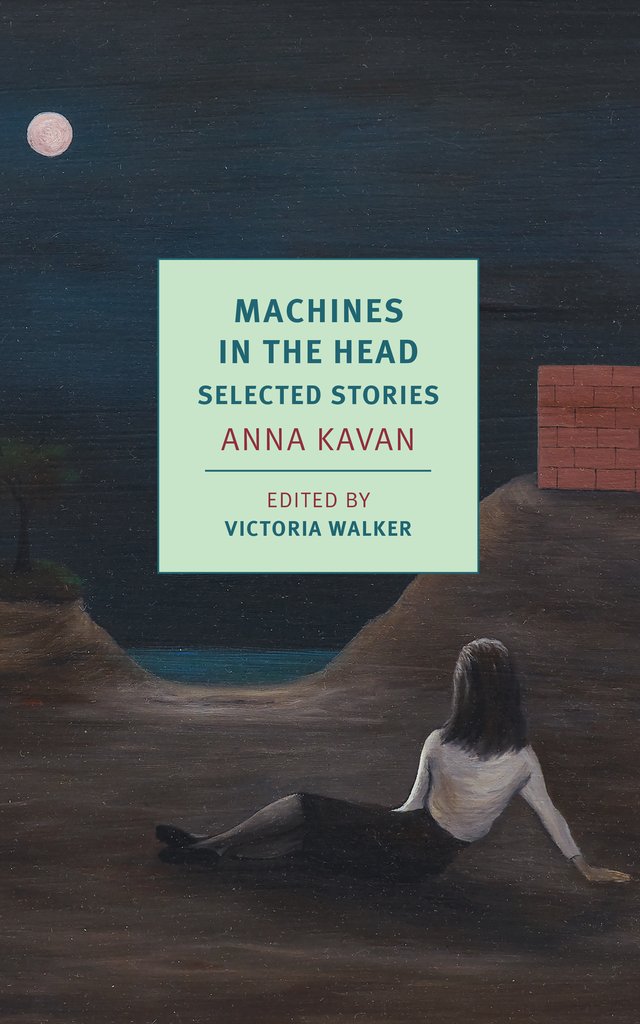
Machines in the Head, new from NYRB, compiles twenty-three Anna Kavan stories that were originally published between 1940 and 1975, as well as one previously unpublished story. The stories here, culled from five previous collections, show not so much a stylistic evolution over three decades of Kavan’s writing as they do a writer pushing herself into ever stranger territory. And while Kavan’s experimental forms shift from story to story, her modes of radical ambiguity, rattling paranoia, and sinister menace course through the collection, giving it a strange coherence.
Machines in the Head is arranged chronologically, with the first nine stories coming from Asylum Piece (1940). These storiesannounce themes and images that repeat throughout Kavan’s writing and this new NYRB collection: sleep, dreams, ice, sun (and the lack of sun), prisons, asylums, hospitals, lovers, friends (and the absence of friends), enemies, persecutors, mysterious patrons, strange summonses from abstract authorities, sentencing and judgment, windows, walls, doors.
“Going Up in the World” is a miniature study of cold anxiety in which the unnamed protagonist suffers alienation from the “Patrons” who seem to abandon her. “The Enemy” is five paragraphs of Kafkaesque persecution and paranoia. In “The Summons,” an ugly waiter ruins a meal with an old friend, and our narrator is soon taken away by an ambiguous authority, only to return to dinner to have her friend urge her to go back to the authority on her own volition. The nightmare-dream logic here is part and parcel of Kavan’s style, as is the the conclusion of “The Summons”:
…I began to wonder, as I have wondered ever since, whether the good opinion of anybody in the whole world is worth all that I have had to suffer and must still go on suffering — for how long; oh, for how long?
Pretty much every tale in Machines in the Head ends in existential suffering, inconclusive menace, our outright doom. The narrator of “The Summons” tells us at one point that “a feeling of dread slowly distilled itself in my veins,” a line that could fit neatly into any of the stories here.
Suffering and despair continue in “At Night,” where the narrator’s bedroom is a “jailer,” her bed her “coffin.” The story’s surrealist touches capture the all-too-real horror of insomnia. “Machines in the Head” continues the sleep motif, showing us the terror of that tyrant, the alarm clock. Kavan conveys the awful moment many of us experience upon awakening too early:
Roused in this brutal fashion, I jump up just in time to catch a glimpse of the vanishing hem of sleep as, like a dark scarf maliciously snatched away, it glides over the foot of the bed and disappears in a flash under the closed door.
“Asylum Piece II,” however, suggests that there is trouble in dream:
I had a friend, a lover. Or did I dream it? So many dreams are crowding upon me now that I can scarcely tell true from false: dreams like light imprisoned in bright mineral caves; hot, heavy dreams; ice-age dreams; dreams like machines in the head.
In “The End in Sight,” our narrator, having “received the official notification of my sentences,” experiences time’s passing “like shadows, like dreams,” again suggesting that dreams and sleep are not the solution to anxiety and unease. “The End in Sight” concludes with our narrator still in the grips of anxiety, waiting to be carted away by invisible and unnamed forces.
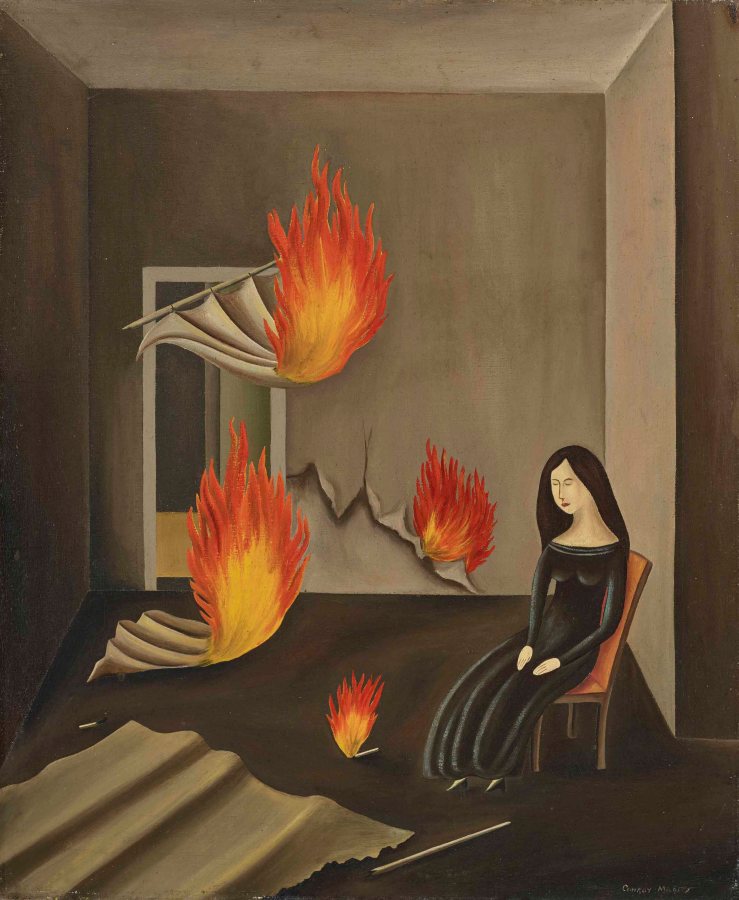
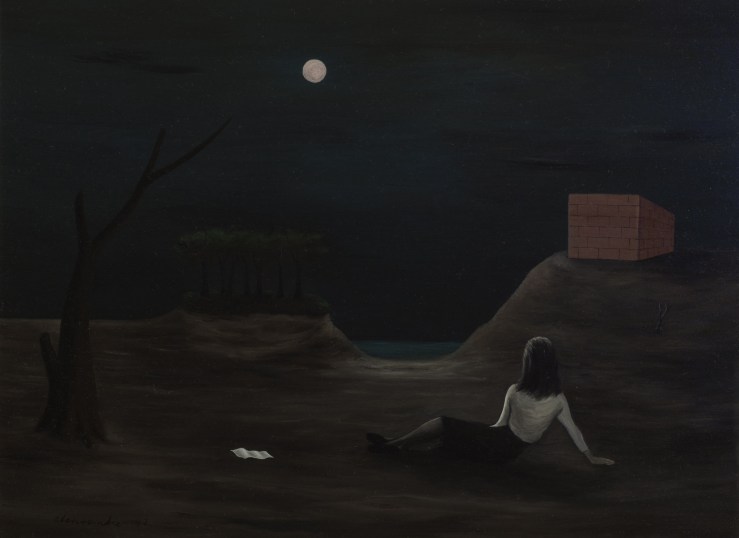
Reverie, 1948 by Gertrude Abercrombie (1909–1977)
Asylum Piece was the first collection that Kavan published under the name “Anna Kavan.” She previously had written under her legal name, Helen Ferguson, but took “Anna Kavan” (from a character in her 1930 novel Let Me Alone) first as a pen name and then later as her new personal identity. It’s hard not to read Kavan’s fiction as largely semi-autobiographical, while also recognizing that much of that biography was the result of imaginative invention and re-invention. Asylums and psych wards show up in her stories so much because she spent quite a lot of time in such places. Kavan suffered depression and attempted suicide several times in her life. Alienation and loneliness permeate her work: her characters can never seem to truly know each other, to truly communicate. Kavan was essentially alienated from her parents; her father abandoned the family (and later committed suicide), and she spent most of her youth at boarding schools. Both of her marriages failed before the publication of Asylum Piece, a fact that underscores her stories’ curves toward despair. She did have romantic relationships later, doomed as they were, and also was extremely close to Dr. Karl Bluth, the German psychiatrist who prescribed her heroin from the time that he met her until he died in 1964.
Iterations of Bluth—sympathetic doctors—-start to appear in some of Kavan’s stories stories starting with I Am Lazarus (1945). The stories here are longer, richer, and more focused than those in Asylum Piece (but still strange, strange, strange). The nightmare of the Blitz hangs over the tales, which are populated with doctors, nurses, and soldiers.
“Palace of Sleep” — the first third-person piece in the anthology is set in a mental hospital. “Palace” picks up the night shift motif of Asylum Piece, focusing on an unnamed patient undergoing treatment for narcosis. “The Blackout” continues the narcoleptic motif. In this story—one of the strongest in the collection—a soldier who had blacked out for five days talks to psychologist. The soldier parcels out bits of a tragic life story, redeemed in part by the aunt who eventually raises him after he’s orphaned. There’s an oedipal undercurrent to “The Blackout,” which circles around a profound horror without actually naming the crime at the heart of the tale. “Face of My People” is another psych ward piece, with a tone and development worthy of J.G. Ballard. (Ballard was a big fan of Kavan’s fiction.)
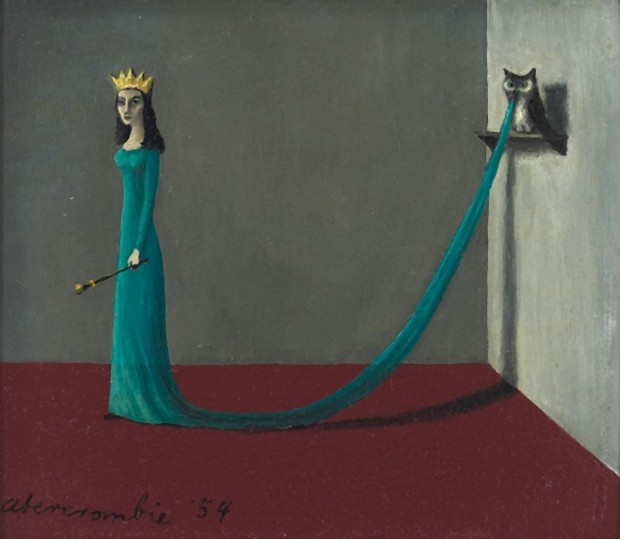
The Queen, 1954 by Gertrude Abercrombie (1909–1977)
“The Gannets” is another very strong piece. In five visceral paragraphs, Kavan condenses the horror of World War II into a strange allegory of terrible violence. “The Gannets” contains one of the strongest images in the whole collection. It’s shocking, really, when it happens—so much of her writing runs on unspecified dread and slow-motion menace, that when she does deploy concrete horror, the effect is devastating. I won’t spoil that devastation by quoting the image, but I will share the story’s final paragraph:
How did all this atrocious cruelty ever get into the world, that’s what I often wonder. No one created it, no one invoked it, and no saint, no genius, no dictator, no millionaire, no, not God’s son himself, is able to drive it out.
“Our City” is a longish Kafkaesque exercise that feels similar to the early short stories “Airing a Grievance” and “The Summons,” but with more absurd humor and more control. Kavan elides details that would allow us to identify the titular city as London during the Blitz. Instead of realism, we get something closer to a psychological portrait of a place under the most extreme duress. “Our City” is a slow-motion panic attack, a fever dream that sprawls outward but refuses to resolve.
Machines in the Head includes just three stories from A Bright Green Field (1957), but all are excellent. “A Bright Green Field” is the surreal story of a visitor (to where?!) who witnesses “prone half-naked human bodies, spreadeagled on the glistening bright green wall of grass.” The bodies are bound “by an arrangement of ropes and pulleys [with] semi-circular implements of some sort fastened to their hands.” The bizarre image has an even more bizarre explanation: These people are employed in the Sisyphean task of mowing the grass in this fashion. Why? Well, look, are you expecting a rational answer?–
That poison-green had to be fought; cut back, cut down; daily, hourly, at any cost. There was no other defence against the mad proliferation of grass blades, no other alternative to grass, blood-bloated, grown viciously strong, poisonous and vindictive, a virulent plague that would smother everything, everywhere, until grass and only grass covered the face of the globe
If “A Bright Green Field” is allegorical—and it really, really doesn’t have to be—perhaps it’s an ironic allegory of humanity’s perverse relationship to ecology.
The plot of “Ice Storm” is scant: a woman travels from New York City to Connecticut to visit some friends and decide whether or not to leave America. It turns out that she doesn’t really like her friends that much, and she’s ultimately unable to make a decision, “Because there were far too many decisions to make about everything and no permanent set of values by which to decide.” With its touches of realism, “Ice Storm” feels anchored in autobiography. (The title and much of the imagery suggest that “Ice Storm” might be the germ–or a germ—of Kavan’s 1967 novel Ice.) Kavan interposes newspaper headlines, seemingly at random, throughout the story, a device that might have come off as a gimmick; instead the headlines serve to highlight the narrator’s alienation from reality.
“All Saints” is the most avant-garde exercise in the collection. The story—story is probably not the right word—the story seems to drift between two or three consciousnesses that riff on decadent decline and imminent death. I’ve read it several times and still can’t puzzle it out, which is why I like it so much, I suppose. (I put a big star on the margin next to the line, “the end of every project comes down to the rat.”)
The stories from Julia and the Bazooka (published in 1970, two years after Kavan’s death) are the first to deal openly and frankly with drug addiction. “The Old Address” is a sad first-person number steeped in agoraphobia. Our addict-narrator, discharged from the clinic, ventures into an anonymous but teeming world which she murders in her imagination in an abject and revolting sequence:
Huge black clots, gouts, of whale blood shoot high in the air, then splash down in the mounting flood, soaking the nearest pedestrians. Everybody is slipping and slithering, wading in blood. It’s over their ankles. Now it’s up to their knees. All along the street, children start screaming, licking blood off their chins, tasting it on their tongues just before they drown.
The poison-blood-drowning-murder vision continues for several more paragraphs, before the narrator capitulates to her own panic, realizes that there’s “only one way of escape that I’ve ever discovered,” hops in a taxi, and tells “the man to drive to the old address.” Another sad ending.
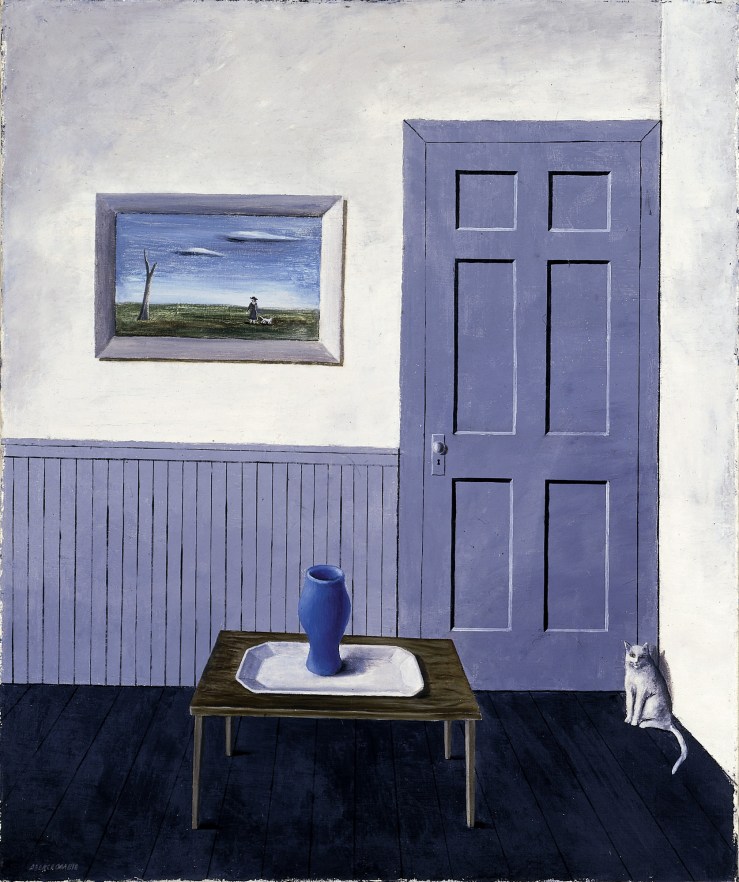
White Cat, 1938 by Gertrude Abercrombie (1909–1977)
The magical realism of “A Visit” initially suggests the possibility of happy ending. Kavan gives us a rare tropical locale, where our narrator receives an erotic night visitant, gorgeous a leopard. She longs to meet the leopard again, but never sees him until he returns in a new form:
One day while I was on the shore, I saw, out to sea, a young man coming towards the land, standing upright on the crest of a a huge breaker, his red cloak blowing out in the wind, and a string of pelicans solemnly flapping in line behind him.
She glimpses the youth and leopard together just one more time, and lives the rest of her life in disappointed waiting. Sometimes the pair enter her dreams though, which only weighs her down with “the obscure bitterness of a loss” — which she blames on herself. Kavan doles out a magical epiphany, only to hobble it down to a kernel of disappointment, another machine in the head.
“Fog” tells the story of a woman high on heroin, driving her car at a dangerous speed through foggy streets. She tells us how peaceful she feels, then adds: “The feeling was injected, of course. She ends up committing a terrible crime on her joyride, and is soon brought in by the police. As the fog of the heroin wears off, the story skirts a bipolar line reminiscent of Edgar Allan Poe’s “The Tell-Tale Heart” In the end, the narrator wishes to nullify her consciousness—to “stay deeply asleep and be no more than a hole in space.”
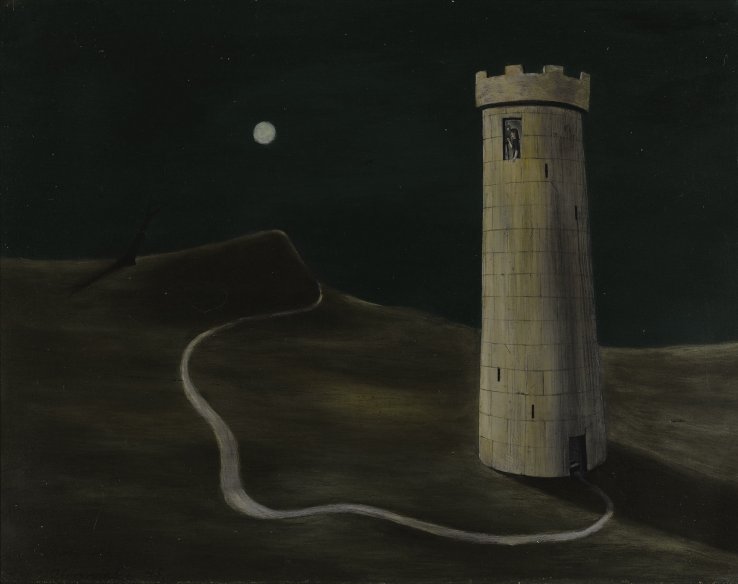
The Ivory Tower, 1945 by Gertrude Abercrombie (1909–1977)
The hero of “Julia and the Bazooka” is unstuck in time. Kavan essentially tells a version of her own life story here, with its sad childhood, failed marriages, and heroin addiction. (The titular “bazooka” is a syringe.) In some paragraphs, Julia is a young child; in others, she is a new bride, or a young woman traveling the world, or meeting the doctor who advises her to stick with heroin — “Without it she could not lead a normal existence, her life would be a shambles, but with its support she is conscientious and energetic, intelligent, friendly.” In other paragraphs, Julia is dead. Indeed, like Katherine Anne Porter’s “The Jilting of Granny Weatherall,” “Julia and the Bazooka” shows us a consciousness unraveling towards death.
The final two stories in Machine in the Head, while as strange and disconcerting as anything in the collection, are notable for one major difference: both have happy endings. “Five More Days to Countdown” (the only story here from 1975’s posthumous My Soul in China) is a gleeful picaresque exploding in energy. The story centers around an experimental school run by a genius named Esmerelda and her hapless husband. Pretty soon the school is in the grips of a youth rebellion that turns into outright violent revolution—and all five days before Christmas:
A sack of mail, directed to Santa, was delivered later. Sifting through through the contents, through the requests for definitive trendy kaftans, avant-garde night caps, exciting fab fun-fur hoods, switched-on gear of all kinds, I found the more basic items. Junior practical fighting techniques. Guerrilla warfare for the under-sixteens, including training in hand-to-hand combat. Do-it-yourself weapons for schools: simple construction of mortars, flamethrowers, ballistic missiles. How to construct an ambush, a booby trap. Useful tips on terrorism, napalm, nuclear devices, with sections on robbery with violence, blackmail, piracy on the high seas, arson, karate.
The gleeful satire here makes me wish there were more Kavan pieces like this. While the energy of the story matches the picaresque energy of Ice, there’s nothing close to the humor of “Five Days to Countdown” in the rest of the collection. (I’m also a sucker for surreal British boarding school revolution stories, like Lindsay Anderson’s 1968 film if….) The absurd vivacity of the tale culminates in a surreal apotheosis of sorts:
Esmerelda and I are swinging high over the world, conveyed through a sky full of snow by eight polar bears, whose bells jingle. Gosh, I never expected a happy ending.
Gosh, neither did I.
The previously-unpublished “Starting a Career” also ends on a positive, if ironic, note. The narrator (yet again!) receives a summons. This time, Kavan names the summoner—it’s Lord Legion, a-not-quite-ousted relic of older times who contests the President (the narrator’s employer) for power. The narrator agrees to become a spy for Lord Legion, a thrilling idea that loads his imagination with all kinds of fantasies.
I was about to become the world’s best-kept secret; one that would never be told. What a thrilling enigma for posterity I should be!
The lines ironically point to Kavan’s own sense of her legacy. While she maintained some success in her lifetime as a writer, she knew that the experimental and avant-garde nature of her writing would guarantee that, well, if she wasn’t exactly “the worlds best-kept secret,” she was definitely bound to some measure of obscurity. The world has a way of catching up to the avant-garde though, and the recent Penguin reissue of Ice and this new NYRB collection suggest that Kavan has found a broader, if not exactly mainstream, audience. Her writing is still challenging today—which is what makes it so engaging. As the collection’s editor Victoria Walker puts it in her foreword—
Kavan’s writing is not to everyone’s taste. Reading her work can be disorienting and discomforting; her narratives shift disconcertingly between past and present tense, first and third person. Her characters are often disagreeable, misanthropic, self-absorbed, priggish or delusional, and the paranoia of her nameless narrators is infectious.
Walker acknowledges that it’s not possible to neatly situate Kavan into any one group of writers. She points out that Kavan is definitely from the Tree of Kafka, and also admired Joyce and Woolf. Walker does make a small canon of writers on Kavan’s wavelength though, and I think the group is is worth listing out: H.P. Lovecraft, Jean Rhys, Jane Bowles, Leonora Carrington, Unica Zurn, Ann Quin, and J.G. Ballard. (I’d also throw in João Gilberto Noll, Gisèle Prassinos, Edgar Allan Poe, and even Roberto Bolaño.)
Two Ladders, 1947 by Gertrude Abercrombie (1909–1977)
Walker’s editing of the anthology is commendable. Images echo earlier images, motifs build, themes swell, and Machines in the Head offers what I believe to be a close-to-comprehensive showcase of Kavan’s proclivities and range. At the same time, I would’ve loved just a few more stories from the mid to later volumes, A Bright Green Field, Julia and the Bazooka, and My Soul in China. It’s probable of course that Walker selected the more achieved pieces from those volumes, dispensing with sketches and experiments that didn’t quite come off—but I’d love to read, say “Lonely Unholy Shore” or “Mouse Shoes” from A Bright Green Field, or “Experimental” and “Obsessional” from Julia and the Bazooka, and really, just any other story from My Soul in China.
I would advise readers interested in Machines in the Head to start with the mid-late stuff. Maybe get into anything from A Bright Green Field and move forward a bit, before snacking on some of the shorter tales from Asylum Piece. You’ll get the full picture and also, perhaps, a more satisfying read. The selections from Asylum Piece are good but so chilly that they invoke a bit of brain freeze.
Machines in the Head provides a fantastic and surreal overview of an overlooked cult favorite, a writer whose work—long championed by those marvelous archivists, the sci-fi nerds—deserves a broader audience. The stories here will not comfort you and they won’t affirm any heroic sympathy for whatever-the-fuck the human condition is supposed to be. But they are terrifyingly, menacingly real in all their sinister surrealism. Recommended.





 Biblioklept